
Travels to India Part 4: Goan Art, Architecture, and Culture
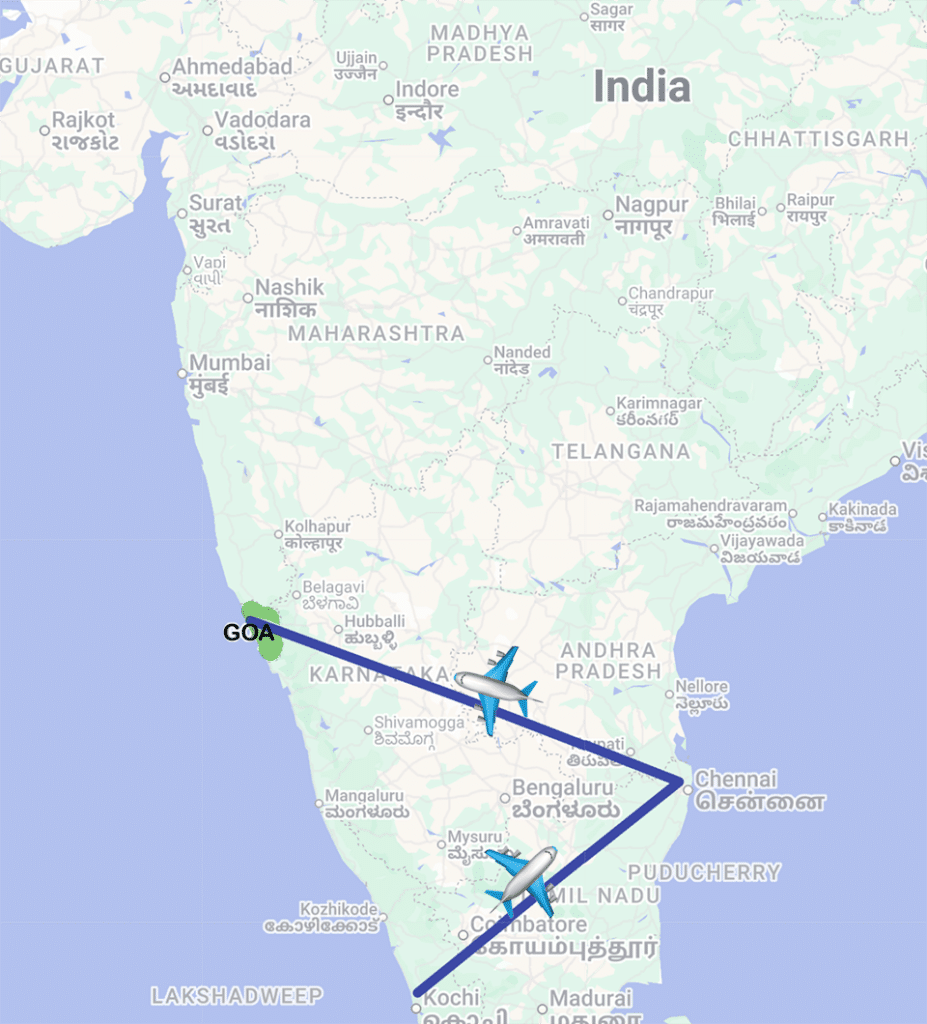
As we said goodbye to Kerala and South India, we had five days on our own before we’d meet up with our Athma Tour friends again in North India. So we decided to spend a few days visiting India’s smallest state, Goa, on the Arabian Sea.
Why visit Goa?
Because its cultural heritage is very different from the rest of India.
Unlike the majority of India, which was under British rule (or French in the case of Pondicherry and a few other places), Goa was colonized much earlier by the Portuguese. In 1510, Portuguese commander Afonso de Albuquerque captured Goa, giving Portugal control of the lucrative spice trade routes along India’s west coast.
Goa became the capital of Portuguese India and remained under Portuguese rule—never British—for more than 450 years. When India gained independence in 1947, Portugal refused to leave until 1961. Goa then became a union territory before officially achieving statehood in 1987.
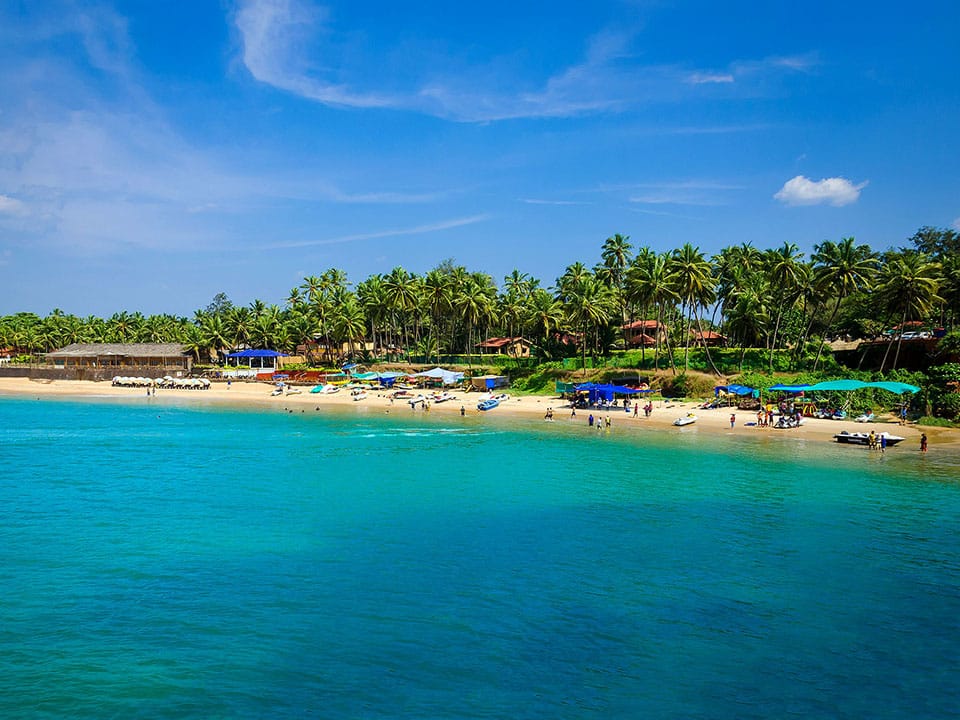
When most people think of Goa, they likely picture palm-lined beaches, Ayurveda retreats, yoga and meditation centers, or DJ-fueled ecstatic dance and tropical rave parties. Though we love Ayurveda, yoga, meditation, and dancing—and the water does look inviting—we live in a beach town in PV, so we didn’t feel the need to spend our time at the beach on this trip. Maybe next time…
We were especially interested in the old Colonial Portuguese history of Goa’s capital city, Panaji (formerly Panjim). While planning our trip, we watched several documentaries about the area. We discovered Make It Happen, a local tour company known for its authentic cultural tours, so we signed up for a couple of their unique walking tours. During our research, we also came across an intriguing Tibetan exhibit at the MOG (Goa’s Modern Art Museum) that was closing the day after we arrived, so we planned to see it right away.
But we’re getting ahead of ourselves… First, how did we get to Panaji, Goa, and where did we stay?
Getting to Goa
We had originally wanted to take the 18-hour train from Kochi to Goa to see the beautiful countryside along the way. But then we discovered the train runs overnight—so we wouldn’t actually see much. And Mallika strongly advised against taking the train when we asked for her help with our Goa reservations. So we flew IndiGo Airlines instead. (Thank you, Mallika!)
At the end of our South India tour in Kochi, we were up early for a 5:30 AM departure from the hotel and a dark drive to the Kochi airport, an hour away. Dear sweet Mallika got up early to send us off from the hotel lobby and wish us safe travels. We would meet up with Mallika, Roger, and Basilica again in a few days to begin our North India tour in Delhi.
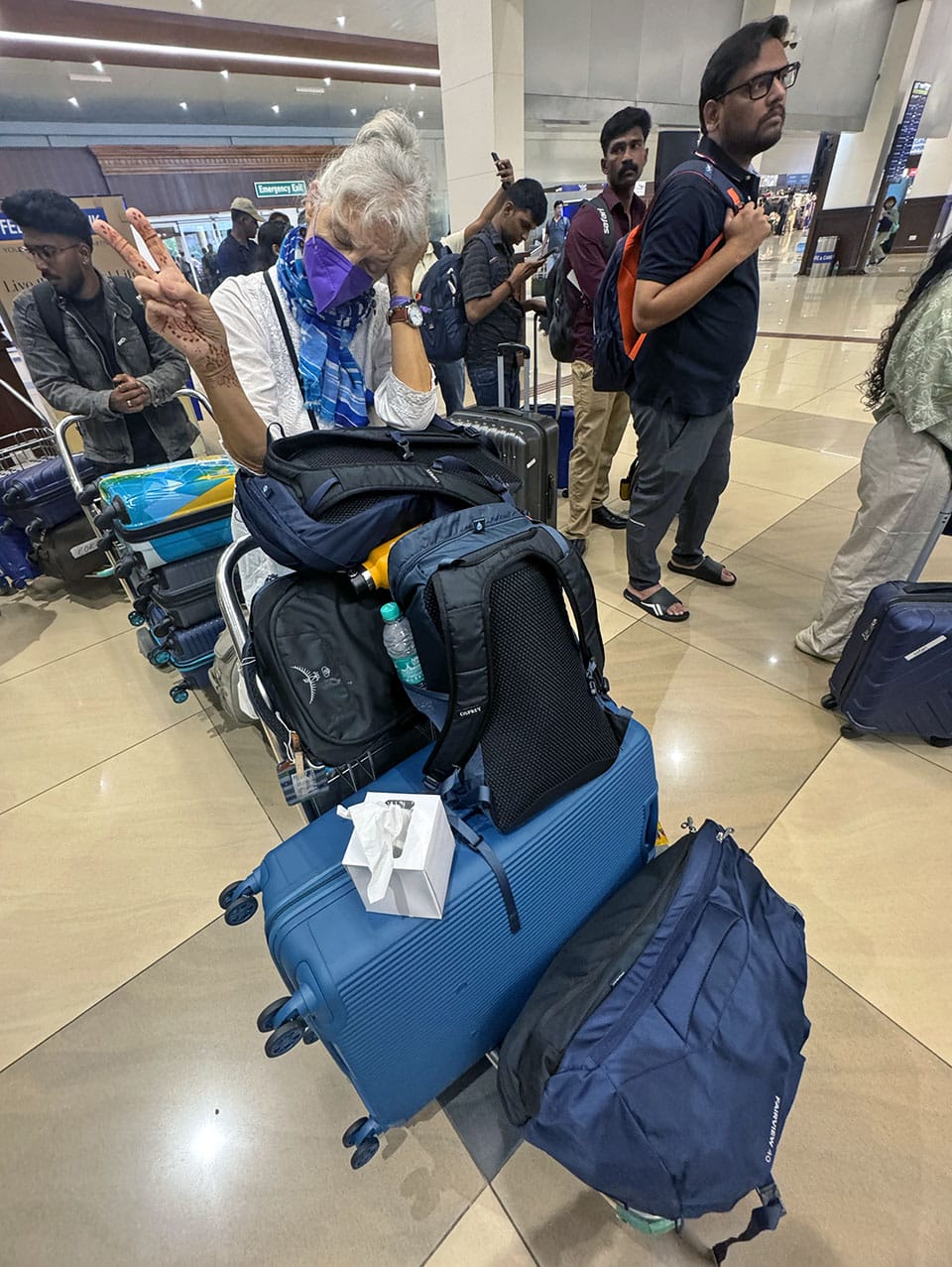
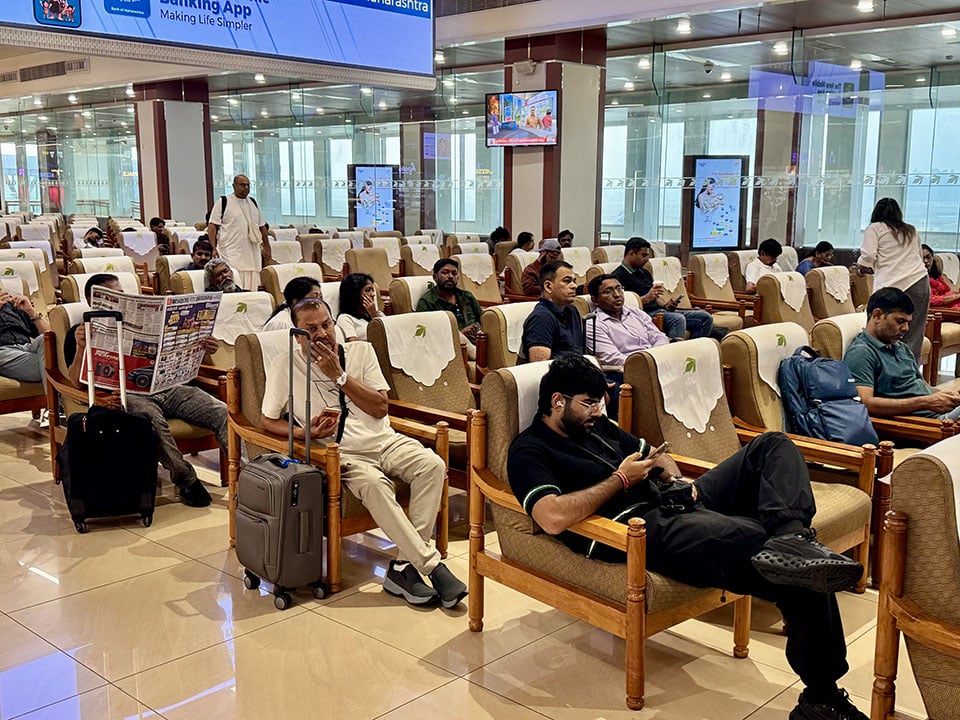
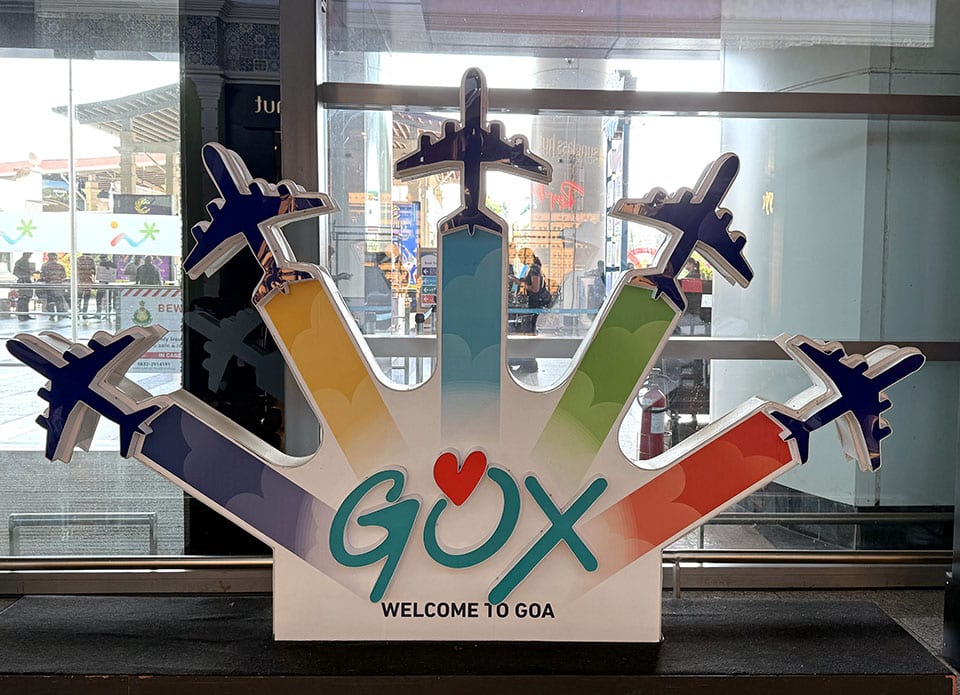
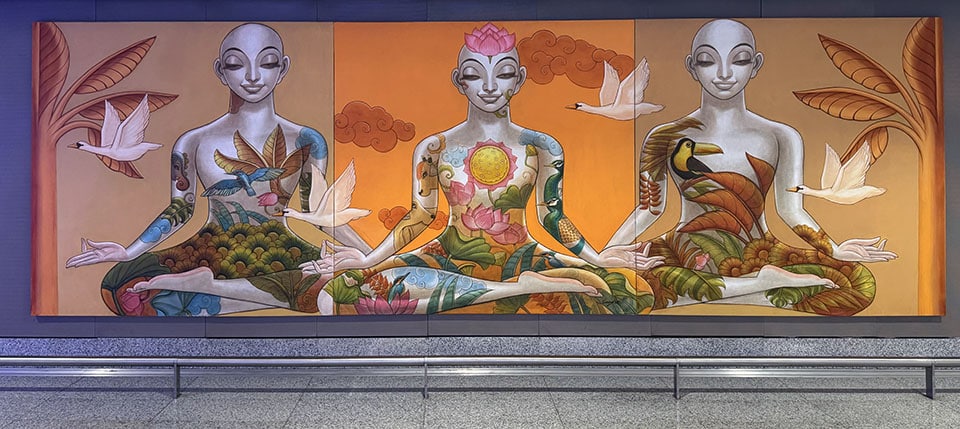
O’dark-thirty at the Kochi airport, have Kleenex, will travel…at least there were plenty of comfy chairs at the Kochi gate. Many of India’s airports feature art depicting Yoga, like this beautiful mural at GOX.
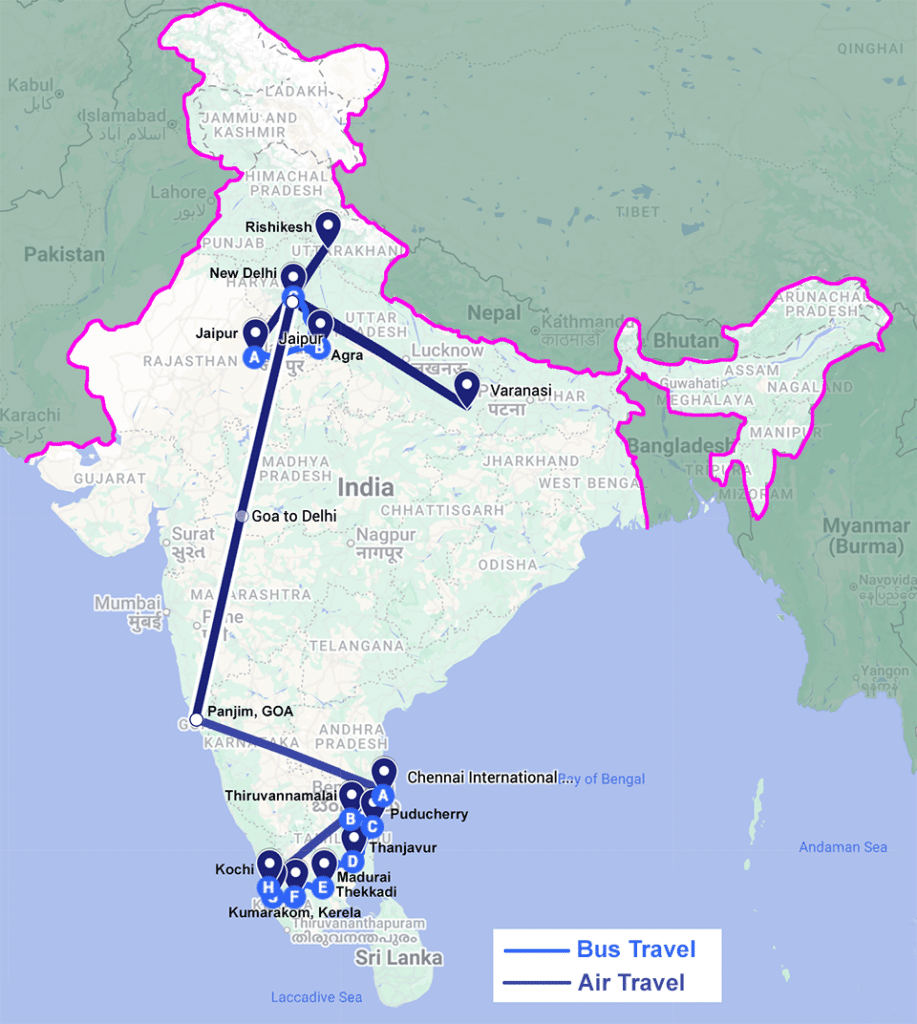
Luckily, we were way too early for rush hour, and our hotel driver was great. As the crow flies, Panaji, Goa, is only 400 miles north of Kochi, both on the Arabian Sea. But oddly, there didn’t seem to be any direct flights between them. So we had to fly east across South India to Chennai, change planes, then fly west again to Goa—nearly 800 miles total. (See map at top.)
Our Takeaways on Domestic Air Travel in India
Throughout our travels in India, we were consistently impressed with the airports and with IndiGo Airlines. It’s a no-frills domestic airline, but they were very clean, well-organized, and punctual.
We also loved IndiGo’s baggage policy. Each person gets one checked bag up to 20 kg, included with the ticket, but the total baggage allowance is combined for people traveling together. We had three bags totaling 39.5 kg—including our newly purchased Indian suitcase stuffed with souvenirs and gifts (thank you, Asoka!)—and we paid no extra baggage fees. Wouldn’t it be nice if U.S. airlines operated this way!
One thing we immediately noticed is that you cannot enter any airport without a boarding pass. Everyone goes through an initial security screening right at the entrance—bags are x-rayed, and passengers walk through a metal detector—so only actual travelers make it inside, which seemed pretty smart.
Security inside the airport is quite different as well. Virtually EVERYTHING comes out of your carry-on: electronics, charging cords, headphones, wallets, belts, umbrellas, watches—basically anything loose or electronic. After walking through the metal detector, everyone also gets individually wanded down. Women are screened in curtained booths, which felt a little unnerving since you couldn’t see your belongings while inside. Thankfully, it was all fine.
We always travel with healthy snacks to avoid buying airport junk food and to ensure Heidi has gluten-free/dairy-free options. Ironically, they did not seem to care at all about our food, unlike the TSA in the US. However, both of our carry-ons were flagged for additional inspection because they apparently thought we had cigarette lighters?? NO, we don’t smoke! We have no idea what looked suspicious.
The Kochi airport itself was especially lovely, with old-fashioned wooden chairs and upholstery that made it feel more like a historic train station than an airport. There were many beautiful shops, including a Forest Essentials Ayurveda store carrying the delicious honey-vanilla toiletries we’d enjoyed at several hotels on our southern tour. And Heidi was thrilled to discover that some of their products are even available online in the U.S.
Our only real airport hassle was at the Chennai domestic terminal, where transfer passengers have to exit the terminal and go back through full security again. By then, we were at least prepared to empty our carry-on bags—and thankfully, no one asked us about cigarette lighters that time!
We landed at GOX in the early afternoon and were picked up by a prearranged taxi driver. Interestingly, he put all our luggage in the front seat because the trunk of his tiny sedan was too small to hold it. We found it hilarious that an airport taxi had no room for luggage! His car was also pretty beat up… but he got us safely to our Airbnb.
First Impressions of Panaji
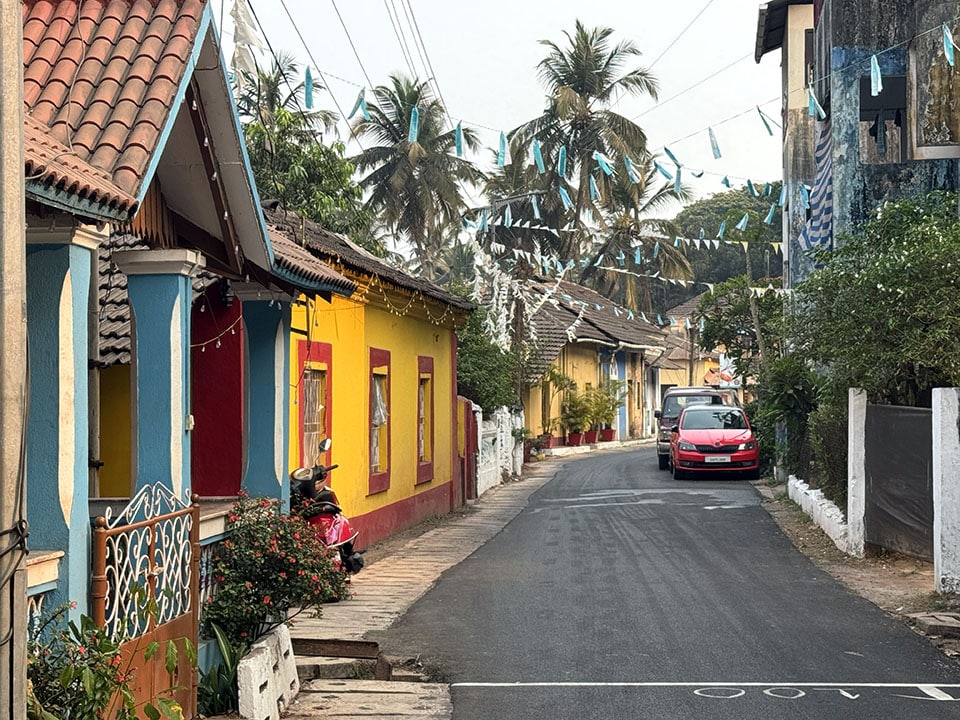
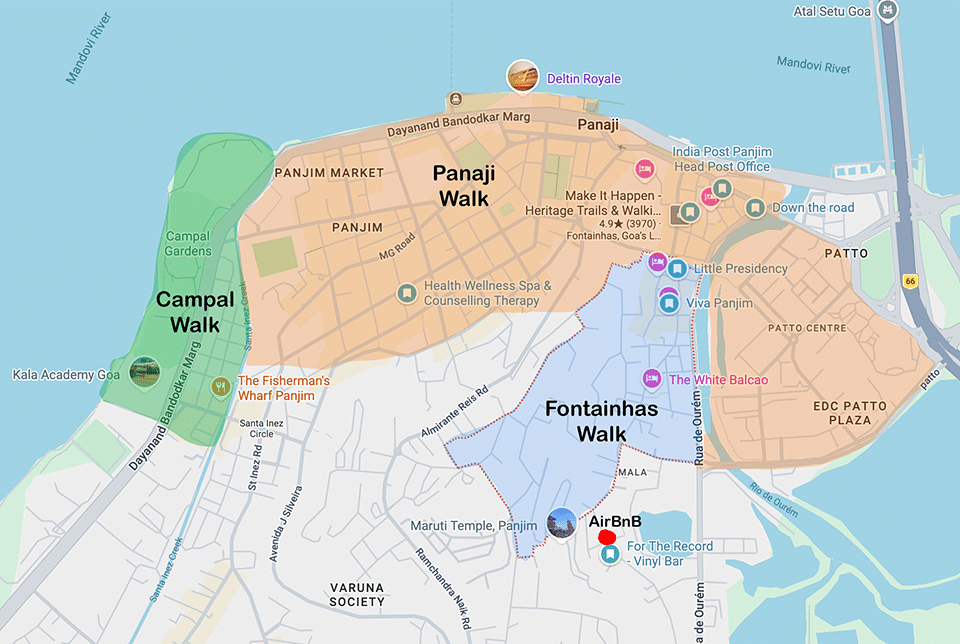
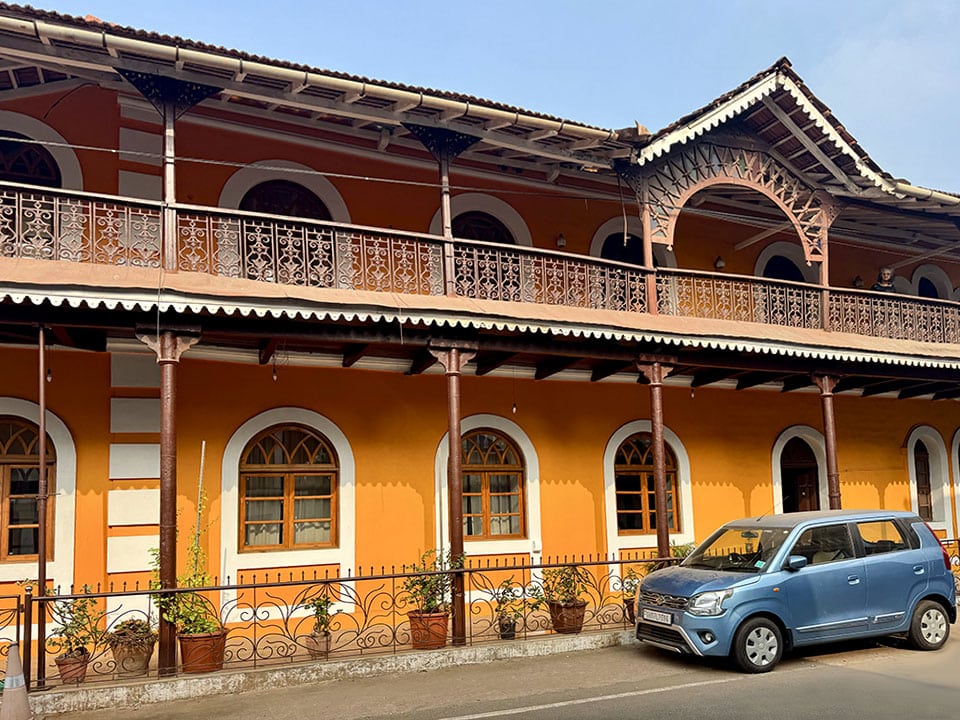
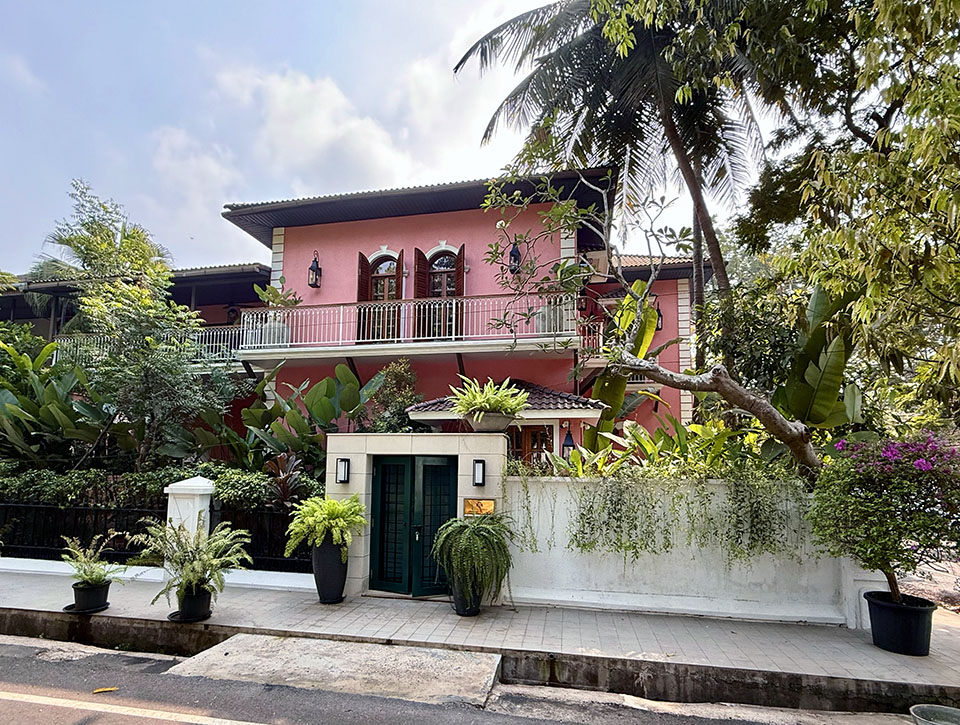
We chose to stay in the Fontainhas (pronounced Fawn-TINE-yish) neighborhood for its walkability. Fontainhas is Panaji’s charming Latin Quarter, a maze of narrow lanes lined with brightly-colored, red-tile-roofed Portuguese-style colonial homes.
In many ways, wandering the quiet streets of Fontainhas felt more like visiting Europe than India. There were far fewer cars and motorcycles here, giving us the confidence to actually walk along the roads (there aren’t many sidewalks) and cross the streets safely.
Airbnb “Super Host”… Not So Super
In all our years using Airbnb, this was our first less-than-stellar experience with a supposed five-star “super host.” It wasn’t terrible, but it definitely wasn’t five-star or super-host worthy.
First red flag? She insisted on moving the conversation from the Airbnb app to WhatsApp because “the Airbnb app didn’t work well on her phone.” In hindsight, we realized moving the conversation off-platform conveniently prevented Airbnb from seeing all the issues that followed.
For starters, she wouldn’t give us the address until our plane had landed, which made it hard to plan ahead. Then, once we finally had the address and were on our way, she messaged us that another apartment had flooded and her staff was dealing with that—so ours wasn’t ready yet.
She asked us to wait in the driveway until her guy, Krishna, arrived to let us in. OK—things happen, we’re pretty understanding. But after standing outside in the midday heat for 20 minutes with all our luggage, we messaged her to ask how much longer it would be or whether we should go somewhere else to wait. No response. We contemplated waiting in For The Record Vinyl Bar, just next door, but it wasn’t open yet.
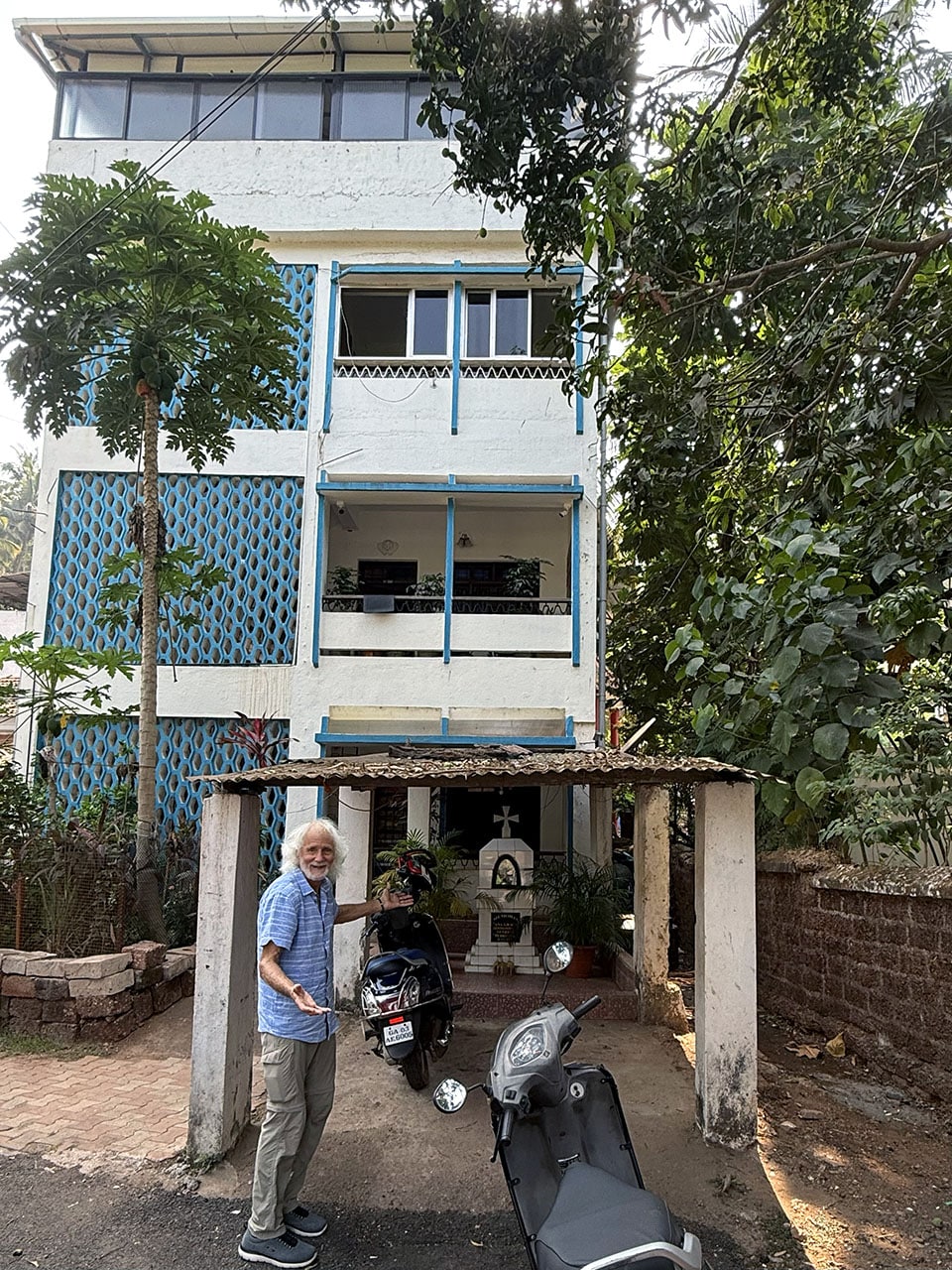
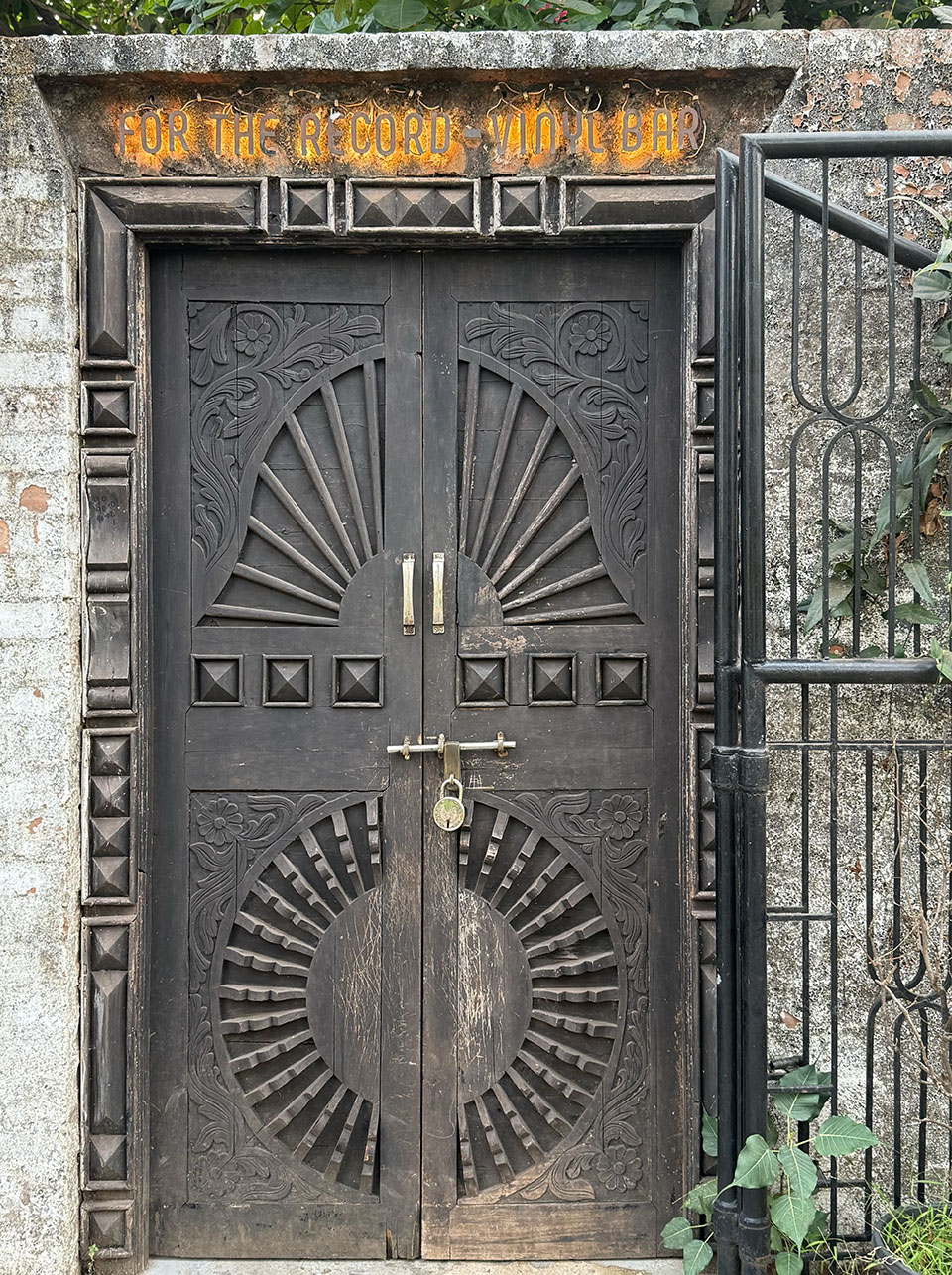
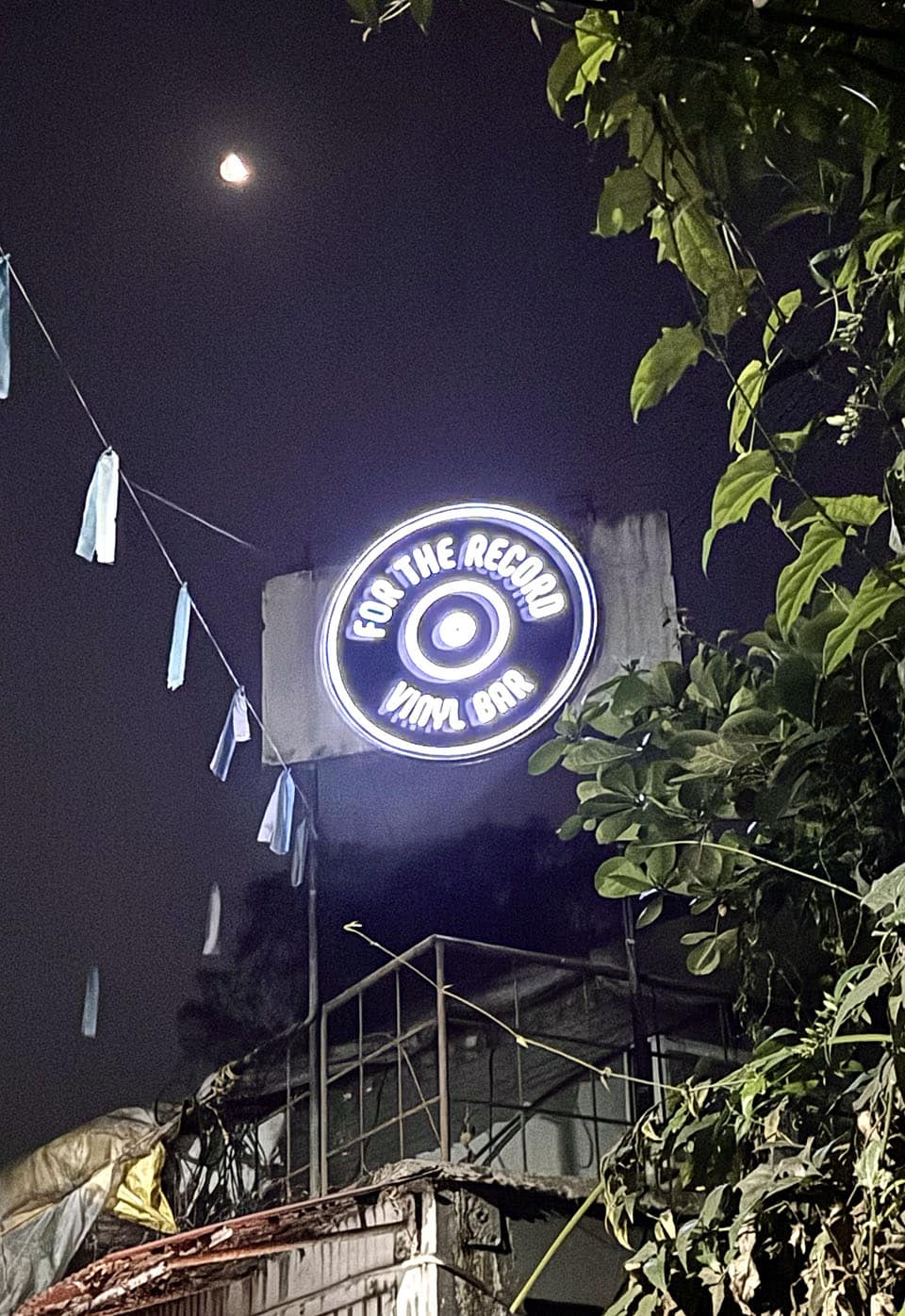
Shortly afterward, a guy pulled into the driveway on a scooter. We asked if he was Krishna. “No,” he said, pointing upstairs, “Krishna is up there.” At that moment, Krishna popped his head out of the second-floor apartment and waved at us.
So apparently, Krishna had been inside cleaning the apartment the entire time while we stood sweltering outside in the driveway? We wonder how long we would’ve waited if “scooter guy” hadn’t shown up. After hauling our luggage up two flights of stairs (no help from Krishna), we were just thankful to be out of the sun.
The apartment itself seemed clean, with a fairly modern kitchen, but the dish towels on the countertop were very stained and looked filthy. Even if they were technically “clean”, they looked like the rags Kirk uses to change our engine oil. In the bedroom, there was no top sheet—just a fitted sheet and a blanket folded at the end of the bed. With the heat, we likely wouldn’t need a blanket, but with the fan or AC running overnight, a top sheet would’ve been great.
So we messaged our “super host” again with photos of the dirty dish towels and asked for clean dish towels and a top sheet. Her response: “In all my years hosting Airbnb, no one has ever asked me for a top sheet before. I’ll round one up if you really want one.” Hum…we’d had top sheets everywhere else in India so far, maybe this was a Goa thing? Some “Super Host”!
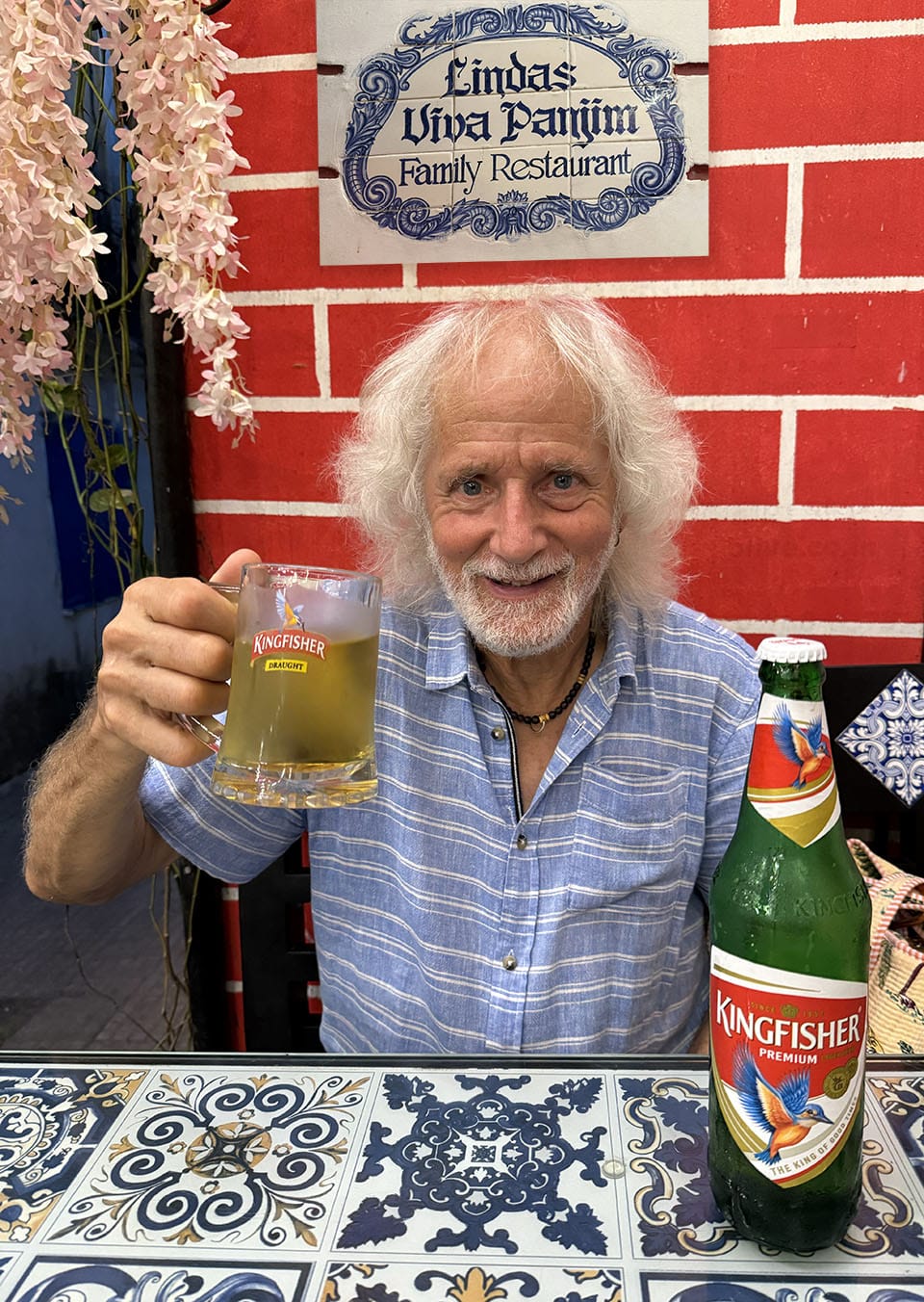
For dinner our first night, we walked a few blocks to Linda’s Viva Panjim Family Restaurant, which came highly recommended online when we searched for the cleanest restaurants in Fontainhas—and Asoka had recommended it as well. So far on the trip, we had successfully avoided “Delhi Belly” and didn’t want to jinx it by eating in the wrong restaurants in Goa. Thankfully, the food was delicious and plentiful, and Kirk enjoyed his Kingfisher beer, the “King of Good Times”. We even had enough leftovers for breakfast the next morning.
Hanuman Shri Maruti Temple and Goa’s Religious Heritage
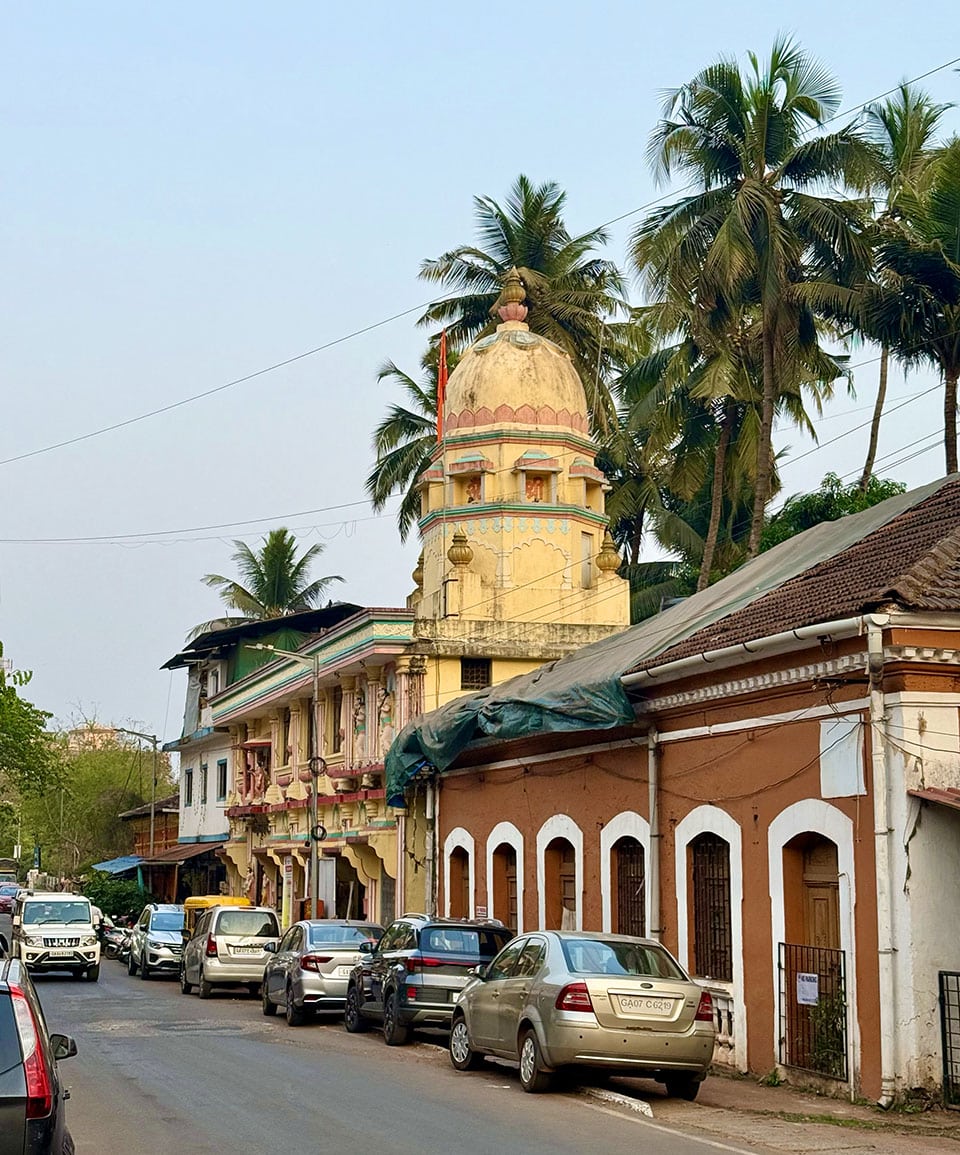
Walking back afterward, we were greeted by a truly wondrous sight glowing red above the neighborhood. Perched high on Altinho Hill overlooking Fontainhas, Shri Maruti Temple is a striking red temple dedicated to Hanuman (Maruti), the Hindu monkey god associated with strength, courage, and devotion. On this particular full moon night, we could hear lovely chanting drifting all the way down to our Airbnb.
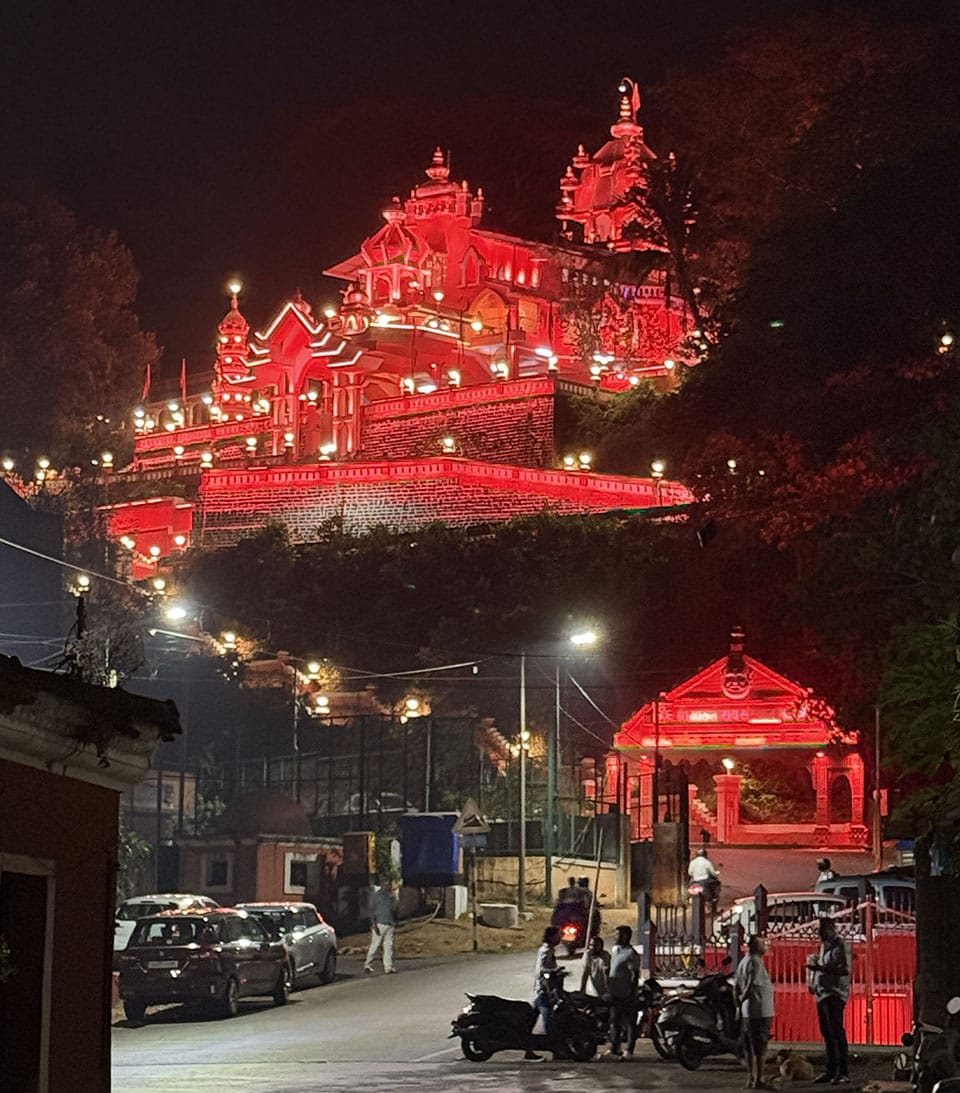
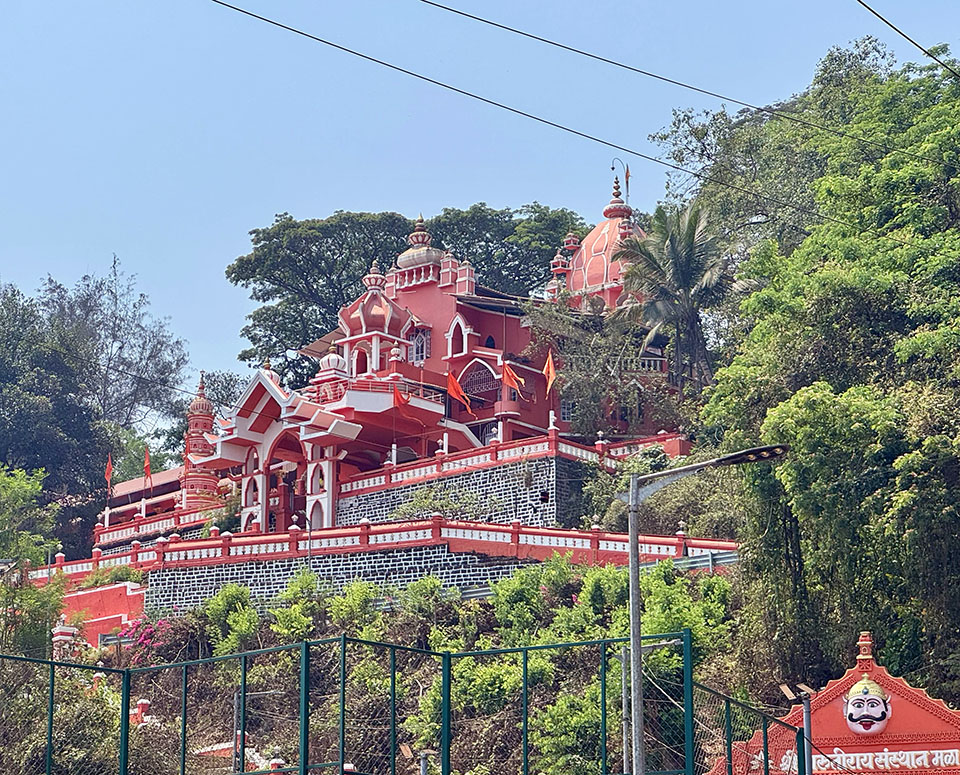
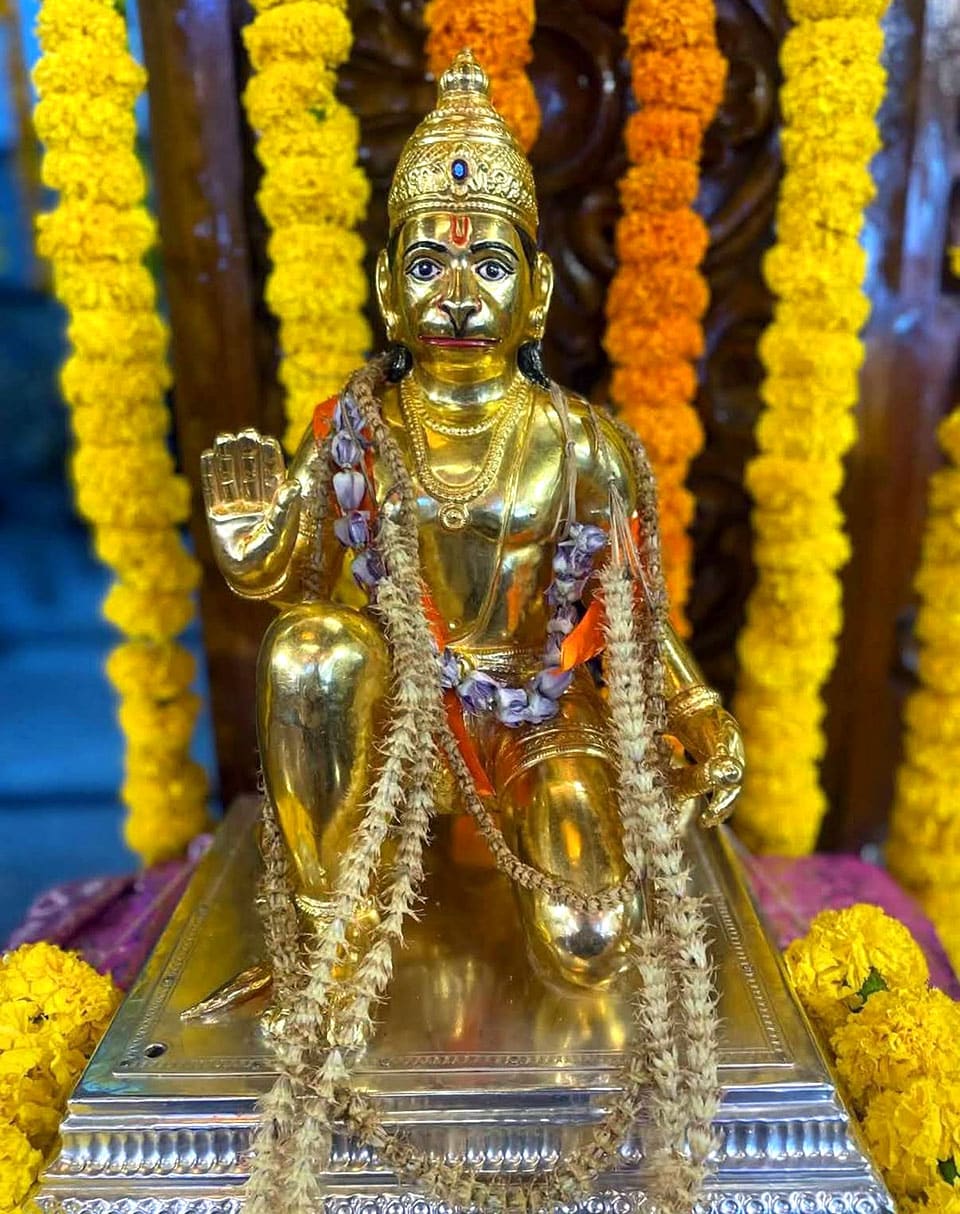
Later, we learned more about the temple’s history, which offered a fascinating glimpse into Goa’s complex religious heritage. During Portuguese colonial rule, public Hindu worship was heavily restricted, and local devotees are said to have secretly hidden and worshipped the Hanuman idol on this hillside. As restrictions eased over time, the temple emerged as an important symbol of resilience and religious freedom for Goa’s Hindu community.
Goa’s religious landscape today reflects centuries of cultural exchange and coexistence. During their 450 years in the region, the Portuguese spread Christianity by building churches, schools, and convents, and many Goans converted to Catholicism. Hindu traditions, however, endured despite periods of suppression and the destruction of temples.
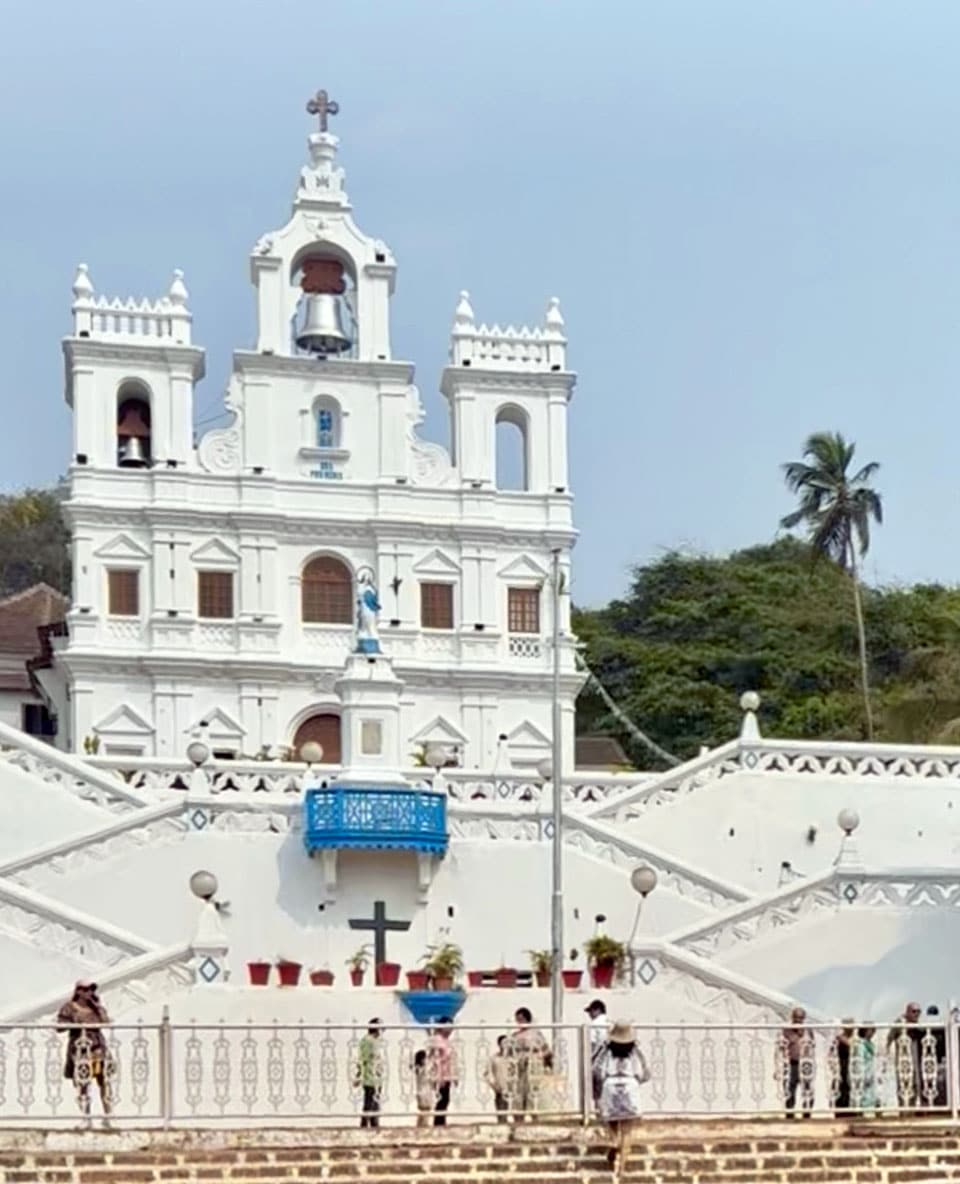
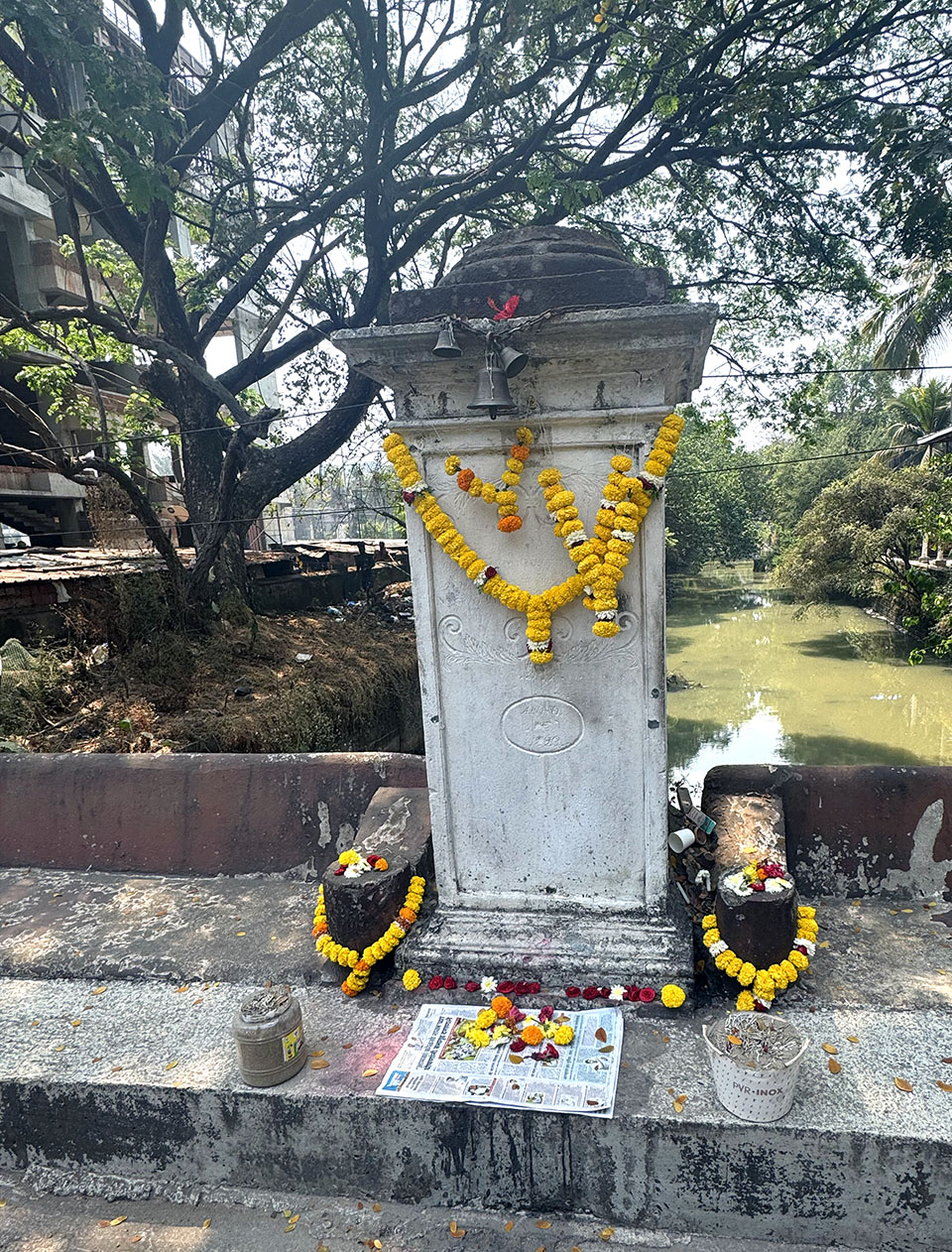
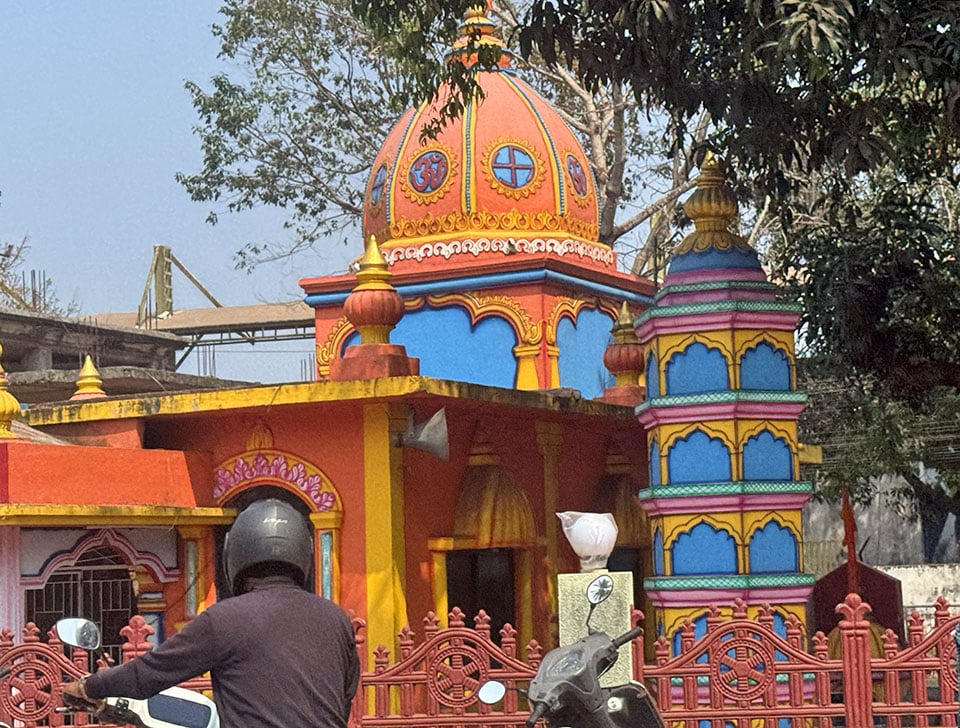
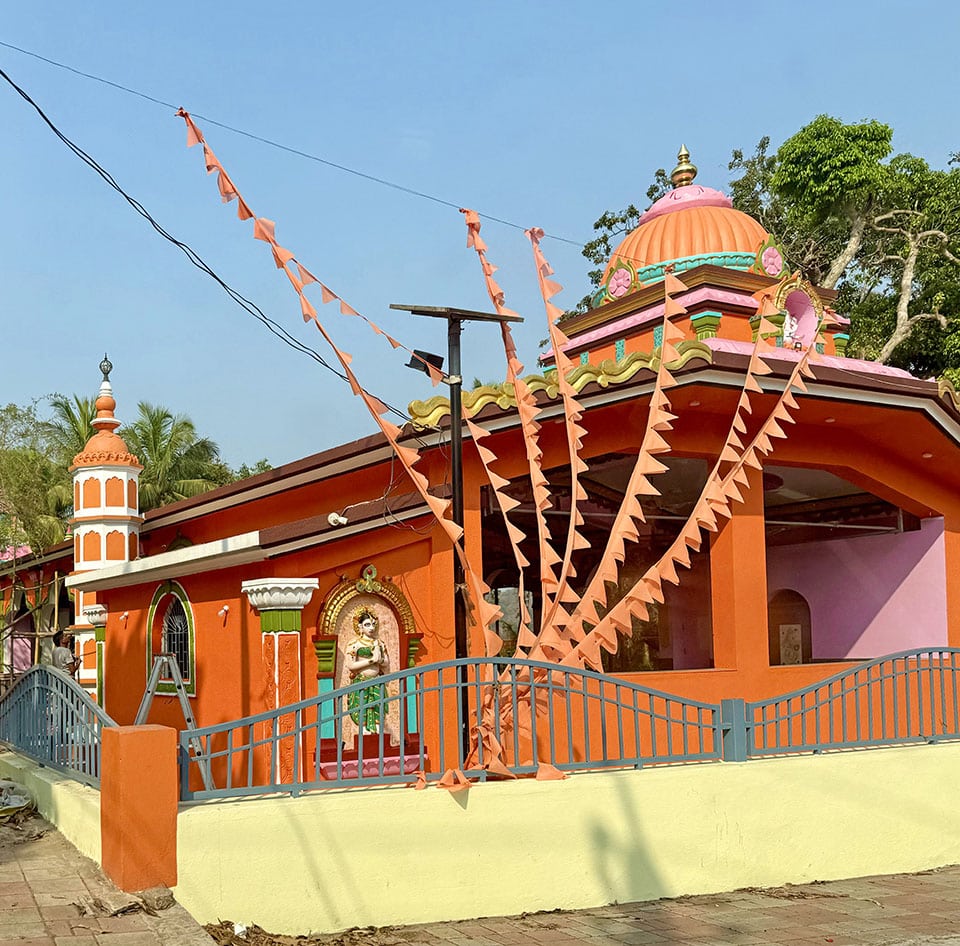
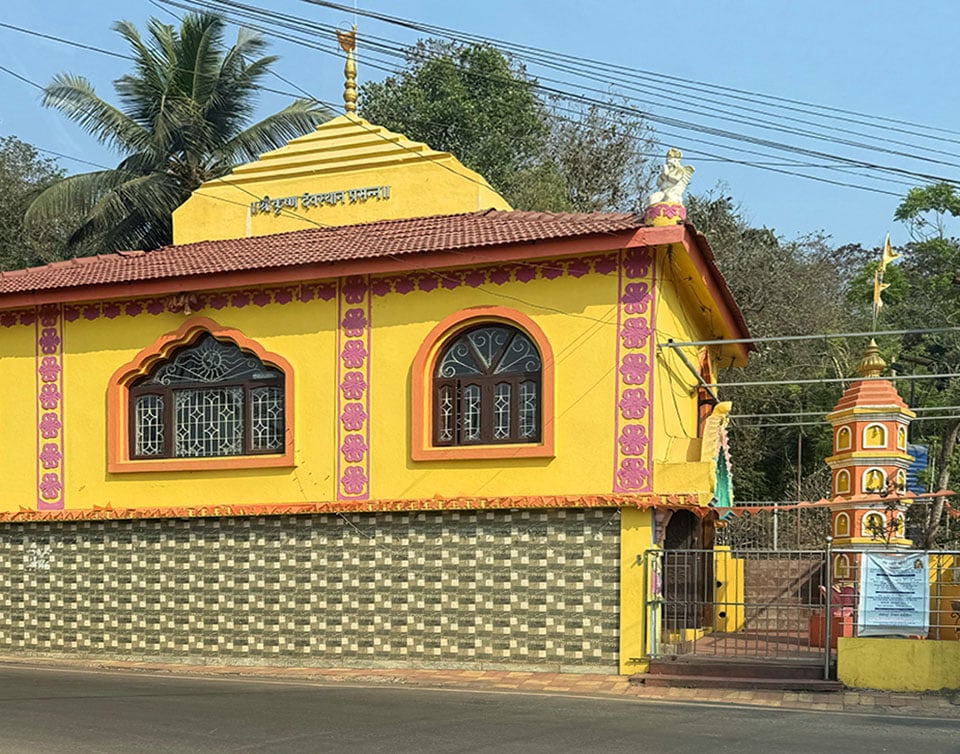
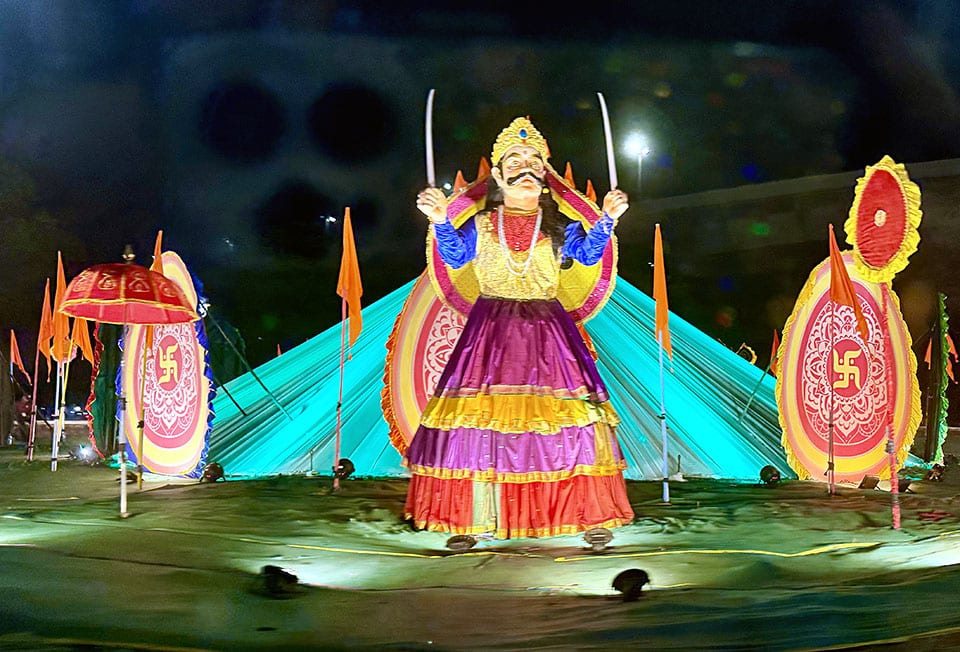
Today, Goa remains a remarkable blend of cultures and faiths, with approximately 55% of the population identifying as Hindu, 24% as Christian, and 18% as Muslim. And we saw many churches and temples nearly side by side. This rich diversity is part of what gives Goa its distinctive character, where colorful Hindu temples, grand Portuguese-era Christian churches, and centuries-old traditions coexist.
Back at the Airbnb, Krishna had apparently stopped by with brand-new dish towels (tags still attached) and a “top sheet” that was actually a tablecloth. Oh well…we made do.
Fontainhas Walking Tour
The next morning, we met our Make It Happen guide, Shreeya, in front of the post office to begin our Fontainhas walking tour. When booking, we had the choice between a group tour and a private tour. The price difference: $8 USD total for the group tour versus $12 USD total for the private tour. We were super glad we “splurged” on the private option—it was so worth it.
Heidi was still under the weather and coughing quite a bit. She almost skipped the tour but rallied at the last minute and was so grateful she did, especially after having already missed out on several activities in Kochi.
A Living Portuguese Heritage Neighborhood
The Fontainhas neighborhood of Panaji is a UNESCO World Heritage Zone and is Asia’s oldest and largest surviving Latin Quarter.
Originally a small fishing village and coconut grove on the edge of Panaji, the neighborhood developed in the late 1700s around a natural spring—the name Fontainhas literally means “little spring” in Portuguese. It expanded rapidly in the early 1800s after cholera and plague outbreaks devastated nearby Old Goa, forcing administrators, merchants, and affluent Goan families to relocate across the river to Panjim.
These colorful colonial homes feature balconies with ornate wooden railings, arched doorways and windows, and decorative moldings around cornices and pilasters. The style uniquely blends Portuguese colonial design with local Goan adaptations, such as high ceilings and large windows for tropical ventilation, covered verandas, and the signature bright, saturated color palette applied to stucco facades, with many homes displaying colorful azulejo tile plaques depicting religious or cultural motifs.
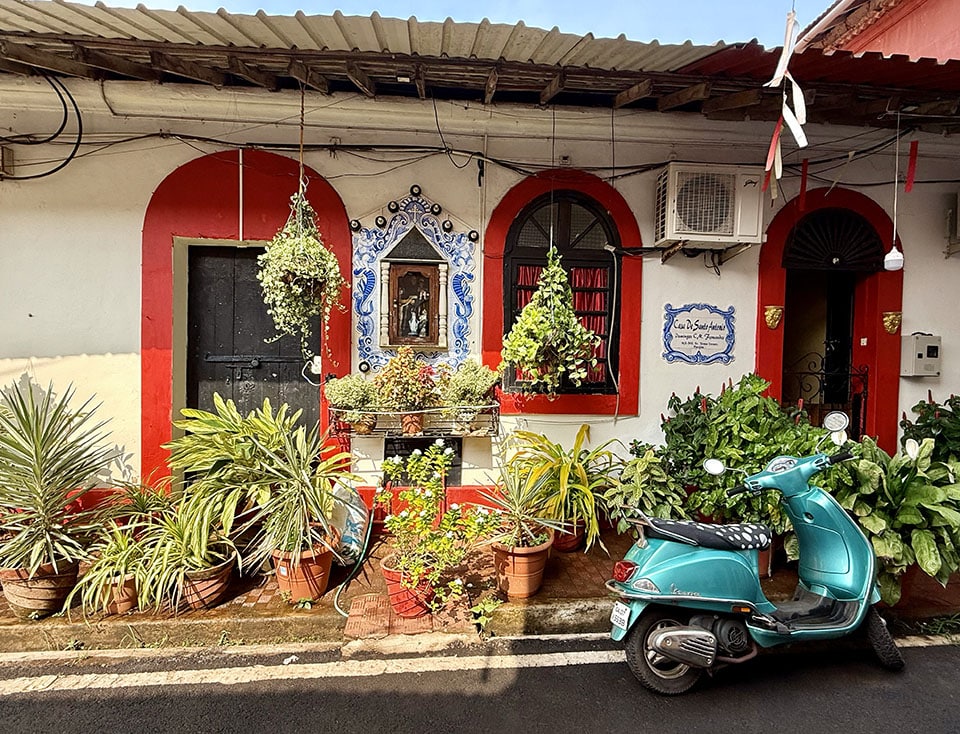
Over time, the area evolved into a tightly packed residential quarter filled with hidden alleyways, family chapels, bakeries, and colorful Portuguese homes. Many buildings still retain original details like oyster-shell windows, covered verandas, decorative stucco work, and wrought-iron metalwork, reflecting centuries of blended Goan and European influence.
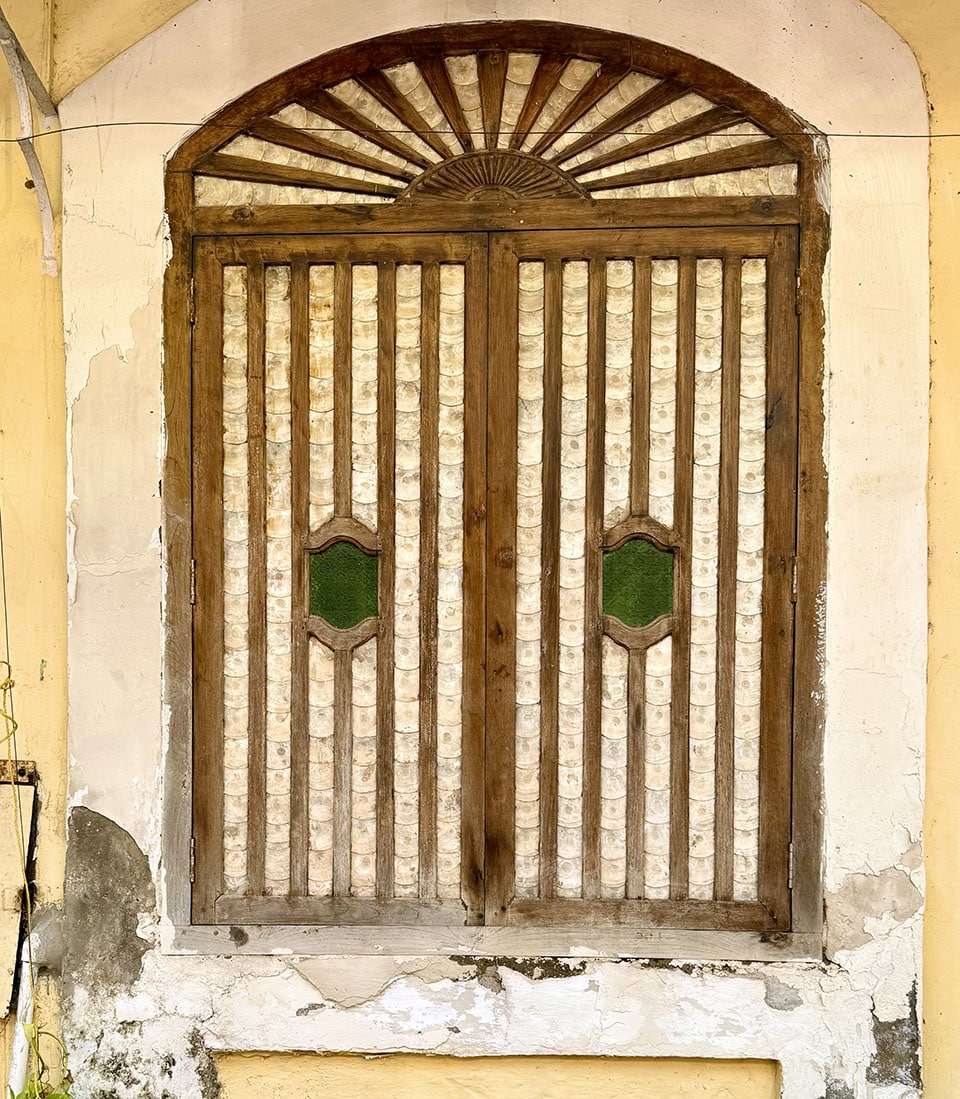
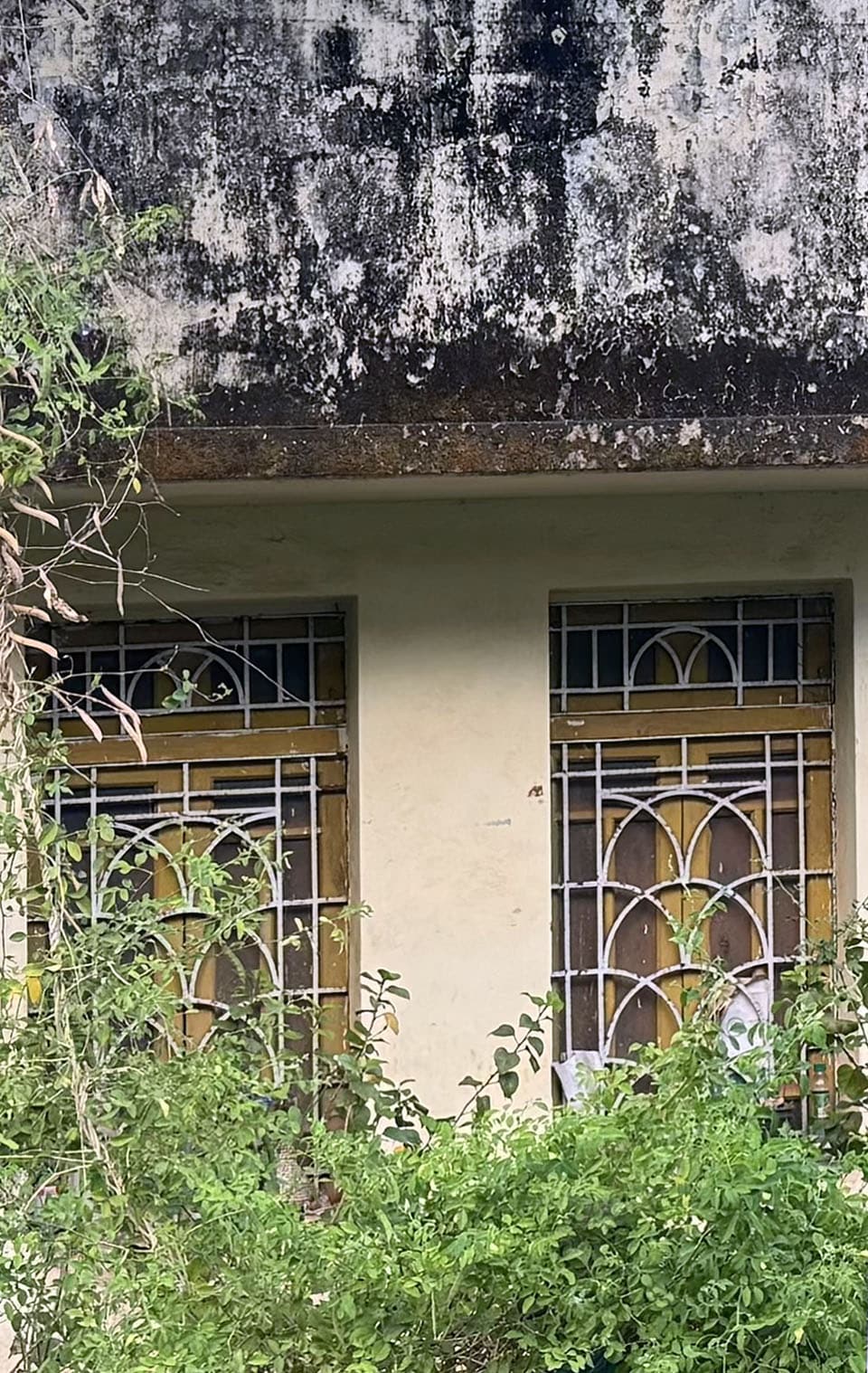
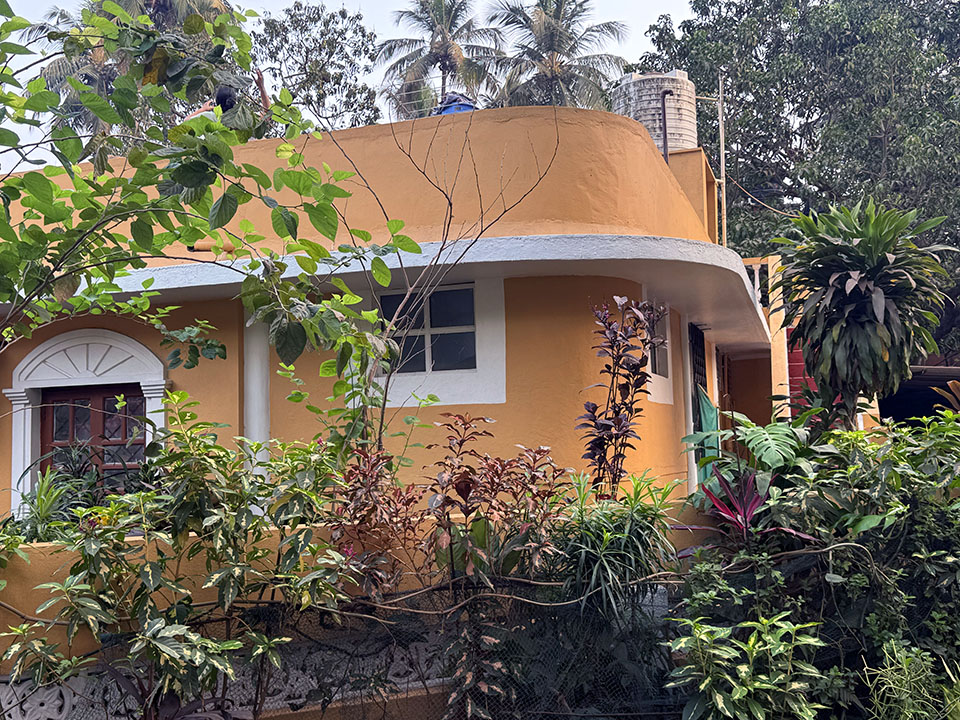
Zoom in on these oyster shells on the left window, and you can see individual shells that let light in. These historic windows were made from flat, translucent mother-of-pearl shells of the local Placuna placenta oyster, which served as an ingenious substitute for scarce, costly glass: they diffused harsh tropical sun into a soft glow, retained moisture with oceanic coolness, and—through tiny gaps—allowed breezes to ventilate rooms, while preserving privacy in the tightly packed neighborhood. Overharvesting of these oysters led to a 2005 ban under the Wildlife Protection Act, making these oyster-shell windows a protected and endangered fragment of local heritage.
Because Fontainhas is a protected World Heritage Zone, homeowners are required to maintain their houses and periodically repaint them in traditional historic colors. For some families, the upkeep became too expensive, and rather than face fines for noncompliance, they moved elsewhere. While some of these historic homes are beautifully maintained, others have since fallen into disrepair, which are still beautiful in a rustic-urban way.
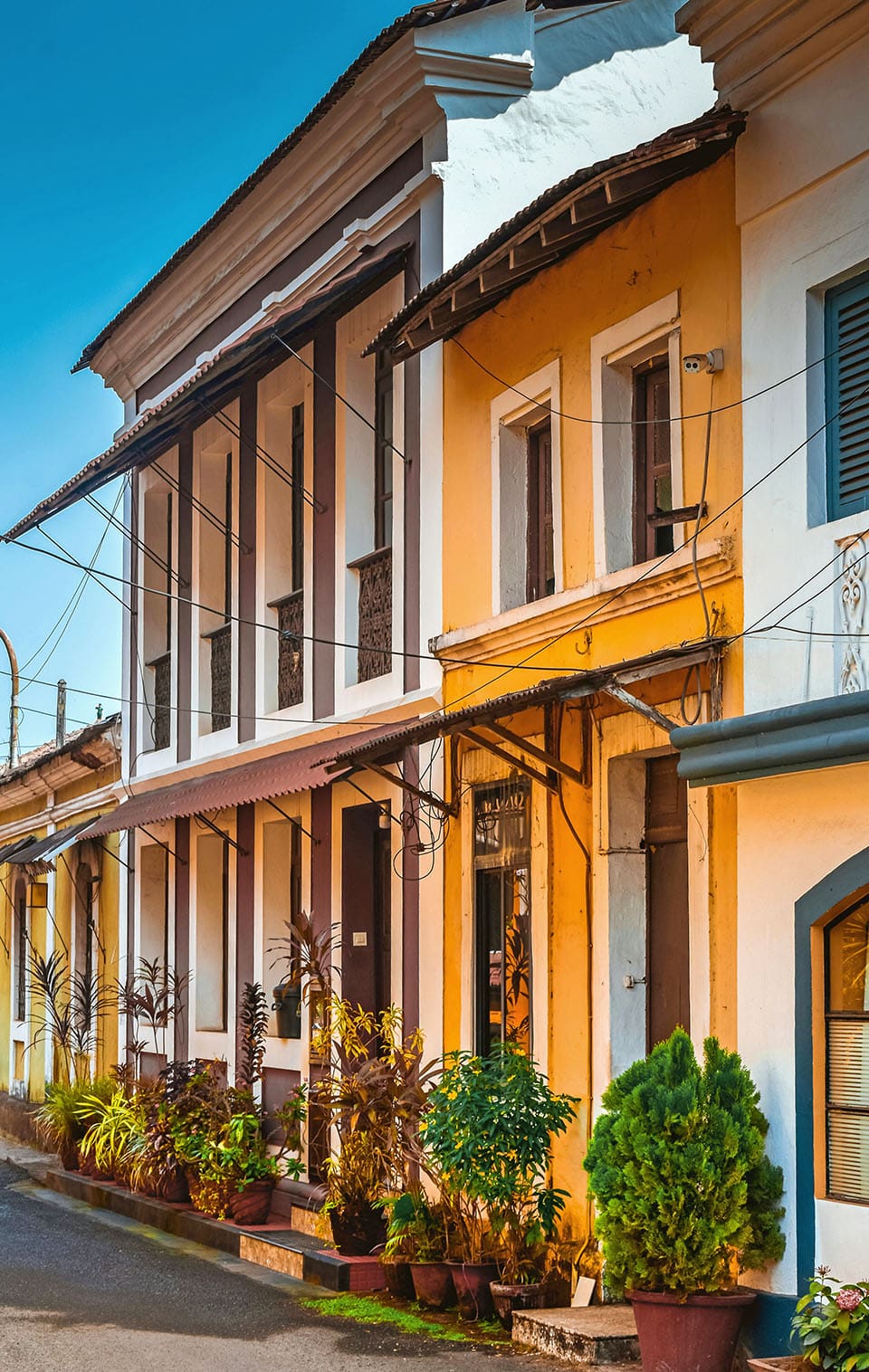
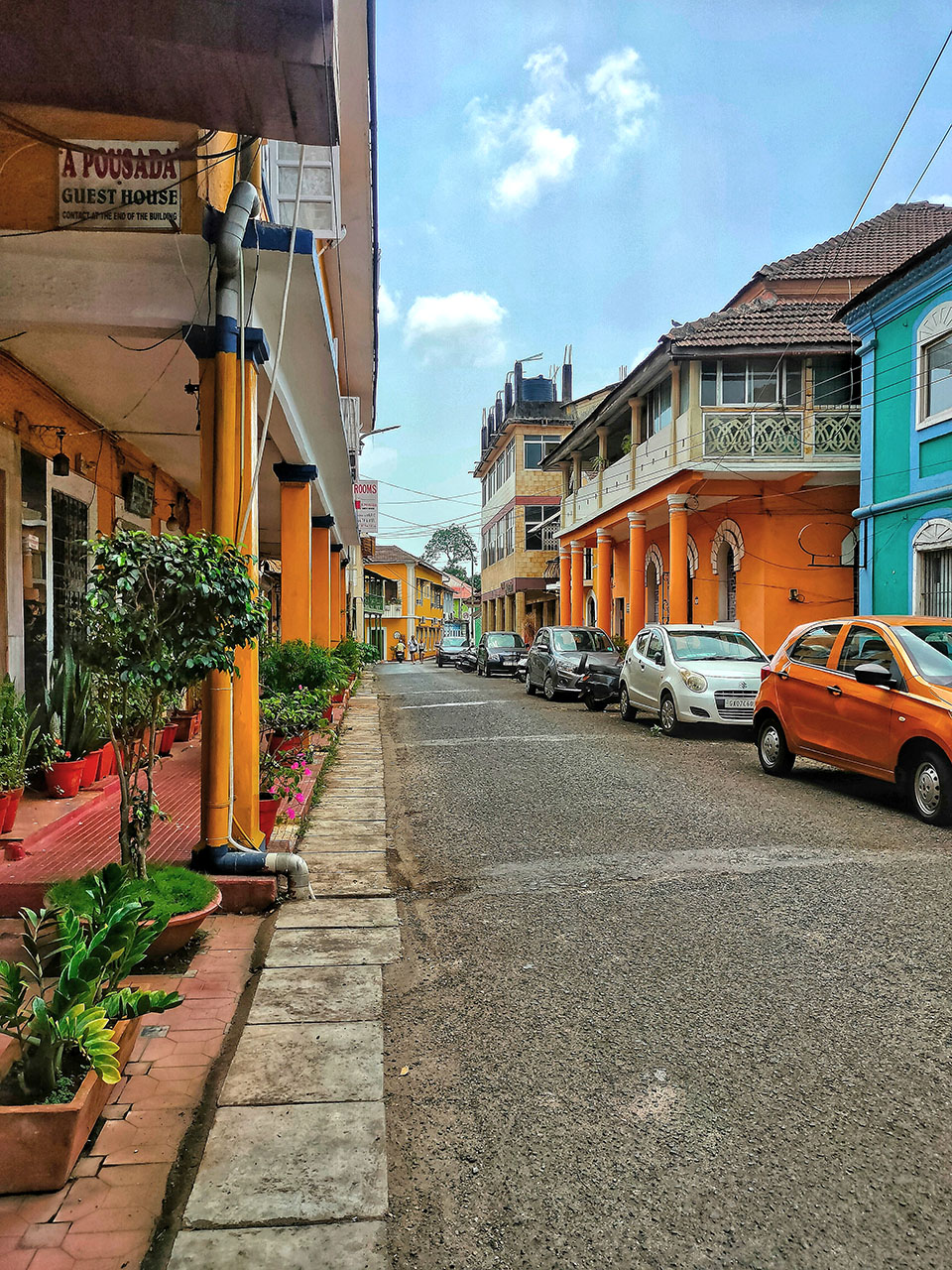
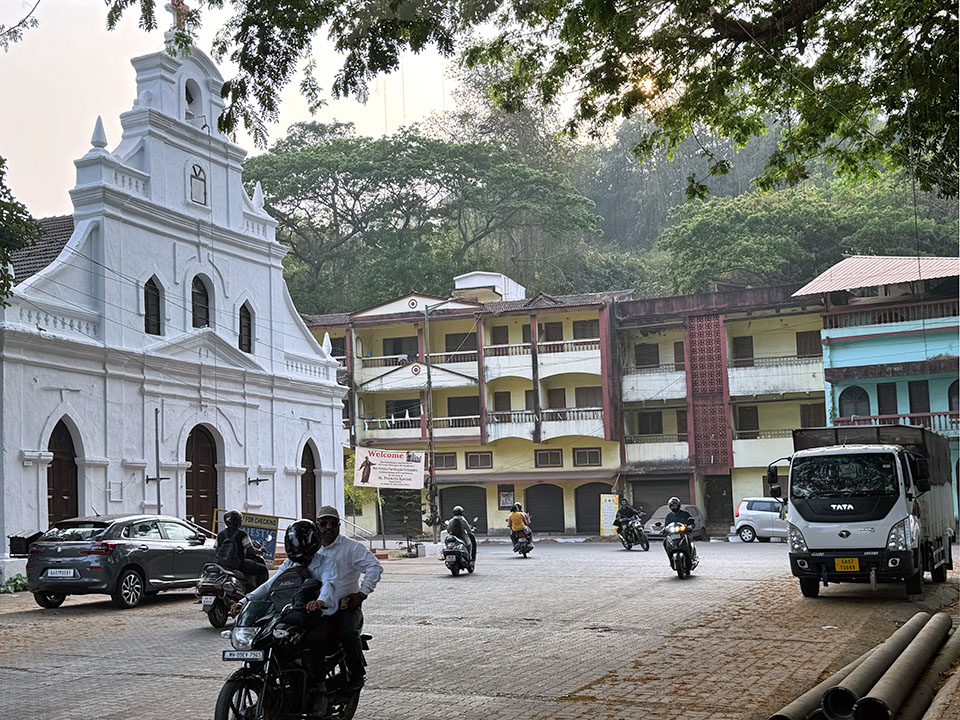
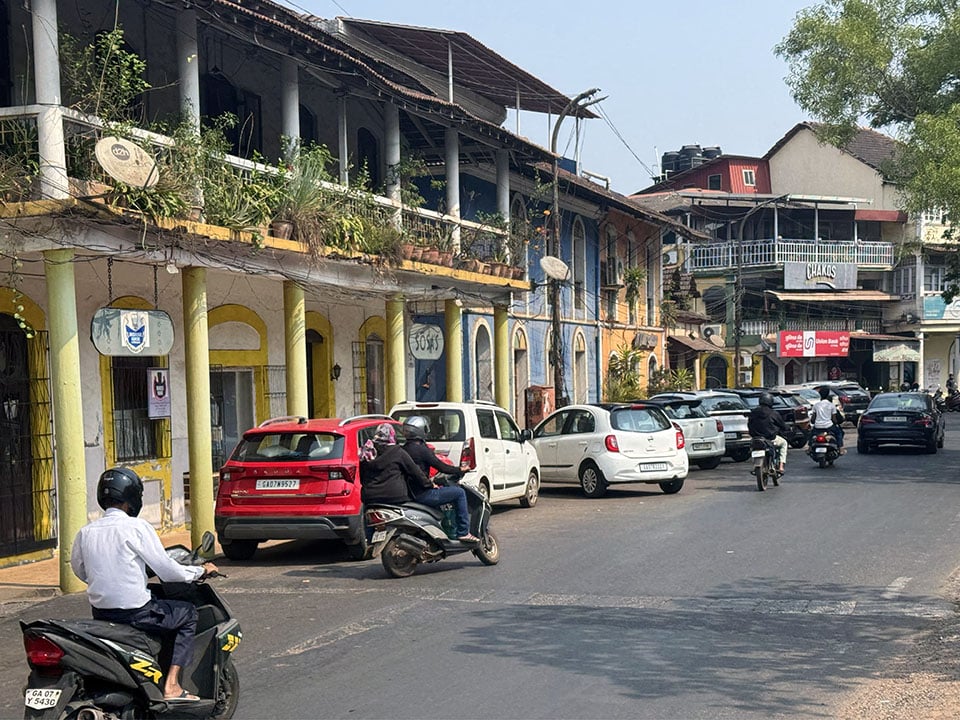
During colonial Portuguese rule, many merchants also owned warehouses along the waterfront to store the goods they traded. Portuguese traders introduced cashews, guavas, and red chilies from Brazil to Goa, and over time, those foods became integrated into Indian agriculture and cuisine throughout the country.
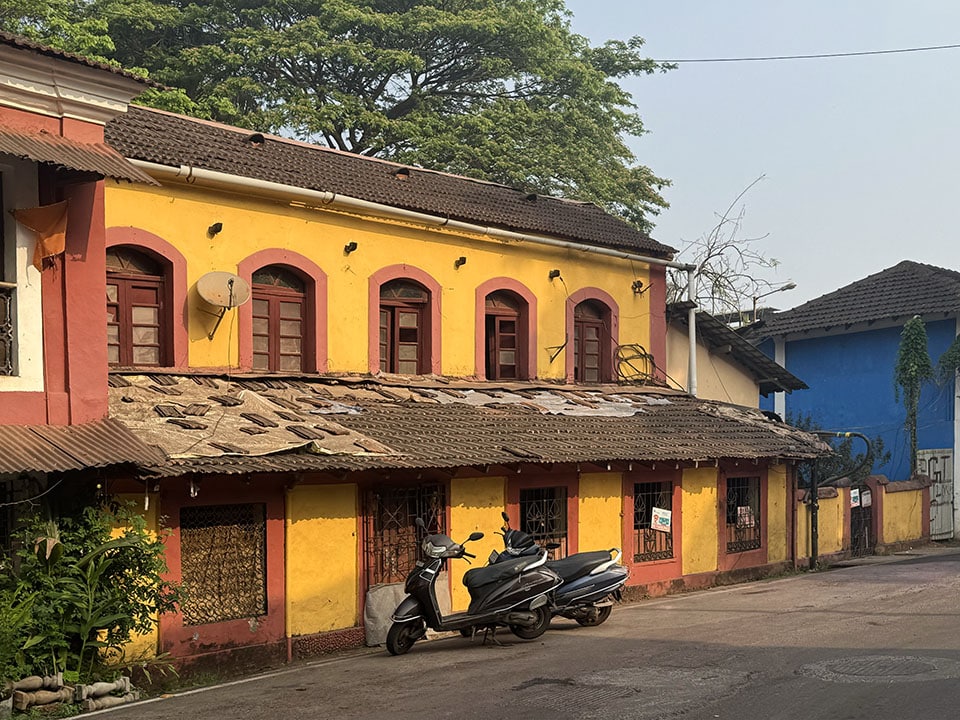
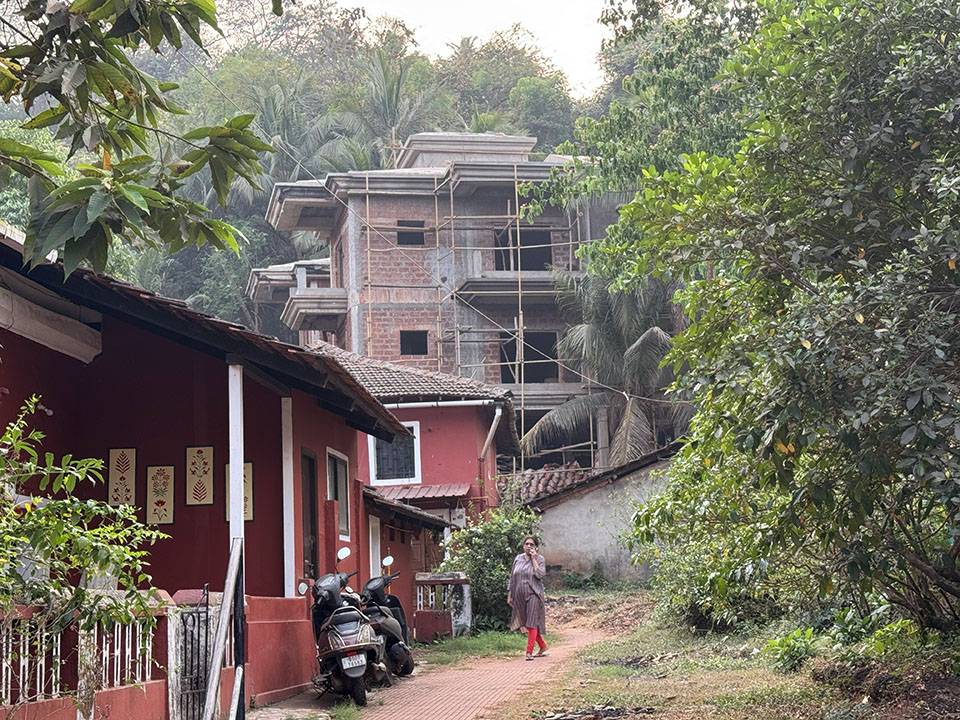
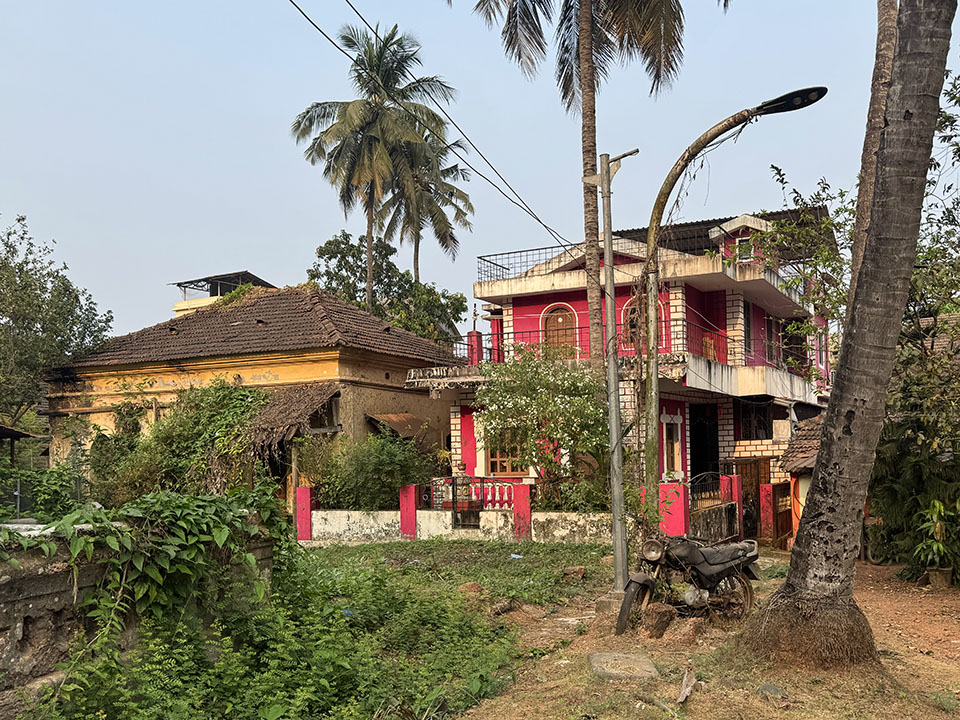
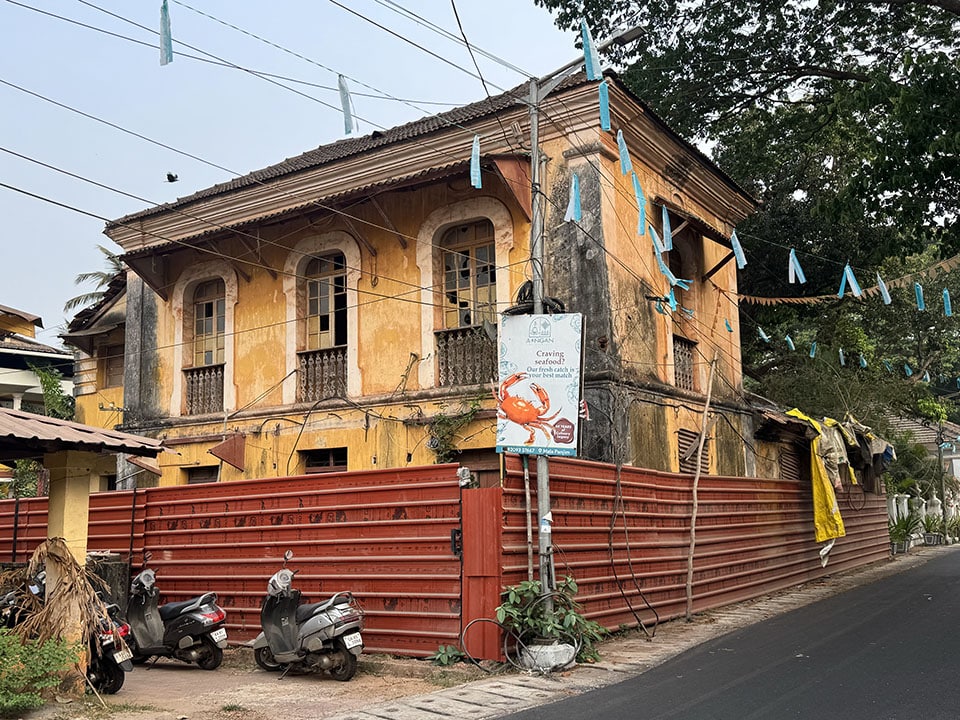
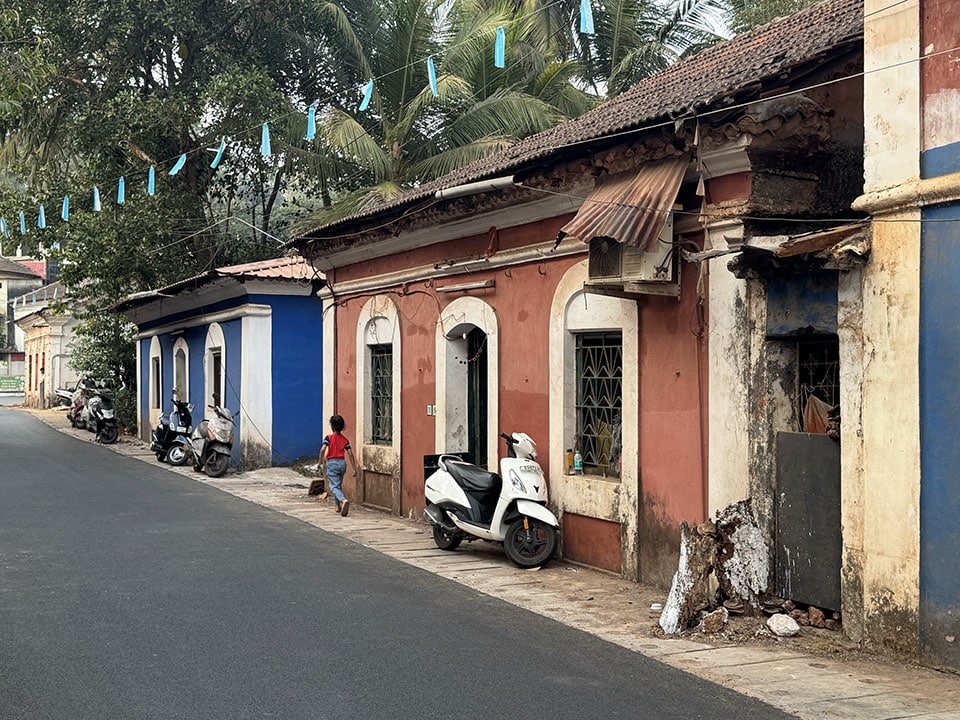
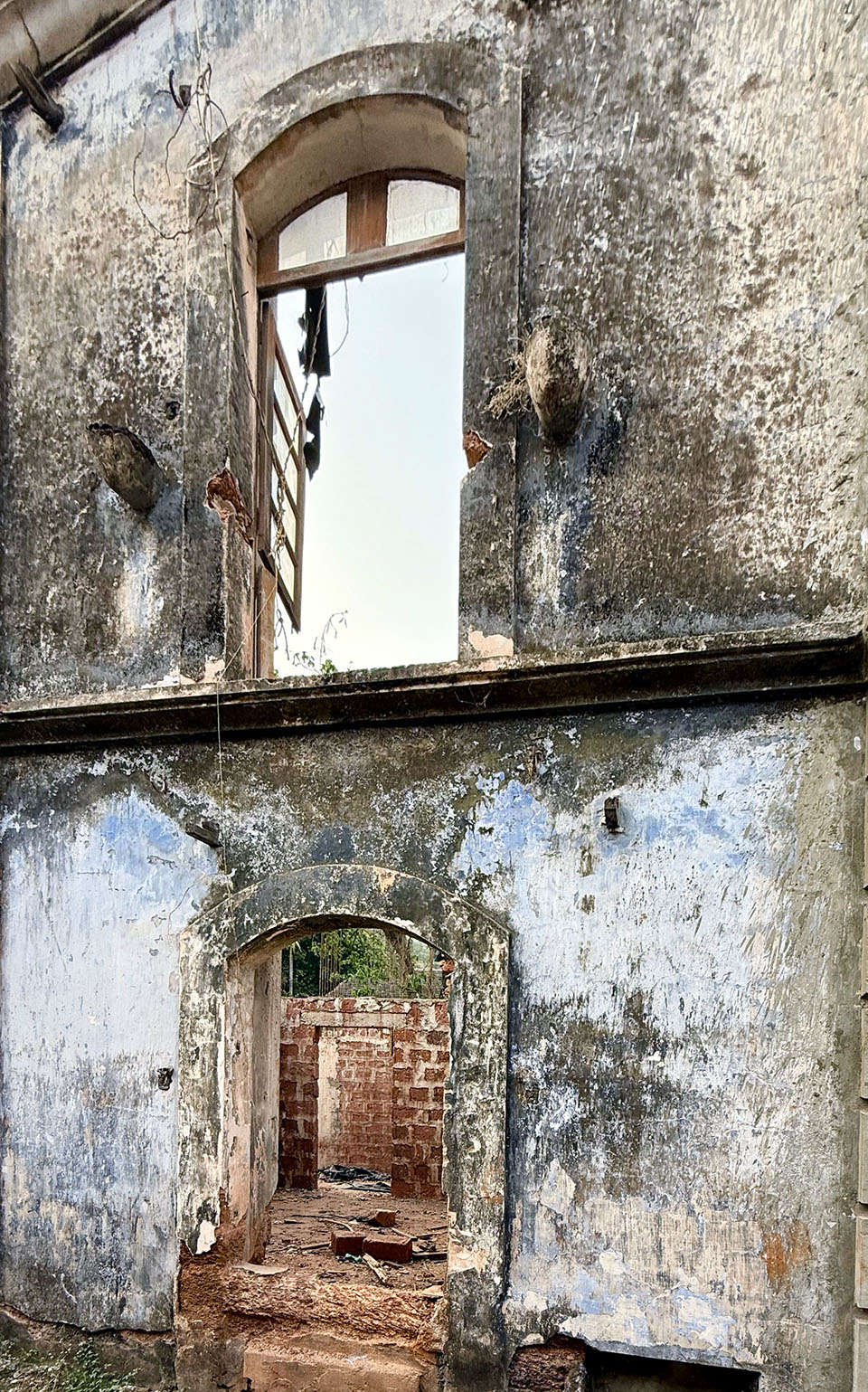
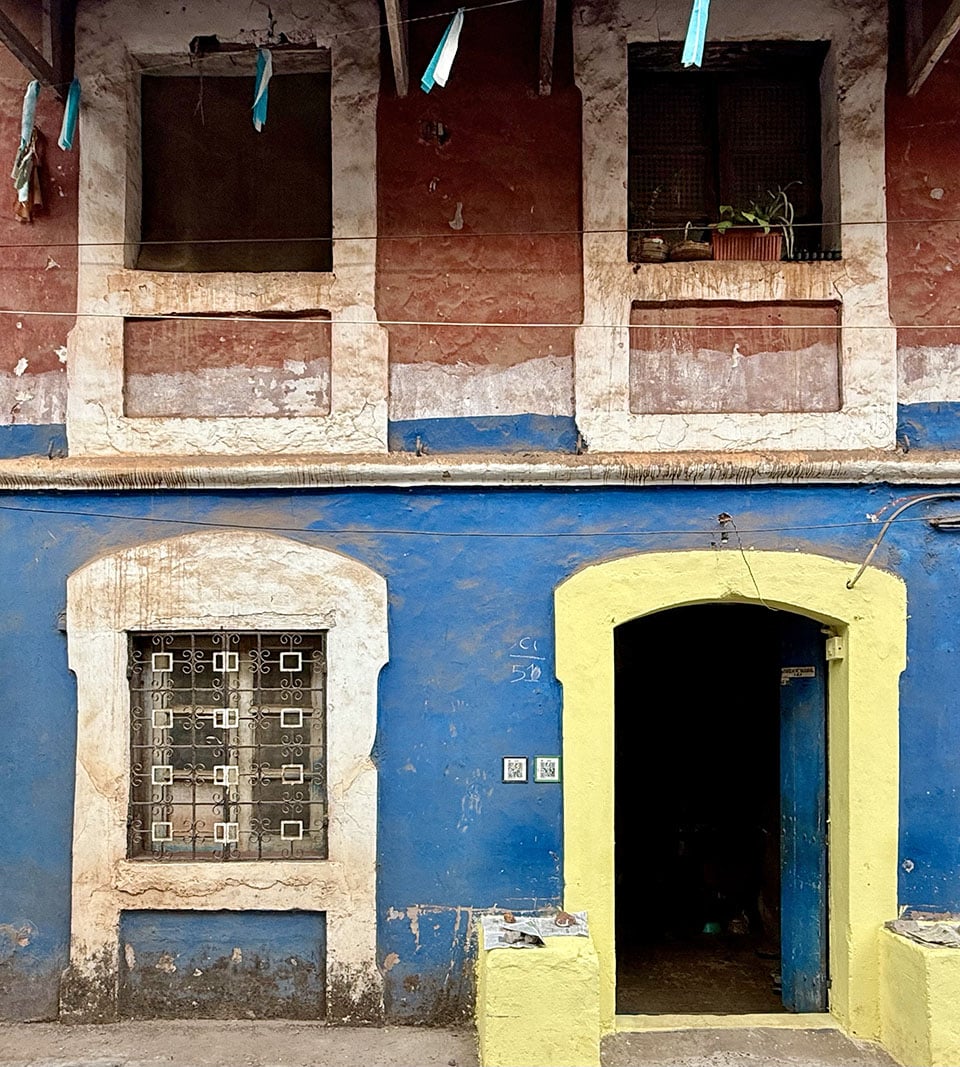
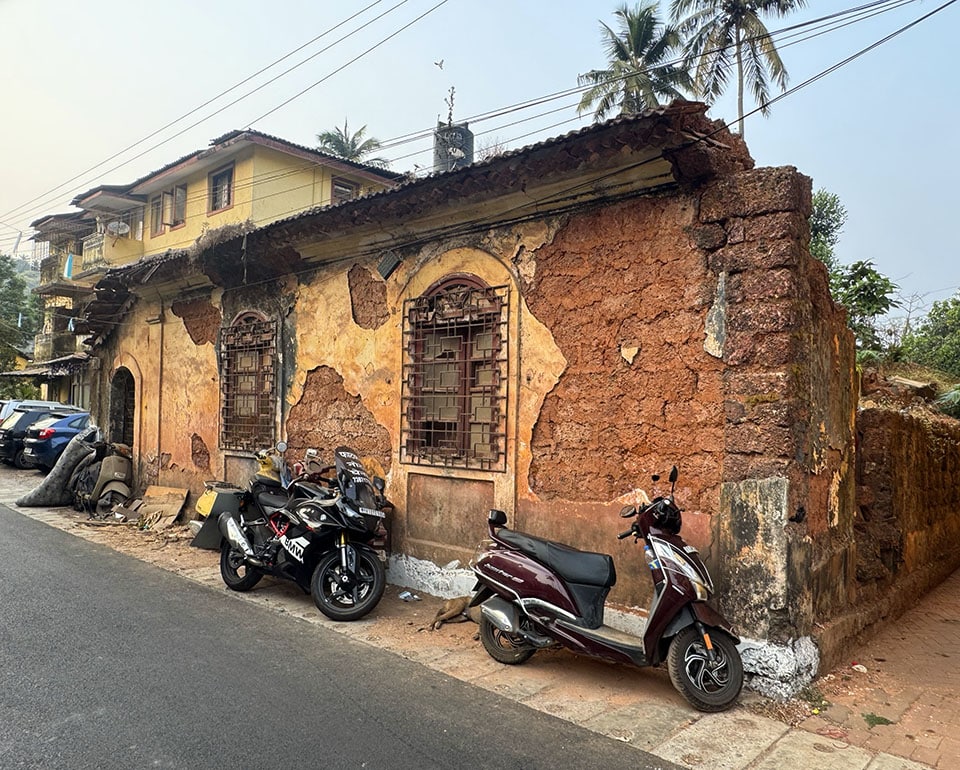
Traditionally, Goan house paint colors were made from natural pigments:
- Red from latrite rock (an ancient reddish volcanic rock, which is the bedrock of Goa and also used in building construction, like this house above)
- Blue from indigo
- Yellow from ocher
- Green, a combination of indigo and ocher
Green was the most expensive paint color because it combined two pigments, so wealthier families often painted their homes green to show off their status.
Inside a Traditional Goan Portuguese Home
One of the most memorable parts of the Fontainhas walking tour was visiting a private residence and meeting the owner himself.
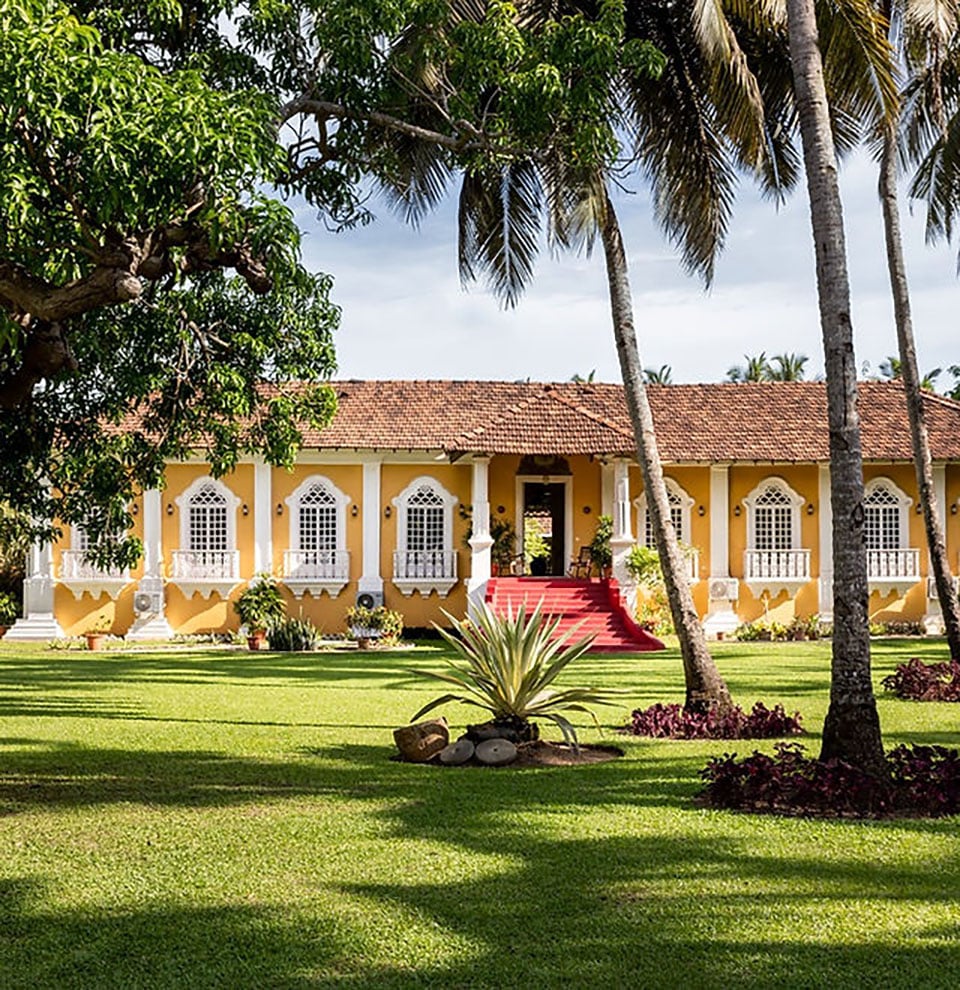
George was raised on a 350-year-old estate outside Panaji (below left, now the Silva Heritage Resort), which the family still owns and operates today as a hotel and wedding/event venue. His parents purchased their home in Fontainhas (below right) in 1950, when he was a young boy, and he and his wife still live there today. They welcome guests into their home to share a bit of Old Goan heritage in person, and we were grateful to our tour guide, Shreeya (next to Heidi in the group photo), and Make It Happen Tours for this unique opportunity.
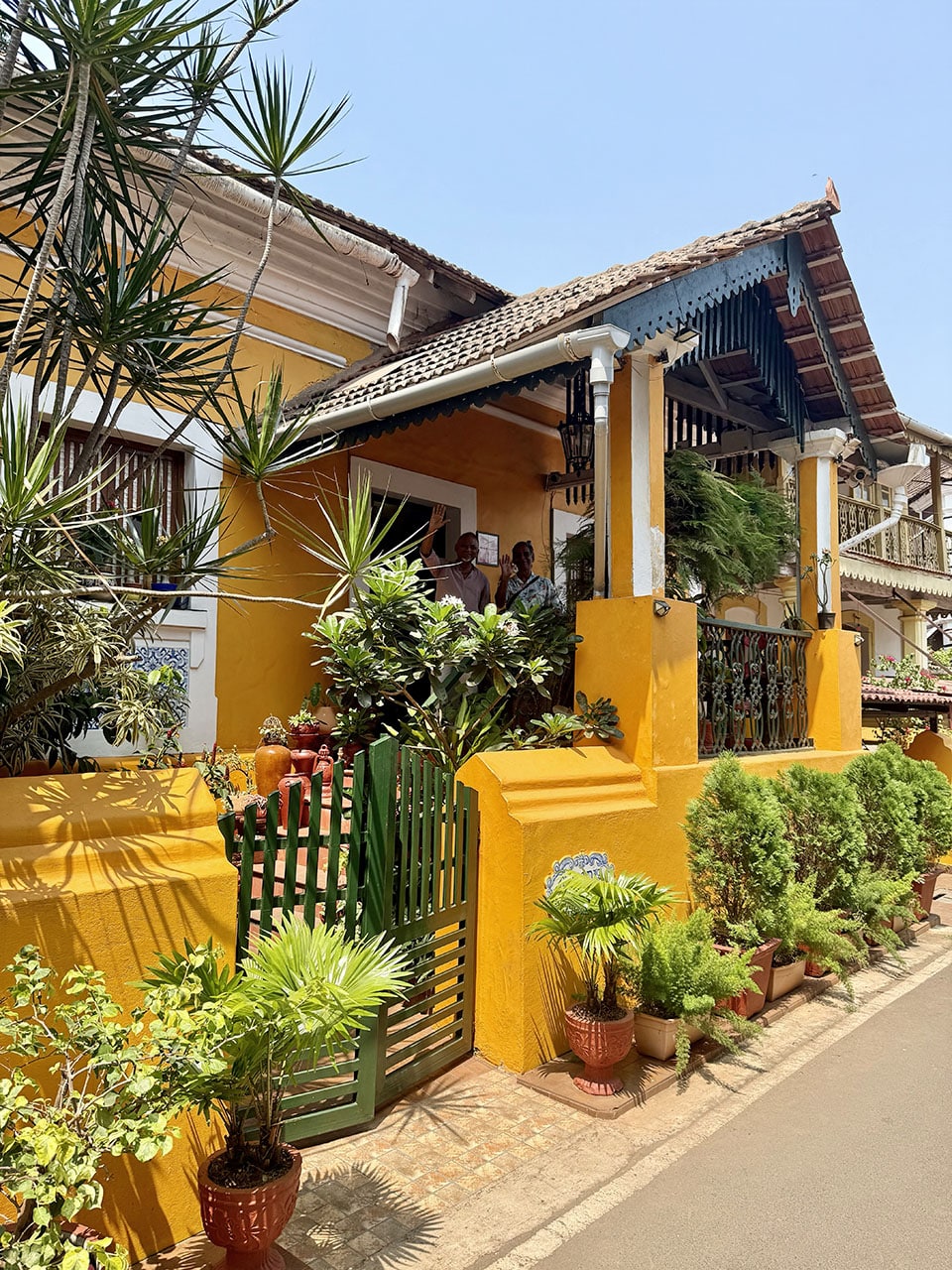
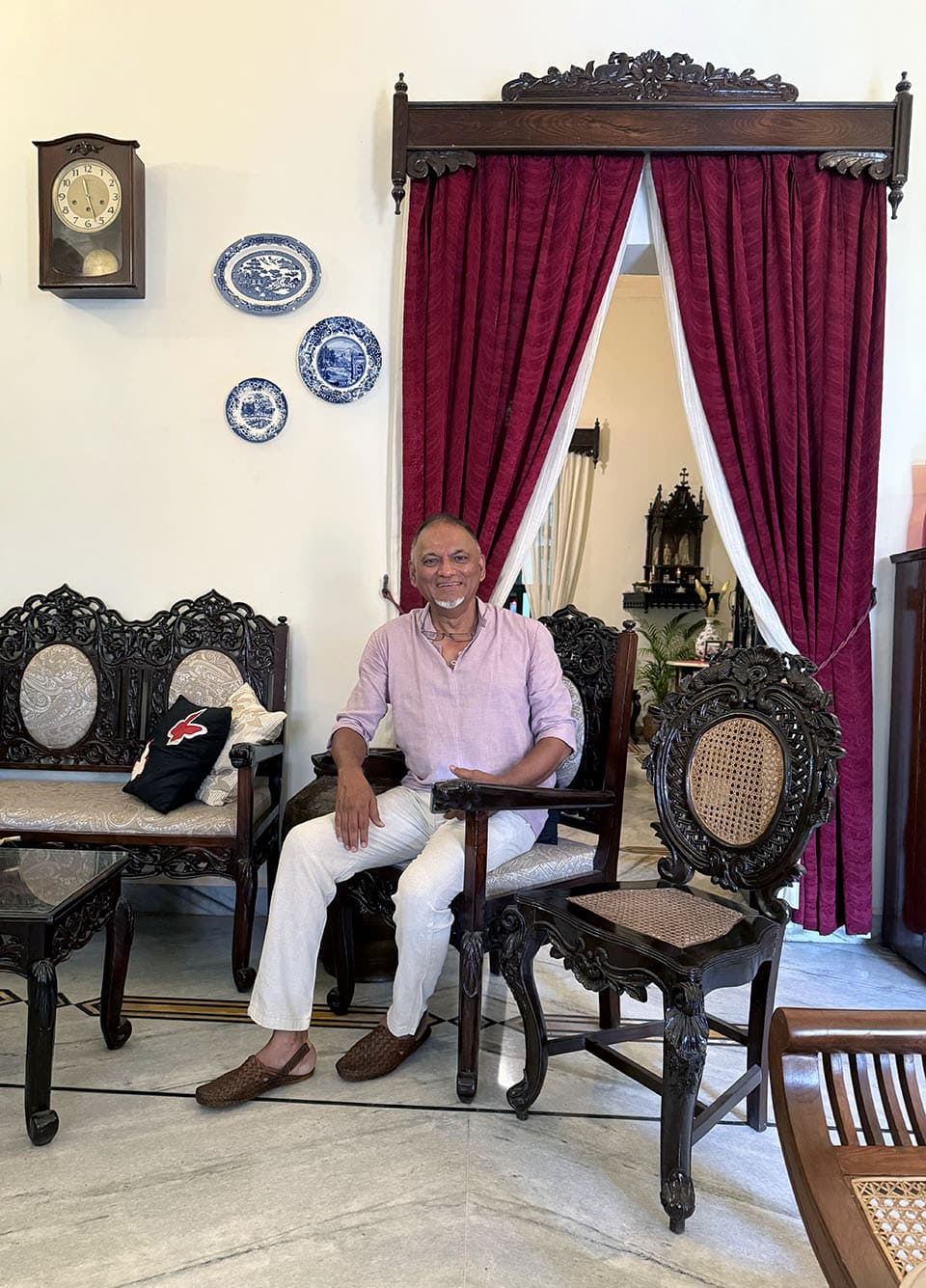
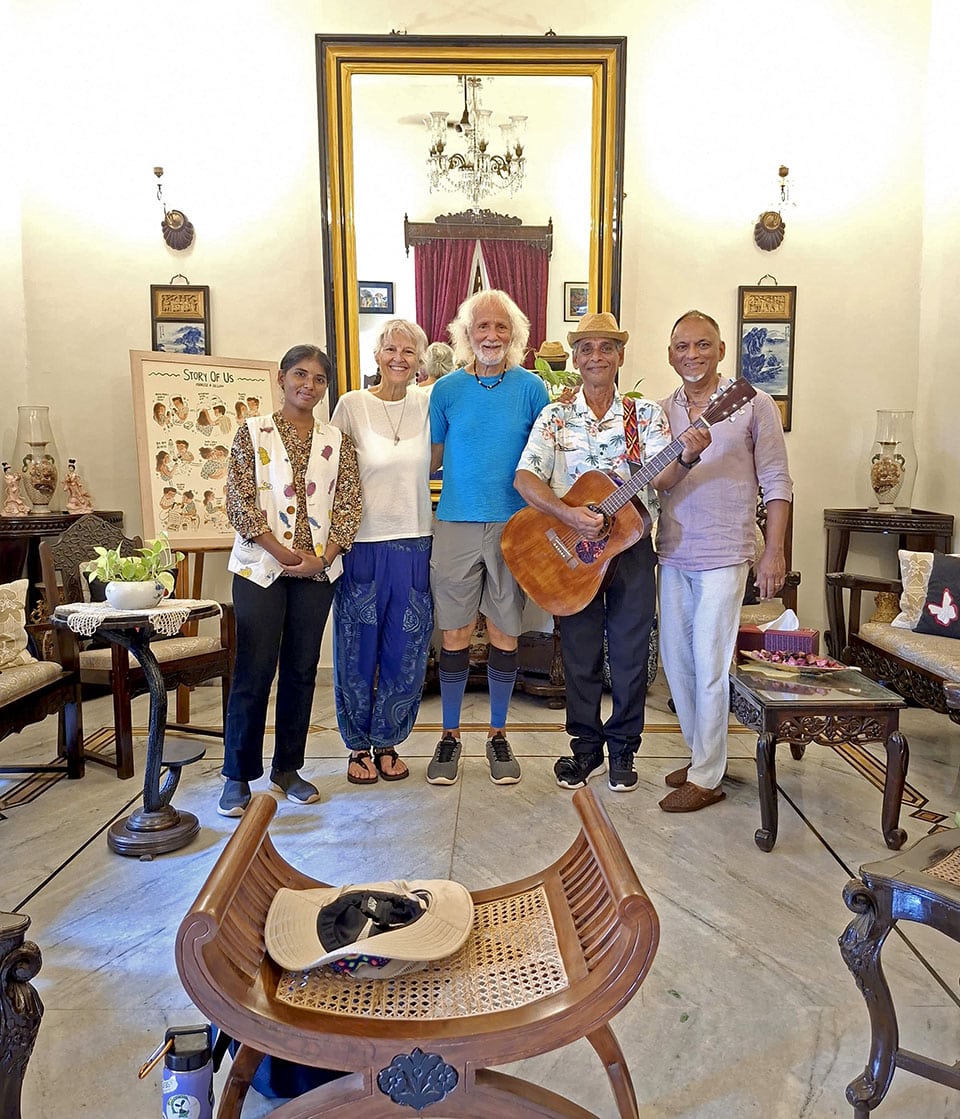
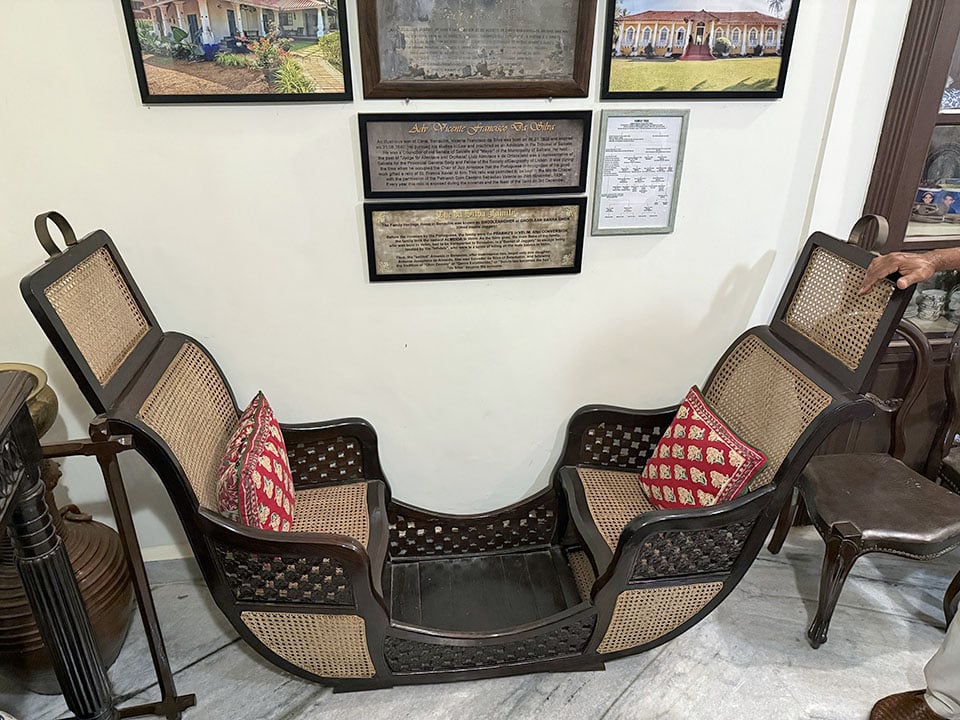
This traditional Portuguese home featured soaring 15-foot ceilings designed to keep the interior cool in Goa’s tropical climate. The house was filled with antique Portuguese furniture and family heirlooms collected over generations, like this sedan chair above, which could be carried on a bamboo pole.
While we were there, one of George’s old high school classmates, Francisco, serenaded us with traditional Goan-Portuguese music on guitar. It was such a wonderfully unexpected cultural experience.
The Legend of the Rooster of Barcelos
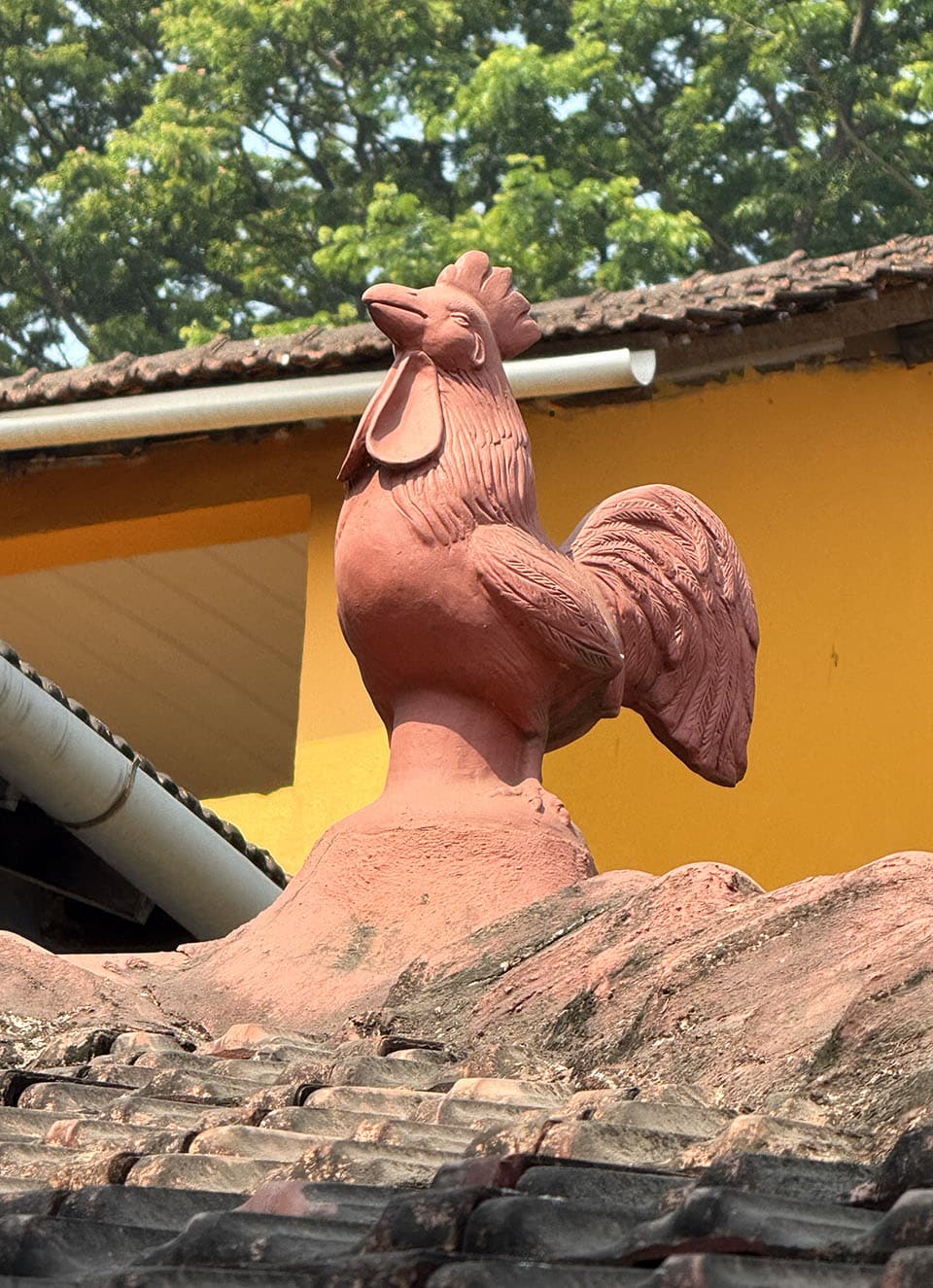
Many houses in Fontainhas had clay roosters on their roofs, and we soon learned why. Shreeya told us this famous Portuguese folk tale about a silver thief, a pilgrim, and a miraculous rooster.
In the town of Barcelos in northern Portugal, a landowner’s silver was stolen. The townspeople were angry and desperate to find the thief.
A pilgrim from Galicia in Spain was passing through Barcelos on his way to Santiago de Compostela to fulfill a religious promise. Even though he swore he was innocent, he was accused of the theft because he was a stranger. The authorities arrested him and sentenced him to be hanged.
Before his execution, the pilgrim begged to speak with the judge who had condemned him. The judge was holding a banquet at the time. Standing before the judge’s table, the pilgrim pointed to a roasted rooster that was part of the feast and declared with unwavering faith that he was innocent. He said that it was as certain that he was innocent as that the roasted rooster would crow when they hanged him.
The judge laughed and dismissed the pilgrim, who was taken to the gallows anyway. As the executioner was about to hang him, something miraculous happened on the judge’s table. The dead roasted rooster suddenly stood up and crowed.
Hearing this impossible news, the judge rushed in horror to the gallows. When he arrived, he found that the pilgrim was still alive because the knot had been tied poorly. The innocent man was immediately freed, and the judge realized his grave mistake.
Years later, the pilgrim returned to Barcelos and built a stone cross to thank the Virgin Mary and Saint James for saving his life and for the miracle that proved his innocence.
The Rooster of Barcelos became Portugal’s national symbol, representing faith, justice, good luck, and prosperity. Today, thanks to Goa’s Portuguese history, rooster figurines are found throughout Goa as reminders that truth will always prevail and as symbols of prosperity and good luck.
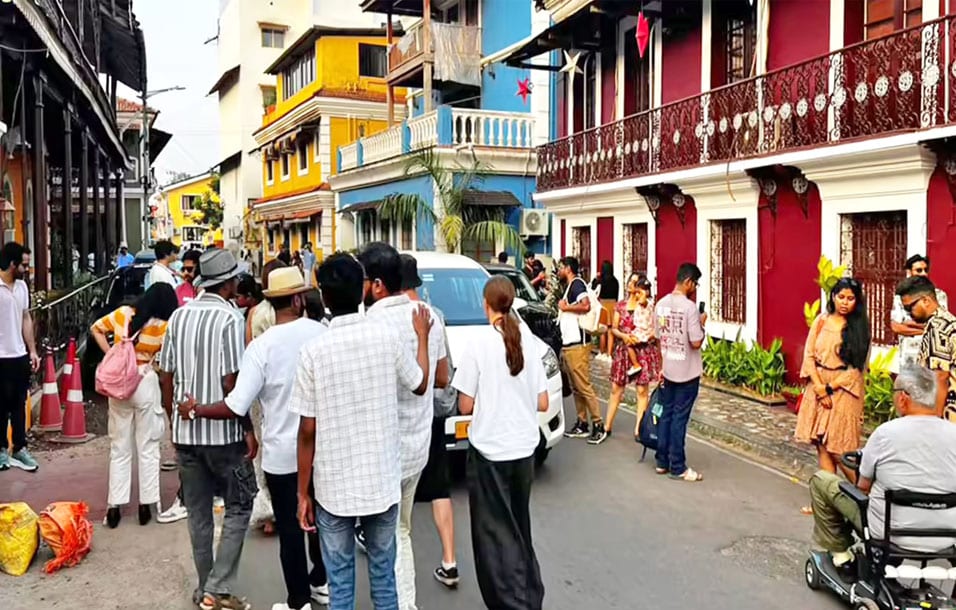
This “Selie-Mobsters” photo captures the strange Fontainhas passion we saw daily. ©Times of India.
One unusual thing we noticed in Fontainhas is that many homeowners no longer allow photographs of their houses. Several Bollywood films and Indian TV shows used the colorful streets as backdrops, turning the neighborhood into a major selfie destination. These days, tourists constantly pose in front of homes for social media photos—often completely ignoring the large “NO PHOTOS” signs posted on gates and doors. It was super crazy to see!
MOG (Goa’s Modern Art Museum)
After the tour, we returned to the Airbnb for lunch and a short nap before heading out again for our afternoon adventure.
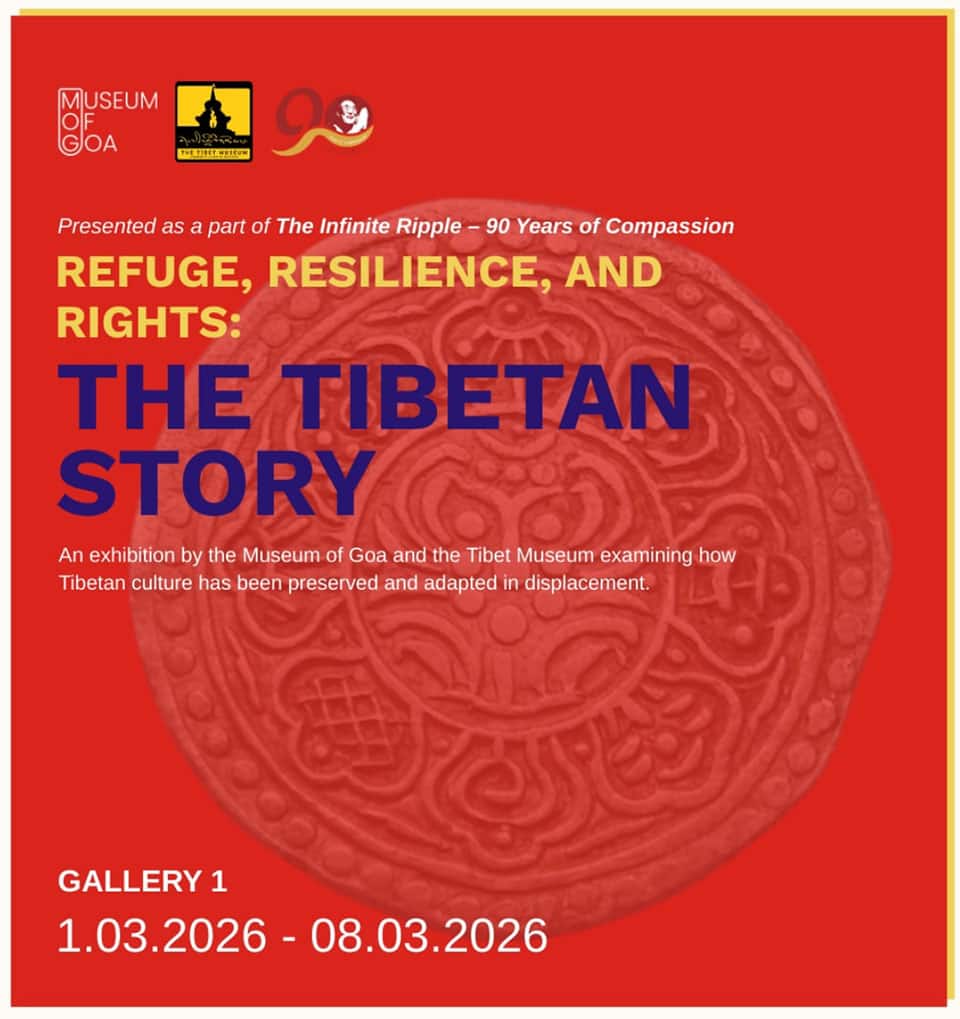
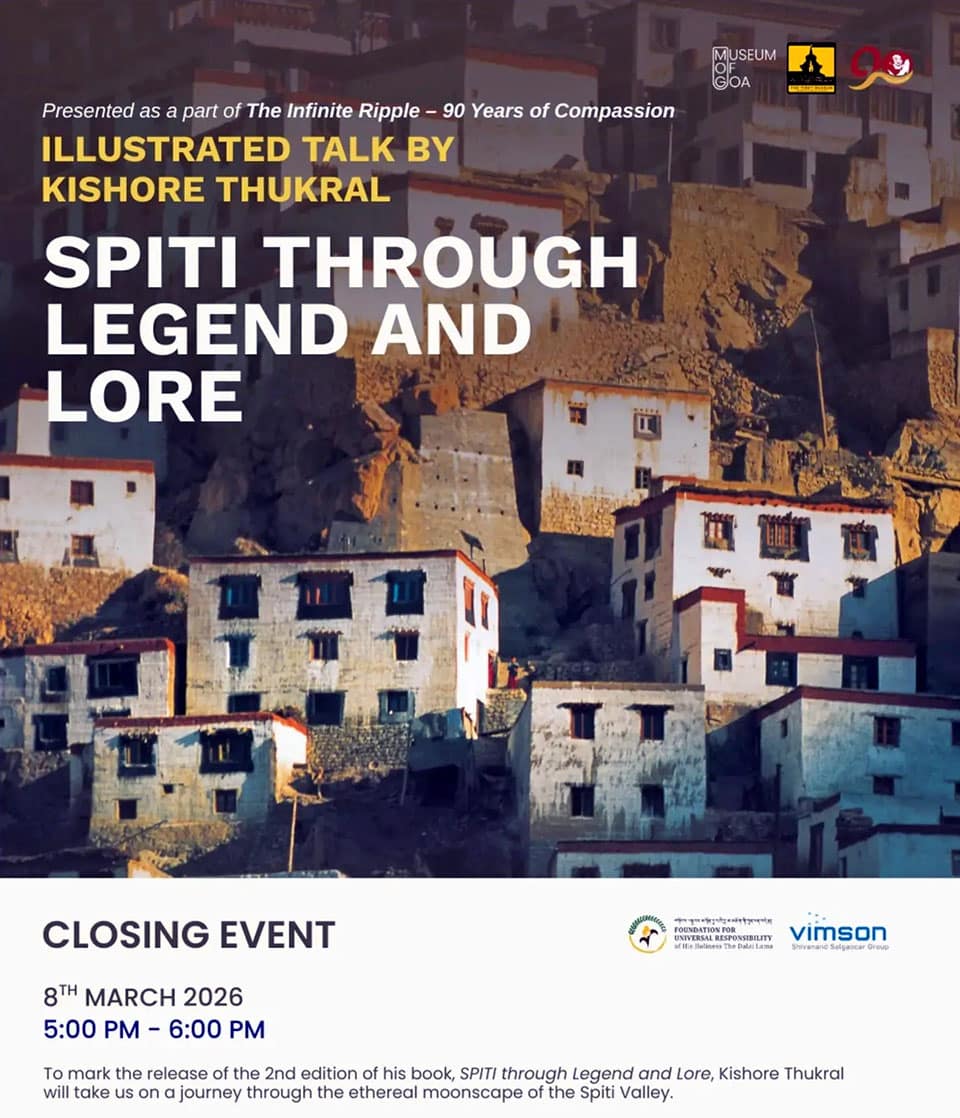
While researching Goa before the trip, we discovered MOG (Museum of Goa, Goa’s Modern Art Museum), which happened to be closing its Tibetan exhibit the day after we arrived. We also learned there were two special free closing events happening that evening, but tickets required an RSVP via WhatsApp. Thankfully, there were still a couple of spots left for us.

As we stepped out of the Airbnb looking for a taxi to MOG, one literally pulled out of the driveway directly across the street. We asked if he was available, and just like that, we met Mitesh—our taxi driver for the next couple of days.
The museum itself really surprised us. Though fairly small, it had the polished, professional feel of SAM or MOMA, with beautifully curated exhibits and an excellent gift shop.
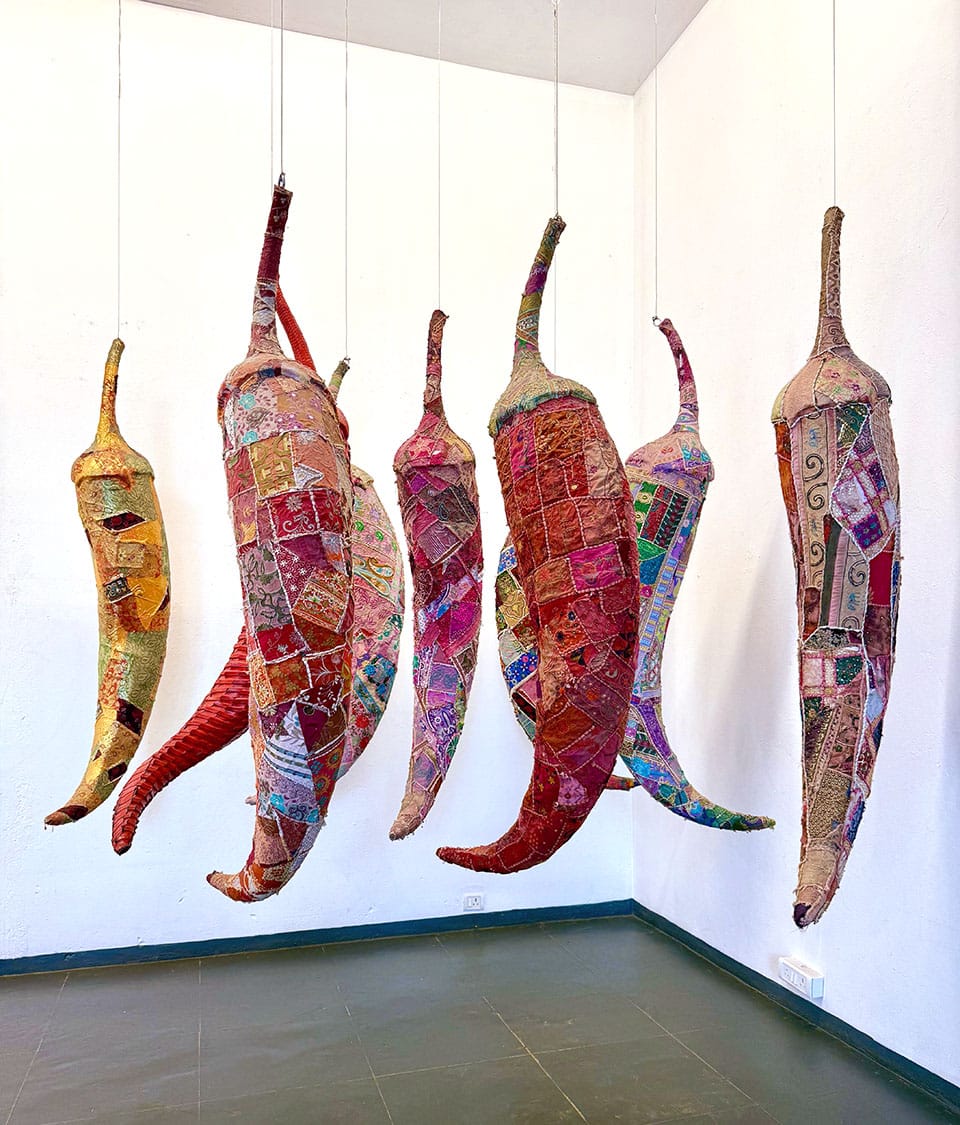
Contemporary artist Dr. Subodh Kerkar, founder of MOG, created an artwork of sculpted chilies wrapped in colorful traditional Indian textiles. The piece honors the 16th-century Portuguese traders who brought chilies from Brazil to India, while the cloth symbolizes how this foreign spice was gradually “Indianised” and became a staple in Indian cuisine—India is now the world’s largest producer and consumer of chilies.
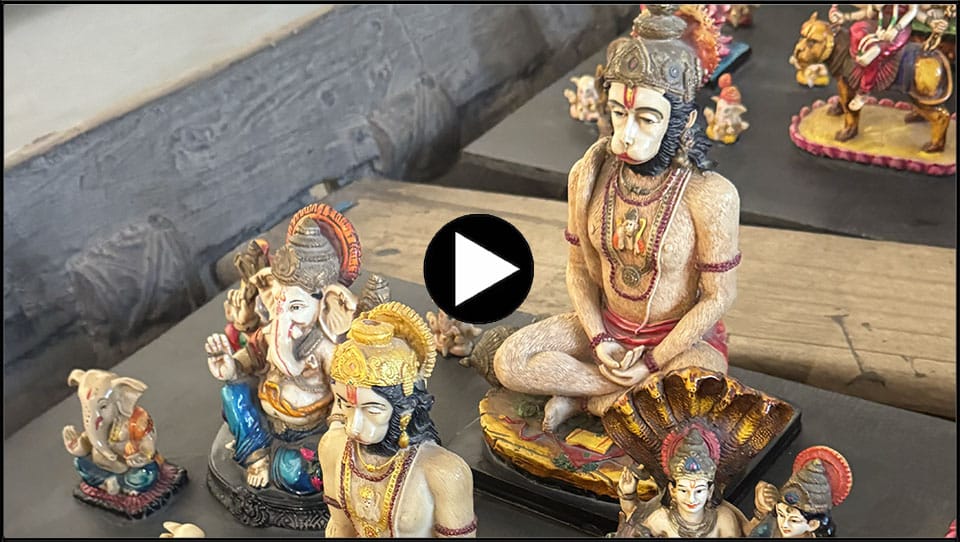
Subodh Kerkar is also the artist behind “Goa’s Ark,” a rocking wooden boat filled with figurines of Hindu deities, symbolizing the perilous journeys devotees undertook during the 16th-century Portuguese Inquisition. When Portuguese forces destroyed over 1,000 Hindu temples, worshippers smuggled their gods by boat to safer areas, and this moving installation captures that perilous migration of faith. The piece stands as a powerful metaphor for Goa’s survival through colonization, religious persecution, and cultural transformation.
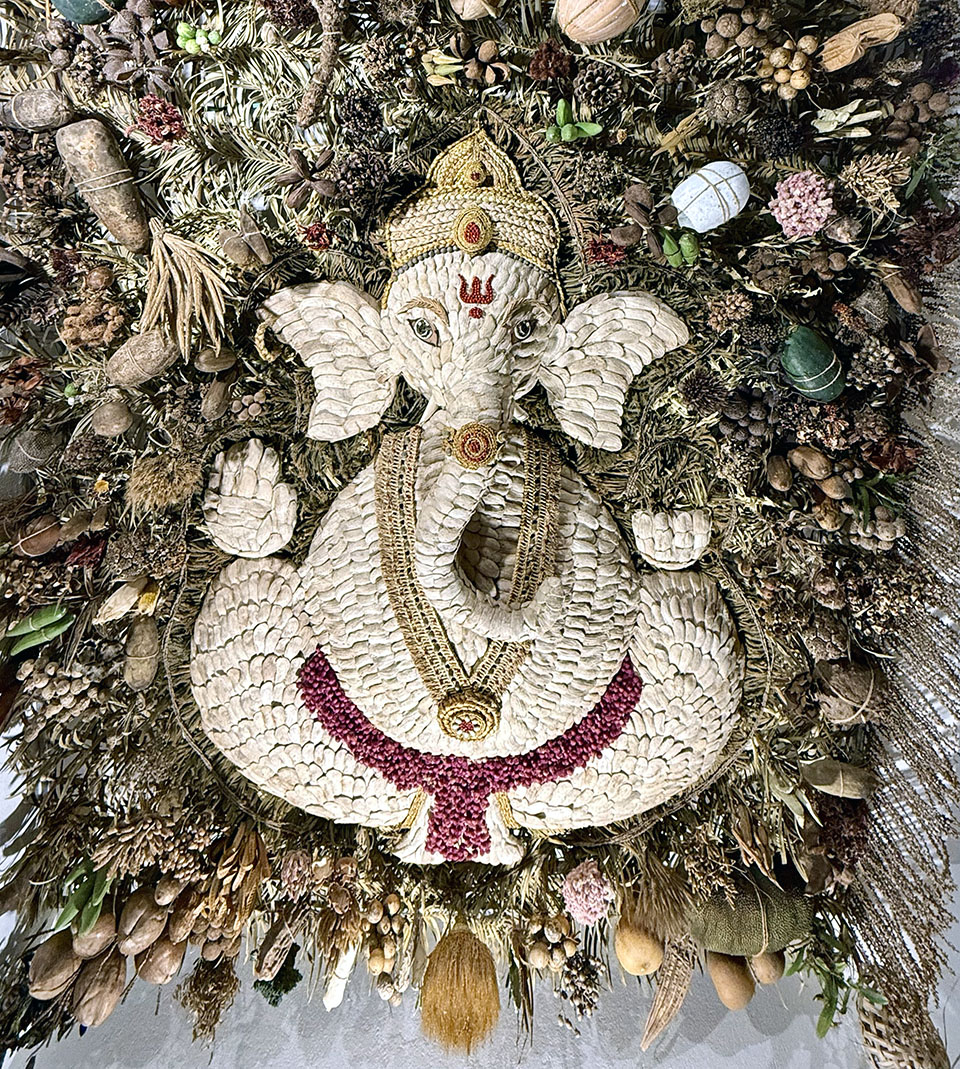
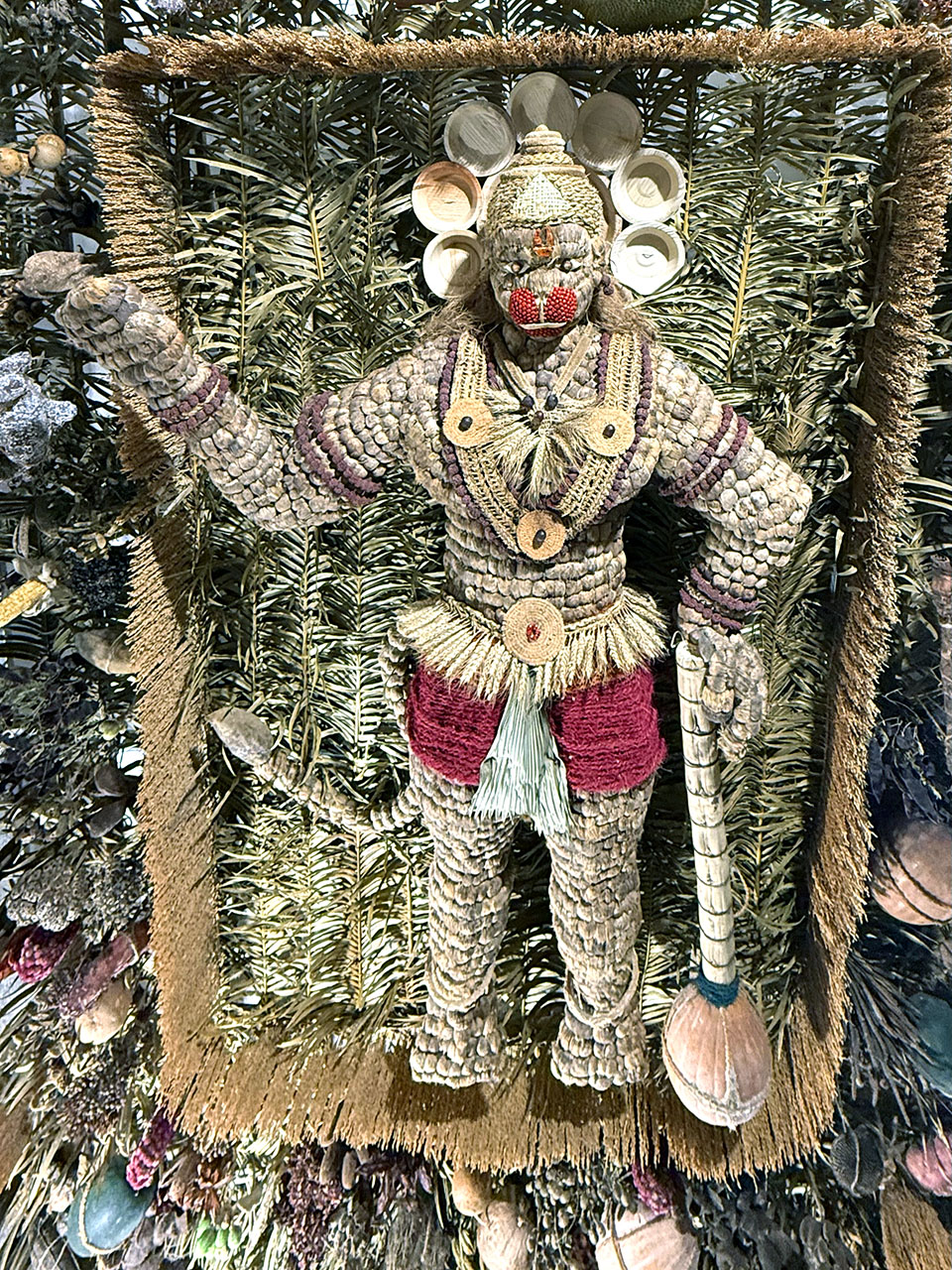
Created by local Goan artists Tanaji Gaude and Datta Naik, these divine sculptures are deep celebrations of regional biodiversity, agrarian heritage, and nature worship. Ancient harvest traditions are beautifully reimagined into towering ceiling sculptures (each about 6.5′ tall) of Ganesh and Hanuman made entirely from local seeds and grains.
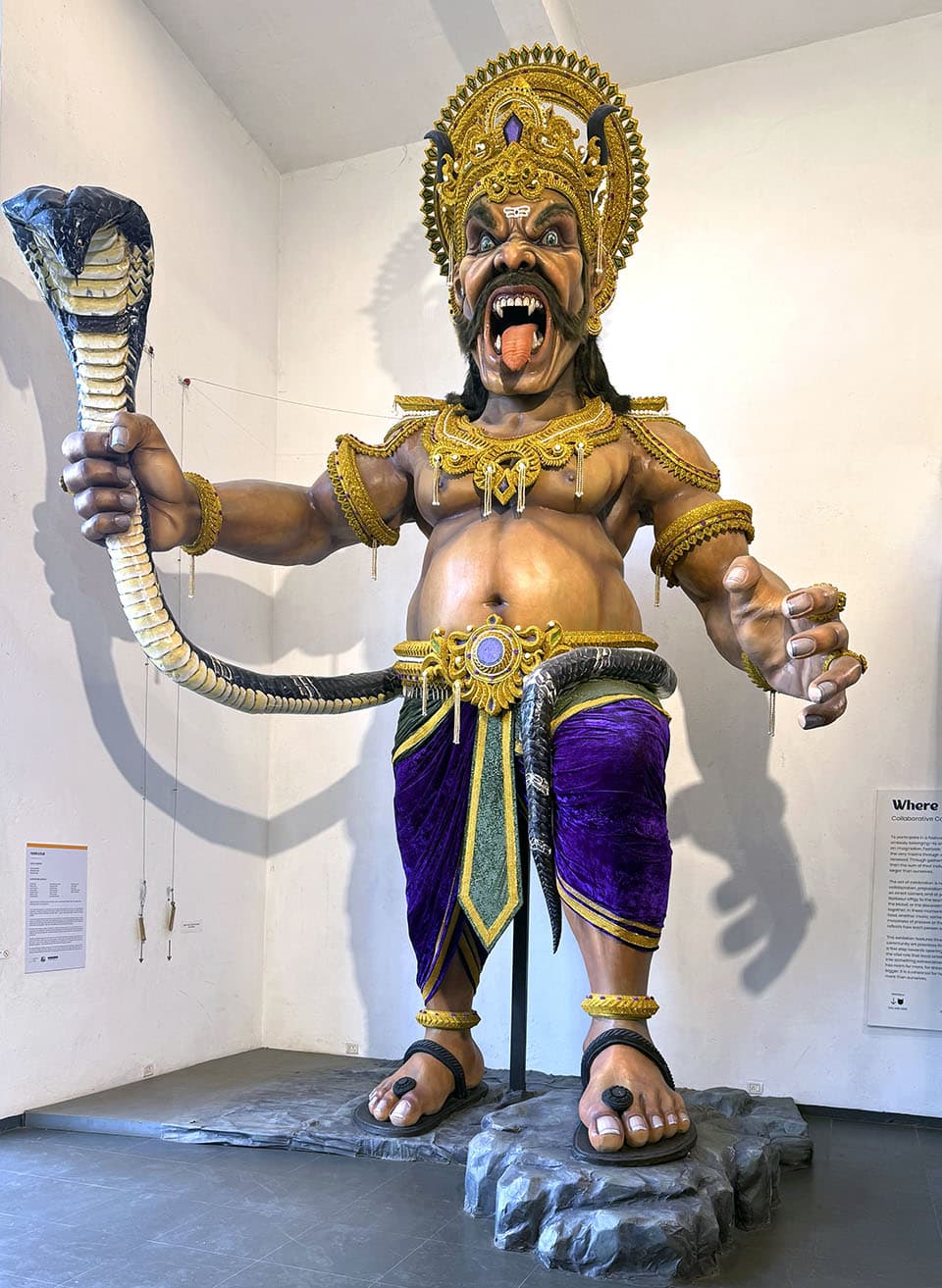
This 22-foot-tall Narakasur is a collaborative art installation created by a group of young Goan artists, celebrating community craft and collective imagination. In typical Goan villages, children help create these sculptures for weeks before Diwali, learning to sculpt, paint, and collaborate as they prepare for the annual Narak Chaturdashi celebration. These effigies are burnt at dawn on the day before Diwali, to celebrate light triumphing over evil. This particular piece blends North Goa’s fierce, muscular stance with South Goa’s round-bellied, human-like form, honoring the same love, labor, and shared creativity that define the tradition.
We only had about an hour to explore the exhibits before the museum closed and the special evening events began. The Tibetan exhibit was especially moving—a photo essay documenting the Chinese occupation of Tibet and the refugee experience of Tibetans fleeing into India.
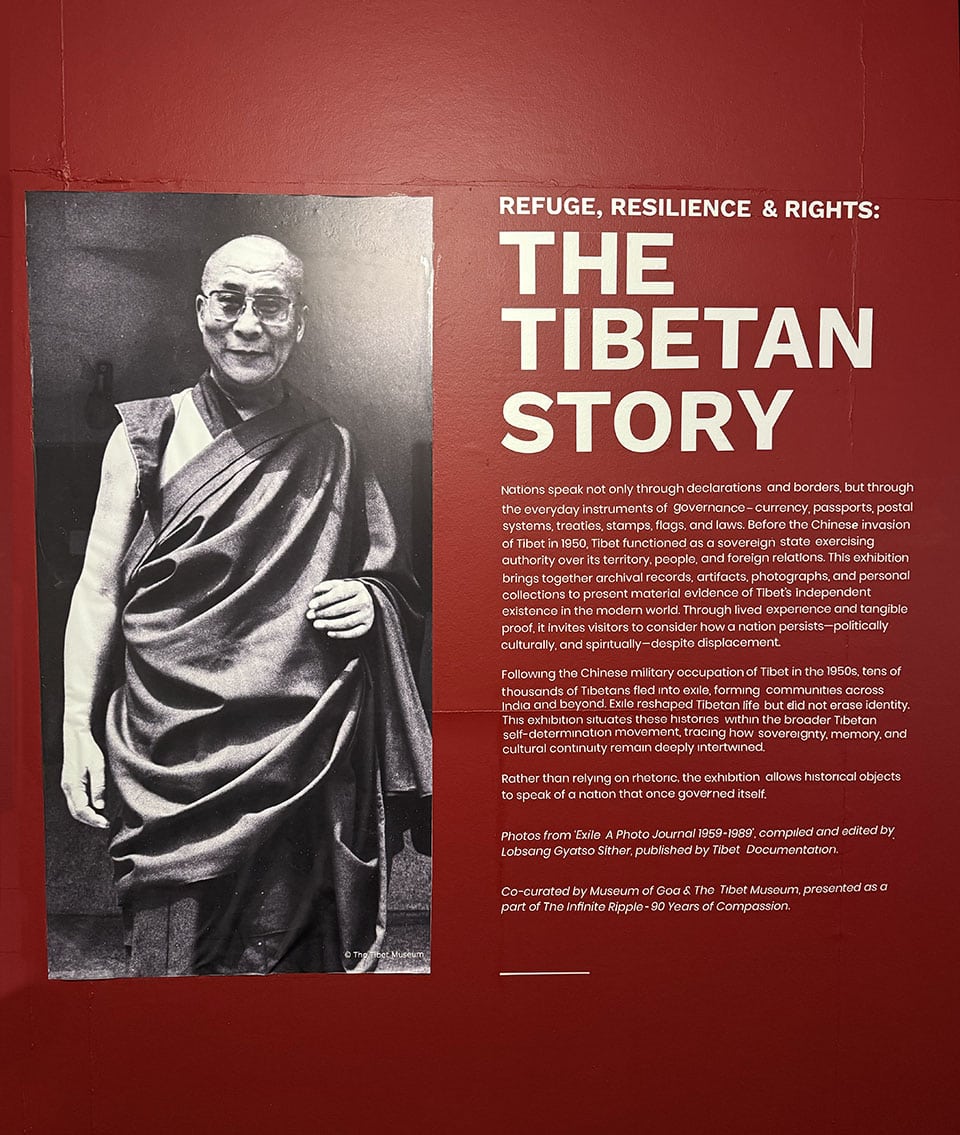
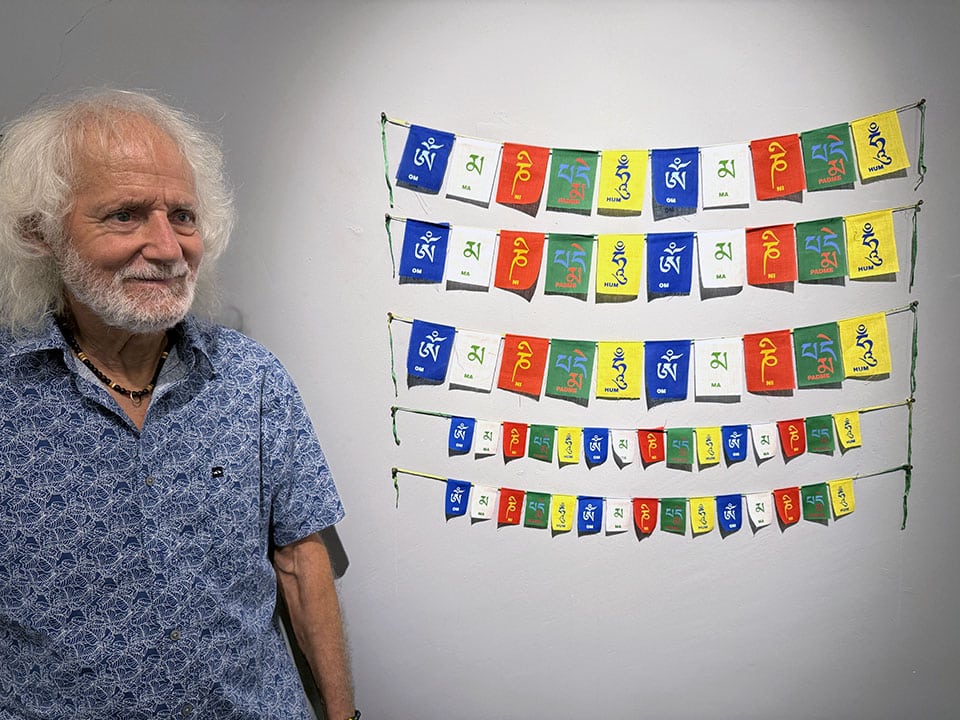
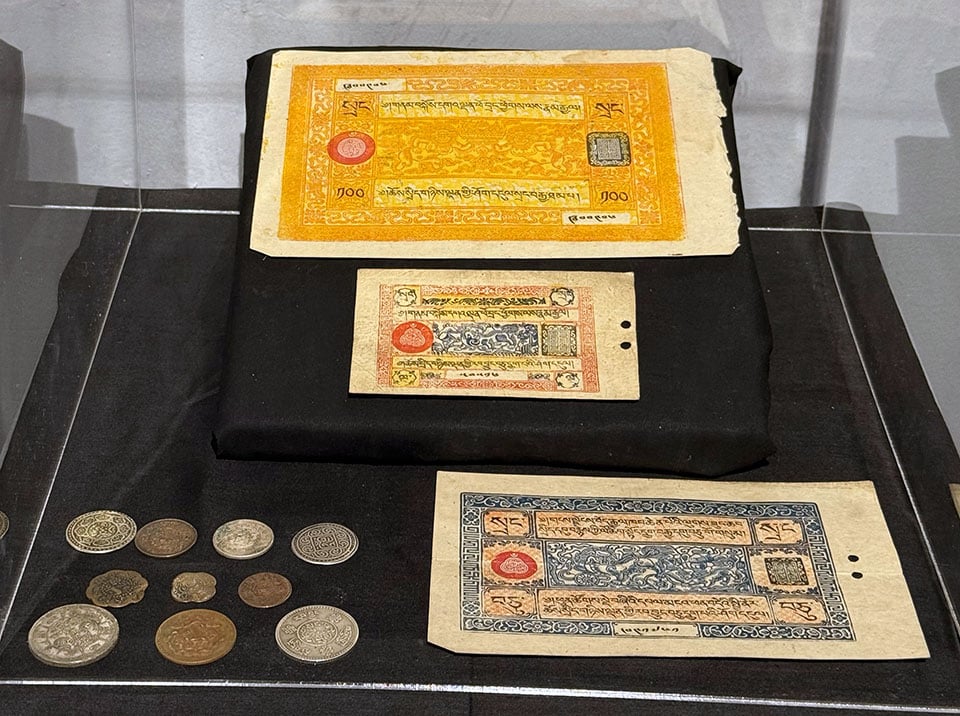
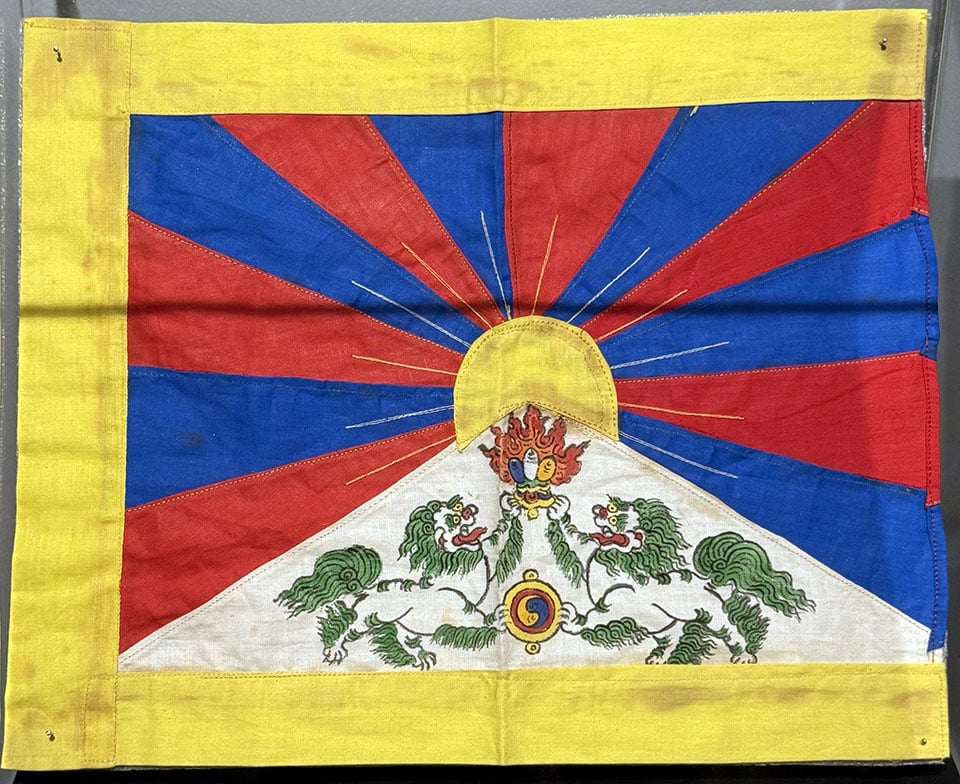
As the exhibit shared, “Nations speak not only through declarations and borders, but through the everyday instruments of governance—currency, passports, postal systems, treaties, stamps, flags, and laws. Before the Chinese invasion of Tibet in 1950, Tibet functioned as a sovereign state exercising authority over its territory, people, and foreign relations. This exhibition brings together archival records, artifacts, photographs, and personal collections to present material evidence of Tibet’s independent existence in the modern world. Through lived experience and tangible proof, it invites visitors to consider how a nation persists politically, culturally, and spiritually despite displacement.“
Heidi has a long-time friend who was born in Tibet. As a young girl, she and her family were among the refugees who were forced to flee to India. We have long been advocates of freeing Tibet from Chinese occupation and oppression. So this story was very near and dear to our hearts.
After the museum officially closed for the evening, those of us who had RSVP’d stayed for the special events.
The first was a lecture by Kishore Thukral, author of Spiti Through Legend and Lore. He shared stunning photographs and stories from Spiti Valley in Himachal Pradesh, near the Tibetan border in North India. We ended up buying his beautiful book and have really enjoyed flipping through it since returning home.
Tibetan Shanag (Black Hat) Dance
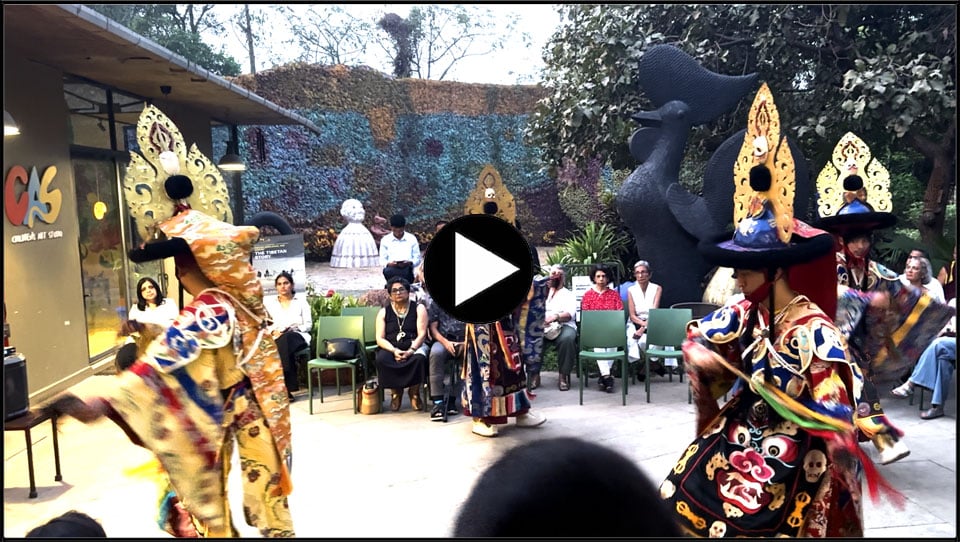
The second event was something truly unforgettable: monks from Tashi Lhunpo Monastery in Bylakuppe performed a traditional Tibetan Buddhist dance ceremony. The mix of traditional Tibetan music played by fellow monks on traditional instruments, accompanying the dancers, was beautifully magical.
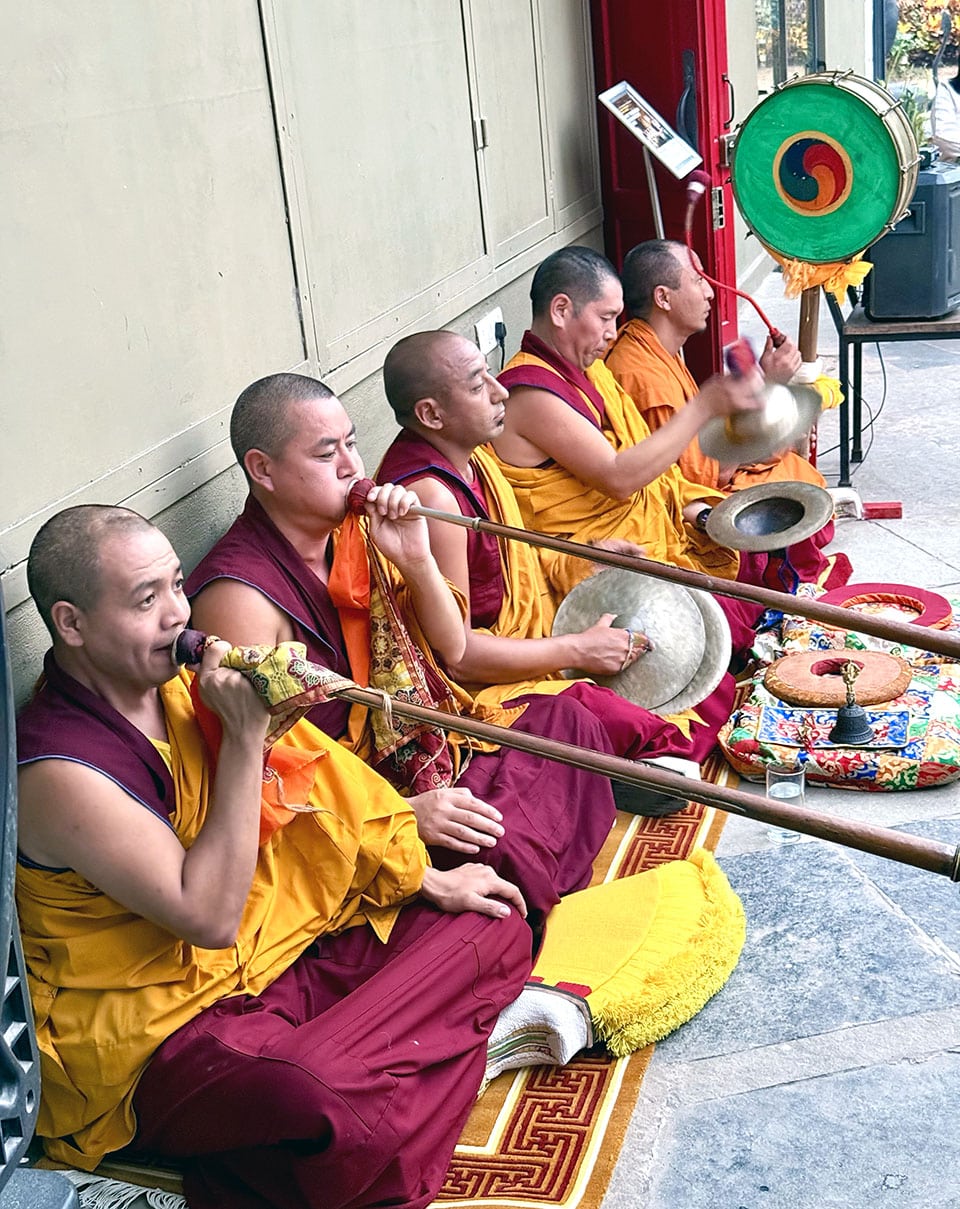
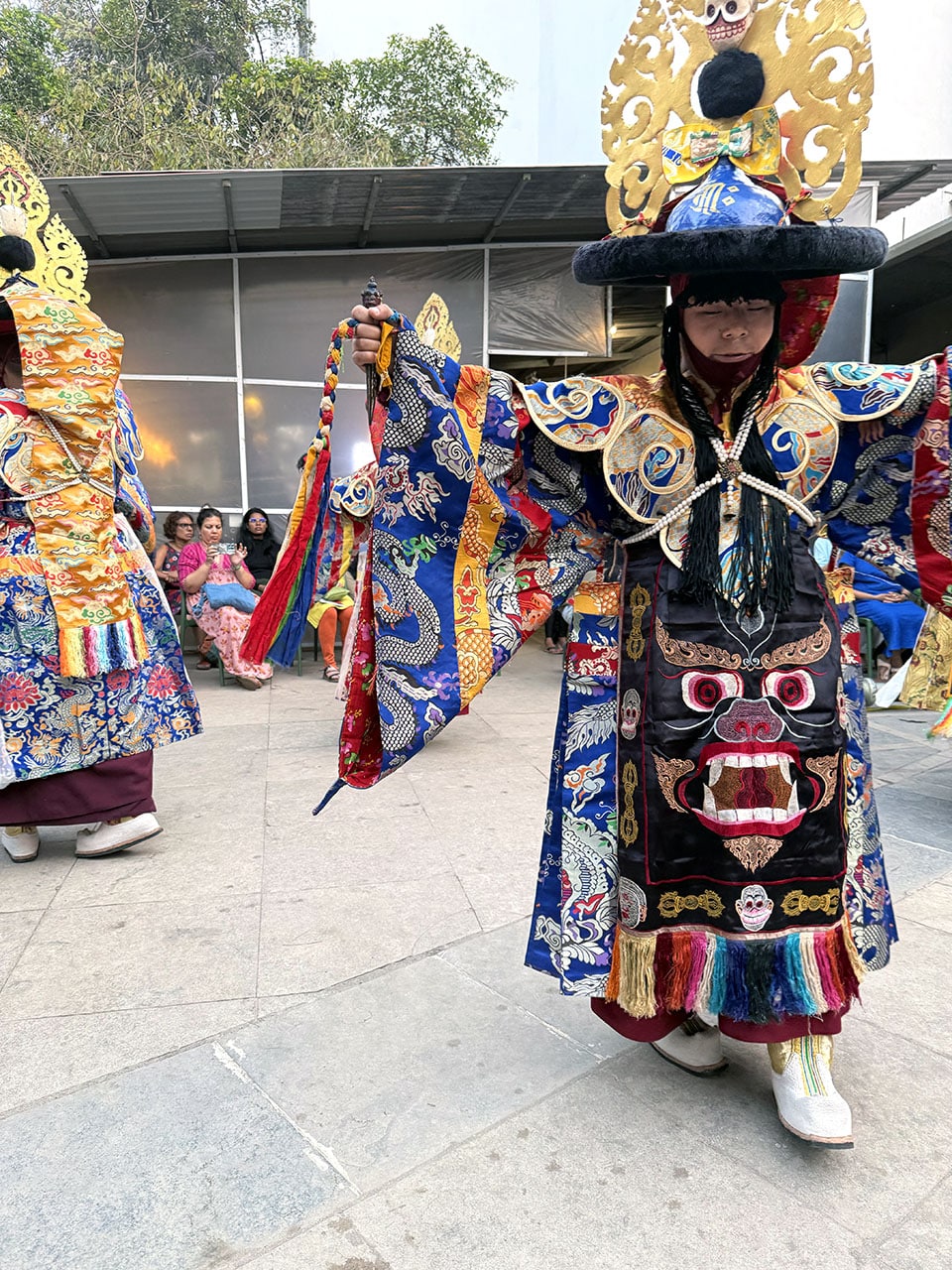
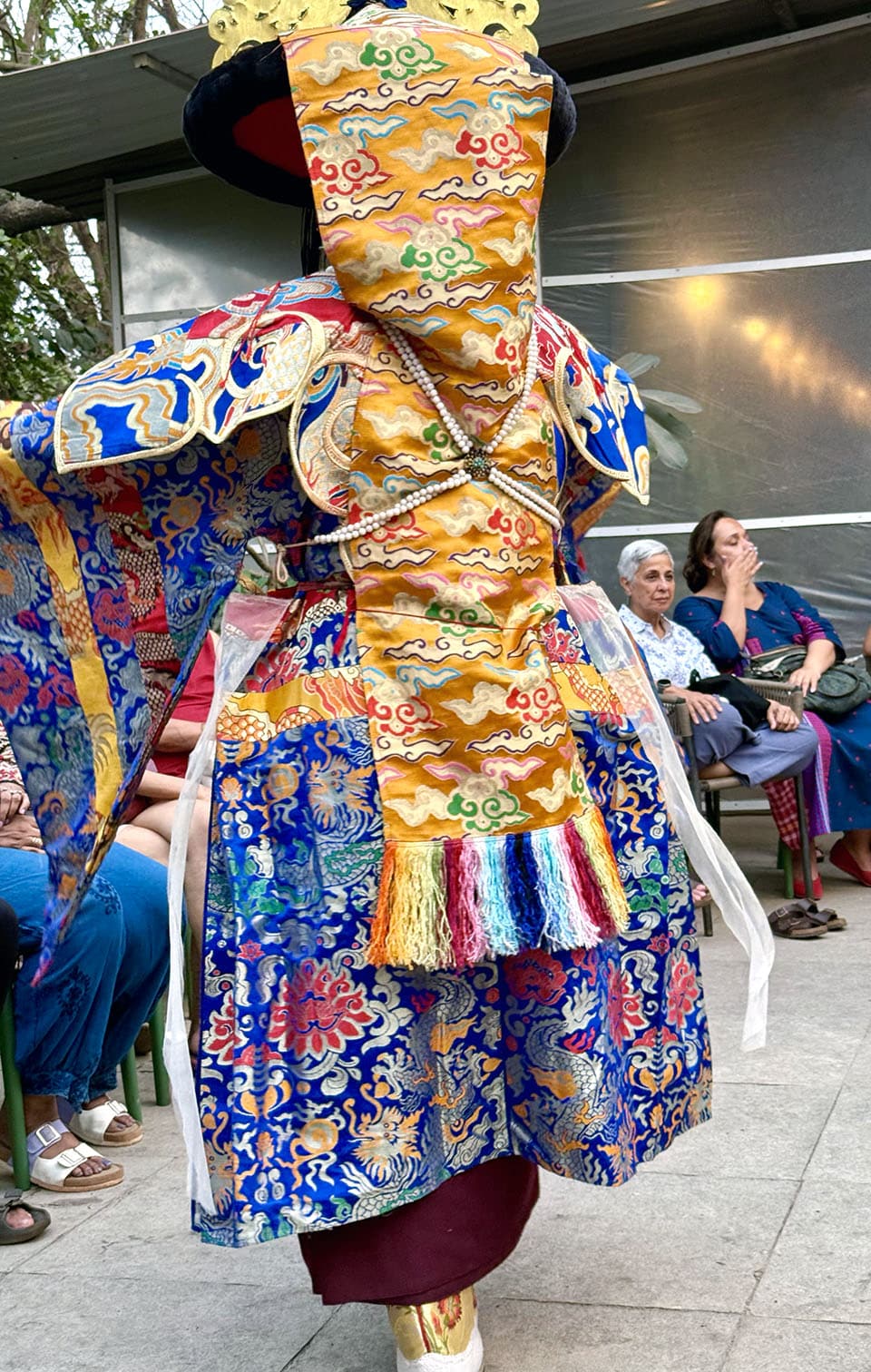
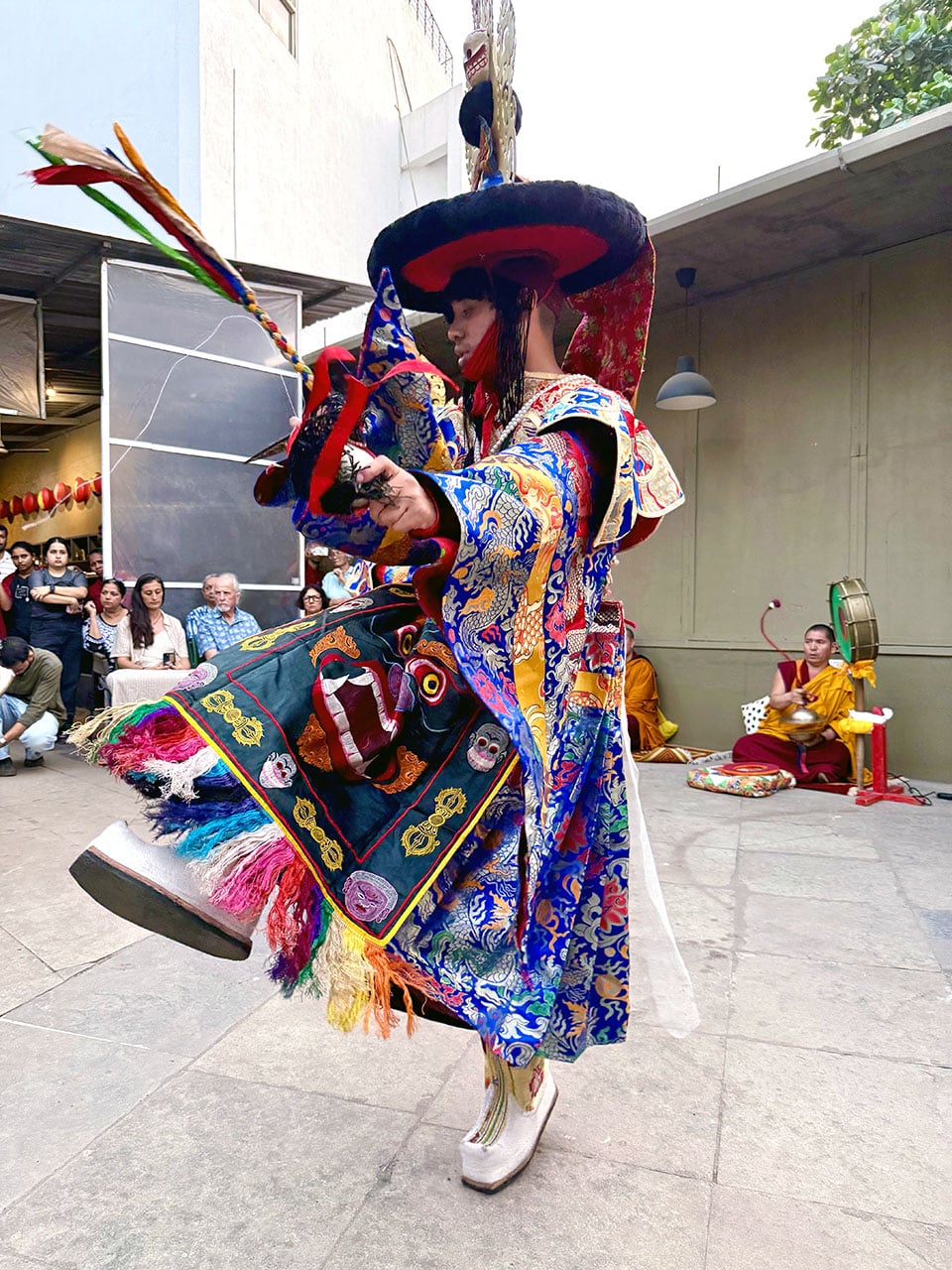
The Shanag, or Black Hat Dance, is a sacred ritual traditionally performed during monastery festivals and important celebrations such as Losar.
Dancers wear striking black hats and richly layered, ornamented robes that signal ritual authority and tantric power, and represent protection against harmful forces and the triumph of wisdom over negativity.
Words really can’t do the dance justice, so we’ll let the photos and videos speak for themselves.
OMG Kokum! Our New Favorite Beverage
After Mitesh picked us up and returned us to Fontainhas, we walked to MOs Cafe—recommended by Heidi’s friend Lauren, who spends part of the year in Goa. The food was fantastic—fresh, healthy, and beautifully presented.
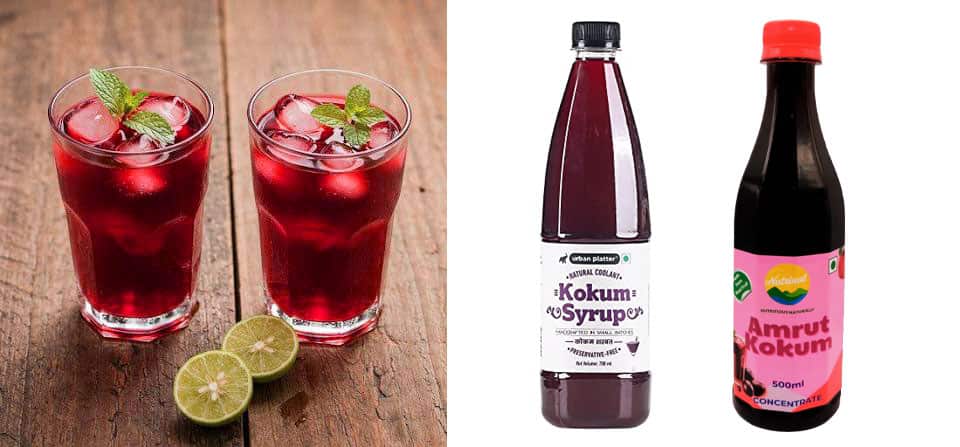
At MOs, we also had our first taste of Kokum, a refreshing, fizzy Goan drink made from kokum syrup and mineral water. Kokum sharbat is traditionally made with tart kokum fruit, sugar, cumin, and black salt and is popular throughout Goa as a cooling drink in the tropical heat. Drinking a cumin-flavored beverage was surprisingly refreshing.
Kokum quickly became a new favorite. We brought some Kokum syrup back with us, but it is now gone. Thankfully, our friend Jai from Athma Tours sent us a couple of bottles, and we just found an online source for Kokum syrup in the US. Give it a try, it might just be your new favorite beverage too!
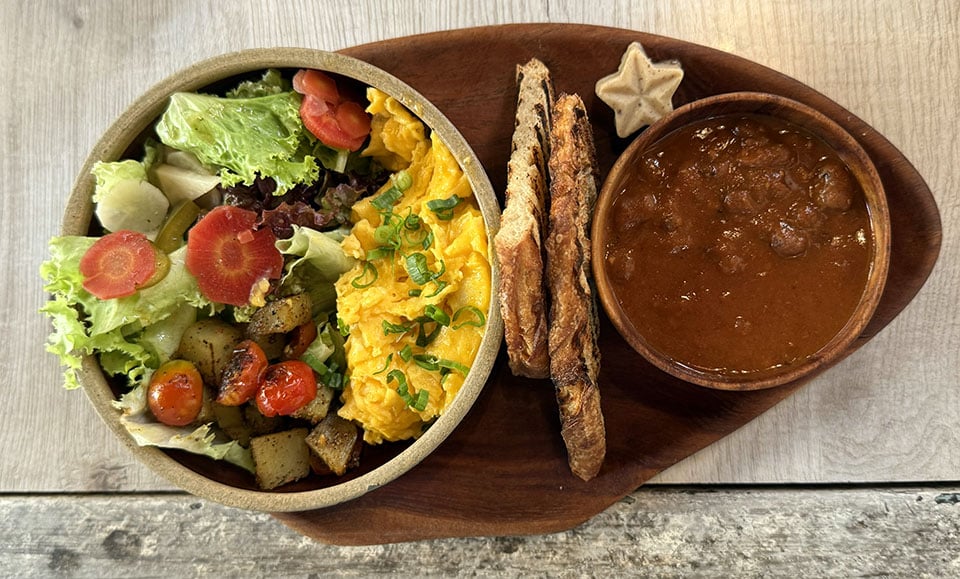
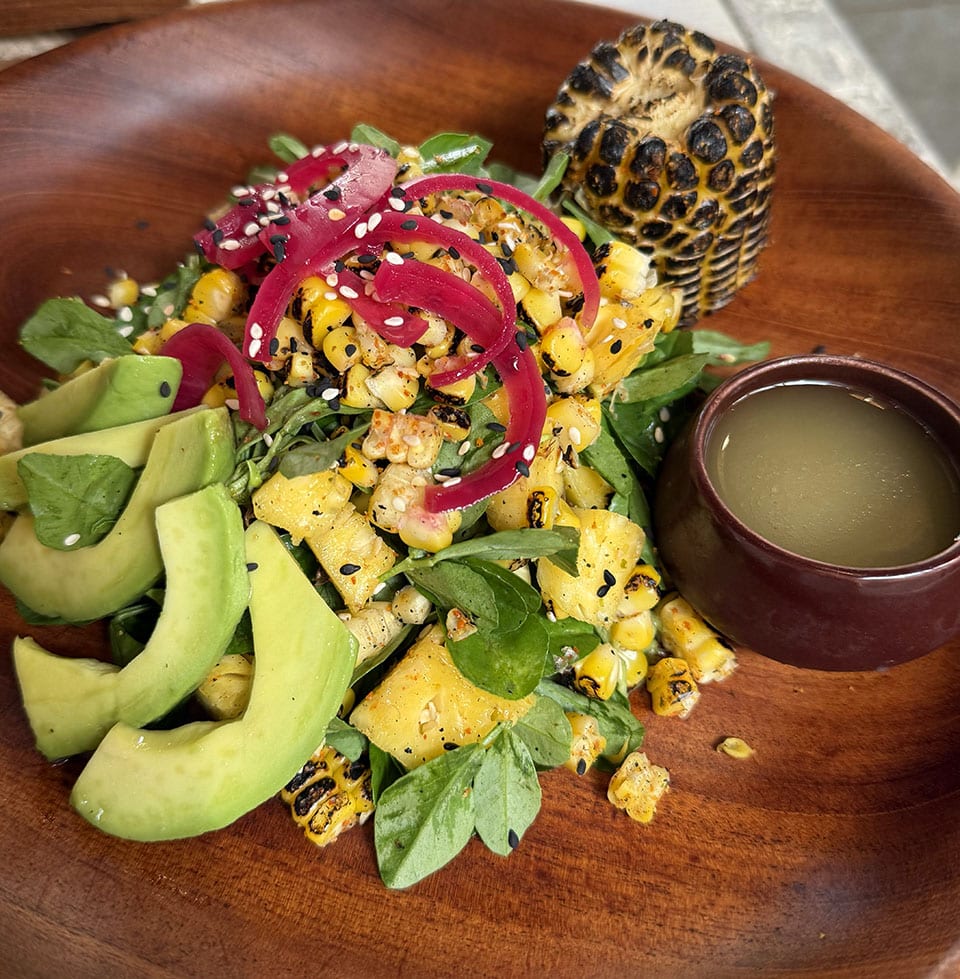
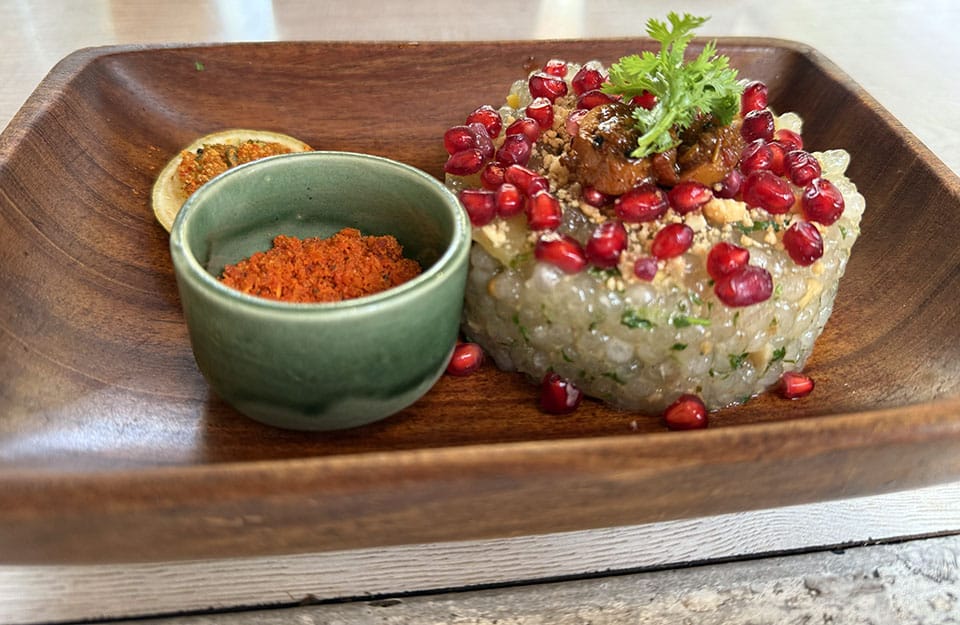
We ended up eating at MOs for most of the rest of our stay. It was so good—and beautifully presented!
Make It Happen Campal Walking Tour
The next day, we signed up for a second Make It Happen tour, this time exploring another colonial-era neighborhood called Campal.
The meeting spot was too far to walk, so Mitesh gave us a taxi ride up and over the hill, right past the beautiful Hanuman Temple. We are kind of kicking ourselves for not planning time to actually visit it.
Kala Academy & Campal Heritage District
We met our new guide, Trancy, at Kala Academy, one of Panaji’s most important cultural landmarks.
Kala Academy was designed by celebrated Indian architect Charles Correa and built between 1973 and 1983. Created as a center for Goan music, dance, and theater, the building is considered a masterpiece of modern Indian architecture, blending contemporary design with Goa’s tropical climate and riverside setting.
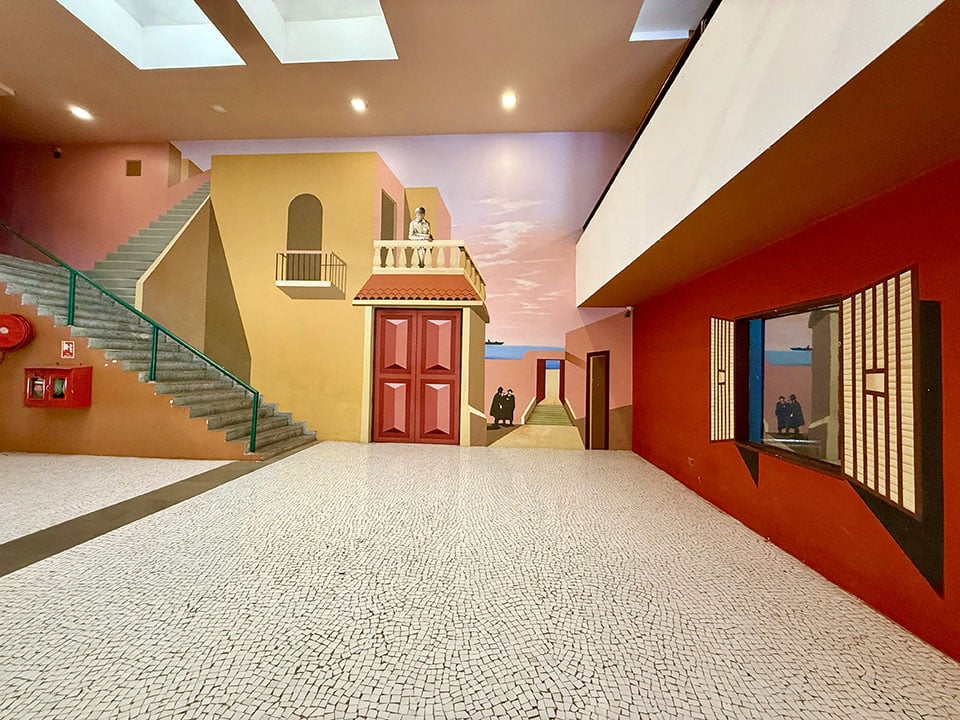
The academy—one of Panaji’s major cultural and artistic hubs—also features murals, by famed Goan artist Mario Miranda, like this one above.
Campal itself is one of Panaji’s loveliest heritage neighborhoods, known for quiet tree-lined streets, elegant Indo-Portuguese homes, and peaceful riverfront promenades. Originally a marshy area, Campal became one of Goa’s first formally planned urban neighborhoods when the Portuguese developed it in the early 1800s using a structured grid layout to help expand Panjim into the state capital.
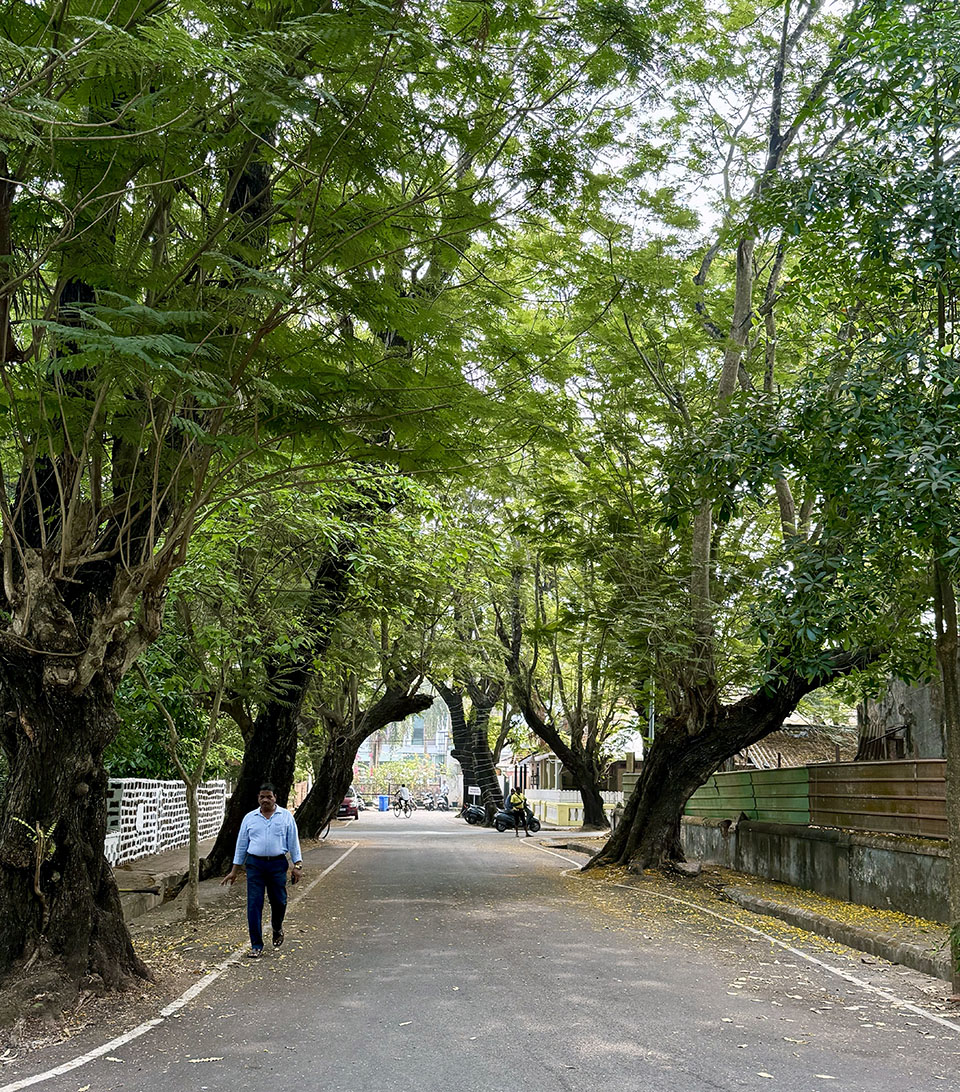
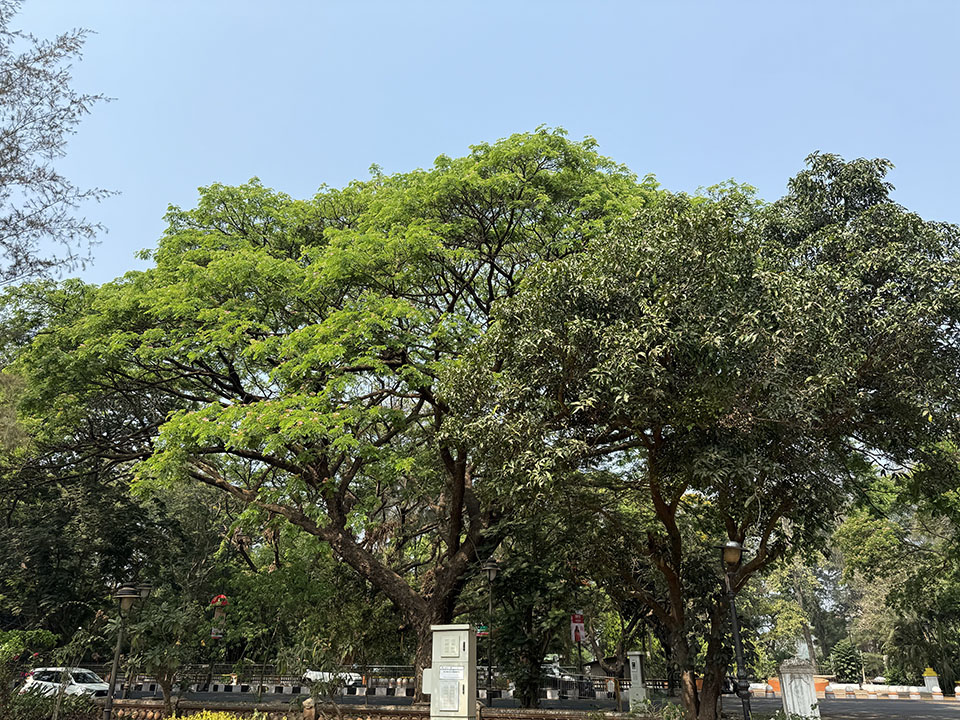
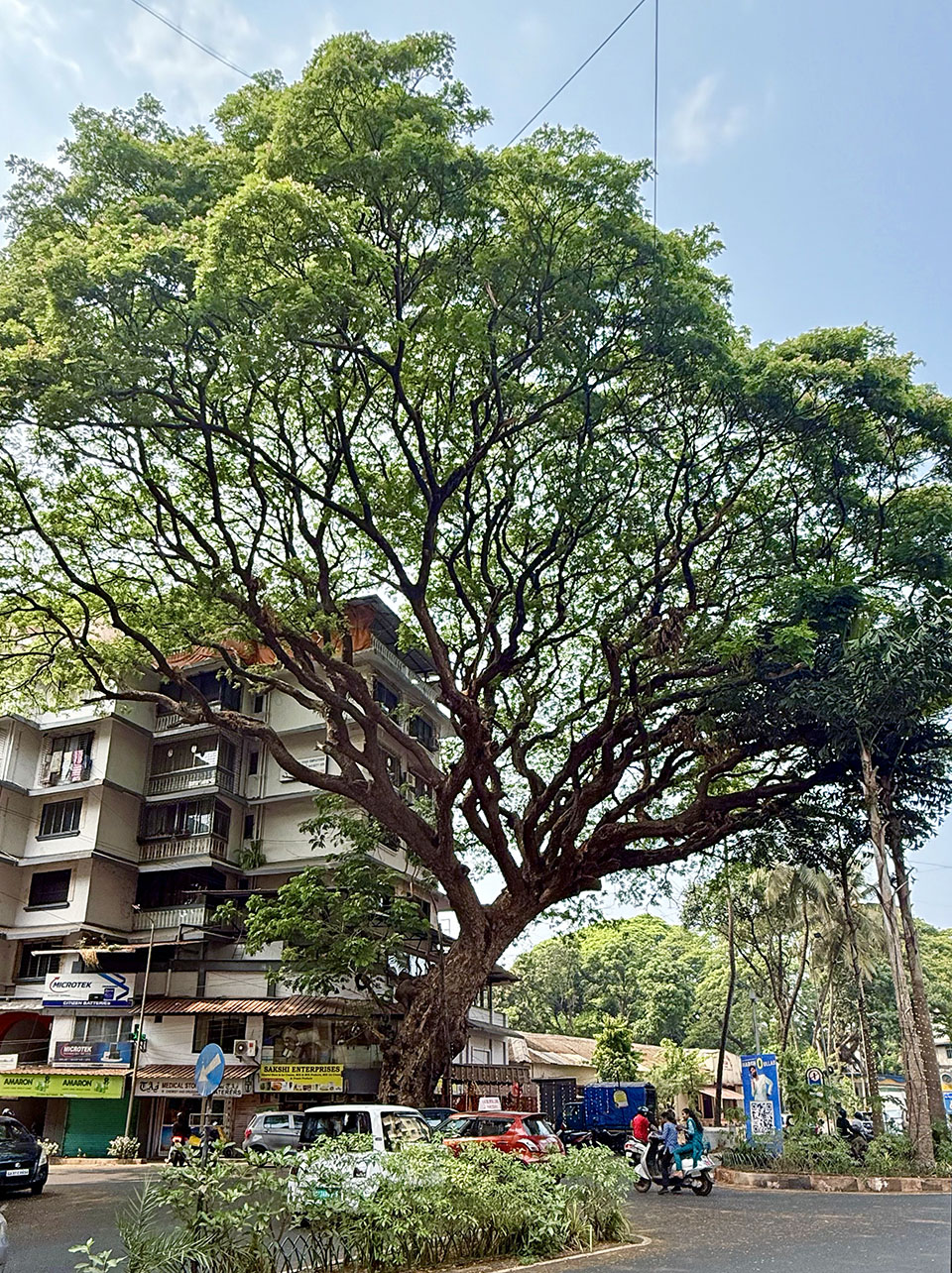
Today, the area remains filled with century-old homes and quiet streets offering a glimpse into Goa’s layered colonial and multicultural past. And we were surprised to see so many trees that looked very similar to our beloved Mexican Huanacaxtle (or Parota) trees. In India, they are Siris trees. As it turns out, they are both members of the Mimosa family. Both trees grow massive trunks and large, umbrella-shaped crowns that spread incredibly wide, offering plenty of shade. They also share the same feathery, fern-like, double leaves and similar flowers and seed pods, too. Halfway around the world—who knew?!
Ant Art?! One of the Strangest Things We Saw in India
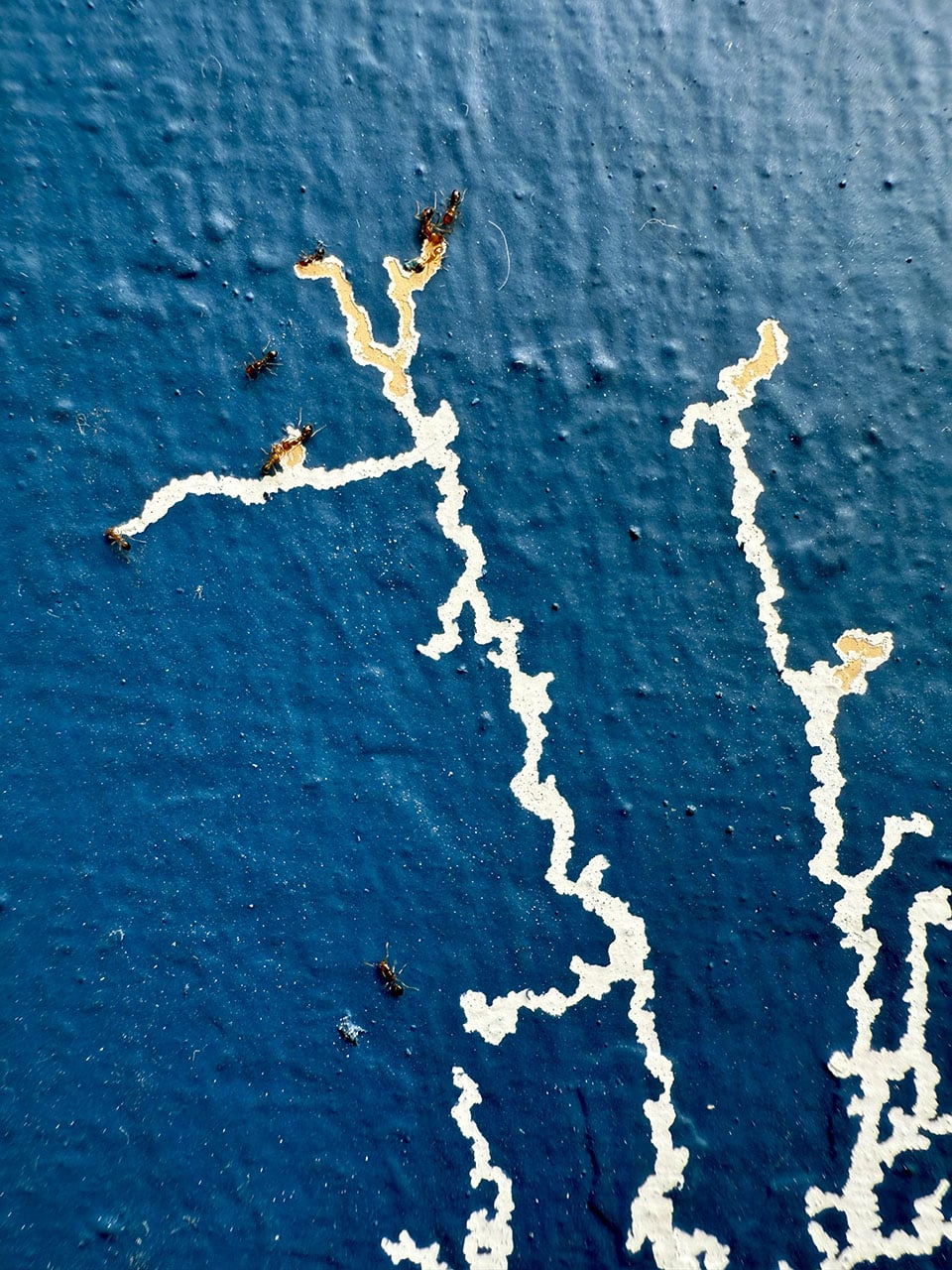
One of the strangest and most fascinating things we saw anywhere in India was a bizarre pattern covering the paint on this blue house.
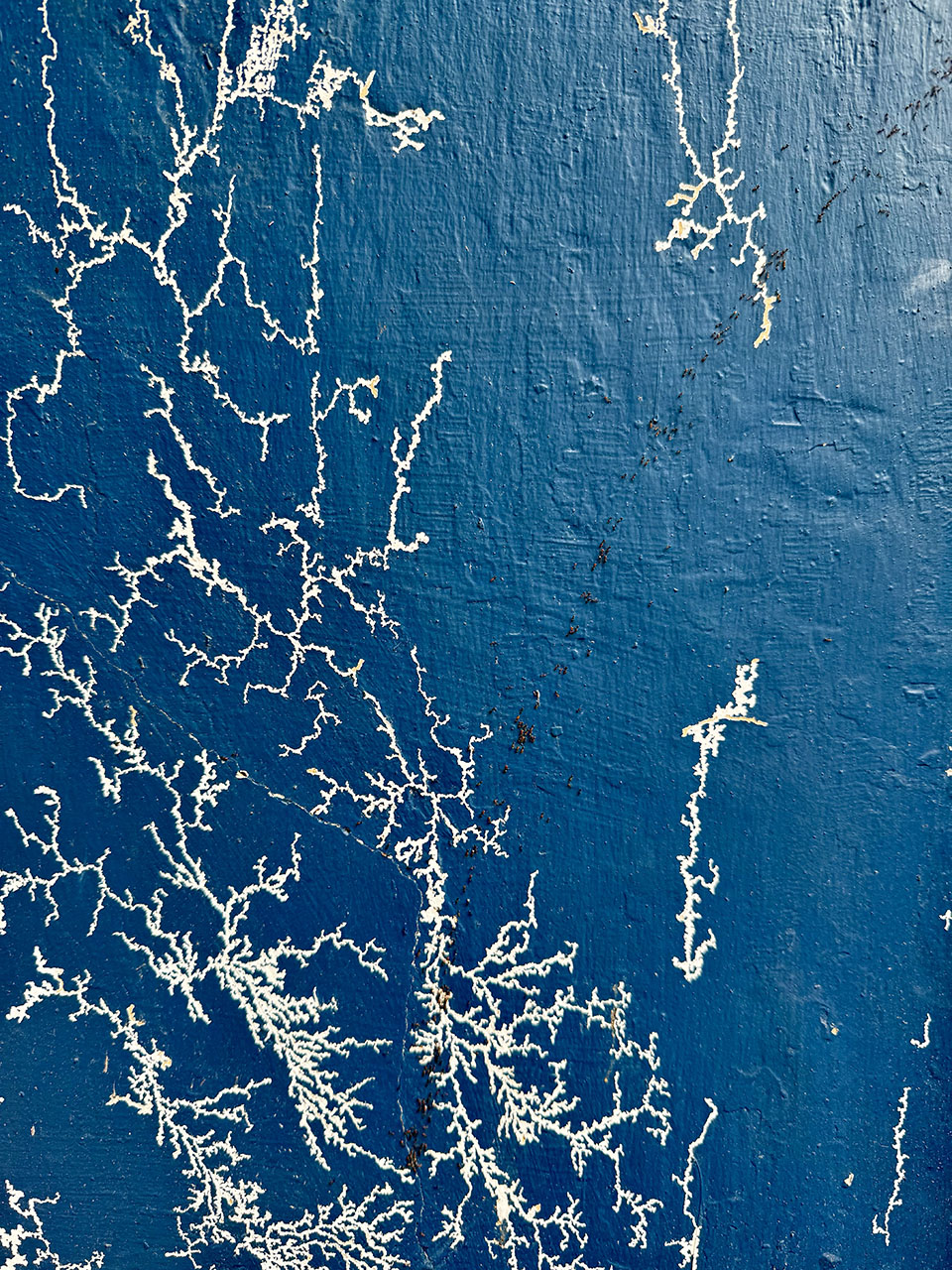
From a distance, we thought it was some sort of graffiti. At a closer glance, it looked like delicate undersea fan coral. Trancy asked us what we thought caused the design.
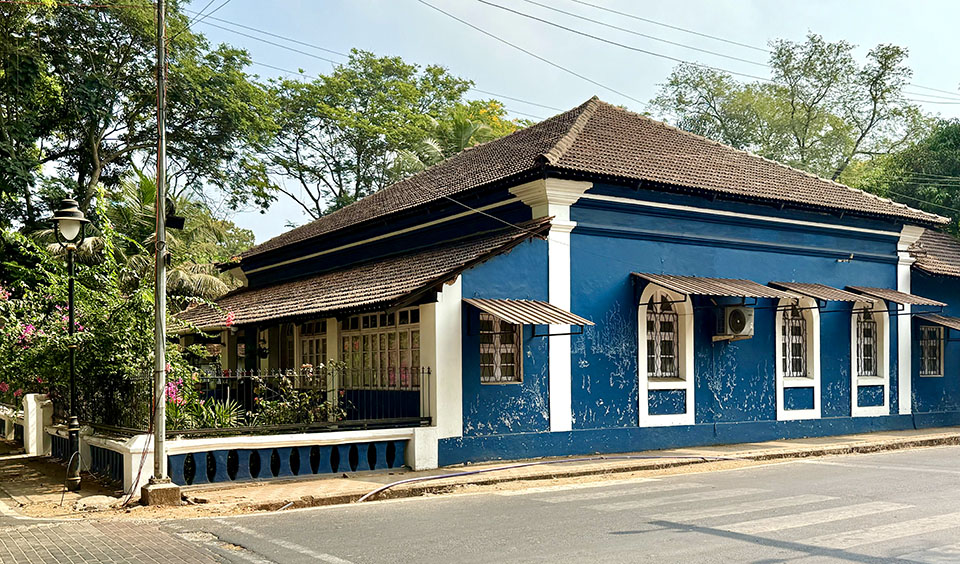
We had no idea…
Turns out it was ANTS! Ants had eaten their way through the paint, leaving behind intricate organic trails across the walls. It was fascinating, and you can see them if you look closely. Naturally, it also made us wonder exactly what nutrients—or toxins—the ants were finding in the paint.
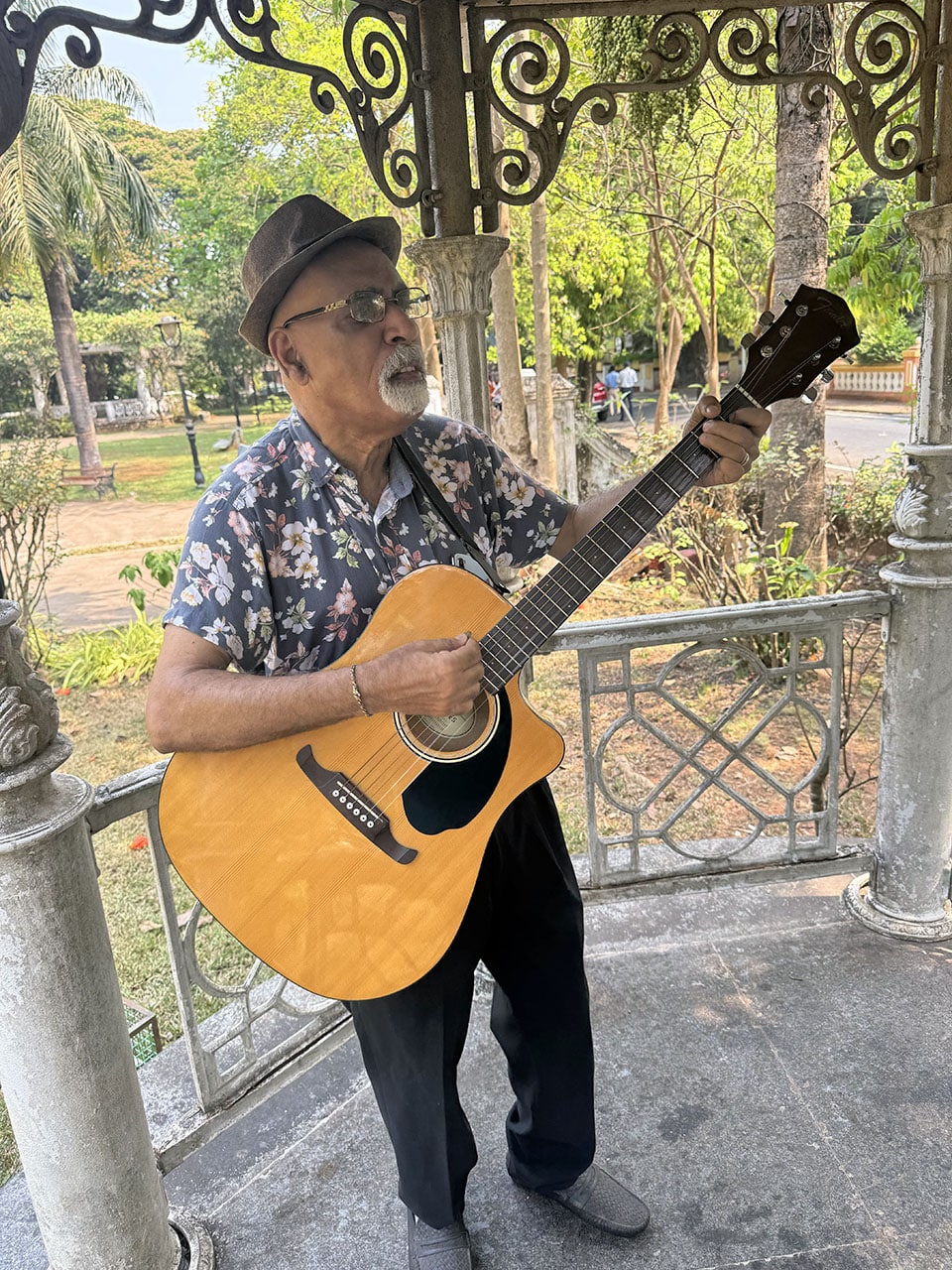
Later, we stopped at a small park with a gazebo, where we were serenaded by yet another guitar player named Francisco. LOL, are all Goan guitar players named Francisco?! He spoke several languages and asked what language and song we’d like to hear. We requested Guantanamera, which he sang beautifully in Spanish, as well as a few traditional Goan songs in Portugese.
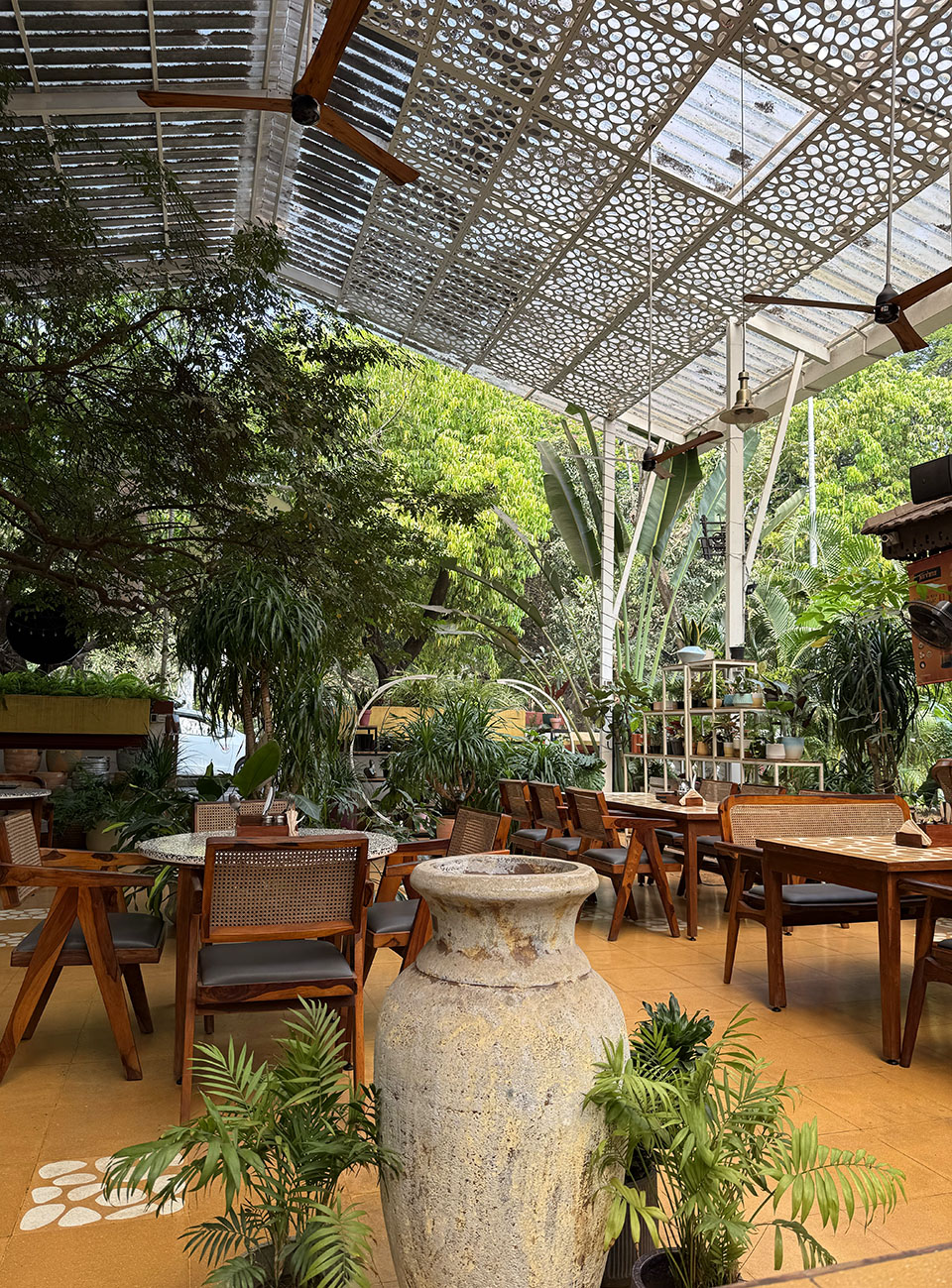
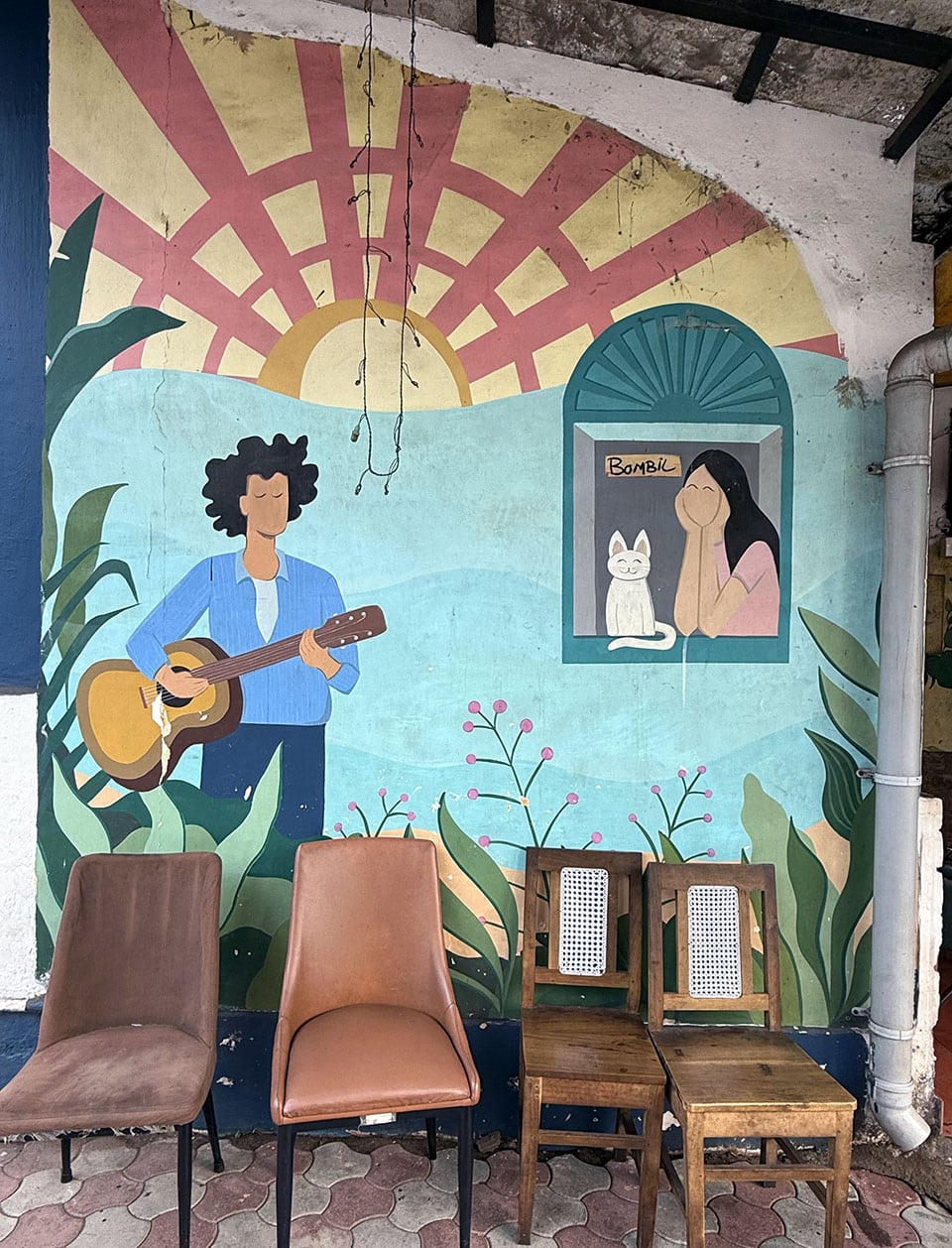
From there, we stopped for some refreshing Kokum at a cute cafe, and then our tour continued through Campal Gardens toward a waterfront pedestrian bridge called Yog Setu.
Yog Setu Bridge & Goa’s Wellness Culture
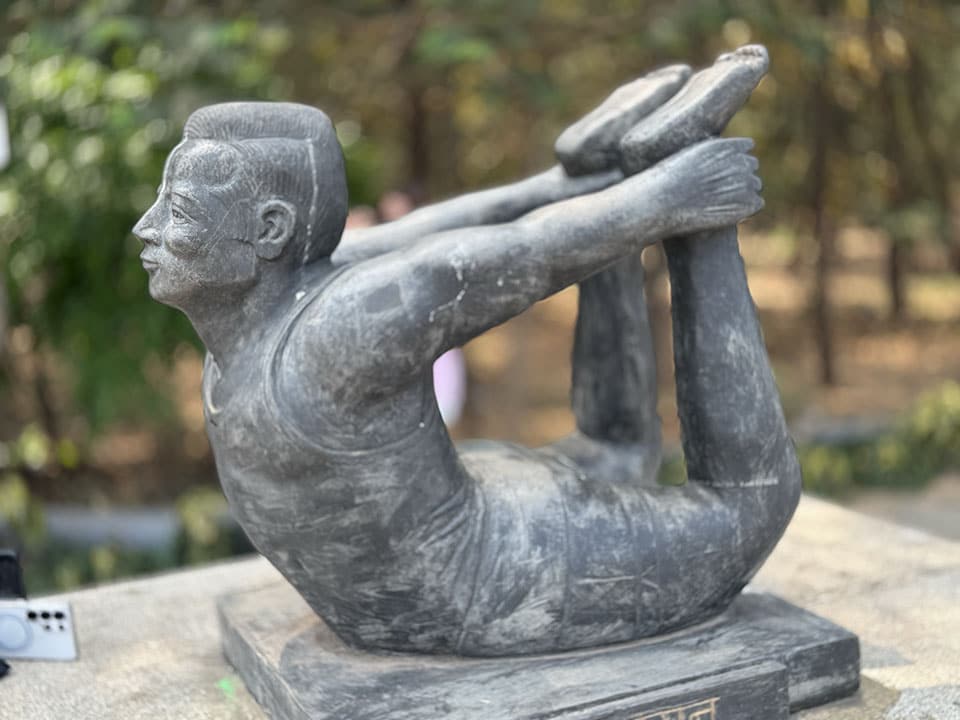
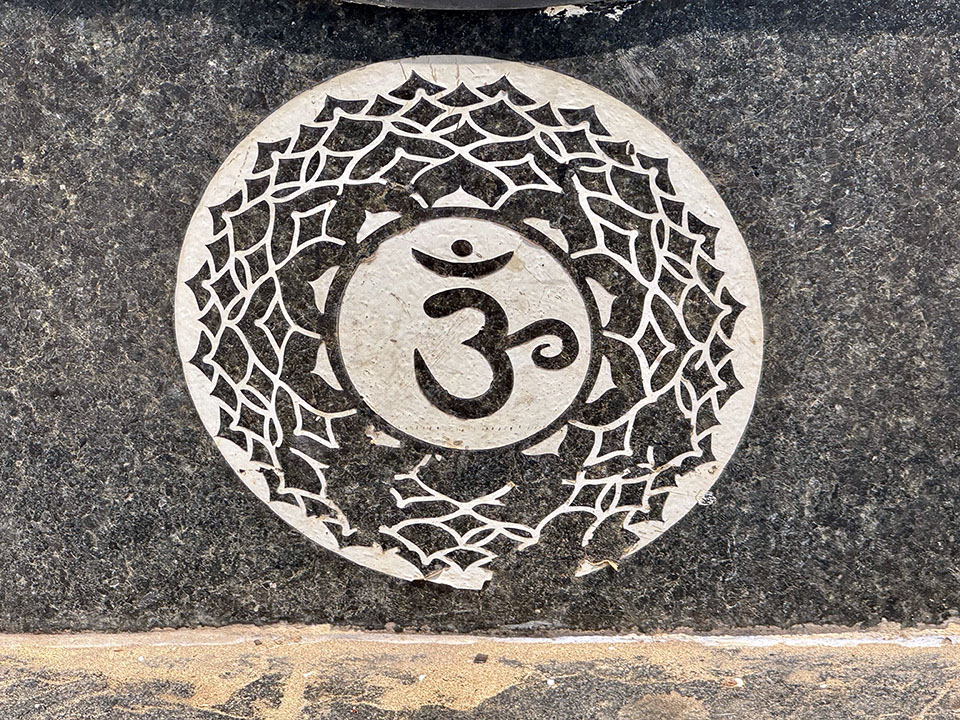
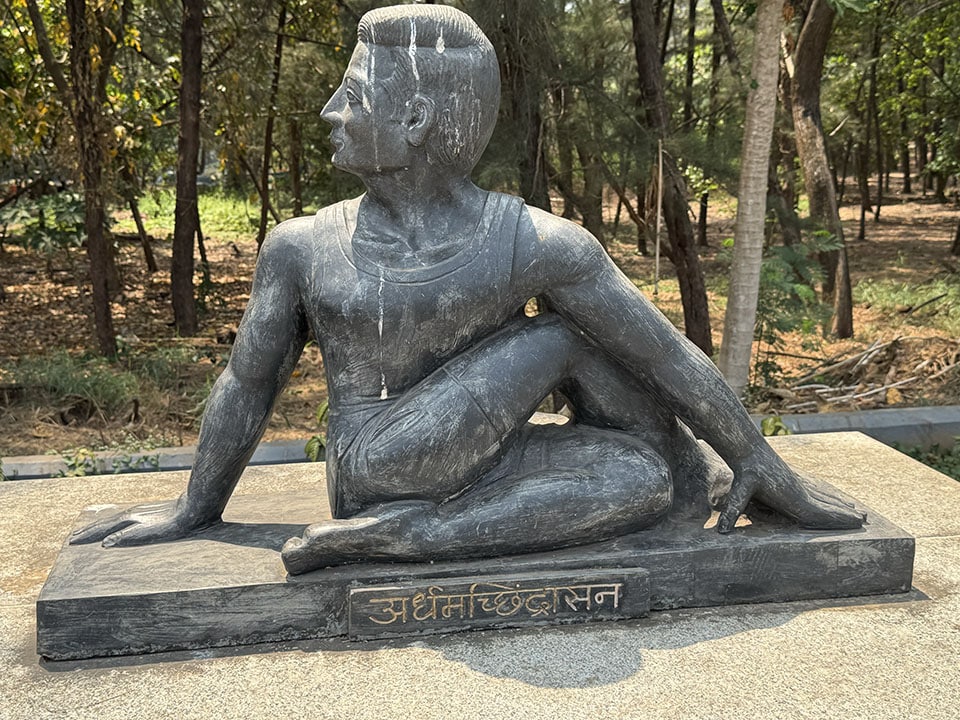
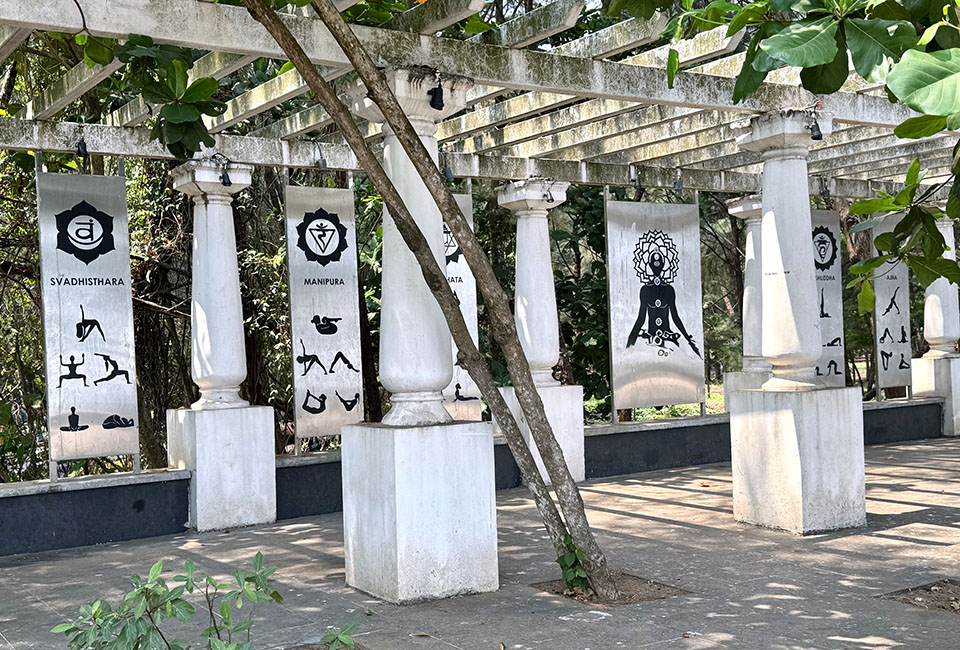
Yog Setu is a wonderful example of how public spaces in India are increasingly being designed around wellness and local identity. Built as part of Goa’s waterfront promenade project, the bridge incorporates yoga-themed sculptures and artistic elements celebrating both movement and meditation.
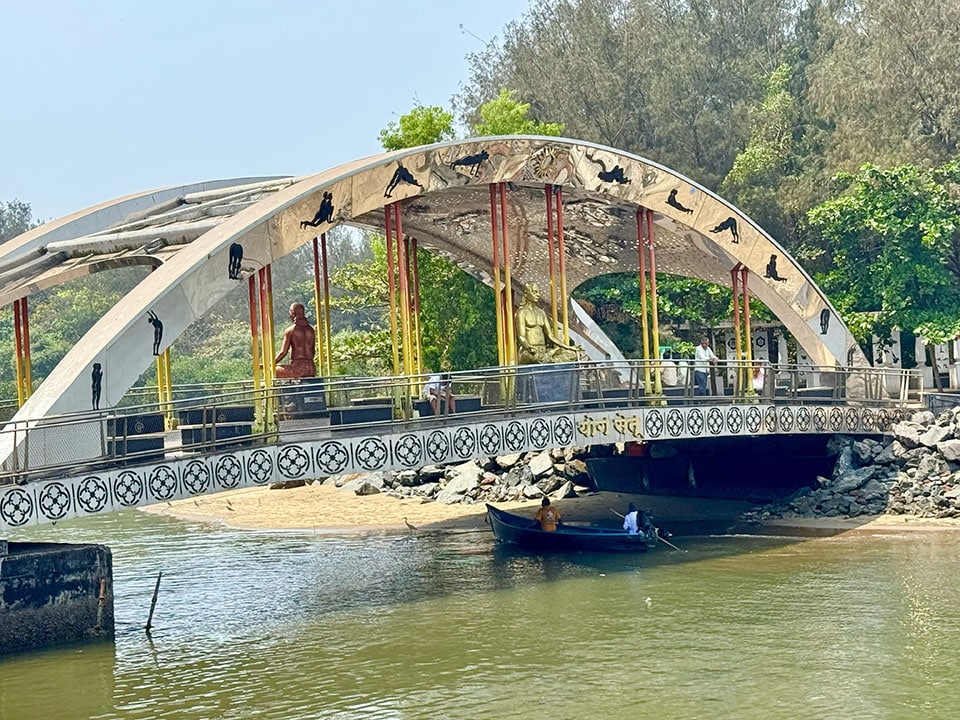
Spanning part of the Santa Inez creek, it was designed not simply as a bridge to cross, but as a place to walk slowly, pause, and enjoy the riverside surroundings. We loved seeing so much emphasis on yoga asanas (poses) and wellness integrated into a public space.
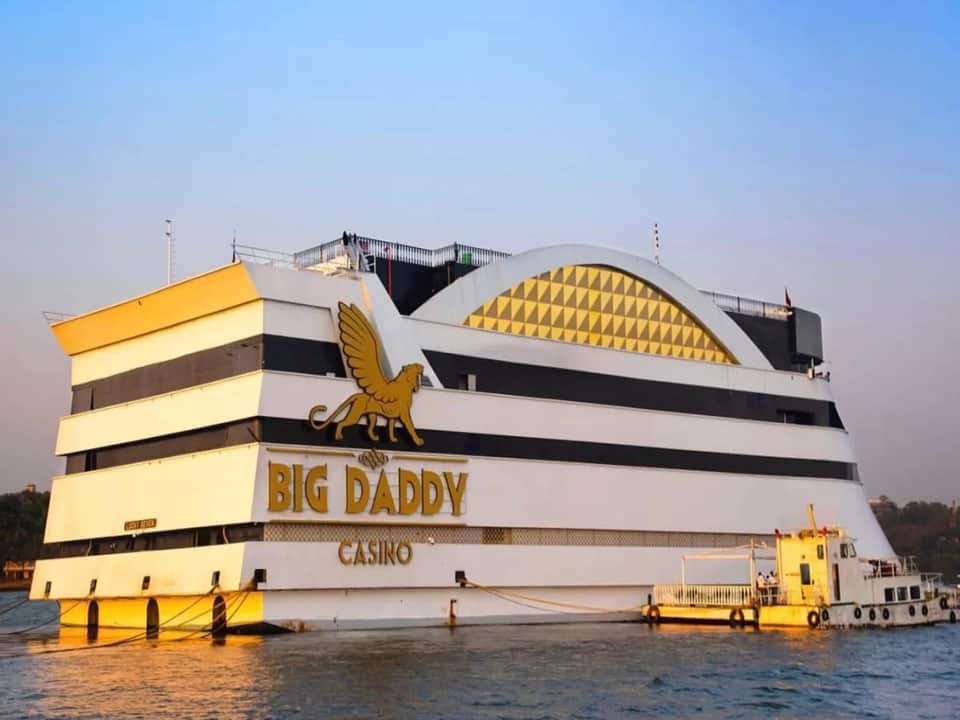
Looking the other direction from the bridge, you see myriad old retired cruise ships repurposed as casinos. The riverbanks along Panaji are home to casinos anchored or docked along the shore—a gambler’s haven, and apparently, people travel here from all over India just to gamble. Seems a shame to sit inside gambling when there’s so much else to see and do in Goa—but that’s just us!
After crossing the bridge, we continued along the promenade to the large statue of Lord Parashuram overlooking the waterfront.
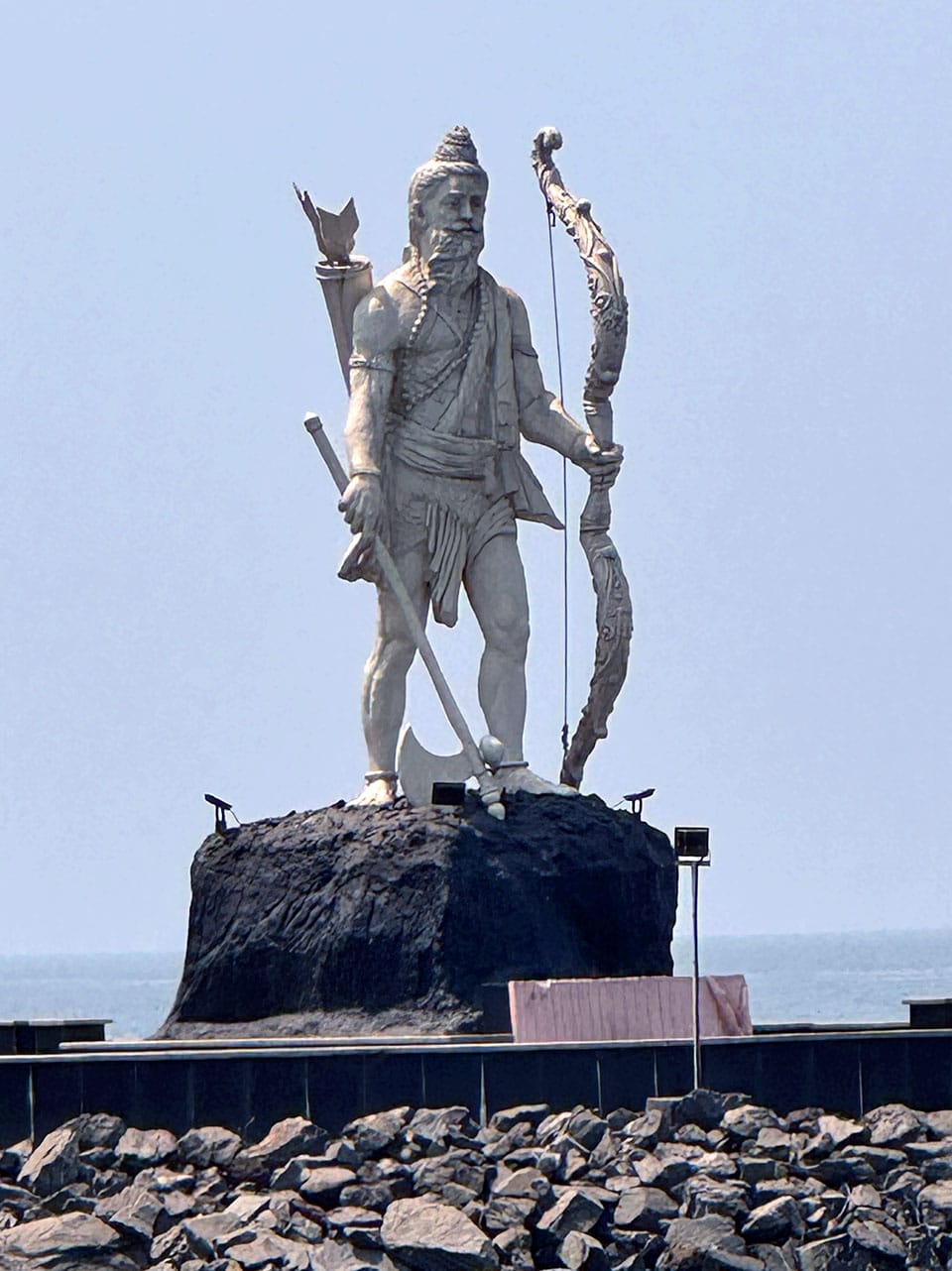
The statue connects one of Goa’s modern public spaces with one of its oldest origin legends. According to Hindu mythology, Parashurama—the warrior-sage and sixth incarnation of Vishnu—shot an arrow into the sea, causing the waters to recede and revealing the land of Goa itself.
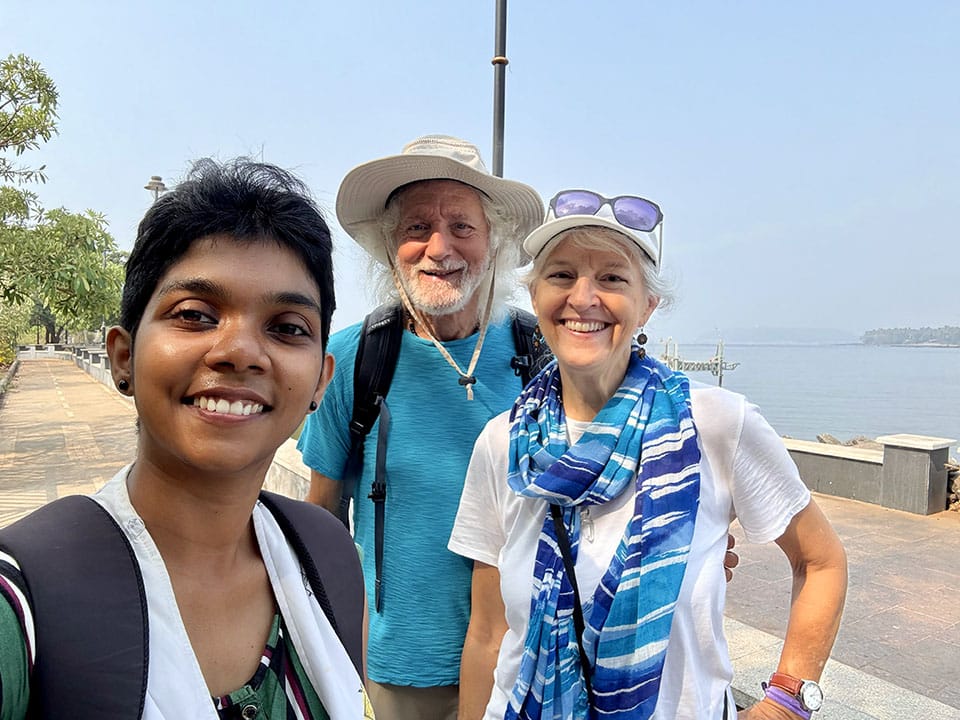
Like the legend, the statue is larger than life. Thanks for a great tour, Trancy, and Make it Happen!
Exploring Panaji on Our Own
That afternoon (after lunch at MOs!), we did our own walking tour around other parts of Panaji, looking for an ATM (we forgot to exchange more dollars for rupees at our last hotel in Kochi—big mistake), an Ayurvedic apothecary, and some souvenir shopping.
The ATM search quickly turned into a goose chase, but we did stumble across some wonderful markets, street vendors, and interesting little shops along the way.
The nearby municipal market was packed with produce vendors and trinket stalls, where we stocked up on colorful Indian glass bangles as gifts. We also passed so many interesting shops along the way: small veggie stalls, a “Maharaja” doorman at a restaurant, makeshift bicycle and scooter repair shops on the sidewalk, and photo ops everywhere.
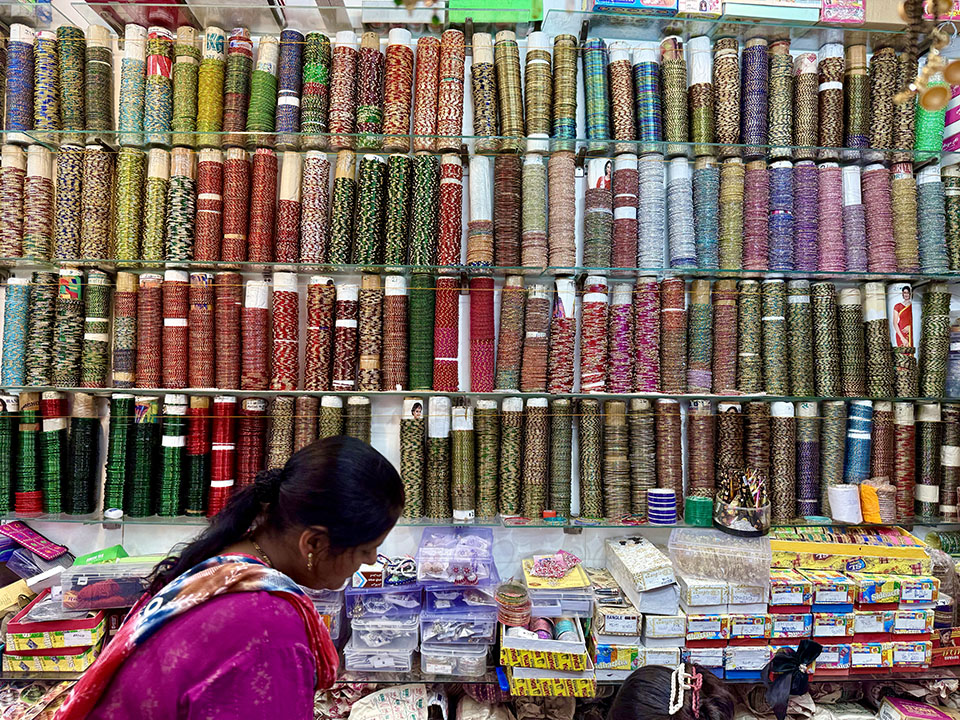
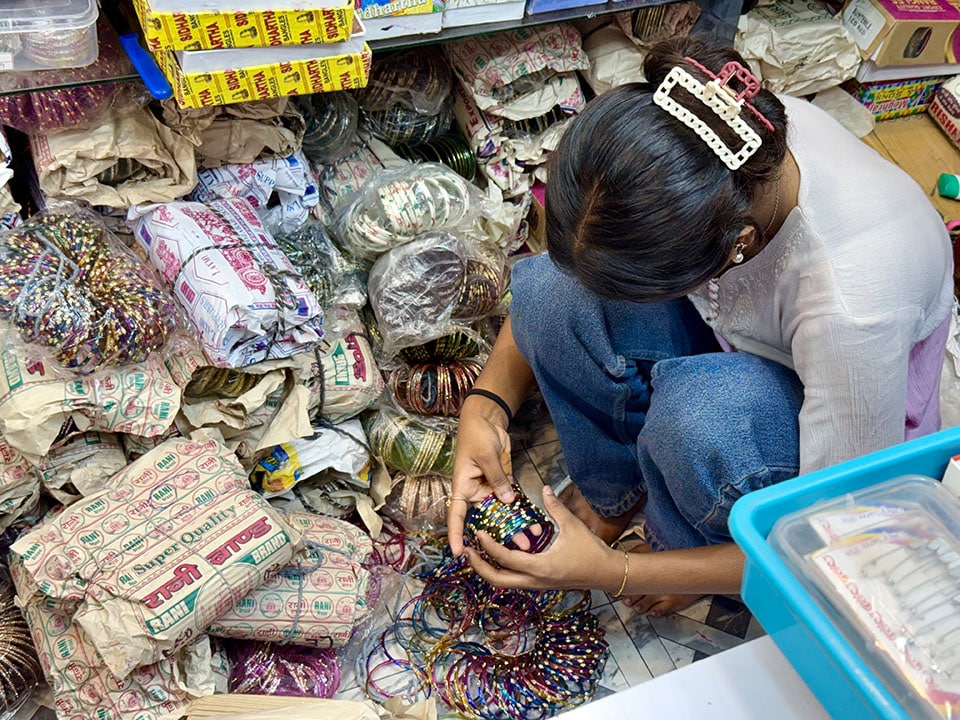
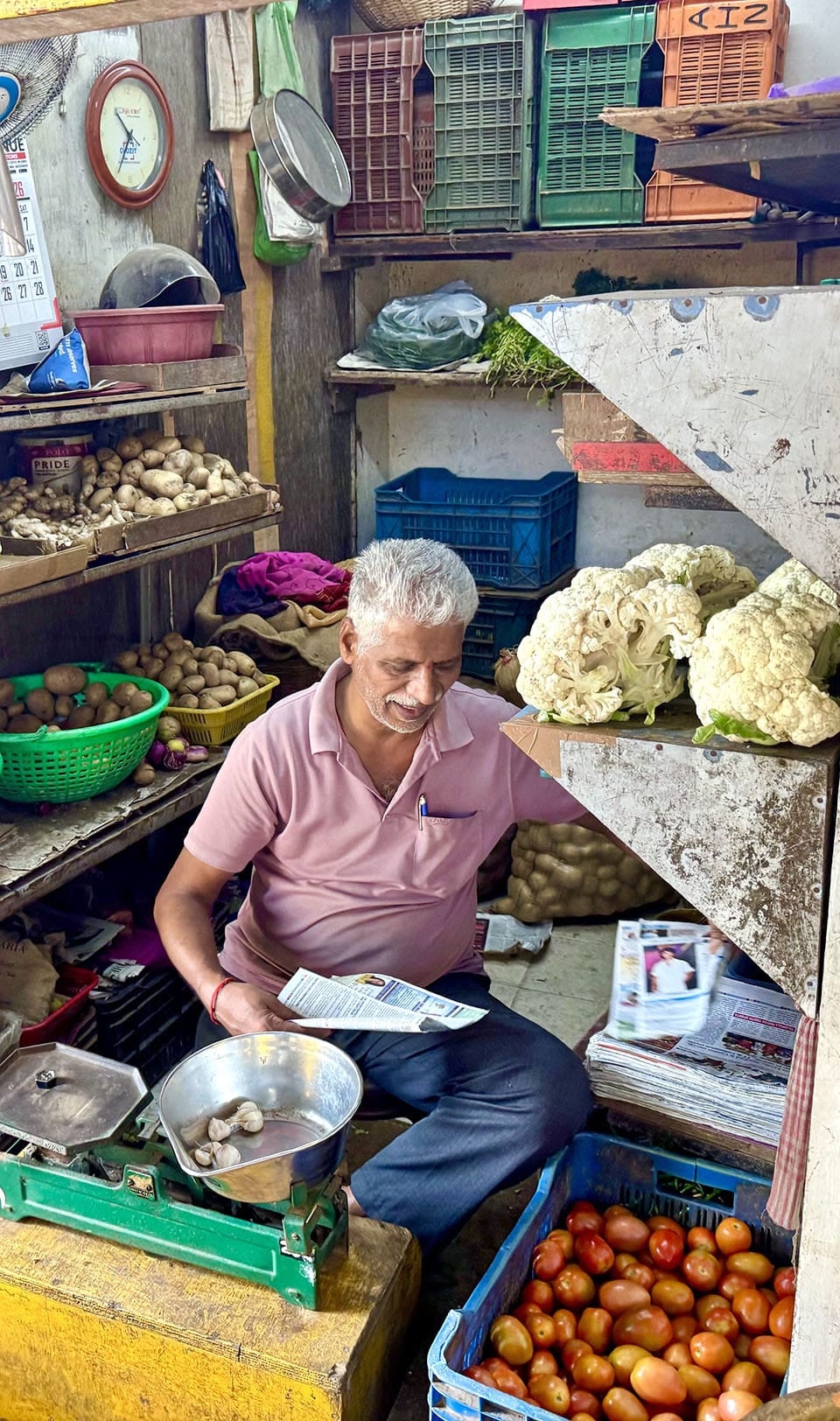
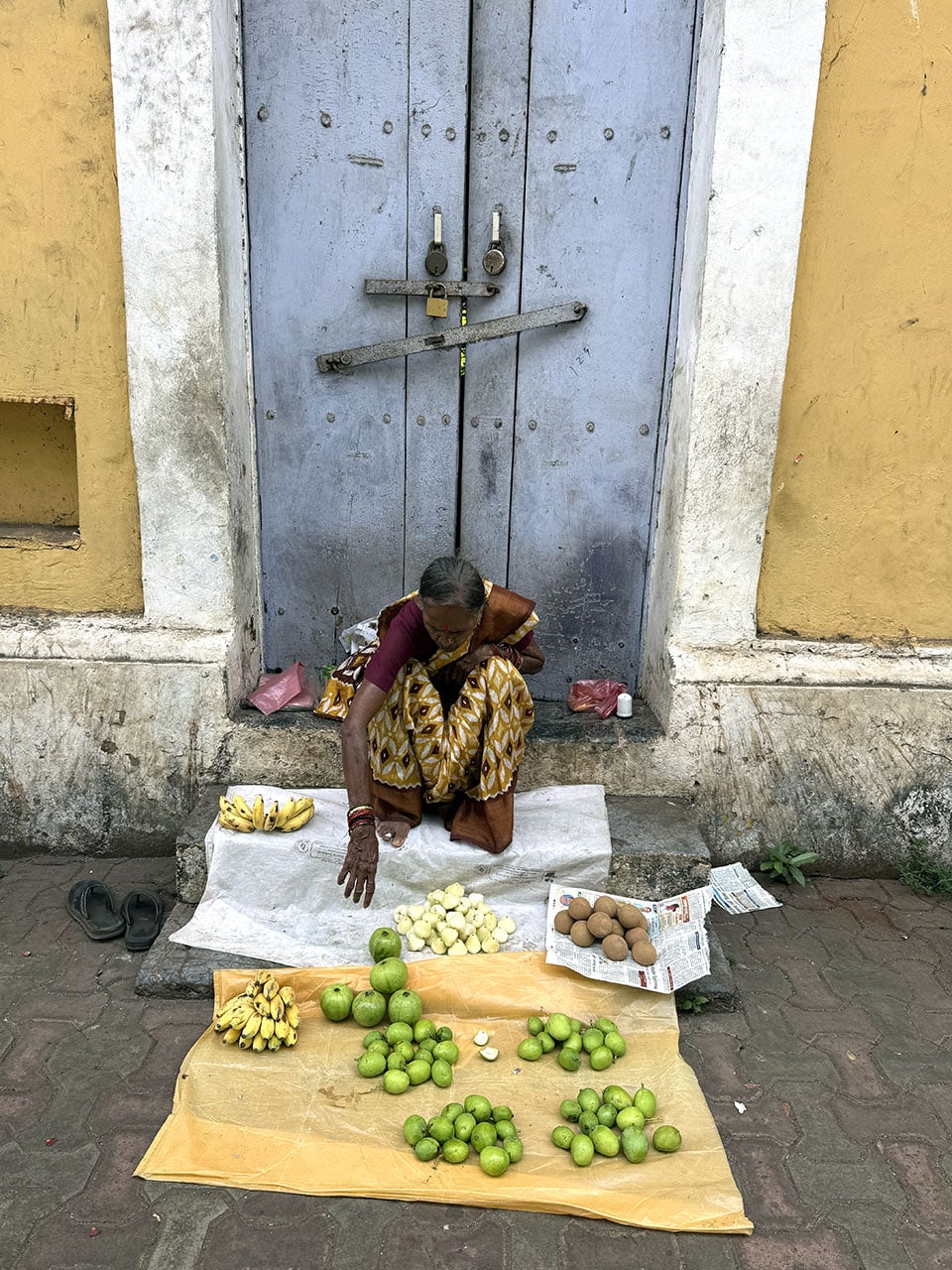
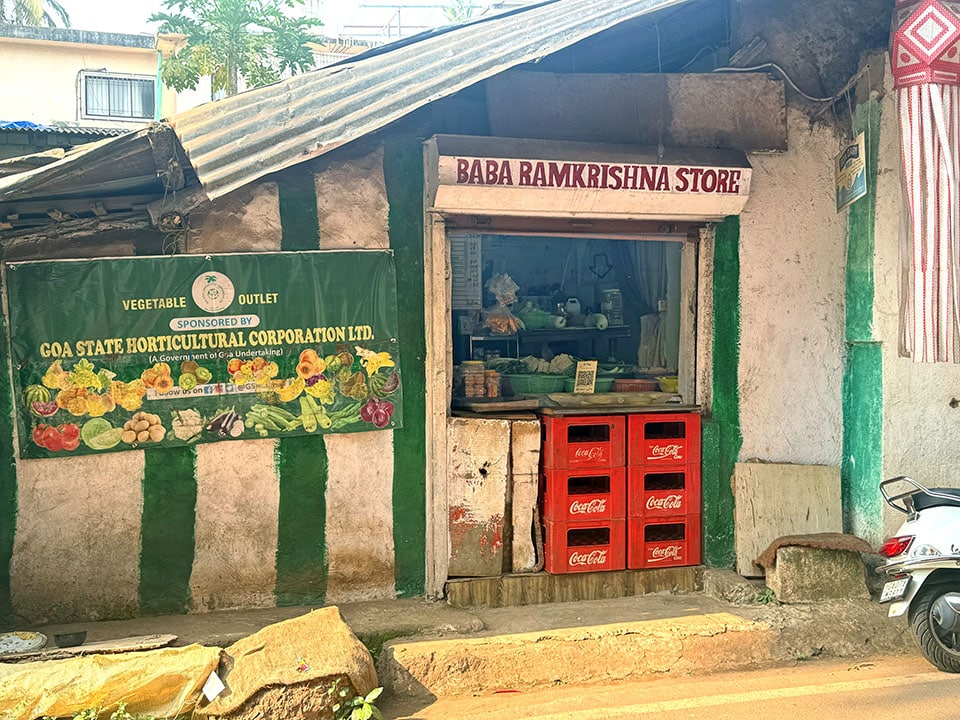
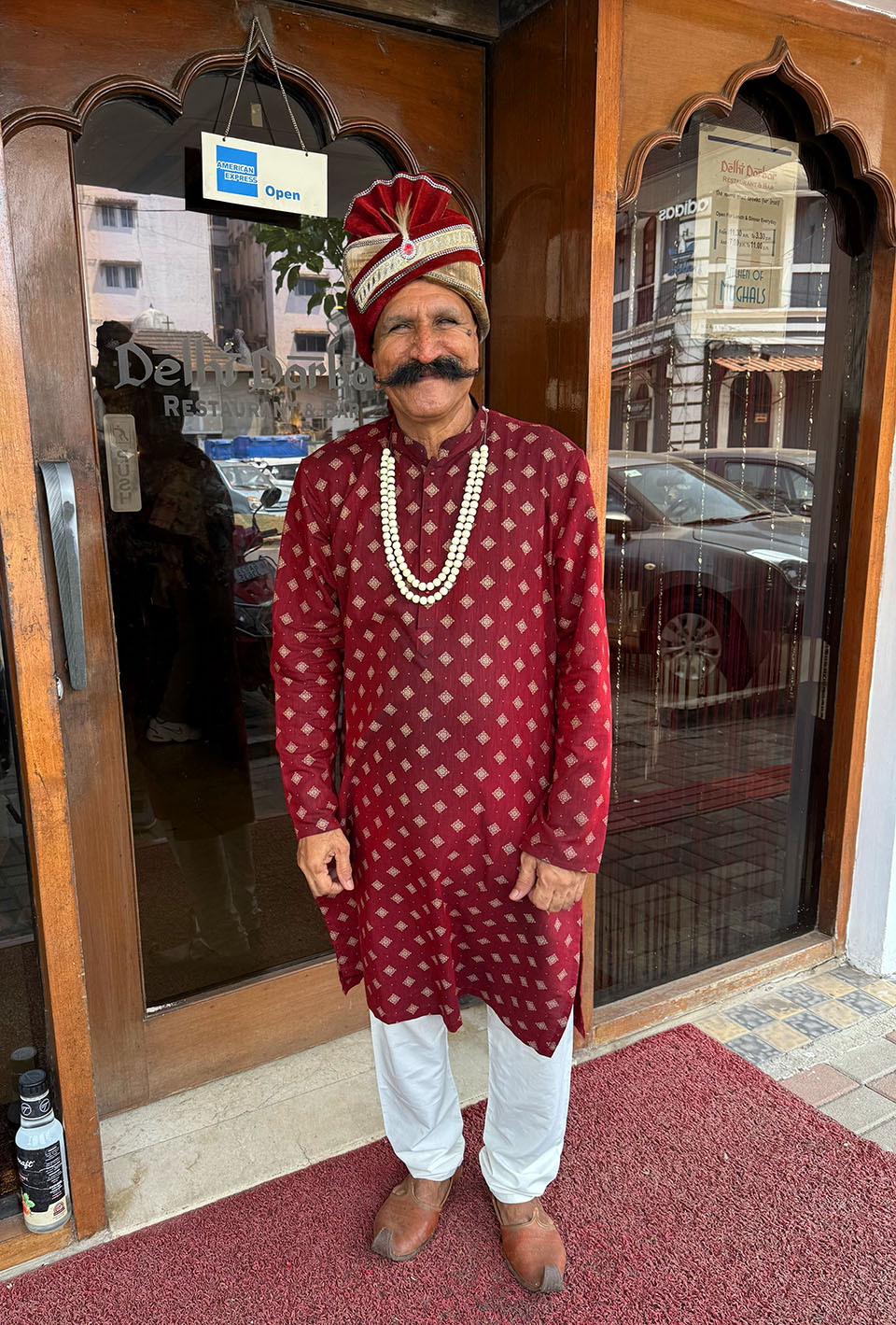
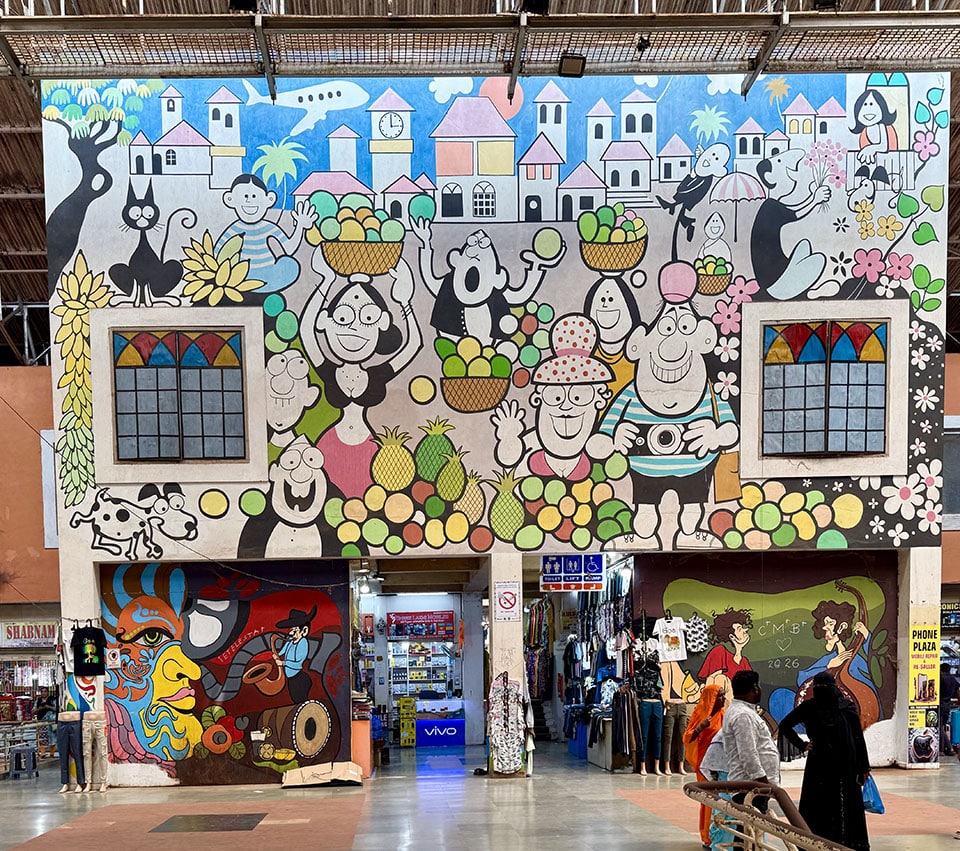
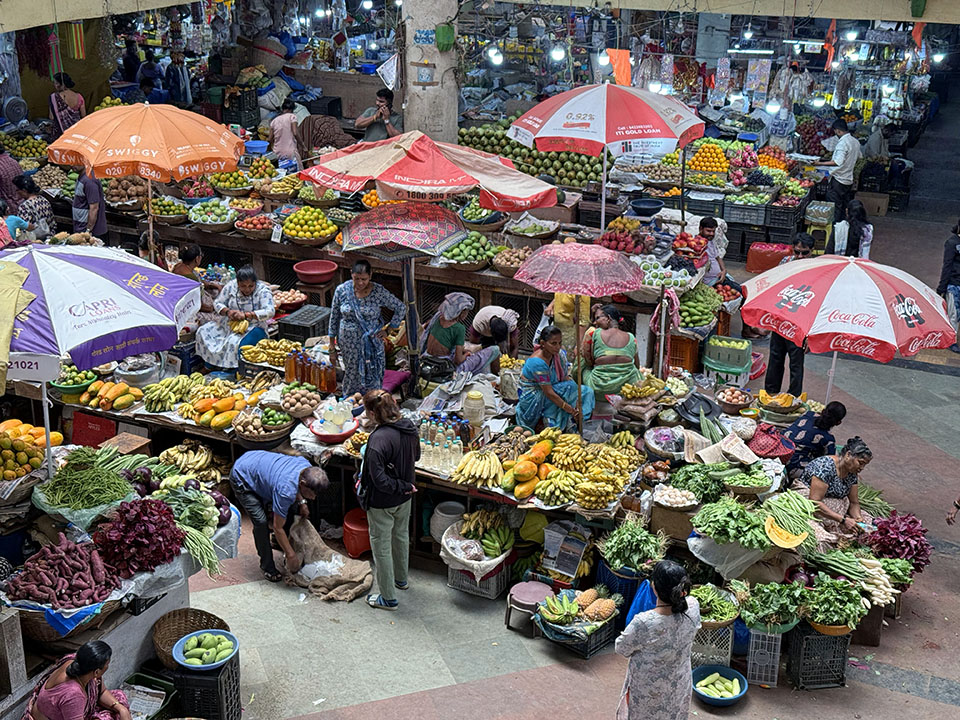
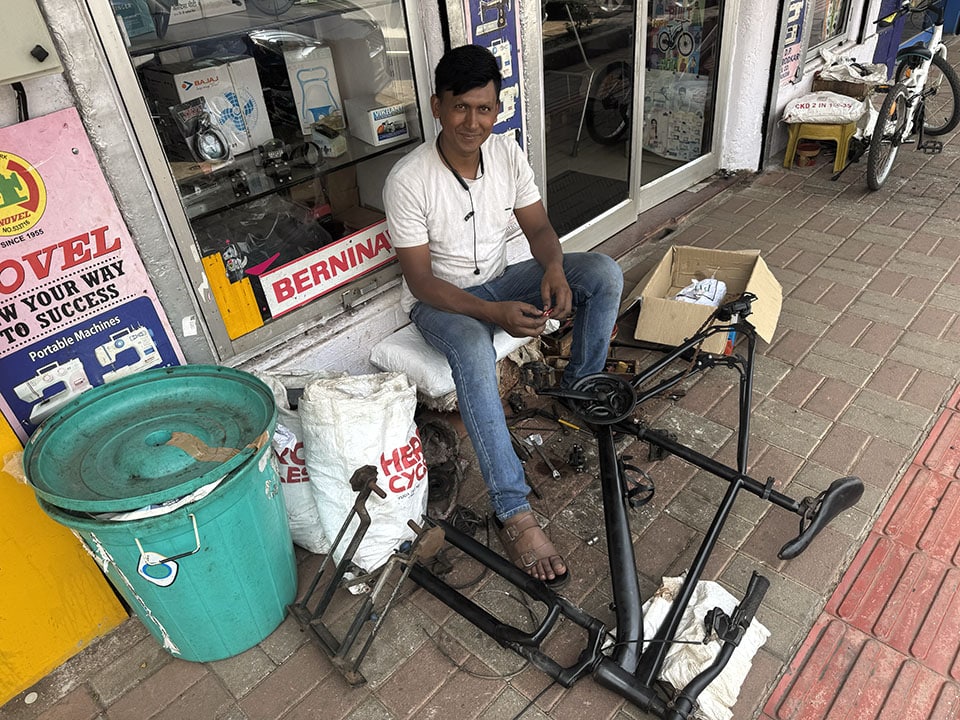
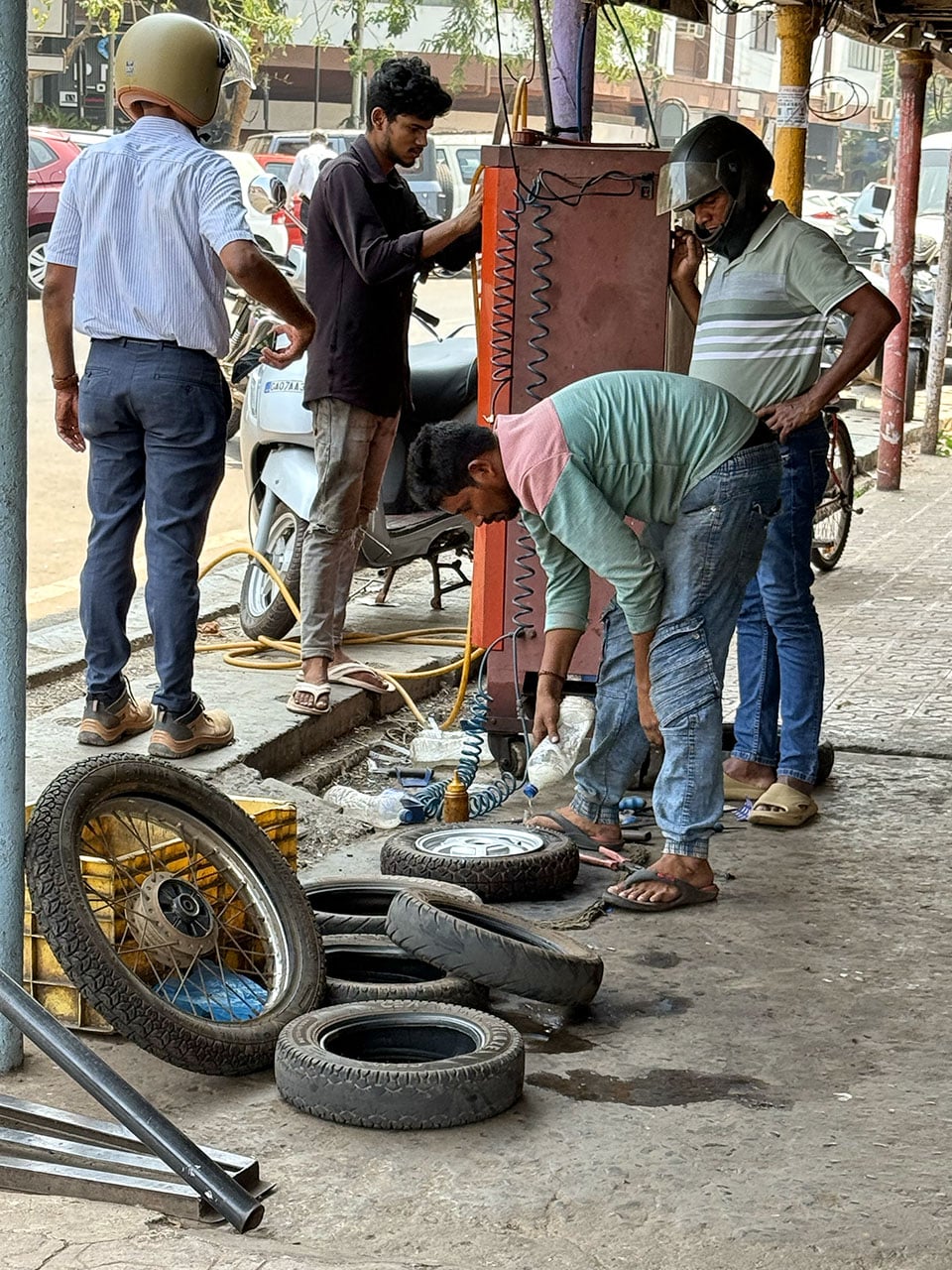
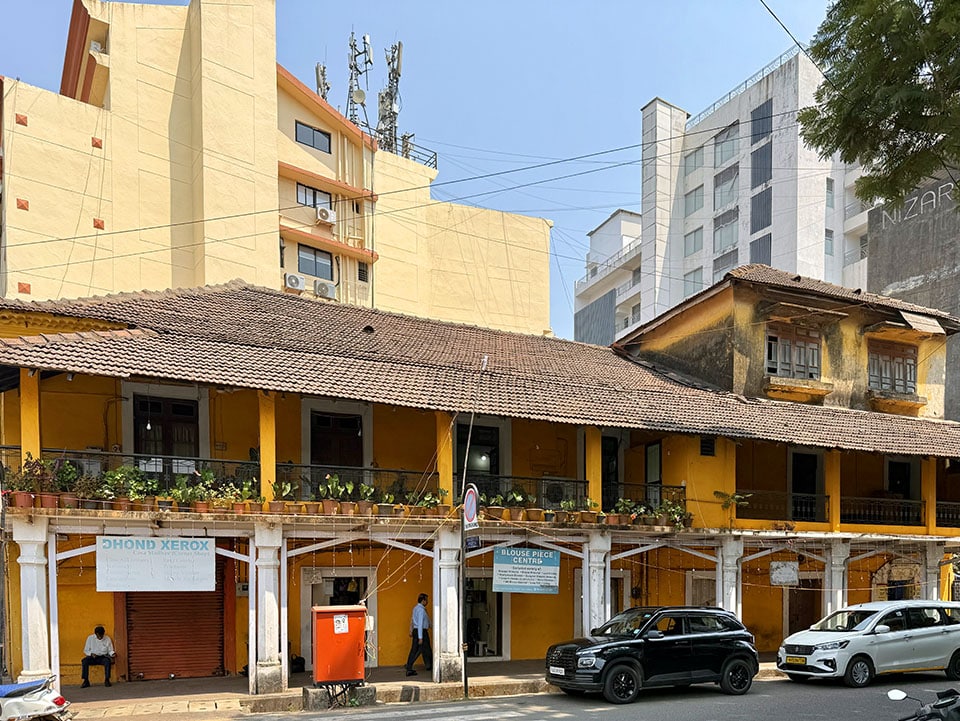
New modern buildings are going up next to old colonial ones.
Ayurvedic Apothecary & Herbal Remedies
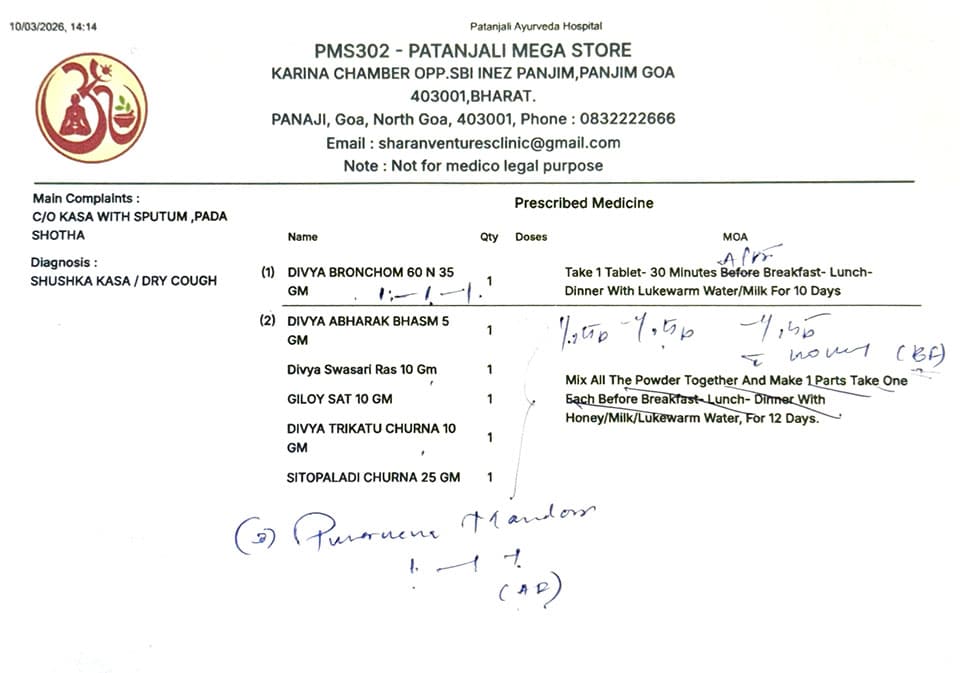
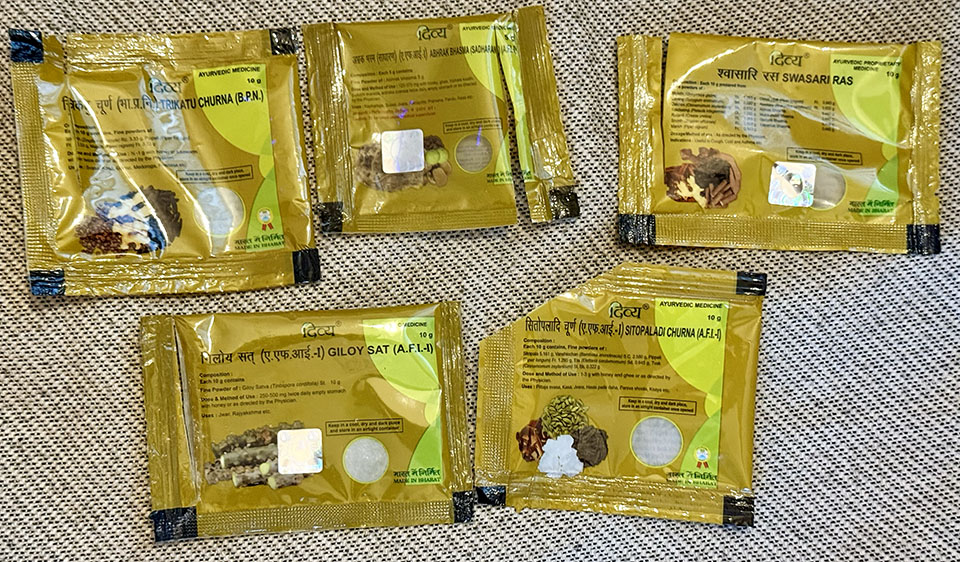
Eventually, we found the Patanjali Ayurvedic Apothecary (thanks to the guy in the market who gave us directions!), complete with an Ayurvedic doctor on-site.
She listened to Heidi’s lungs, said there was no infection now, but she recommended herbs to clear things up before it worsened. No charge for her time (we left a 500-rupee donation). The seven herbs she prescribed to make a medicinal tea for Heidi’s cough cost only about $4.50 USD total. The herbs even tasted great (and probably came from the spice farm in Kerala!)
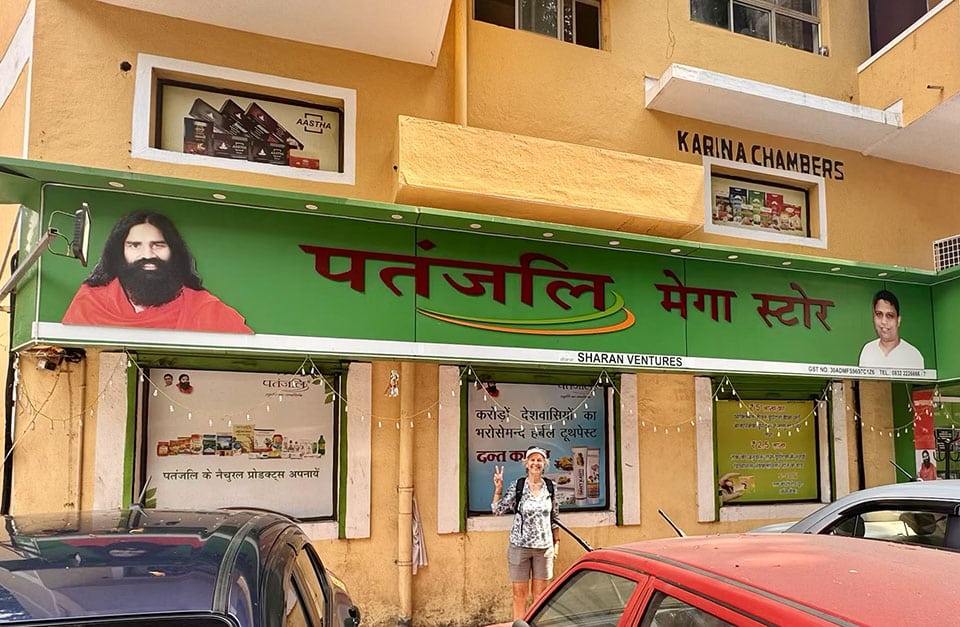
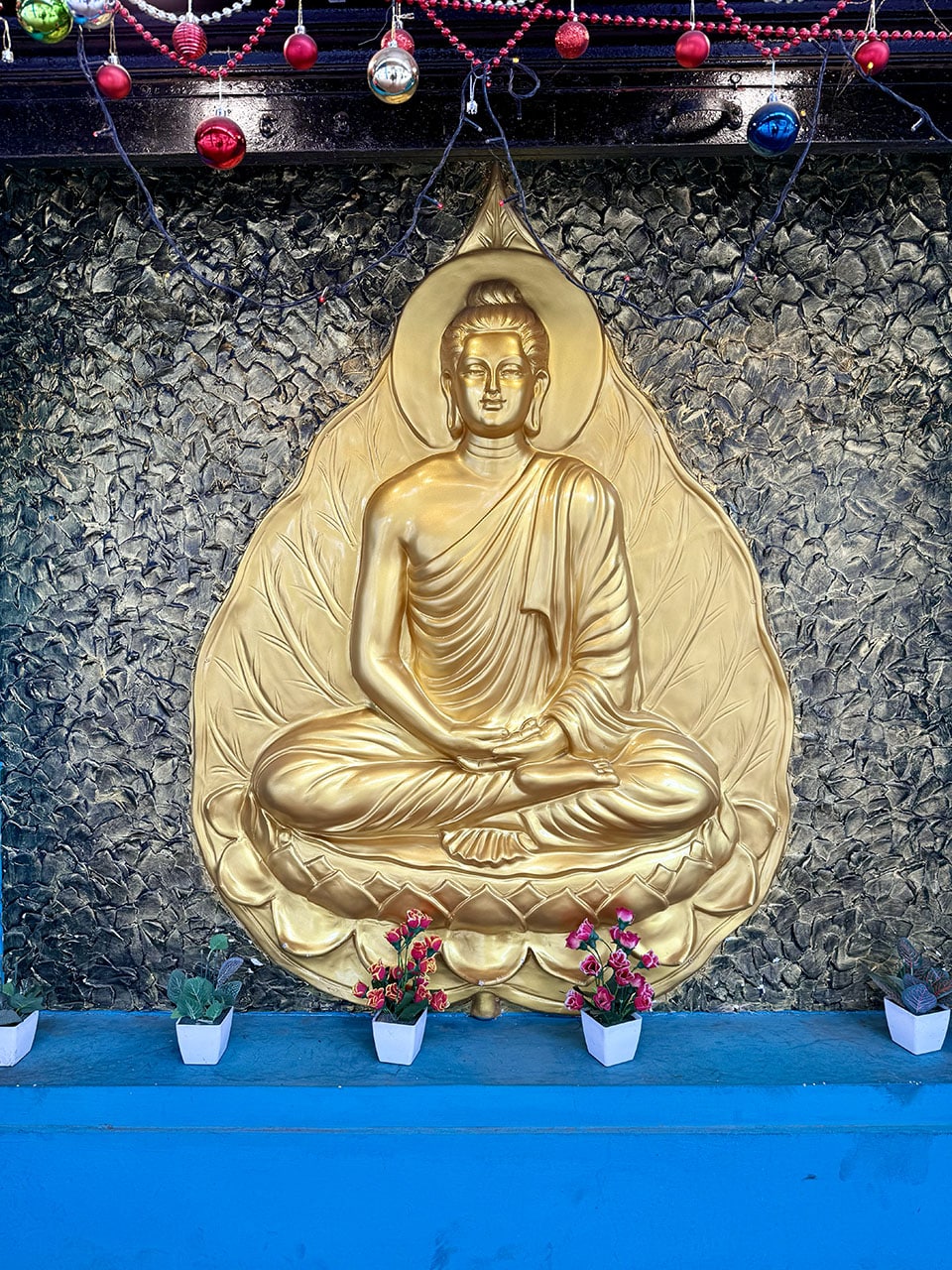
We wandered past beautiful street art, tiny neighborhood shops, and all sorts of interesting street scenes. We saw a golden Buddha, a larger-than-life-size cricket player, busts of Indian warriors on traffic light poles, and brightly colored wall murals…before finally ending our day, hot and exhausted, and ready for our first tuk-tuk ride in India—not too different from the ones we took in Thailand 30 years ago.
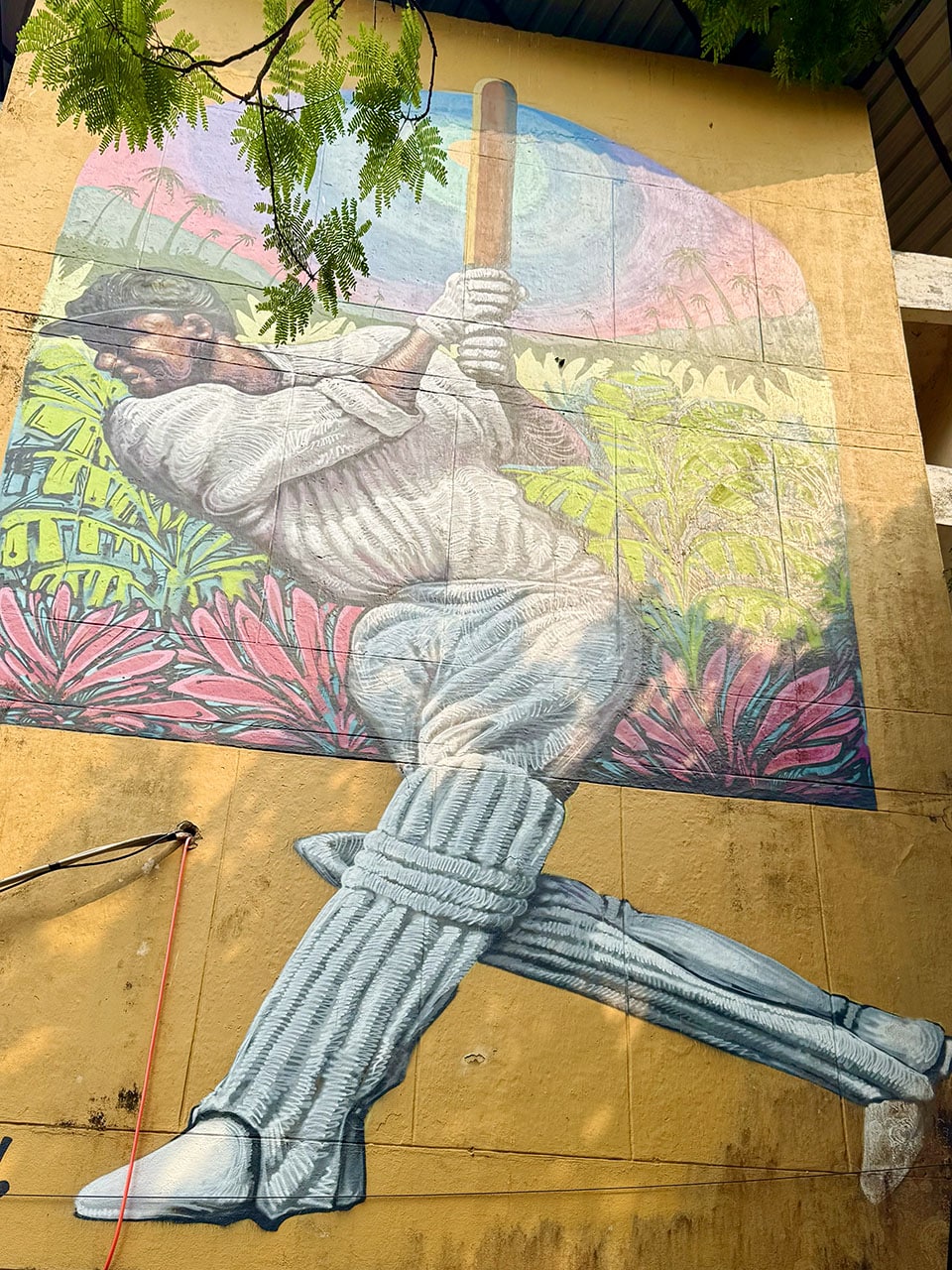
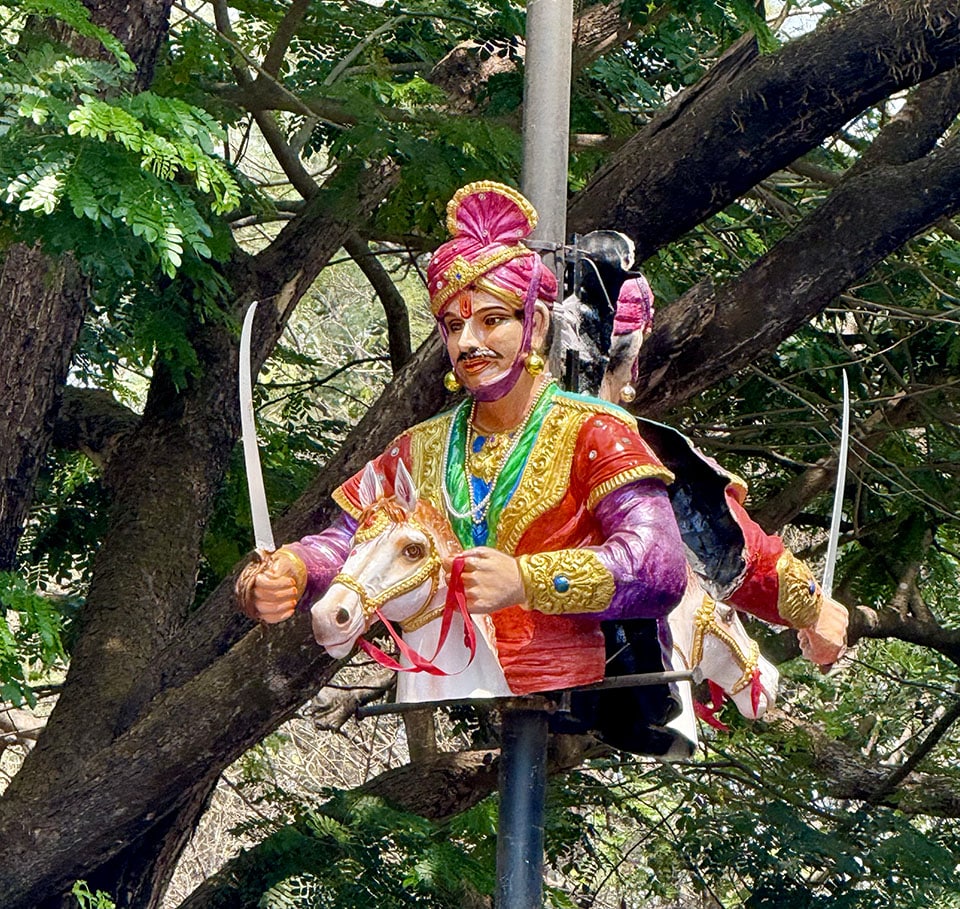
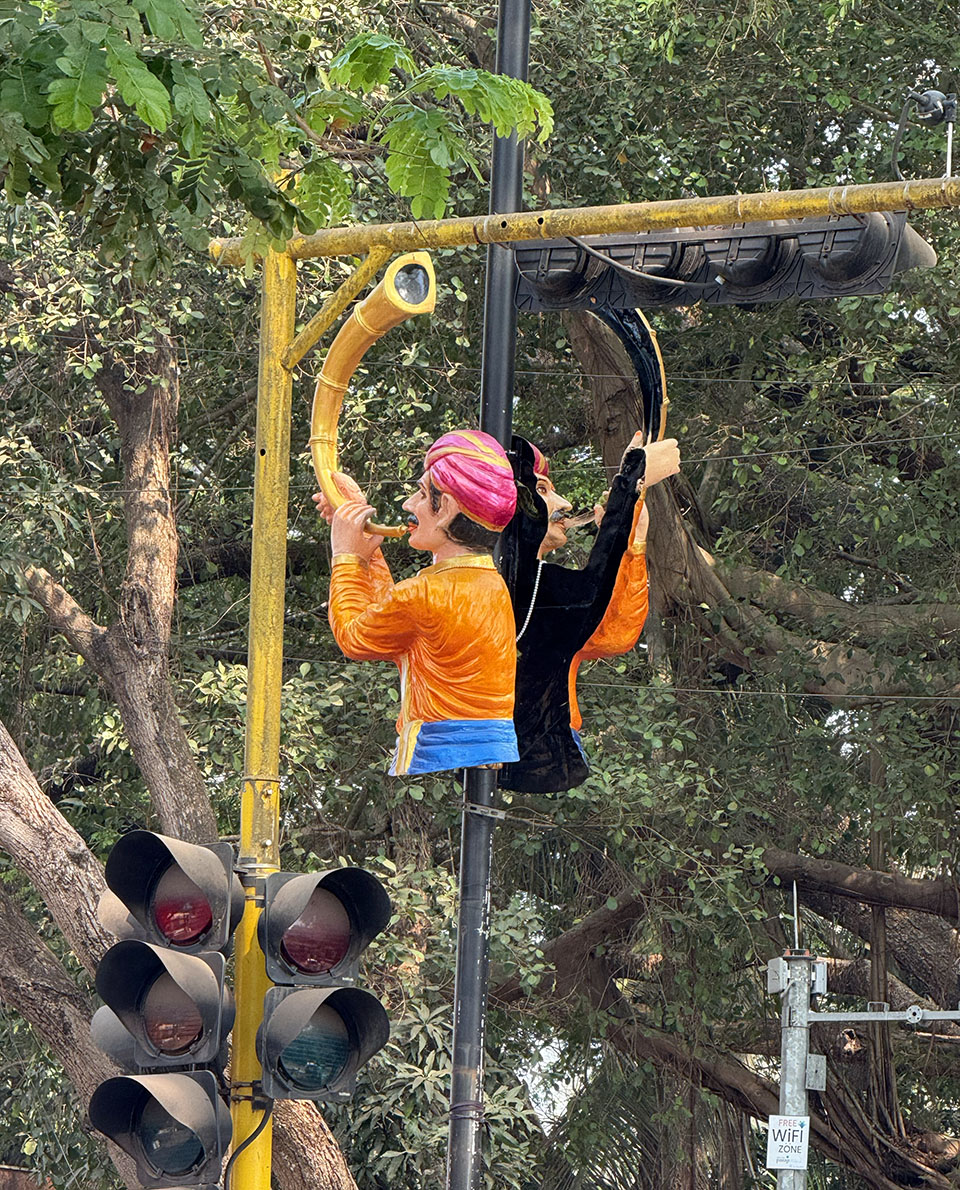
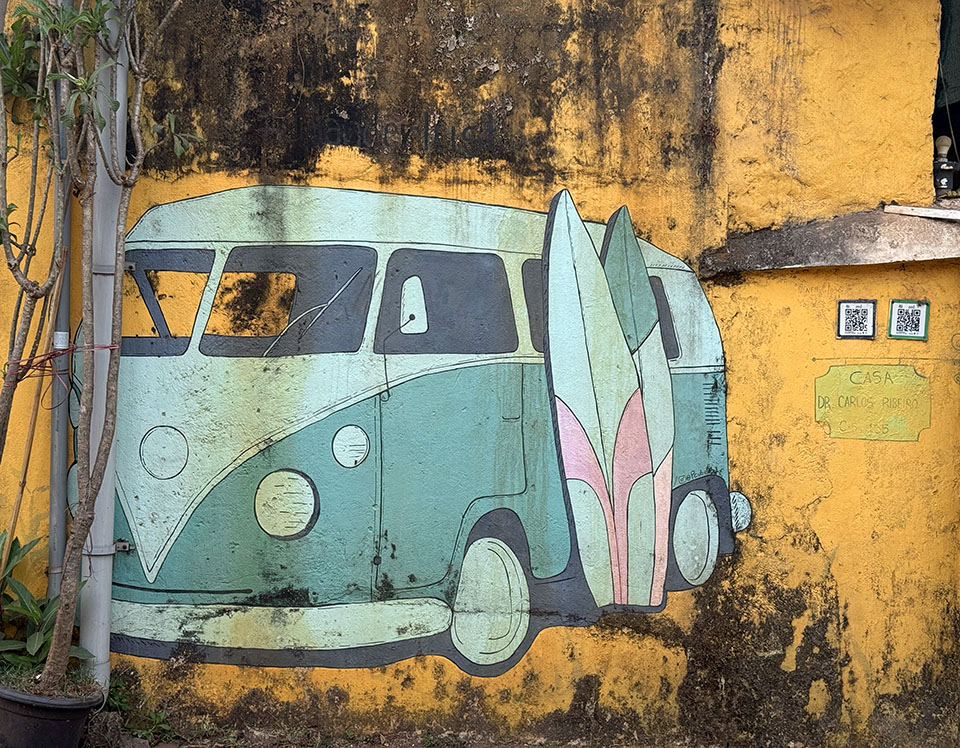
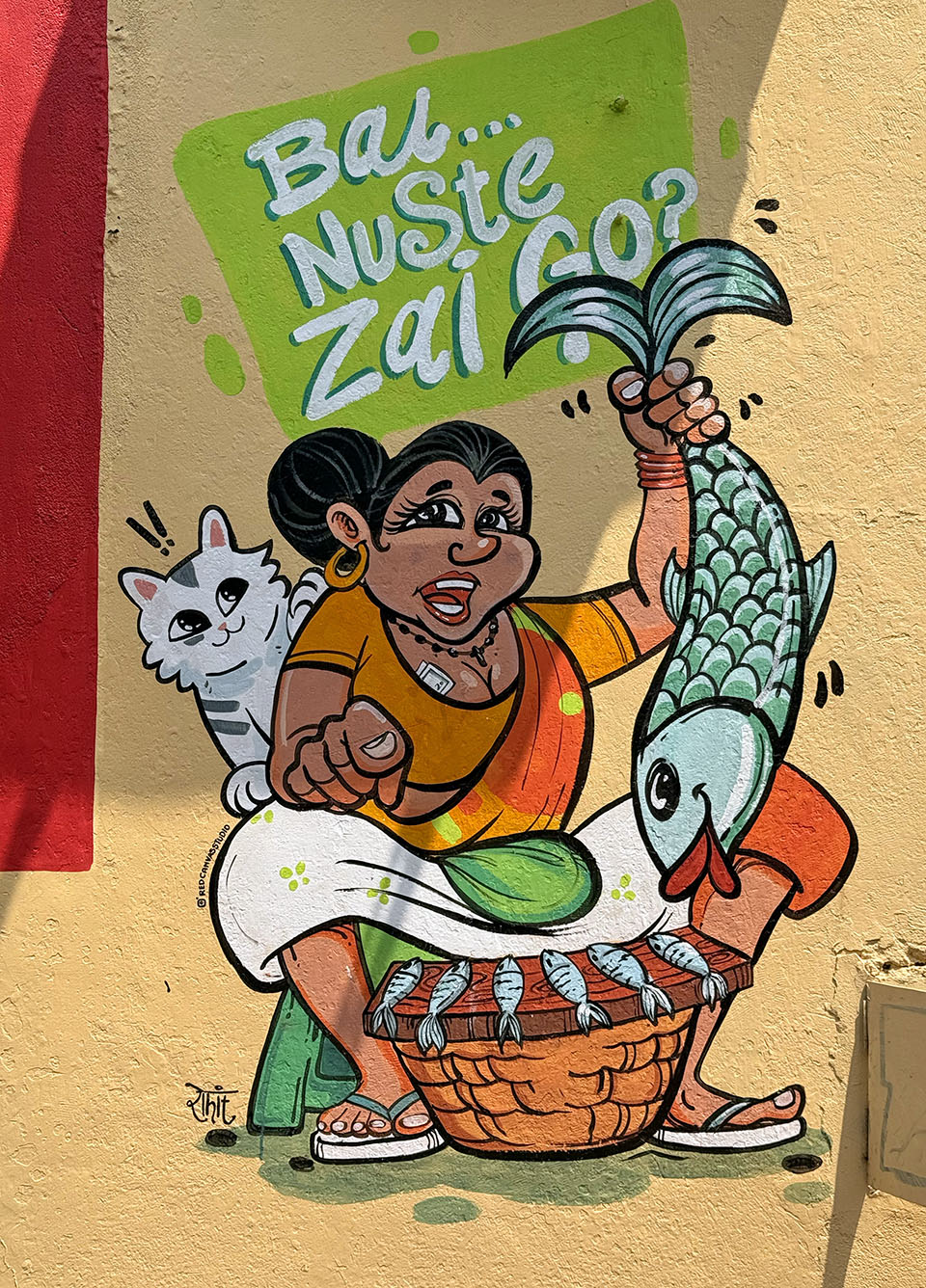
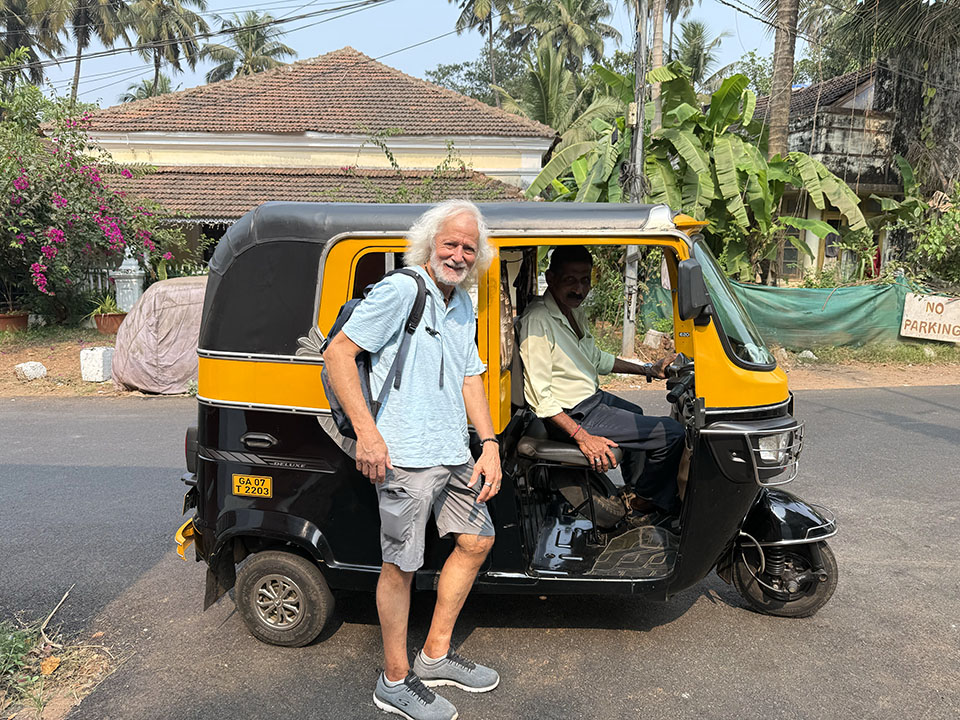
ATM Adventures in Goa
The next morning, we realized we truly needed more rupees. Most places in Goa didn’t accept U.S. dollars, and unlike the rest of our trip, we weren’t staying in hotels where exchanging money was easy. In hindsight, we probably should’ve planned ahead a bit better for the Goa leg of our trip. It was recommended to bring cash in USD or EUR to India, as ATMs can be few and far between or may not work depending on where you’re traveling.
Google Maps said there was a Western Union across the river, about a 15-minute walk from our Airbnb, that supposedly opened at 9 AM. So we headed out early, hoping to beat the heat.
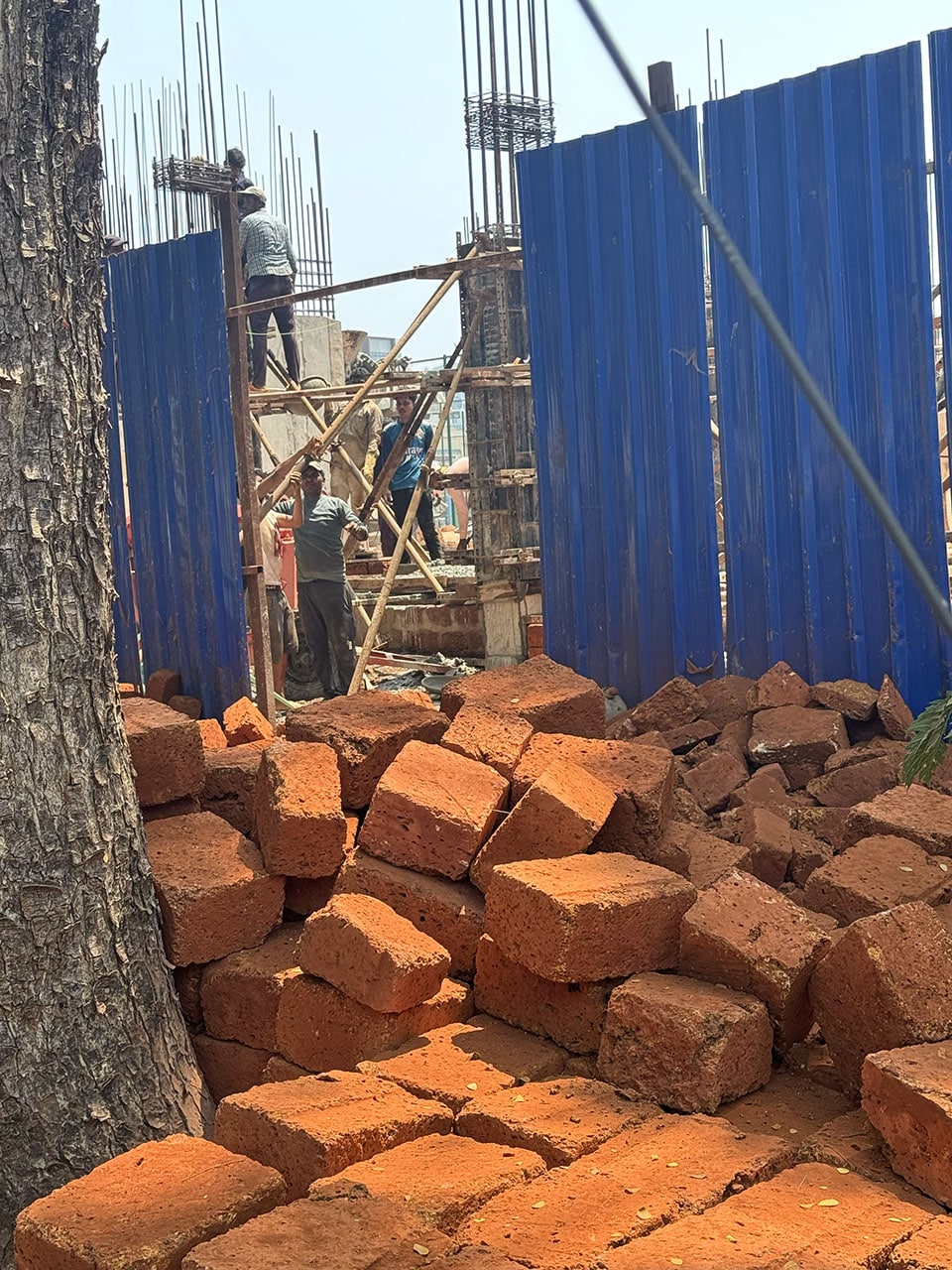
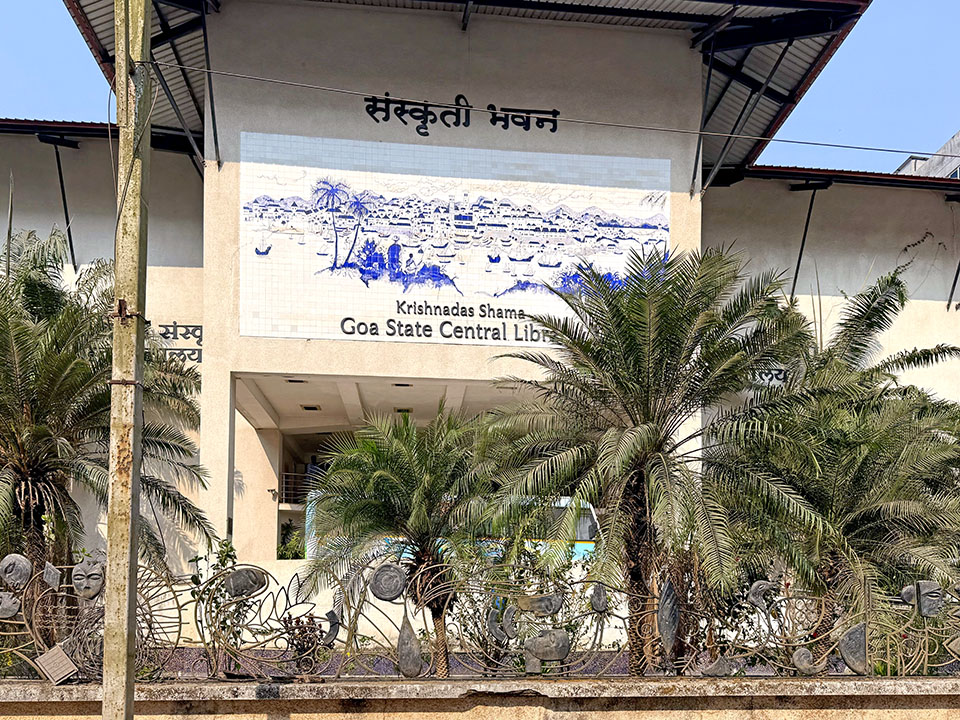
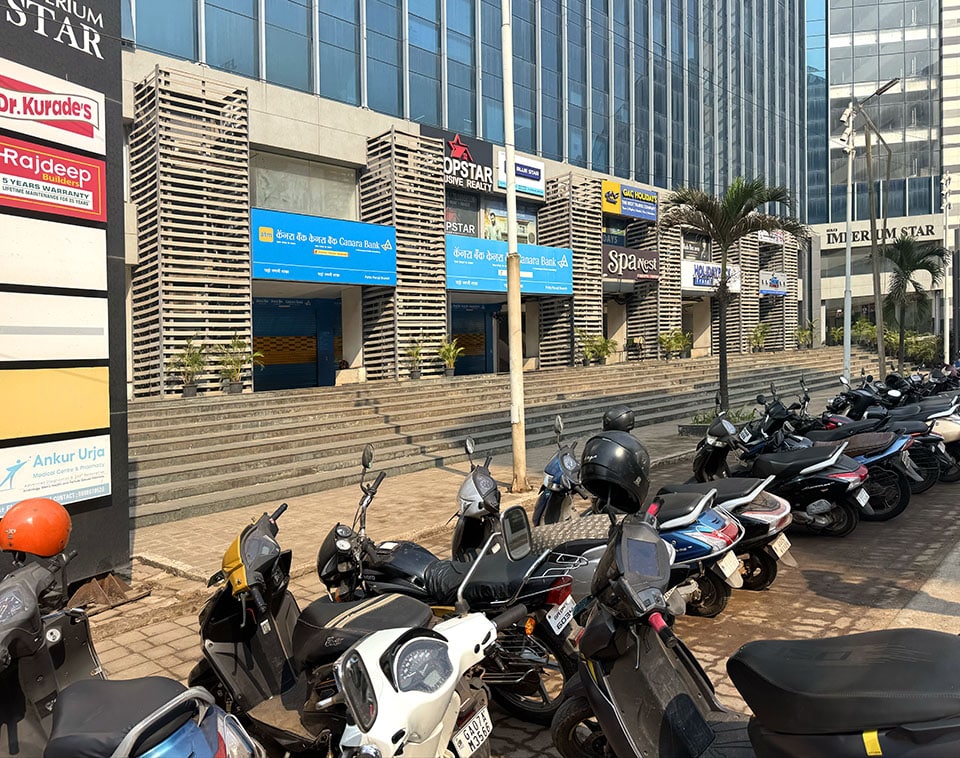
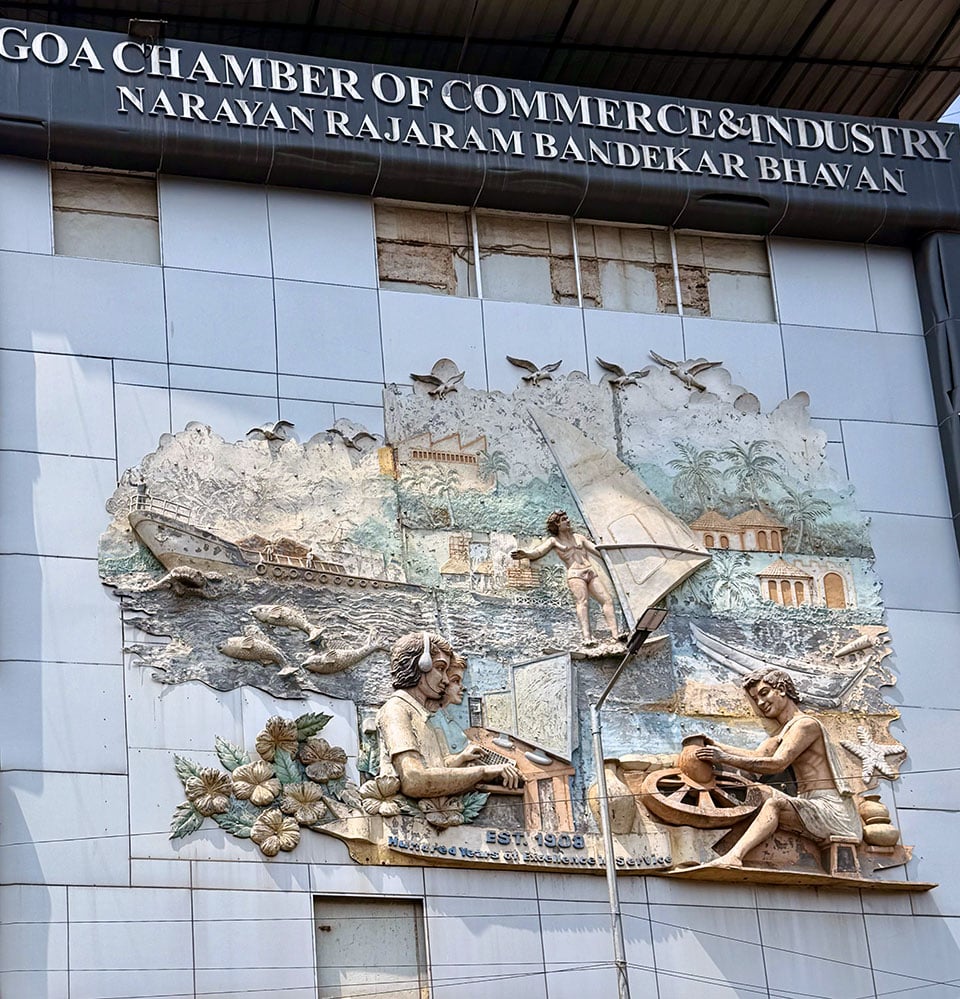
Google then led us on quite the adventure. After crossing the river, we found ourselves first crossing, then walking alongside, a busy arterial road—past construction zones, through modern commercial areas, and into an industrial park which housed the Goa Library. Oddly, both the art museum and the library in Panaji were tucked away in industrial parks.
Eventually, we arrived at several six- to eight-story office buildings. And supposedly, Western Union was in one of them. Except that… apparently it had moved or closed years ago, and no one had bothered to update Google Maps.
Thankfully, there was a Bank of India branch in the same building, and thanks to Ganesh (the “remover of obstacles”), the ATM actually worked. The rupee withdrawal limit was quite low, but at least it allowed multiple transactions, so we just kept withdrawing until we finally had enough rupees.
By this point, it was already over 90°F with heavy humidity, despite it being 9 AM. We decided to head back toward MOs for breakfast, but Google Maps betrayed us one more time. It directed us toward a pedestrian bridge crossing the river—except the bridge had been completely blocked off behind a giant corrugated metal wall.
Thankfully, we spotted locals crossing another footbridge farther upstream, which eventually led us back toward Fontainhas and, more importantly, breakfast at MOs.
One Last Day in Panaji
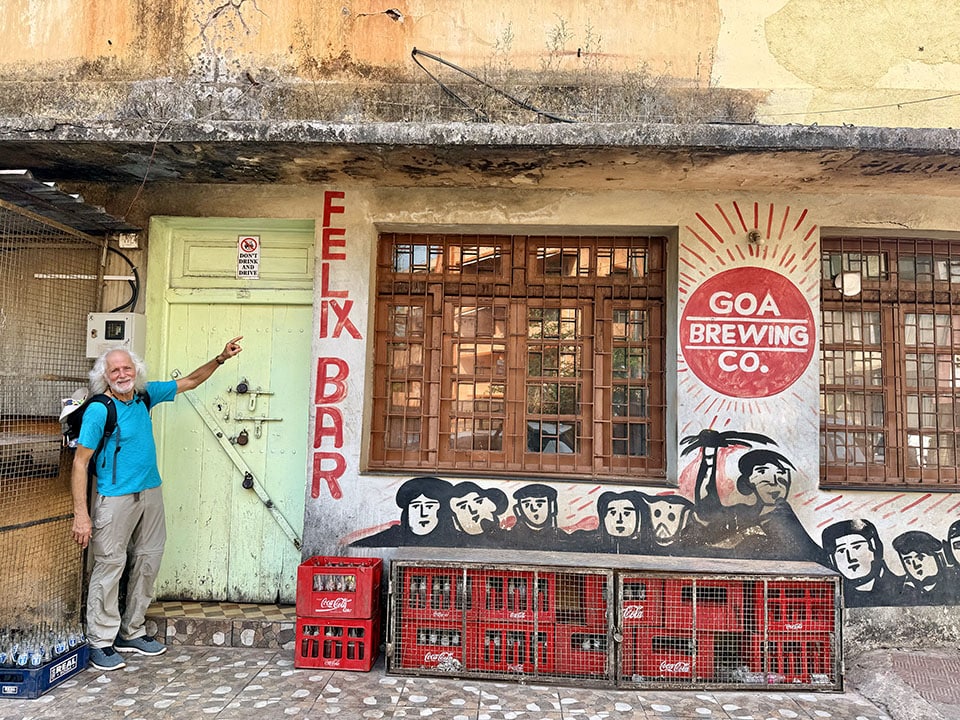
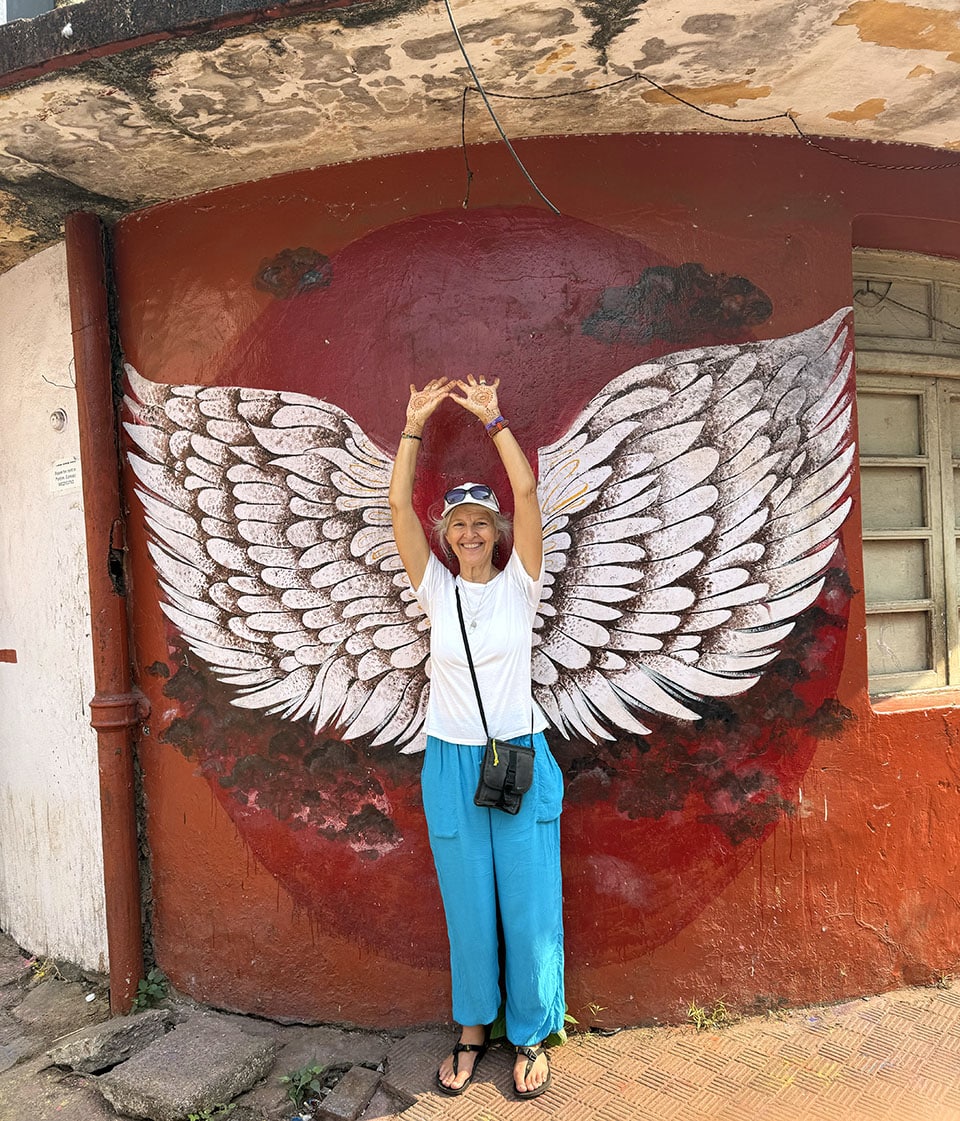
Later that afternoon, we checked out a bit more street art (Felix, this one’s for you!). Heidi, feeling a bit better, even found a cute dress, while Kirk briefly contemplated buying an Indian Nehru jacket—NOT!
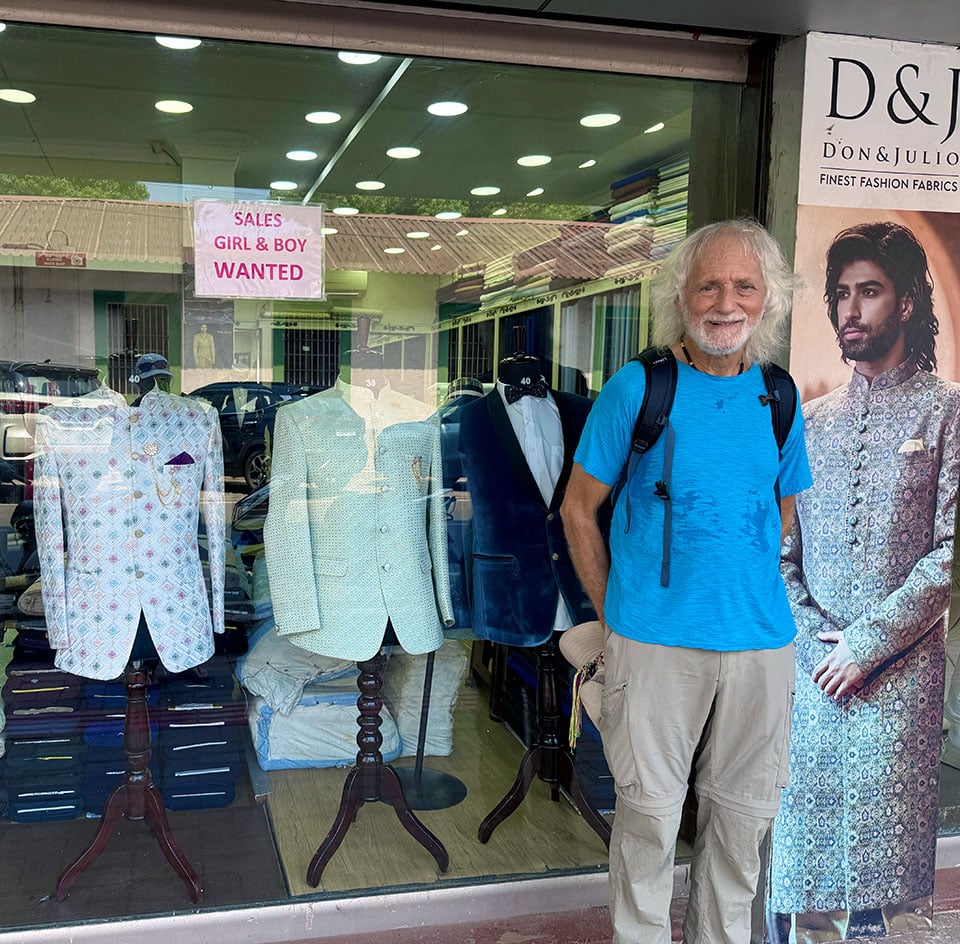
Back at the Airbnb, we packed our bags, made dinner, and then discovered a strong smell of gas in the apartment. Our propane was turned off. So we had to text our “super” host one more time. She sent Krishna over to check everything out, and he determined it was coming from the neighbors.
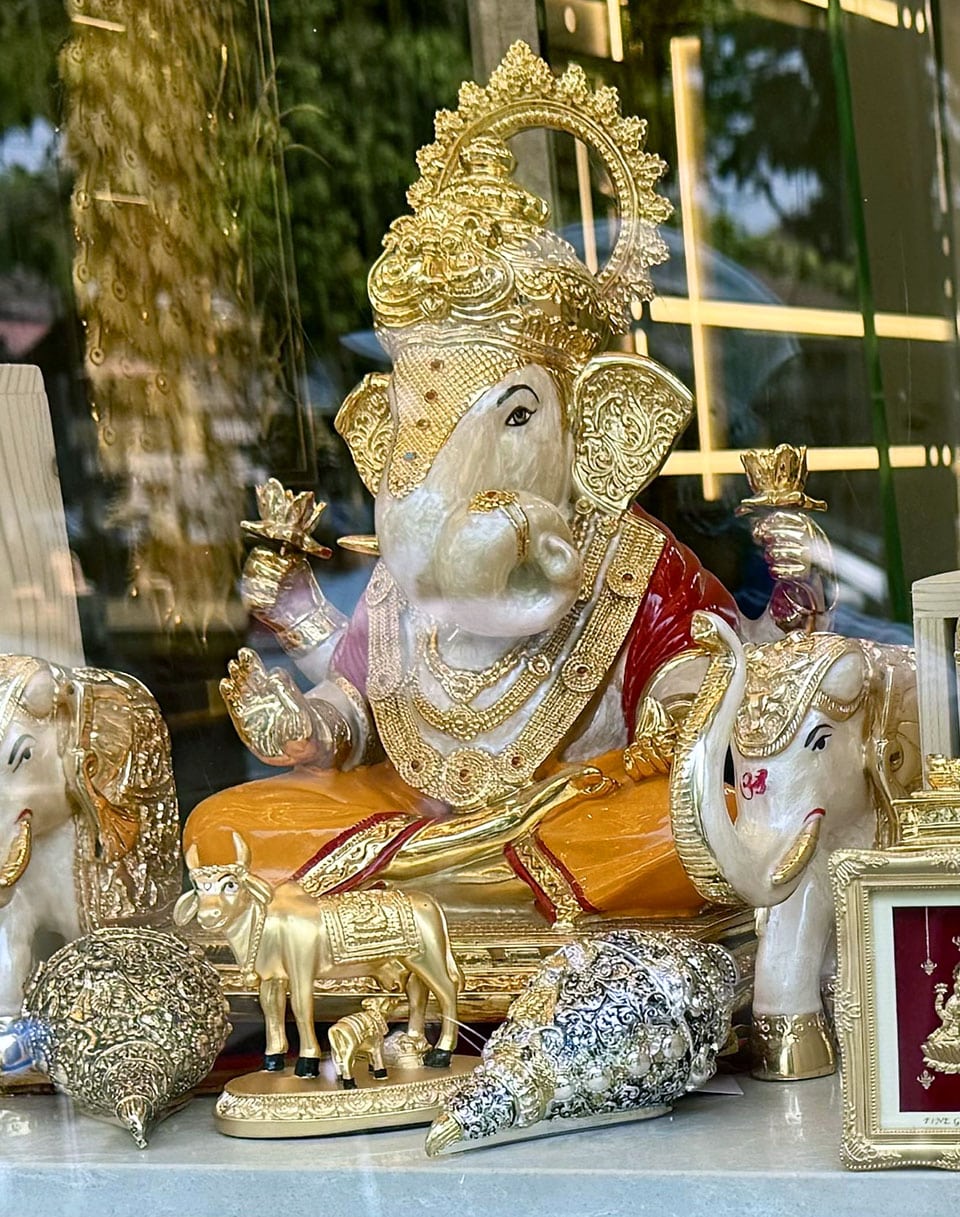
Before hitting the hay, the smell had subsided a bit. So we crossed our fingers, left Ganesh on watch, and hoped there would be no middle-of-the-night gas explosion before our o-dark-thirty wake-up call.
Mitesh picked us up at 4:30 AM and drove us an hour to the airport. We were chatting so much during the drive that he actually missed the airport turnoff and had to loop back around.
It seemed crazy to have so many airport stores like Tiffany’s, Swarovski Crystal, and United Colors of Benetton open for shoppers at 5 AM (after being open all night)! And just like that, we were off to Delhi.
Goodbye Goa
We were genuinely sad to leave Goa. We absolutely loved our time there—minus the “super host,” who actually asked us NOT to leave a review because she didn’t want it to hurt her five-star rating. LOL.
Unfortunately, we ran out of time to visit the Goa Archaeology Museum, which featured an exhibit on Portuguese sailing and navigation and sounded fascinating.
We would definitely return to Panaji someday—if only for the Kokum—and highly recommend staying in the Fontainhas neighborhood, eating at MOs Cafe, and taking a walking tour with Make It Happen. Next time…maybe we’ll make it to the beach!
Next up, we’ll be joining our Athma Tour North India group, Roger, Mallika, Basilica, and a new group of travelers, to visit Mama Ganga (the sacred Ganges River) in Varanasi and Rishikesh, and later Jaipur, Delhi, and Agra.
What a wonderful trip and you have shared your adventures for so many years!
Thanks you two adventurists!
CHEERS!
Amazing Travel Blog. Very interesting and informative….your description and photos give life to the destinations. Looking forward to the next blog.