
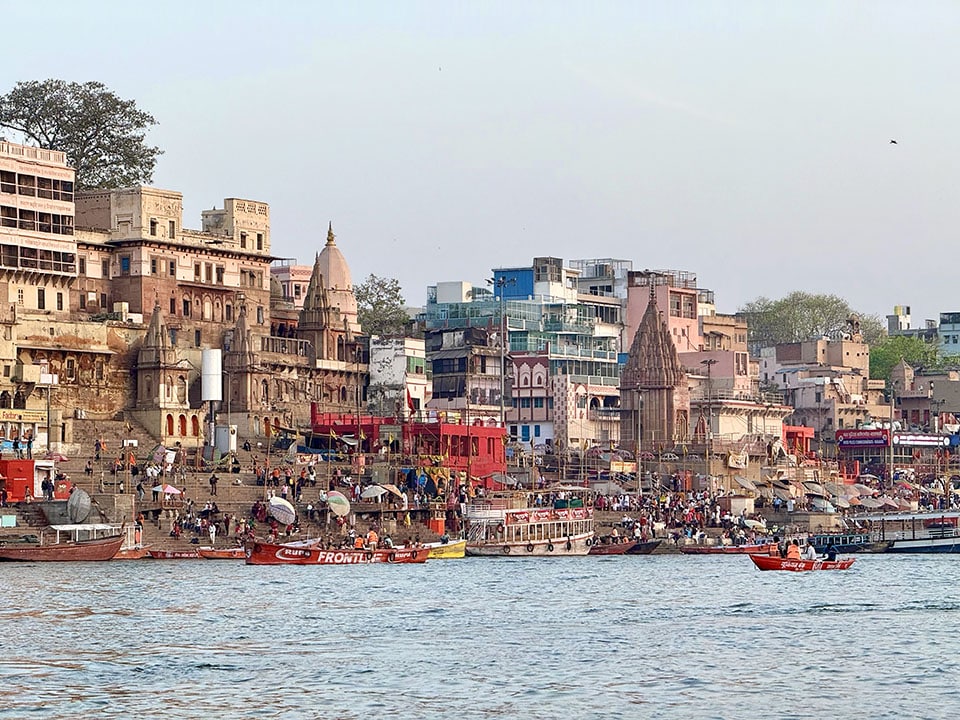
Travels to India Part 5: Mama Ganga ~ Varanasi & Rishikesh
After touring South India and Goa, we were excited to continue our journey into North India and visit the Ganges River, affectionately known as Mama Ganga (Mother Ganga).
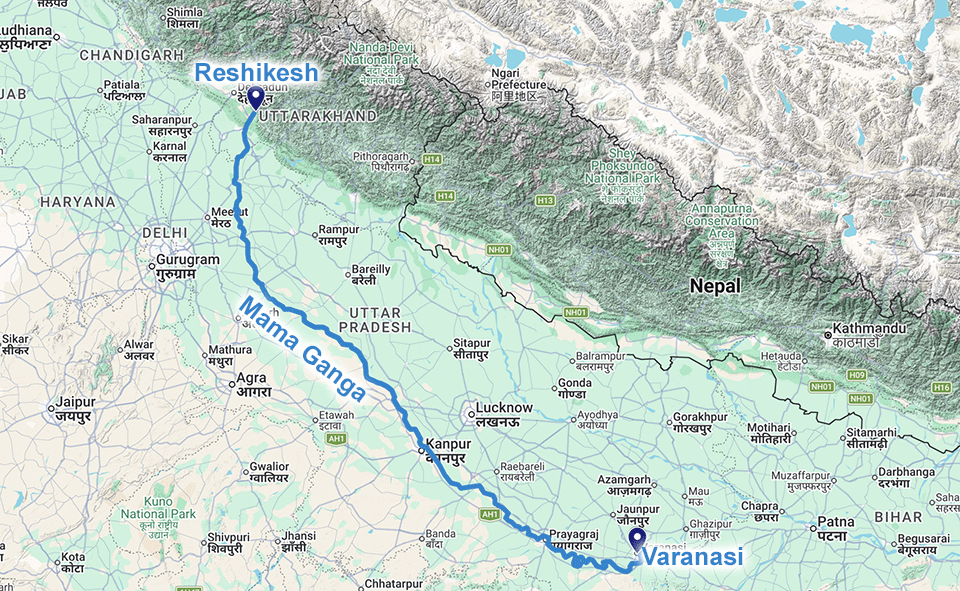
According to Hindu mythology, the river is the celestial goddess Ganga, who descended to Earth to wash away humanity’s sins and is considered a living goddess. Today, the Ganges remains India’s holiest river and is widely regarded by Hindus as the most sacred river in the world—worshiped by a billion people as a “mother who sustains life”.
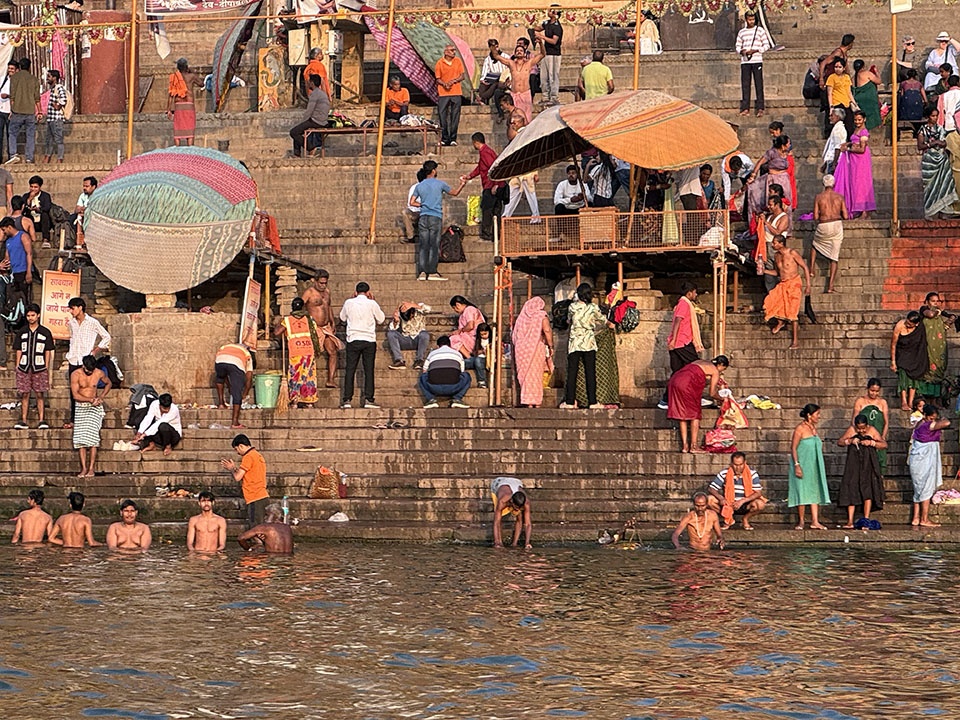
Bathing in her waters is believed to cleanse negative karma, while scattering of ashes in the river—especially in holy cities like Varanasi and Rishikesh—is thought to help souls attain moksha, or liberation from the cycle of rebirth.
Scientists have recently found that the Ganges contains naturally occurring bacteriophages (a type of virus that attacks harmful bacteria)—a discovery that supports the long-held Hindu belief that the river possesses unique self-purifying qualities.
Flowing more than 1,550 miles from the Himalayas to the Bay of Bengal, the Ganges sustains the lives, livelihoods, and agriculture of more than 600 million people across India and Bangladesh.
With such spiritual and cultural significance, we were eager to experience Mama Ganga for ourselves.
Our North India Tour
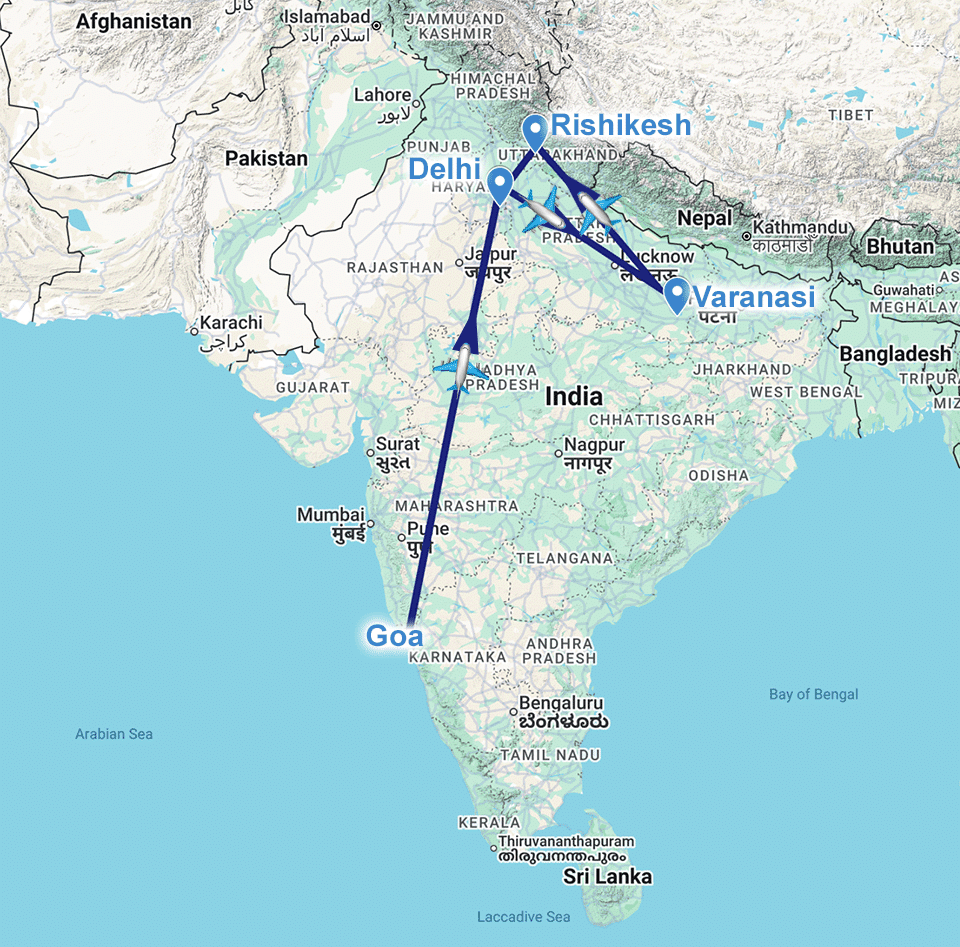
We flew from Goa to Delhi, where we reunited with our wonderful tour guides, Roger and Mallika, and met our new North India tour guide, Remesh.
We also met our fellow travelers for the northern portion of our epic India adventure. Basilica, from Mykonos, Greece, had also been on our South India tour, and we were happy to see her again (she had spent her five days between the tours visiting Kolkata). Synchronistically, five of us hailed from Washington State: Donna from Wenatchee, and Pauline & David from the Seattle area. The group also included Marge from Washington, D.C., Marie from Delaware, and Anne Marie from Toulon, France.
Three additional travelers—Amy, Diane, and Tris—weren’t Roger’s meditators, but joined us from another Athma Tour (based on locations from the book The Love Thief), adding to the diverse mix of personalities, experiences, and perspectives that shaped our journey through Northern India.
Thankfully, the Imperial Hotel in Delhi (where we stayed overnight and would be returning at the end of our tour) let us leave our large new suitcase of souvenirs and gifts in their luggage check until we returned. Unlike our South Indian tour, which was mostly by bus, on the North India portion, we’d be flying between distant locations, with no room for extra luggage.
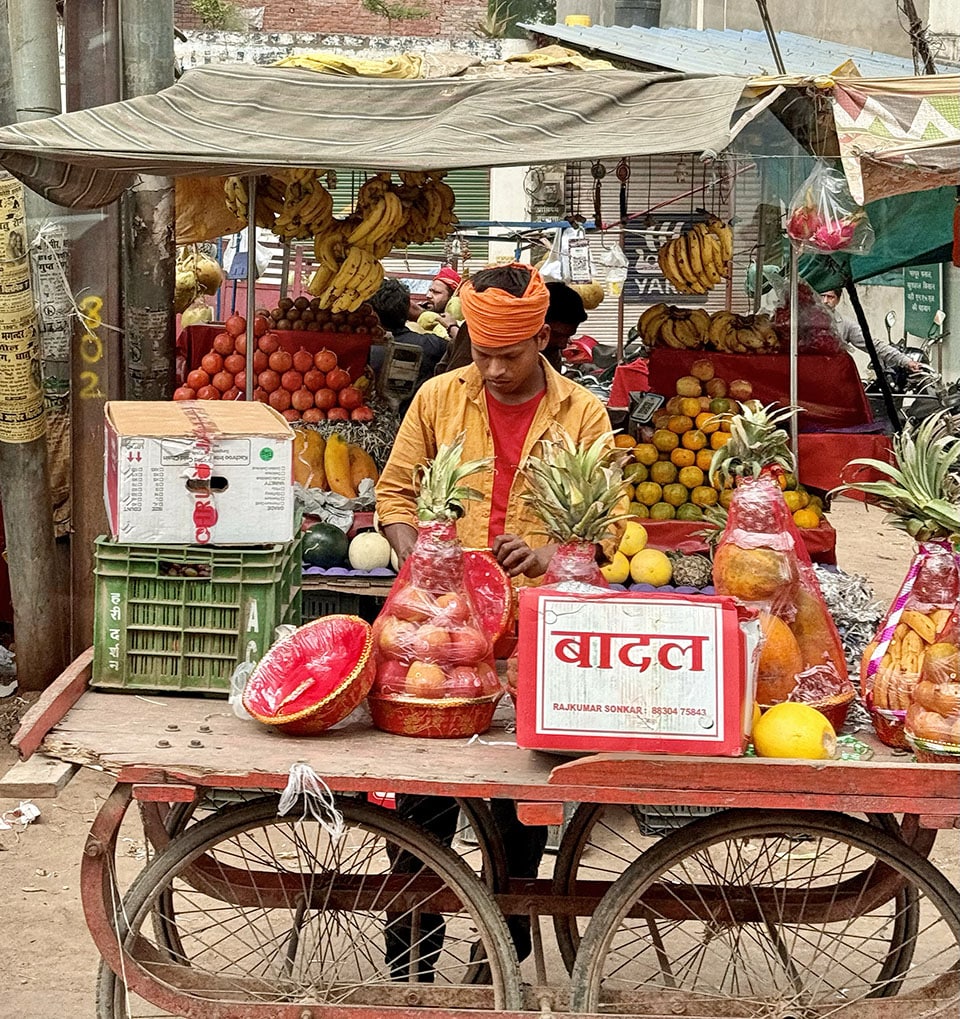
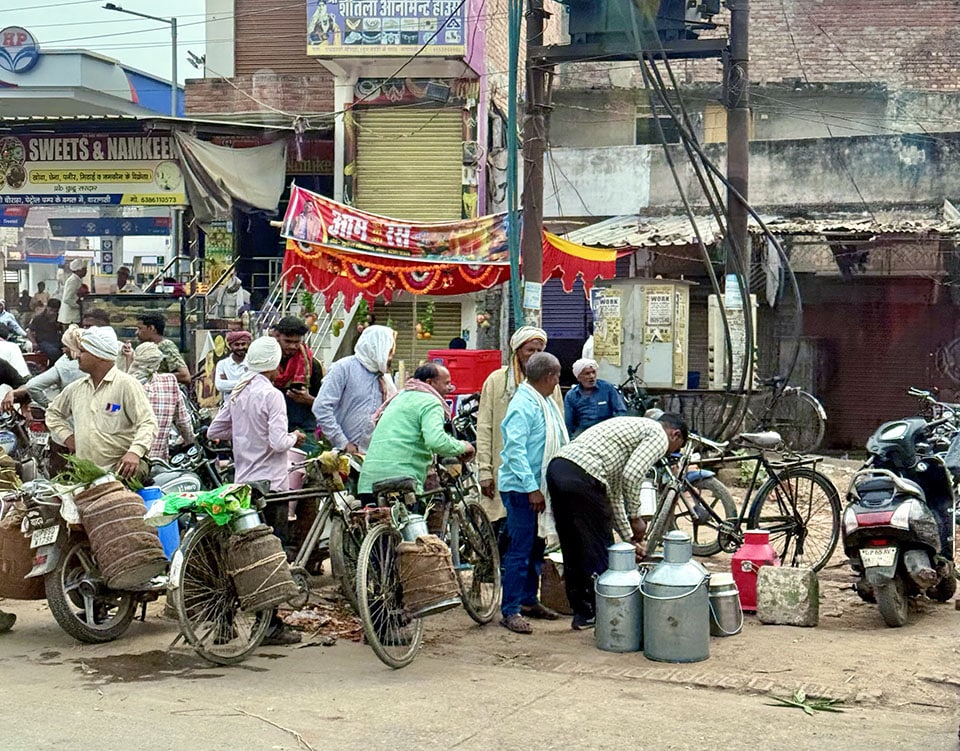
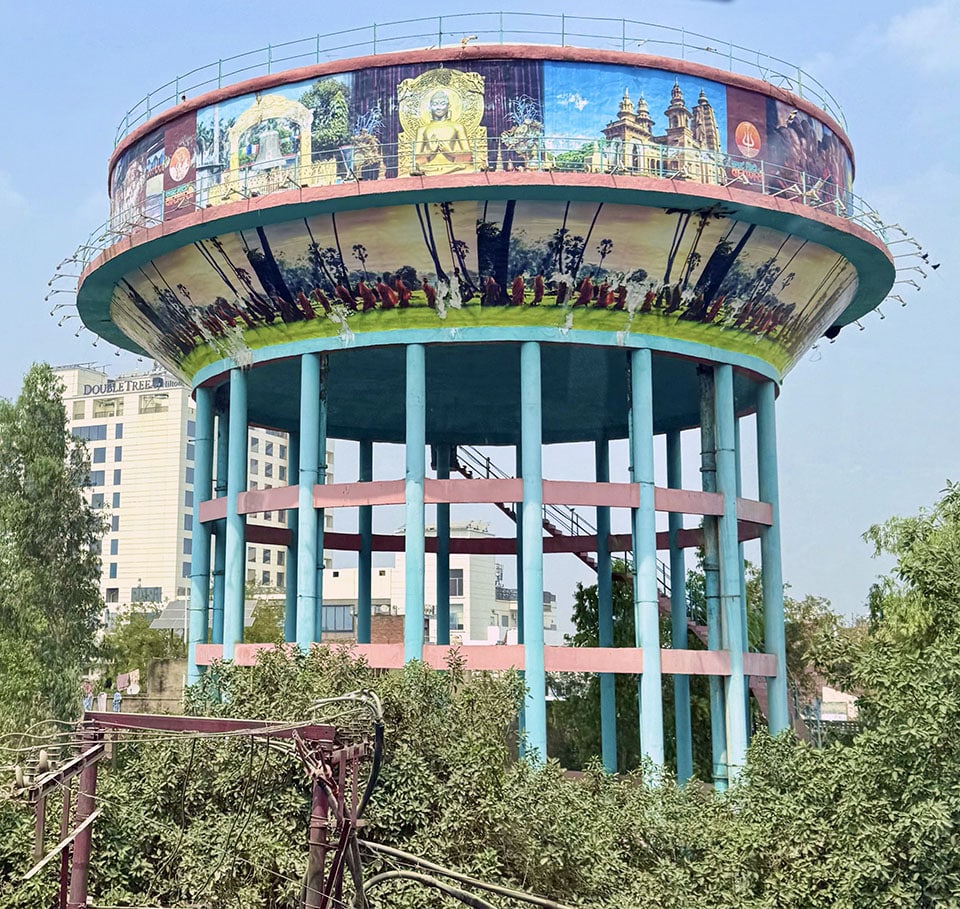
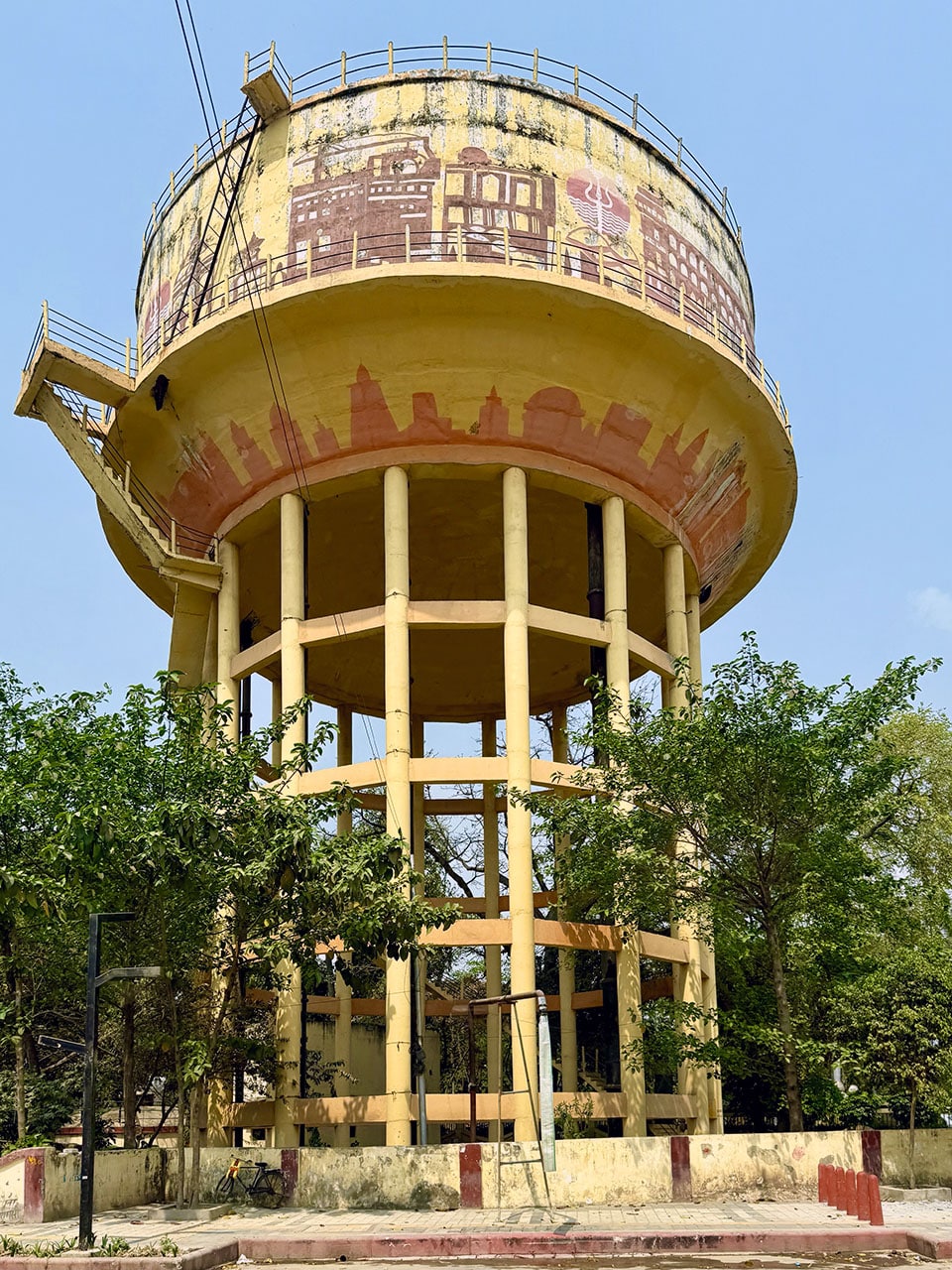
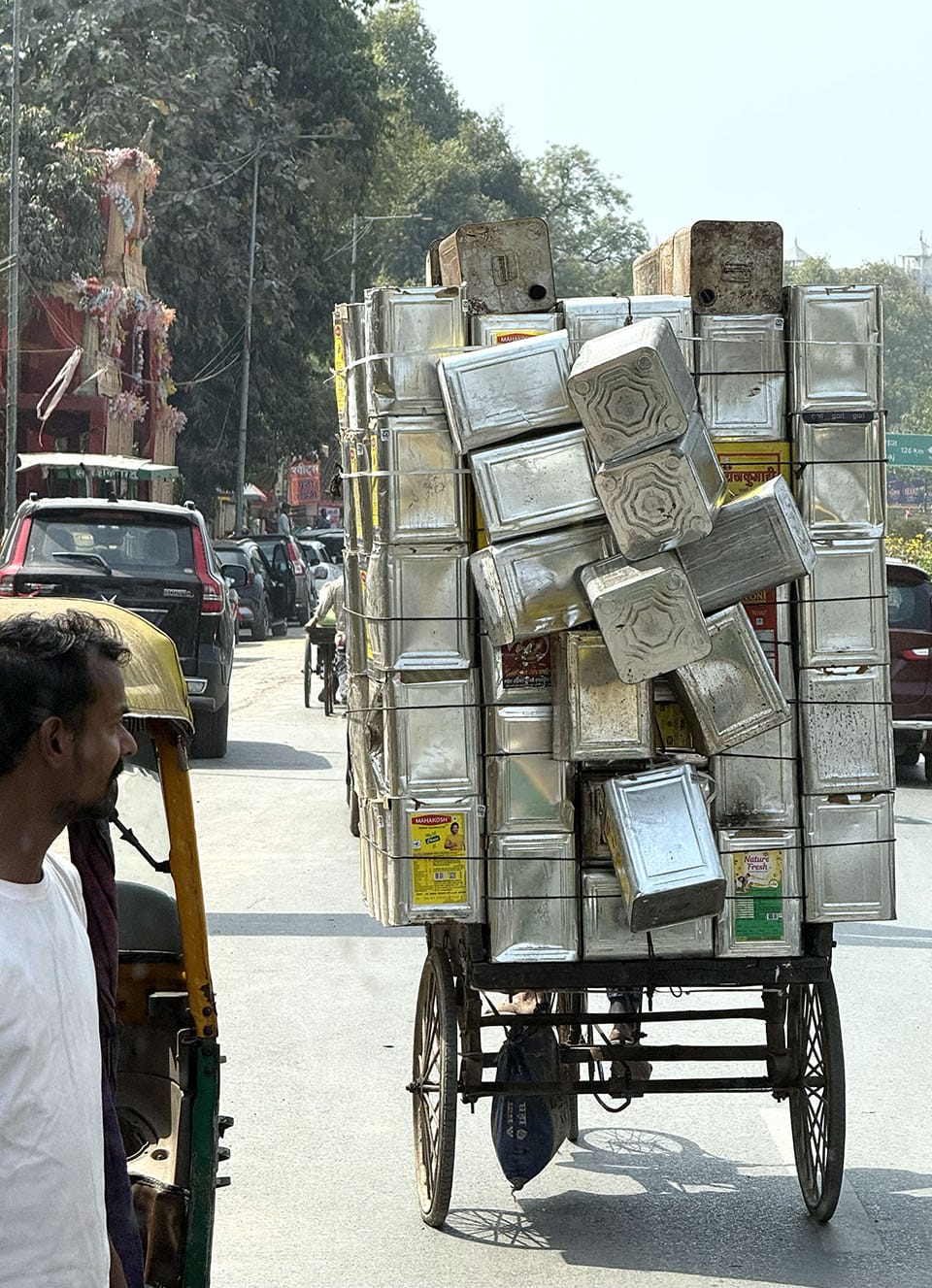
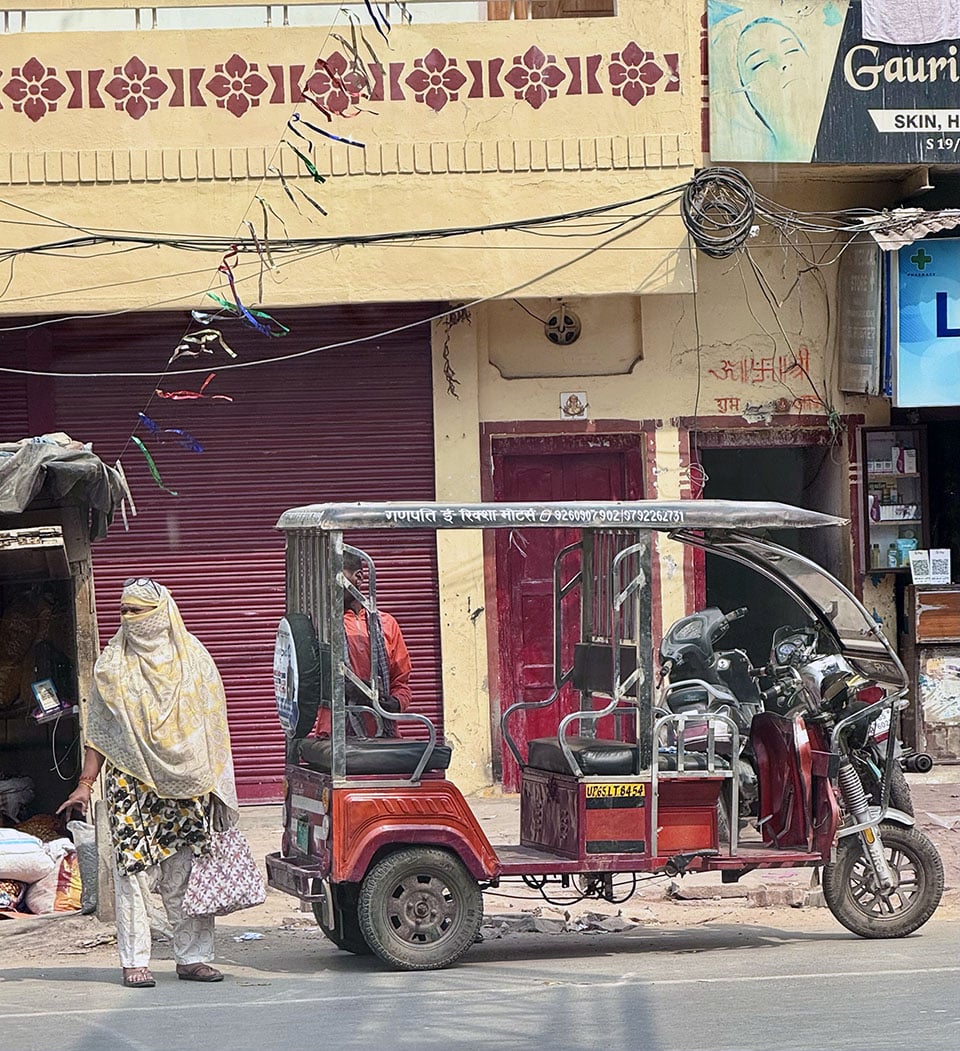
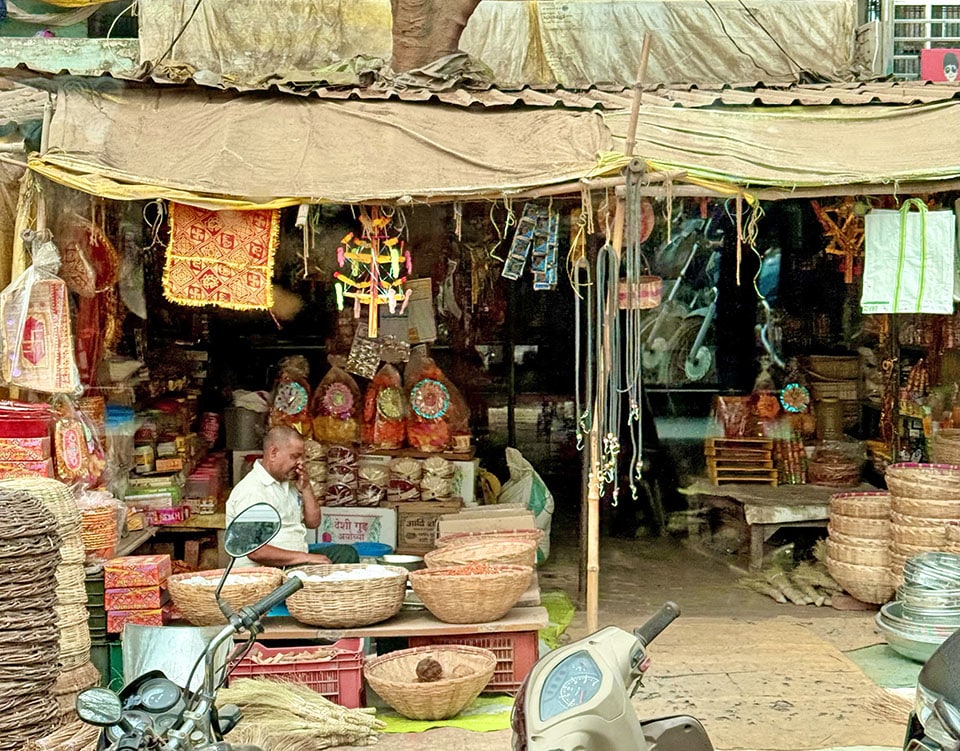
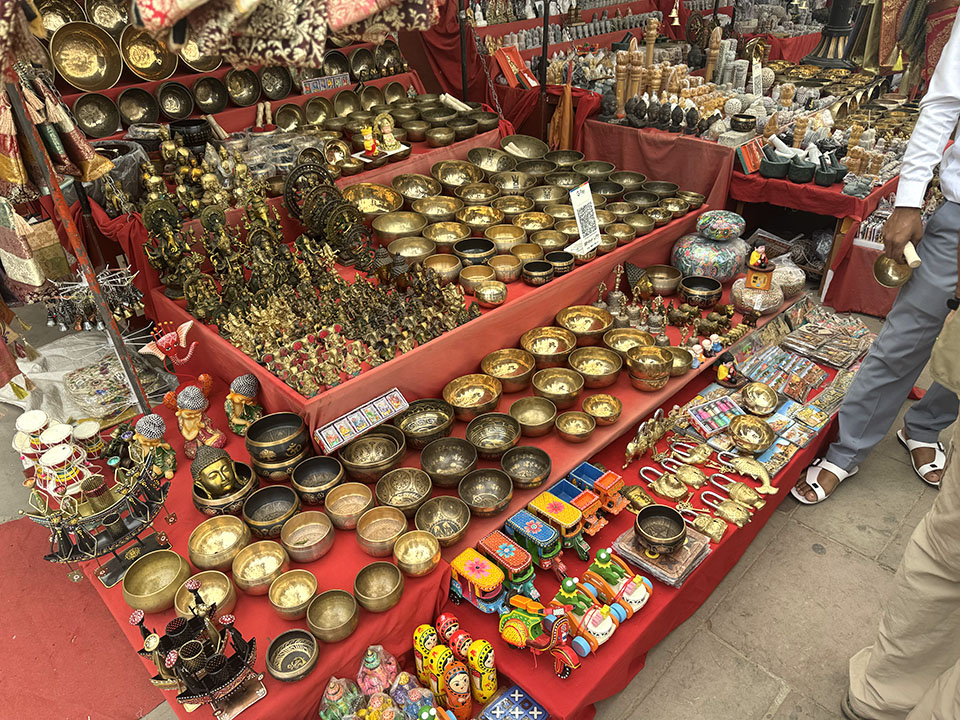
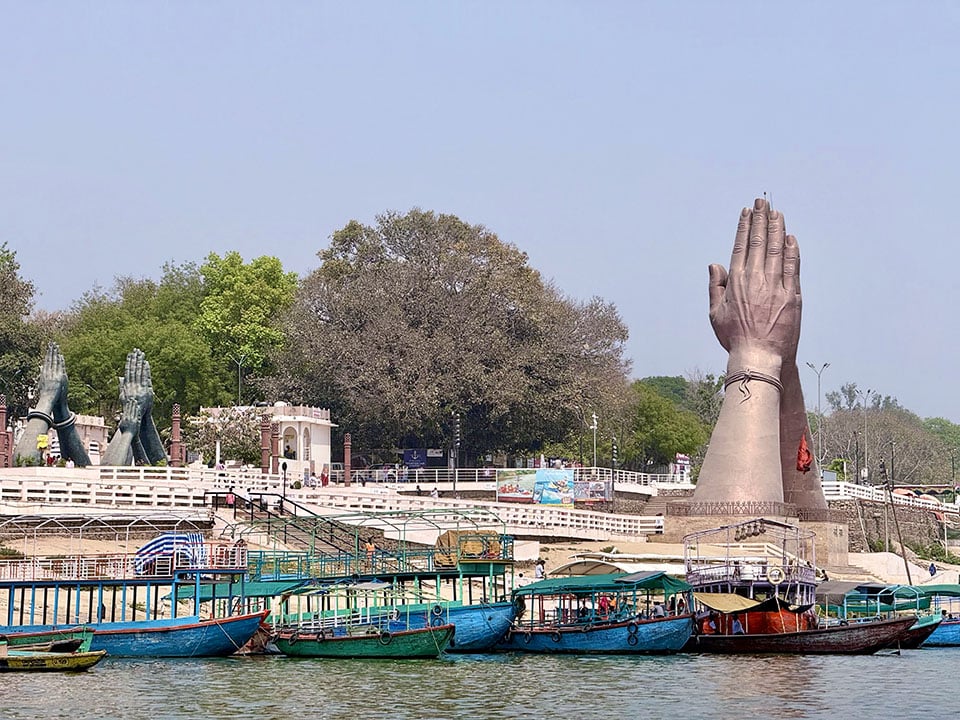
The next morning, we flew from Delhi to Varanasi on our new favorite airline, IndiGo. The flight was only about an hour long, and Indigo Airlines did not disappoint. Once we landed, our group took a 30-minute bus ride through this ancient city of Varanasi—full of street vendors, milkmen on bicycles, painted water towers, and tinmen on rickshaws—to the water’s edge, and our first sighting of Mama Ganga.
Varanasi: City of Light
Varanasi, or the “City of Light” (in ancient times it was known as Kashi, and under British rule known as Banares), is one of the oldest continuously inhabited cities in the world—much of it at least 3,000 years old, and parts are 5,000 years old, which is truly hard to wrap your head around—especially coming from the 250-year-old US!
Varanasi is considered the spiritual heart of India. It is also home to Roger’s own ashram and his late guru, Sri Satua Baba. We were excited to meet Roger’s friend, the current guru of the ashram.
According to Hindu tradition, the city was founded by Lord Shiva. Its legendary luminosity refers not only to the physical light but also to the light of divine wisdom and enlightenment. For many Hindus, Varanasi holds a significance comparable to that of Mecca for Muslims.
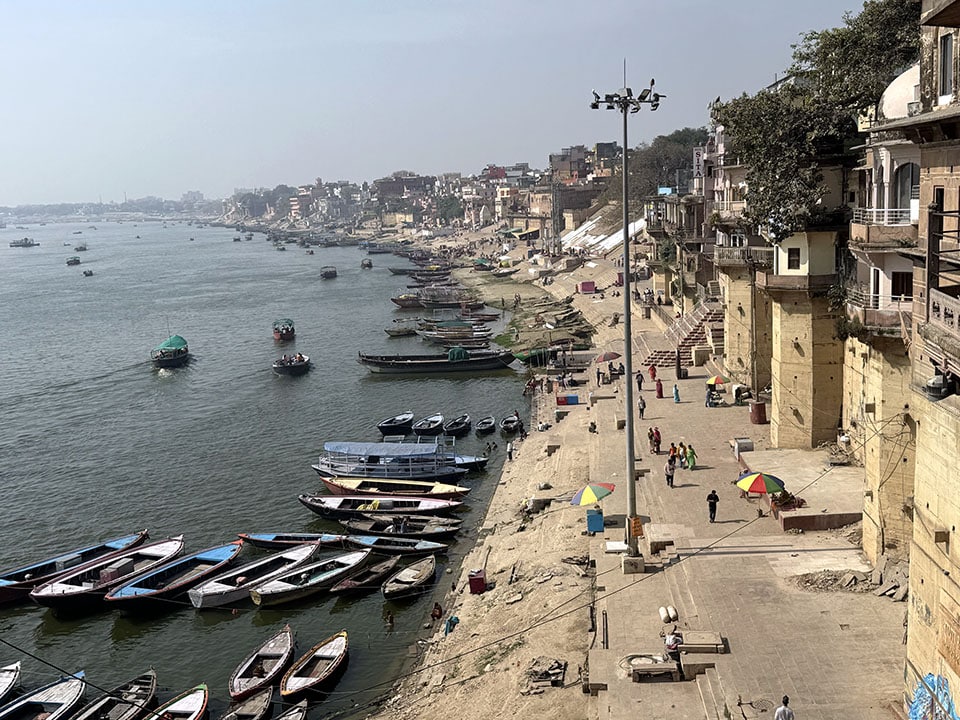
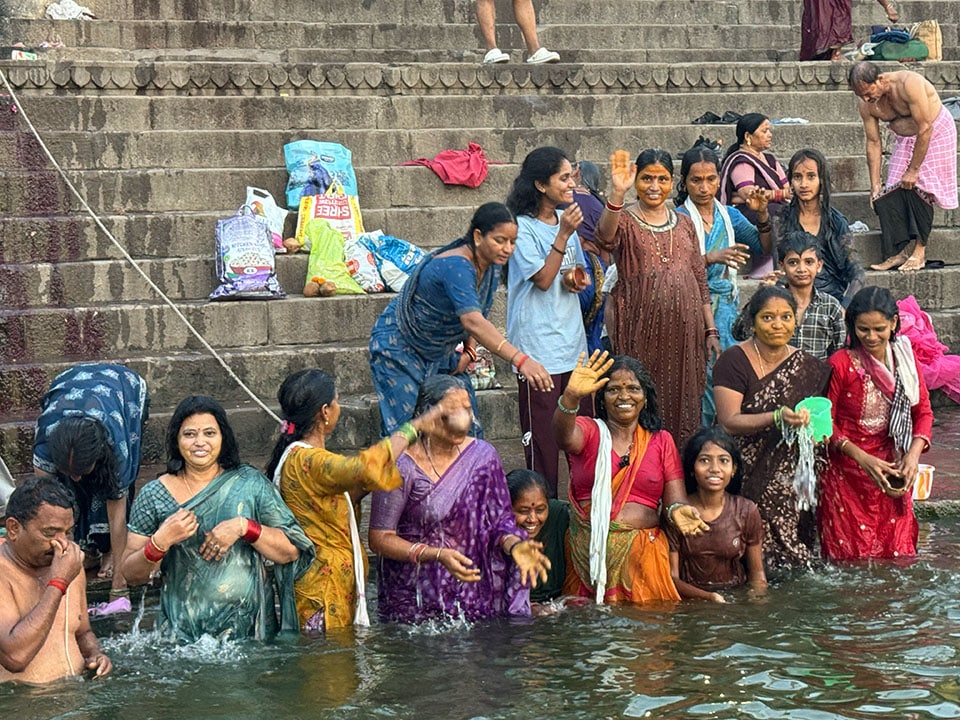
What makes Varanasi unique is its integrated relationship with life, death, and liberation along the banks of the sacred Mother Ganga. Pilgrims come to bathe in her waters, believing they can cleanse negative karma, while the eternal fires of the cremation ghats burn day and night.
Many devout Hindus believe that dying within the sacred boundaries of Varanasi grants moksha—the liberation of the soul from samsara, the endless cycle of birth, death, and rebirth. As a result, thousands of elderly and terminally ill pilgrims journey here each year to spend their final days in this City of Light.
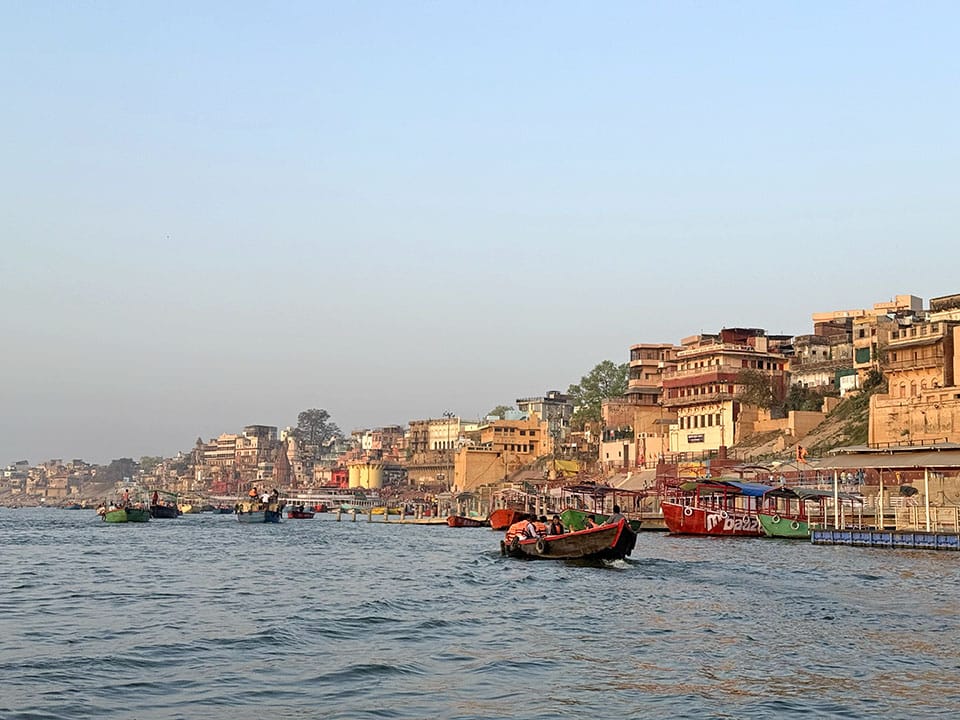
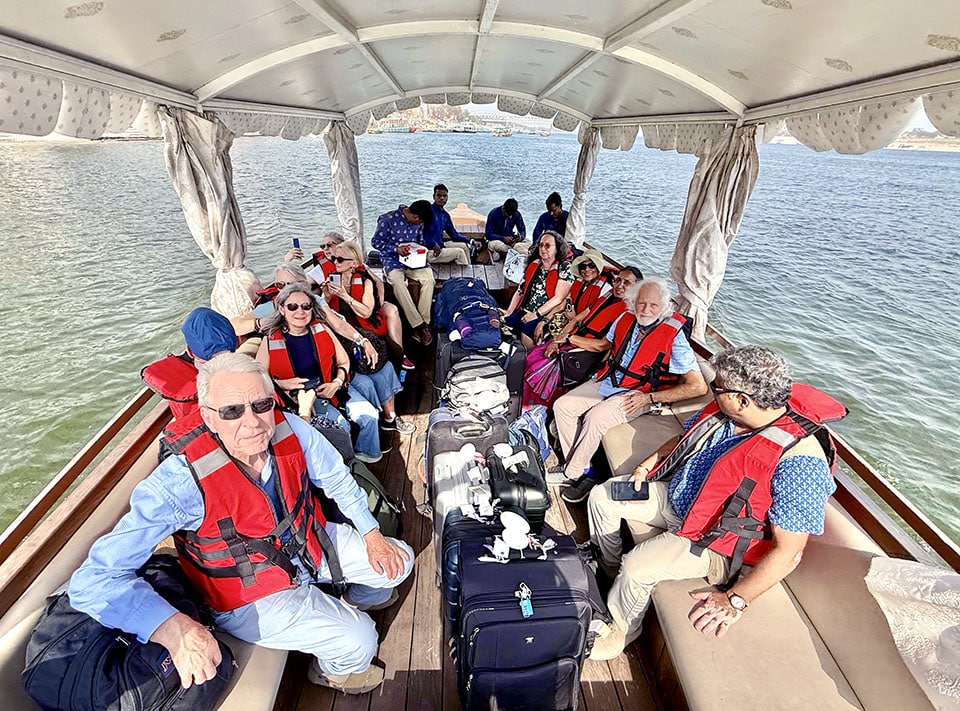
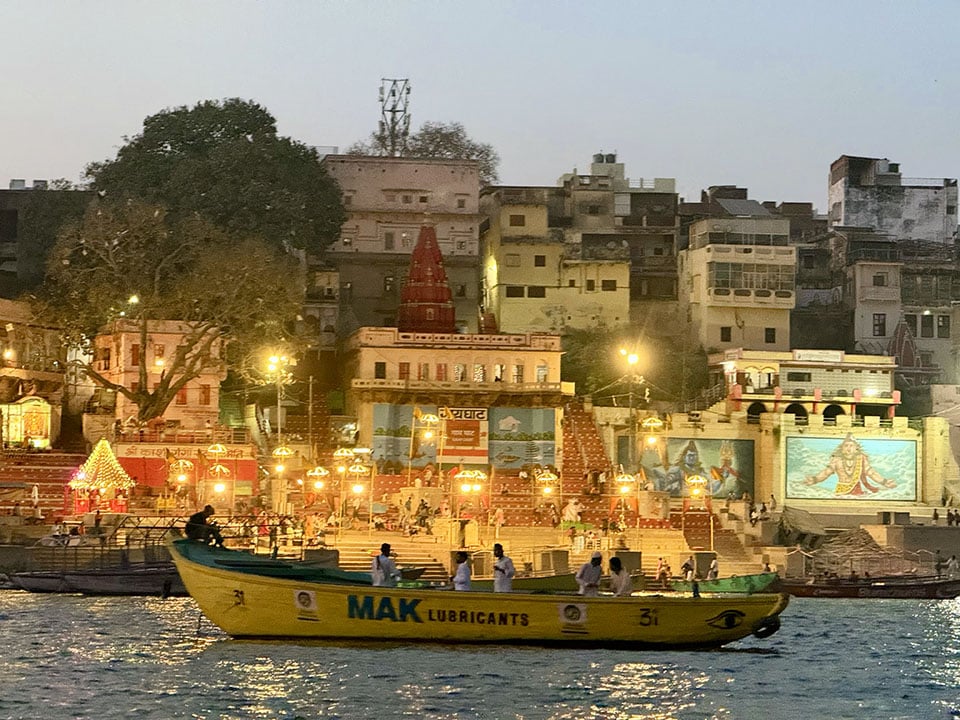
Once at the shores of Mama Ganga, we boarded a water taxi to our hotel. Traveling by boat along the waterfront was like traveling back in time! Seeing the ancient palaces, forts, and buildings, and passing all the ghats (stone steps leading down to the water’s edge) was breathtaking. Cruising along Mama Ganga by boat is the easiest way to access many waterfront businesses, as the ancient city is a labyrinth of narrow winding lanes, sometimes only wide enough for one motorcycle at a time…definitely not a group of 12 with luggage!
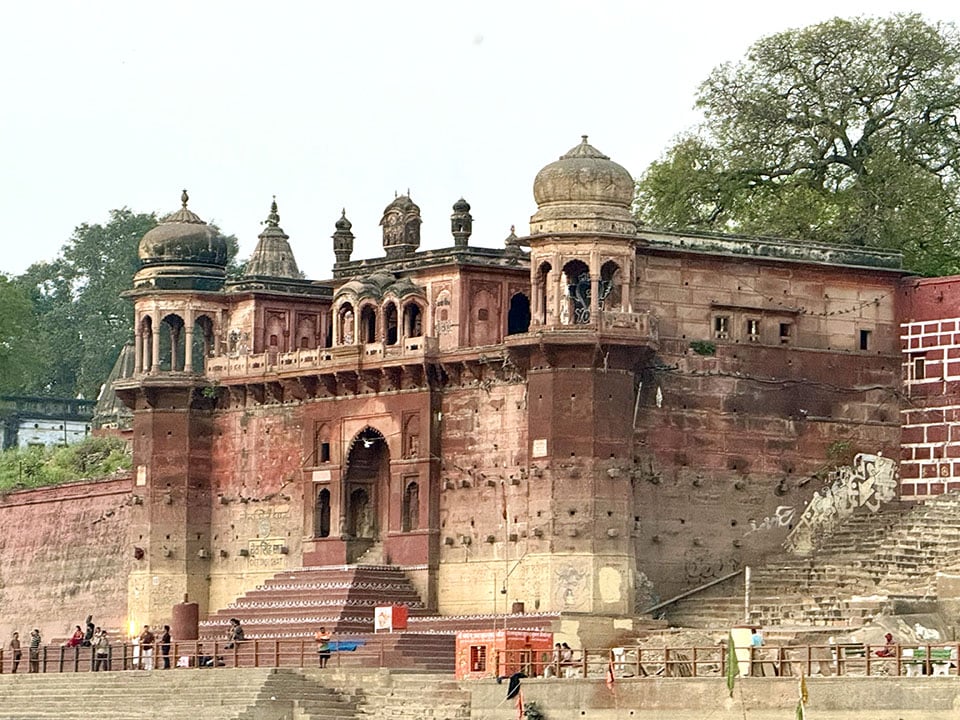
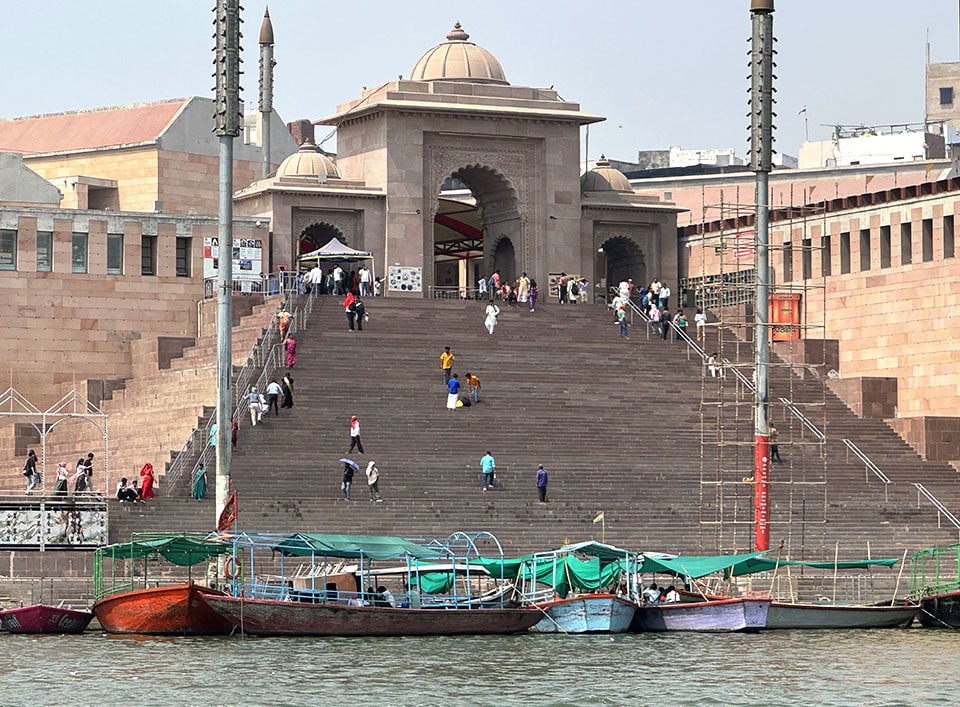
This beautiful, prominent, red sandstone fort-like structure is the Palace of Raja Chet Singh, who ruled the region in the 18th century, and houses three Lord Shiva temples (we passed it several times by boat, but didn’t stop here)
BrijRama Palace
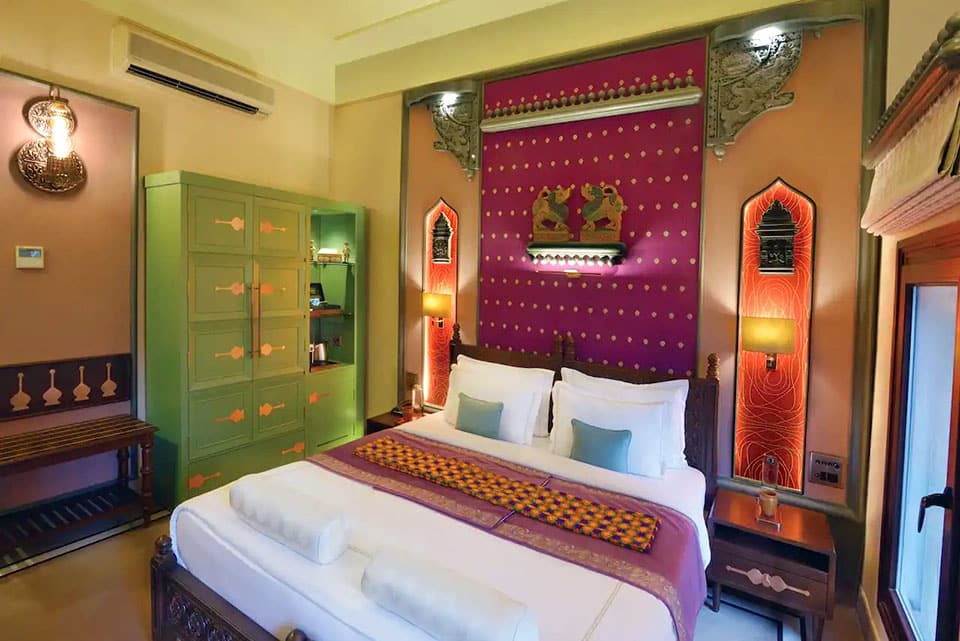
Our jaws seriously dropped when we arrived at the BrijRama Palace Hotel in Varanasi. This former palace was one of our favorite hotels in India. Our room was a bit unusual—it had no windows, perhaps because it was once part of the old harem quarters—but it was still very colorful and beautiful. Since we were really only there to sleep, the lack of windows wasn’t a big deal. The palace’s stunning public spaces more than made up for it, as you can see below. The tallest tower in the photo below is actually an elevator shaft that carries guests from the ghats (steps) up to the hotel.
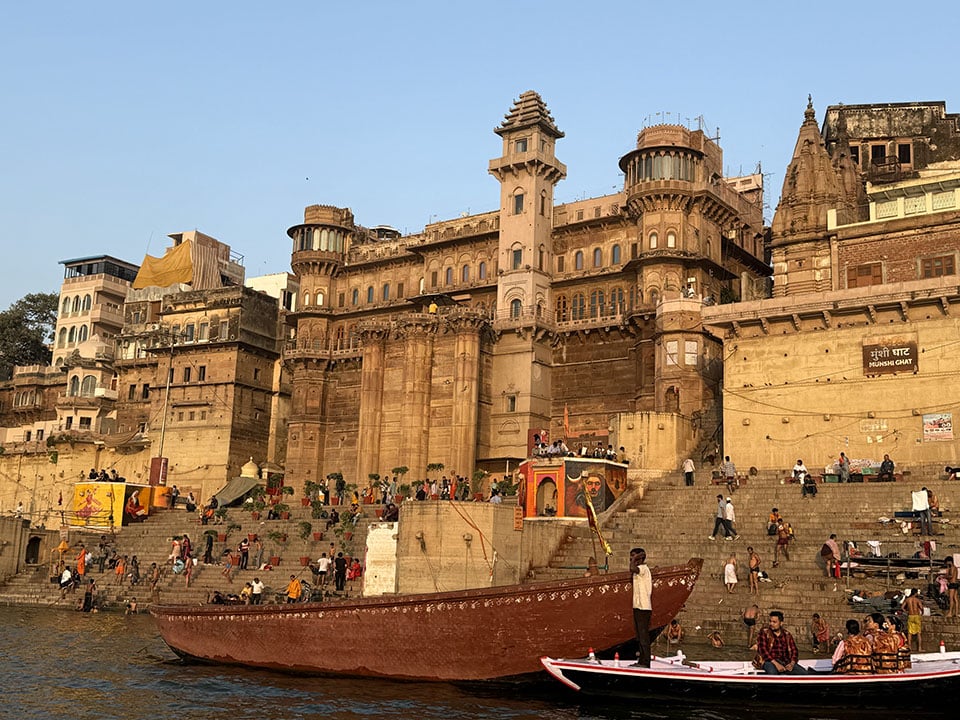
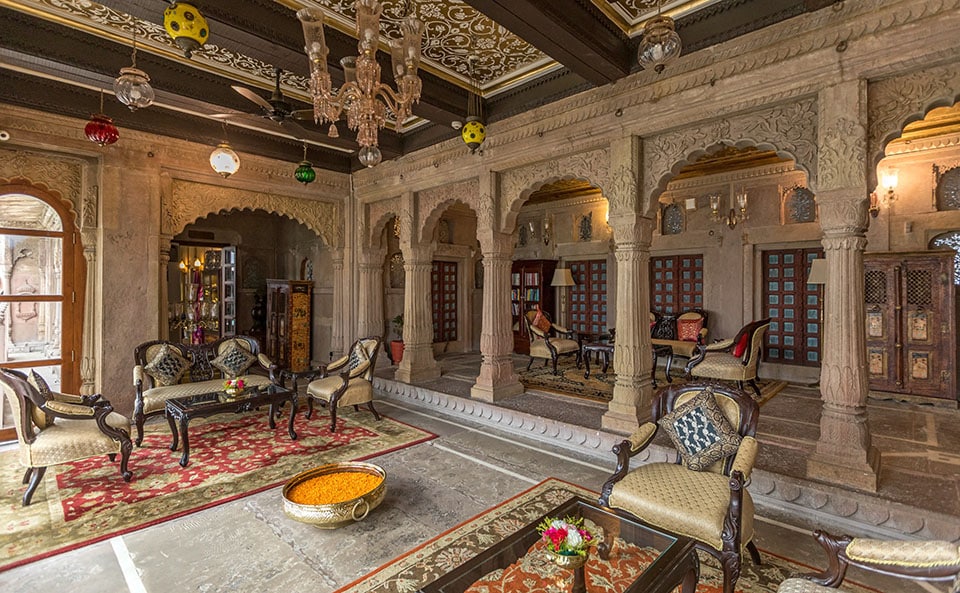
Back in the 1800s, this palace fortress was among the most coveted addresses in Varanasi. Built as a royal residence overlooking the Ganges, it welcomed maharajas, aristocrats, priests, and musicians, all drawn to its unique blend of luxury and spirituality. Intricately carved sandstone, hand-painted ceilings, and gold-leaf details reflected the wealth and refinement of this royal palace.
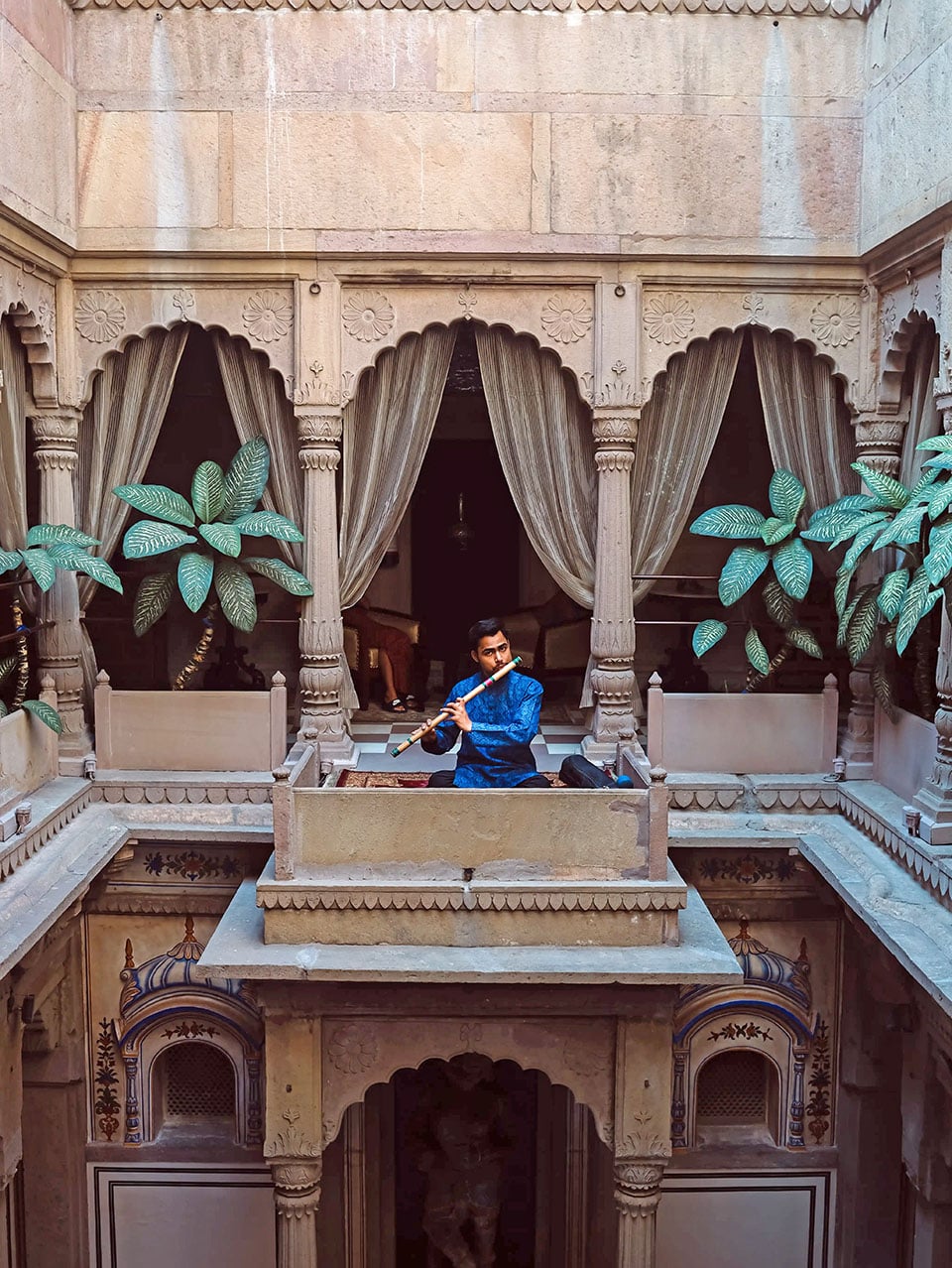
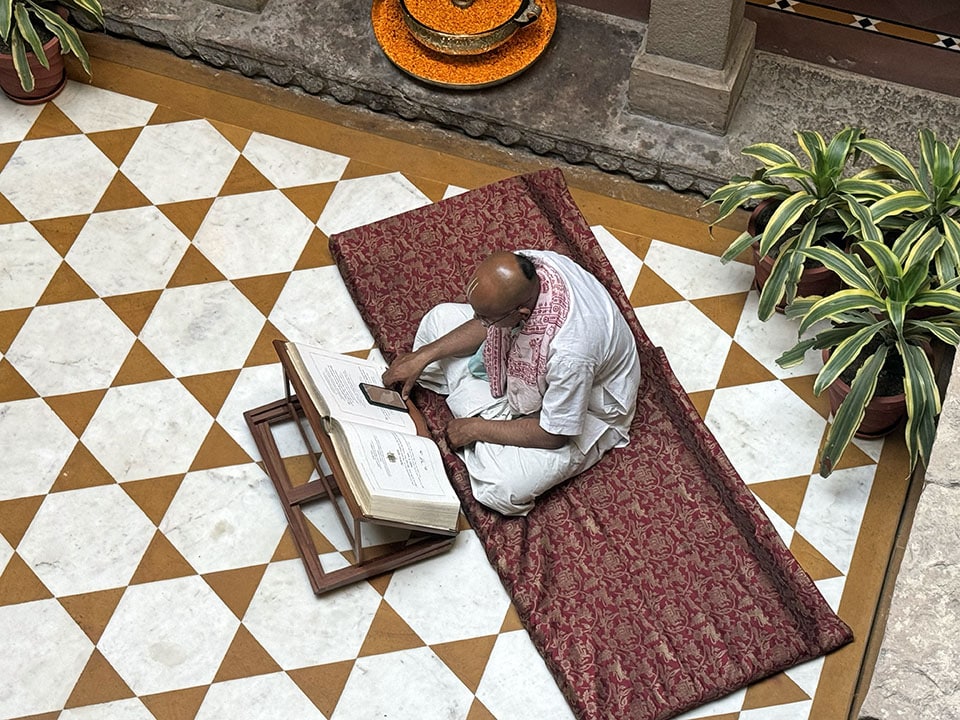
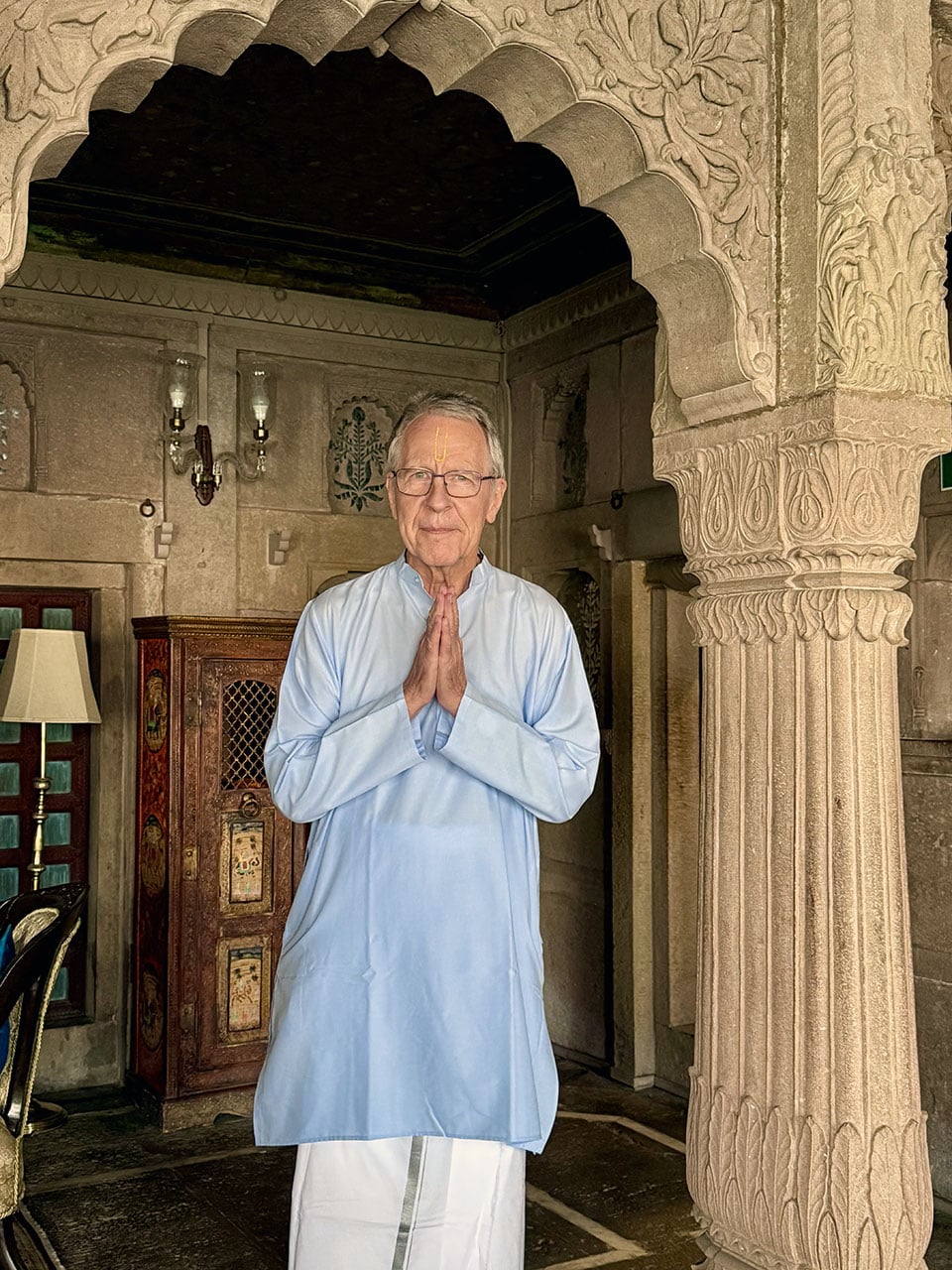
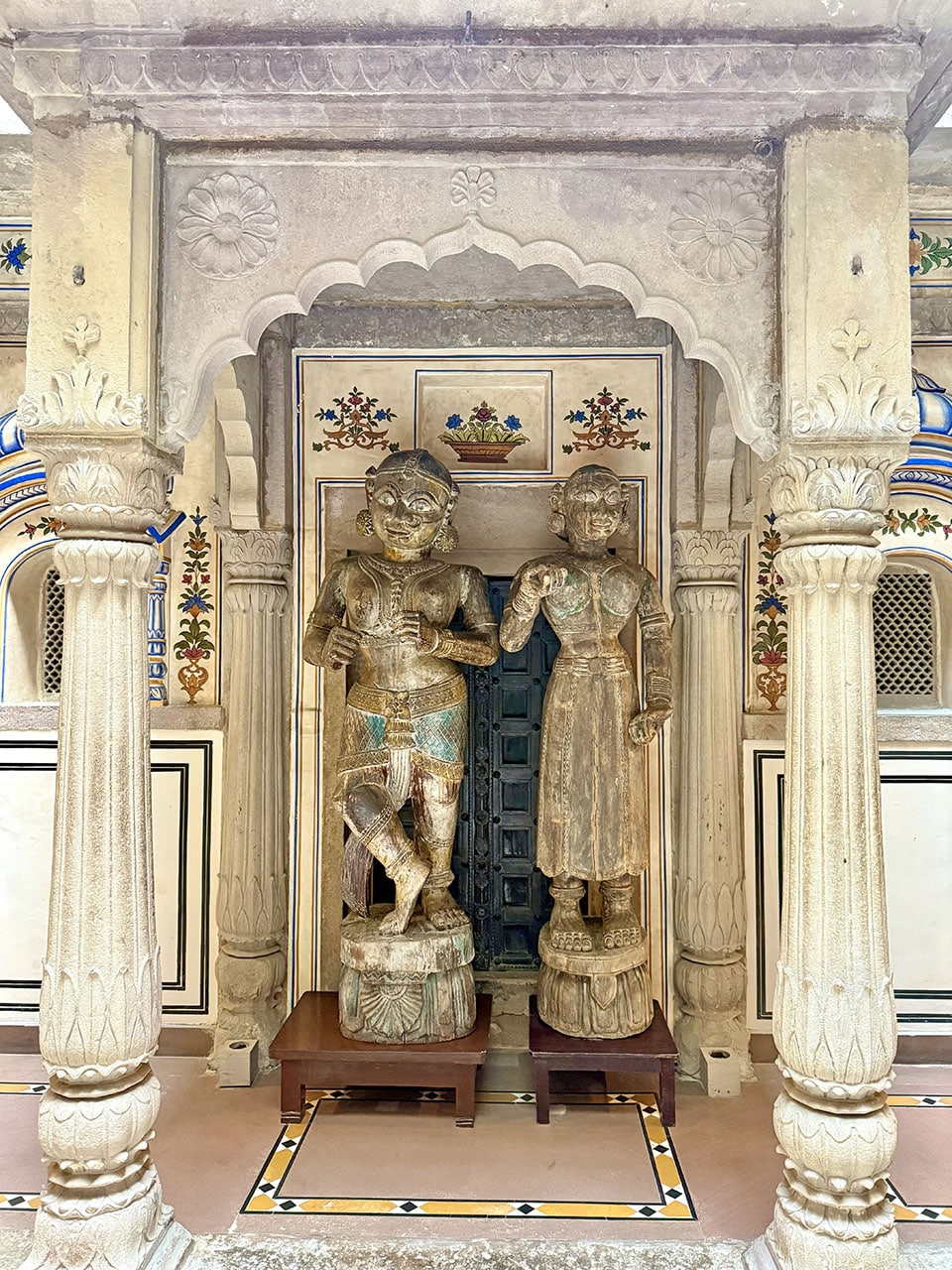
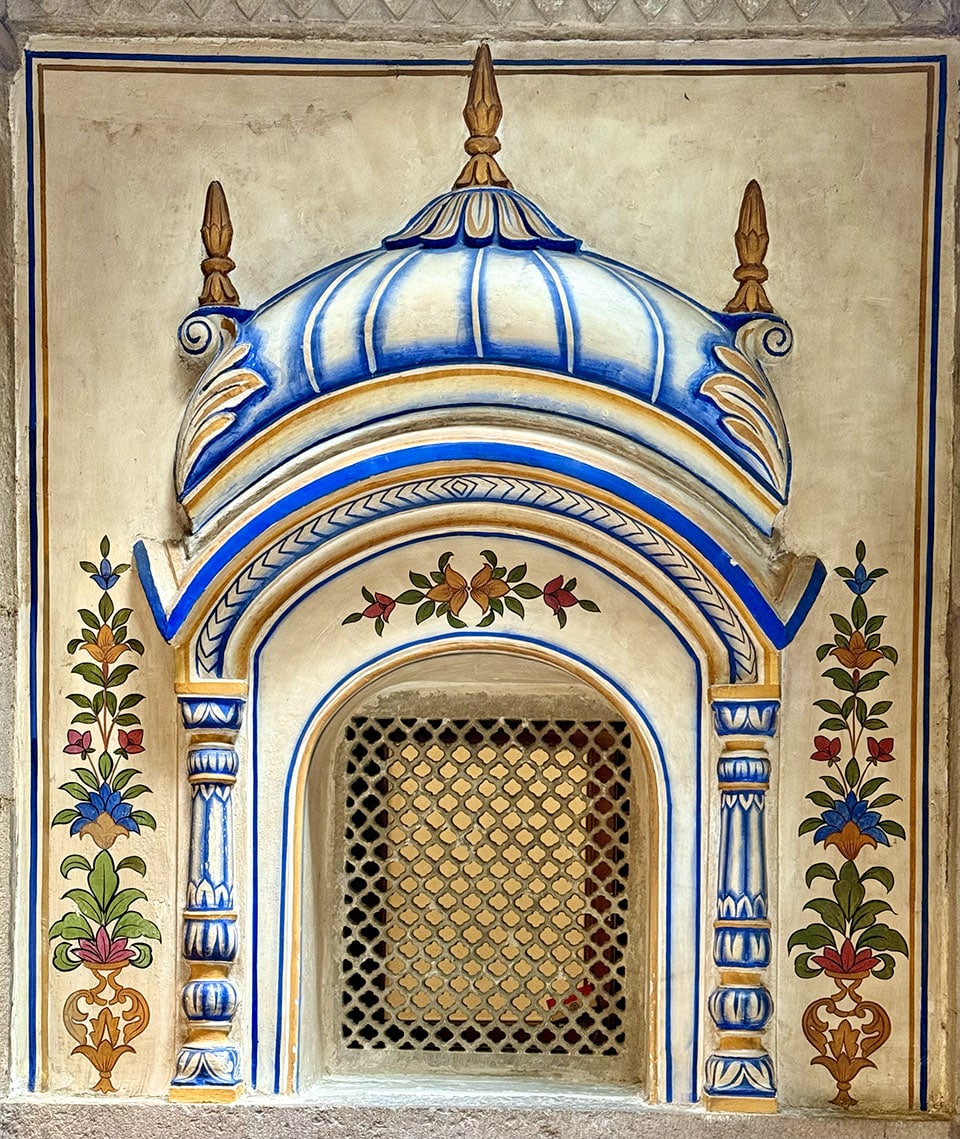
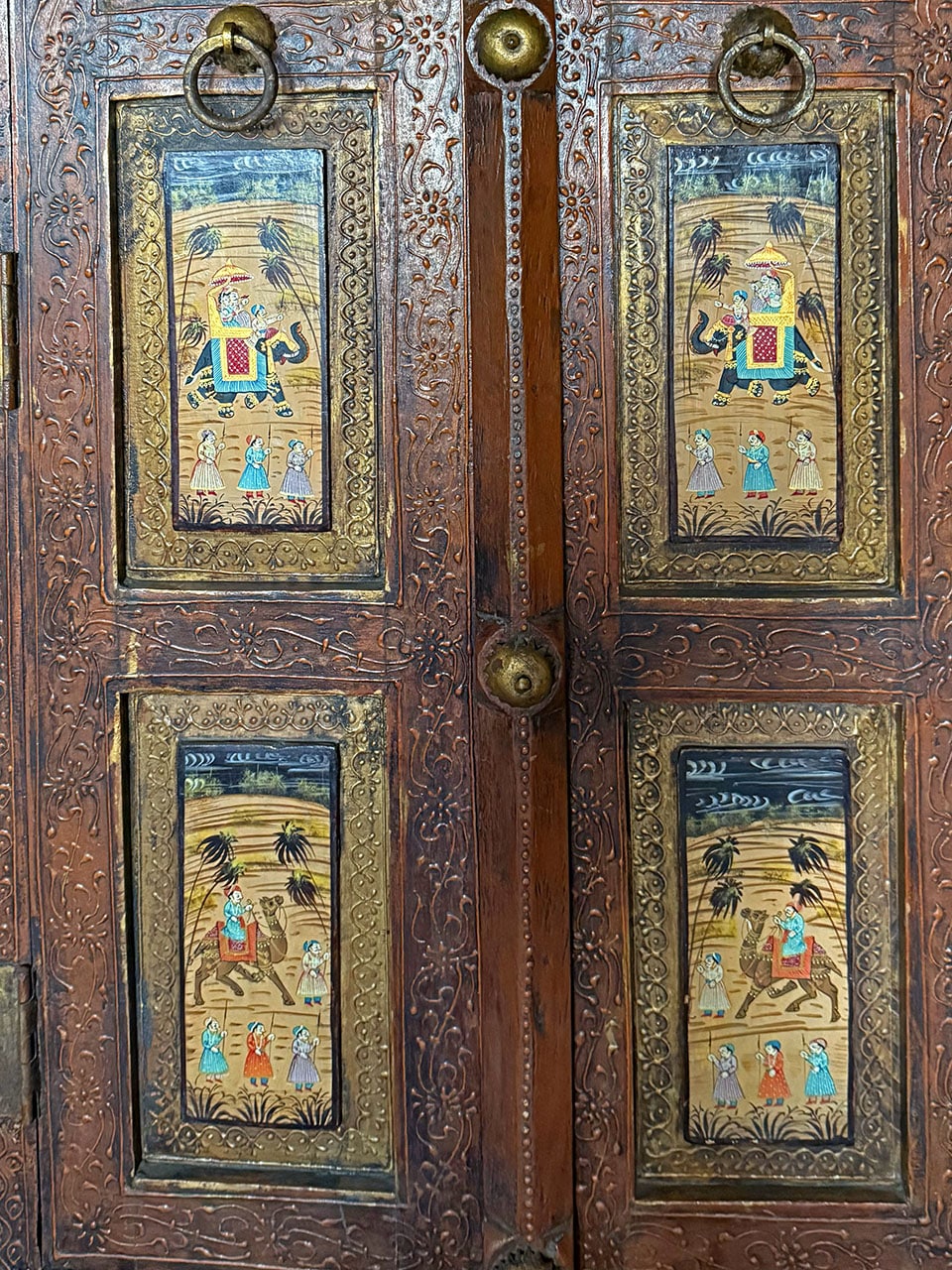
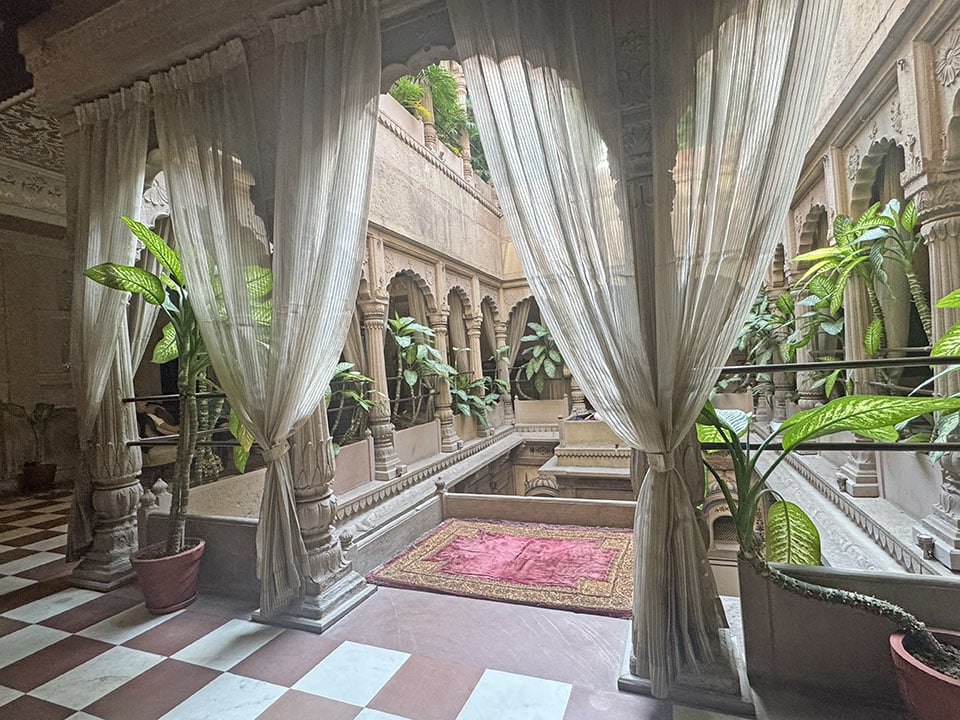
Staying at the BrijRama Palace felt like traveling back to the maharaja heydays—with the live Indian flute music playing in the courtyard, a pundit reciting in Sanskrit from the Bhagavad Gita, henna artists, dancers, and the staff wearing traditional Indian clothing, it was such a lovely experience!
Audio of the beautiful classical Indian flute music with a still photo.
In the afternoon, we took a walking tour around our hotel and got a better understanding of why it was much easier to arrive by boat than to try to get a vehicle through the maze of narrow streets and electrical wires!
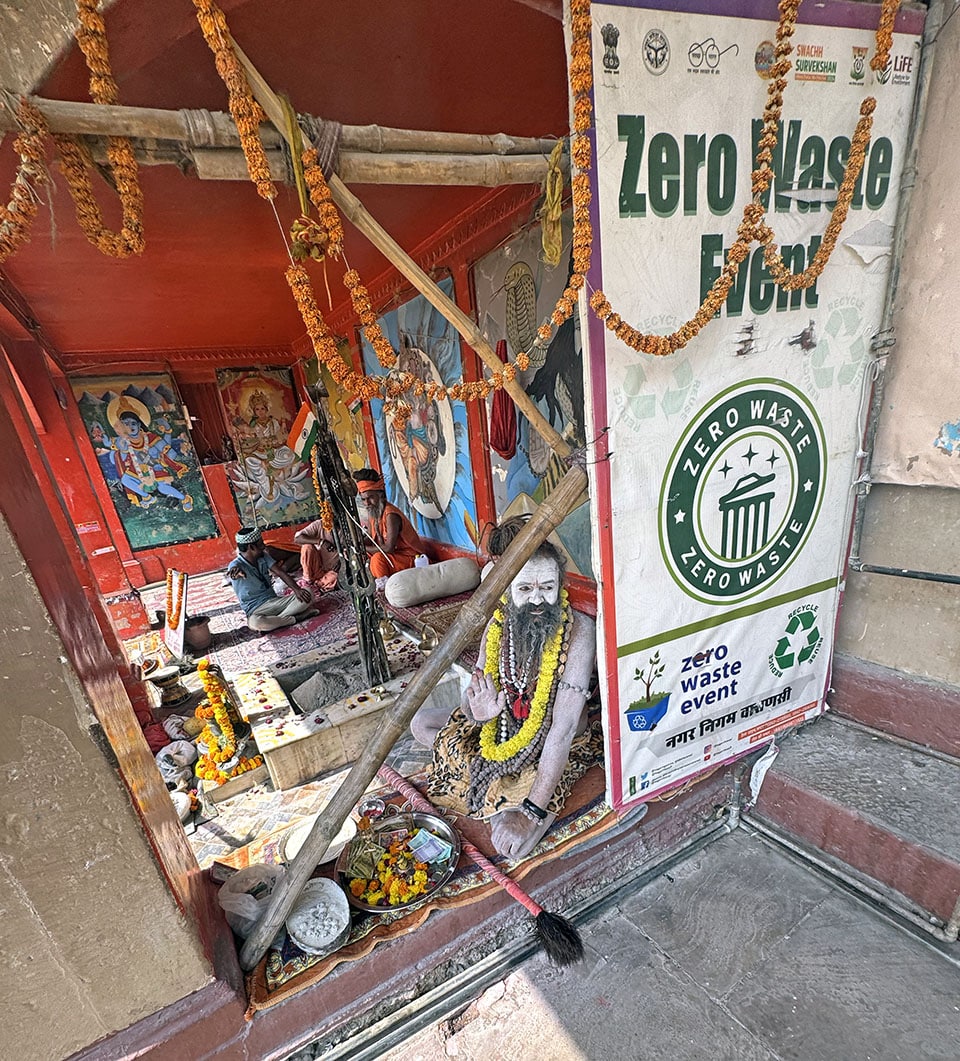
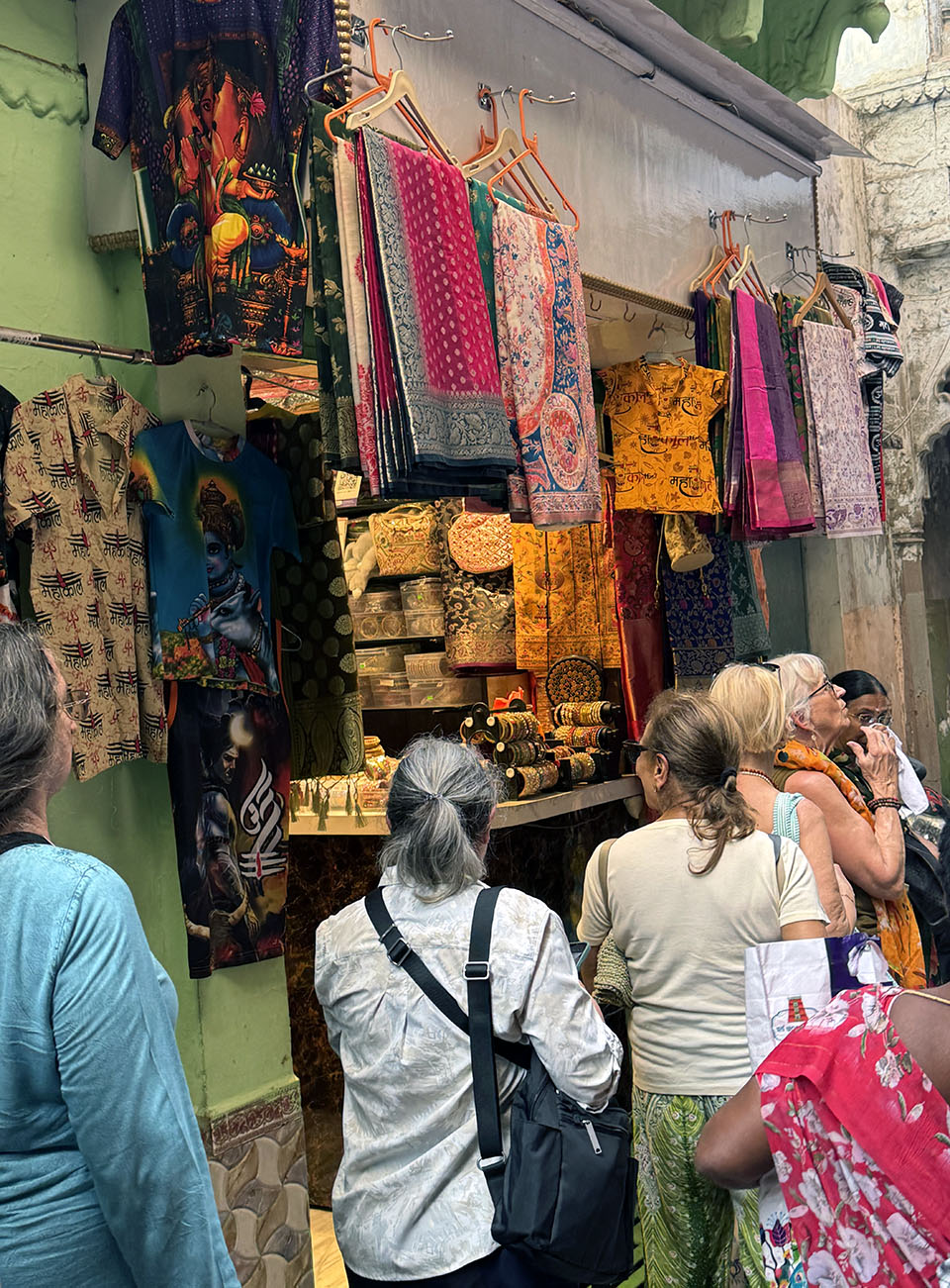
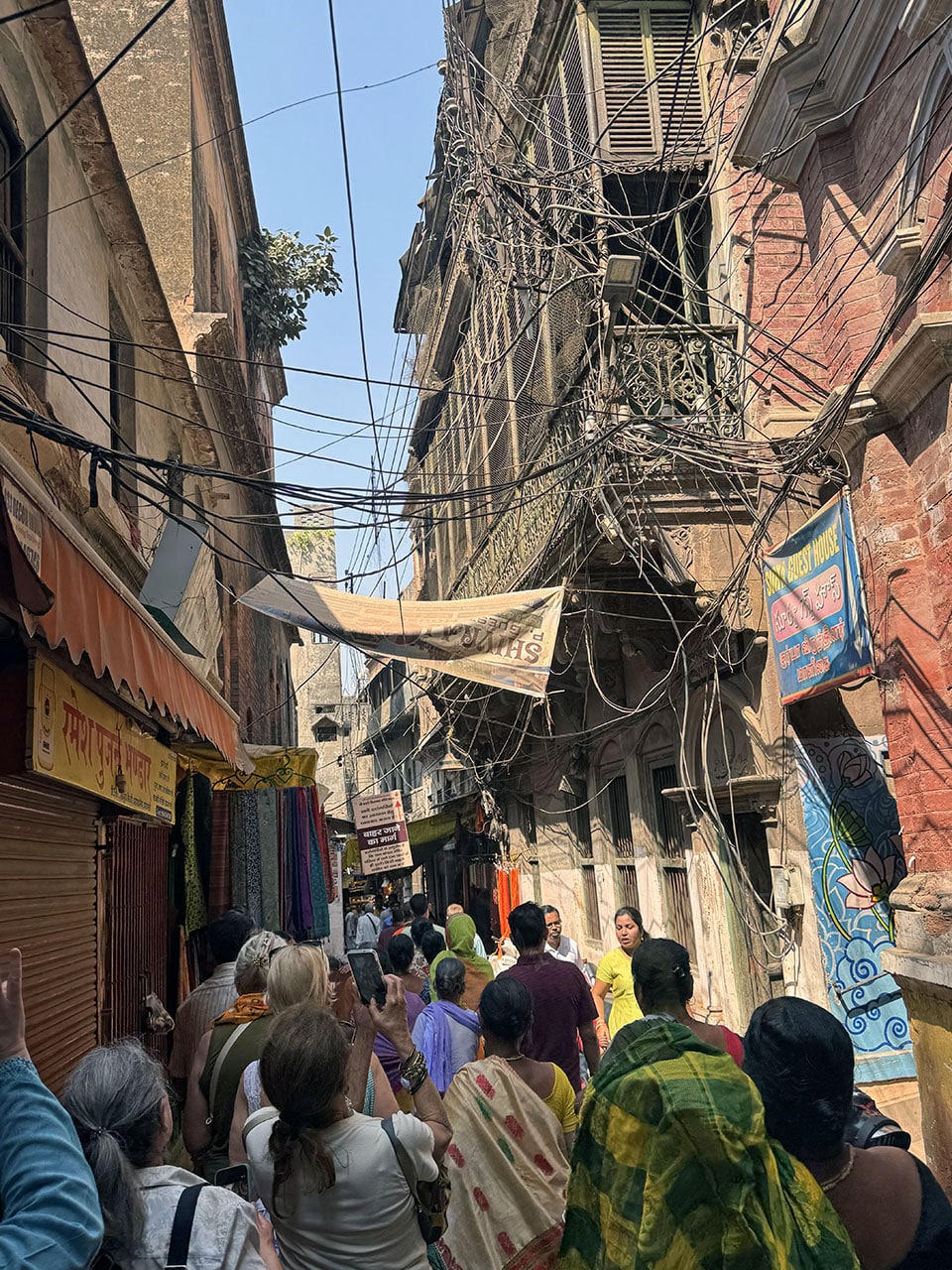
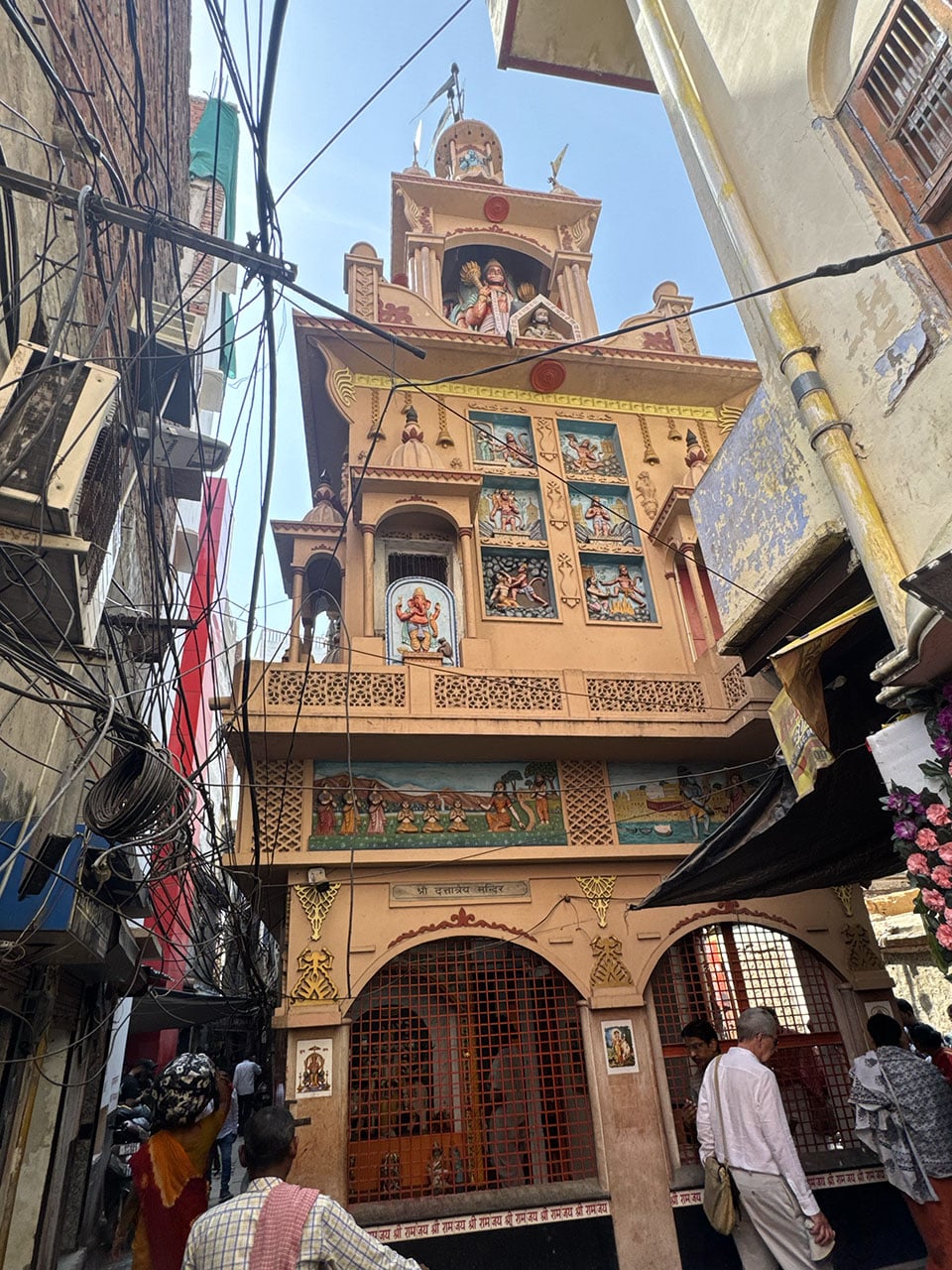
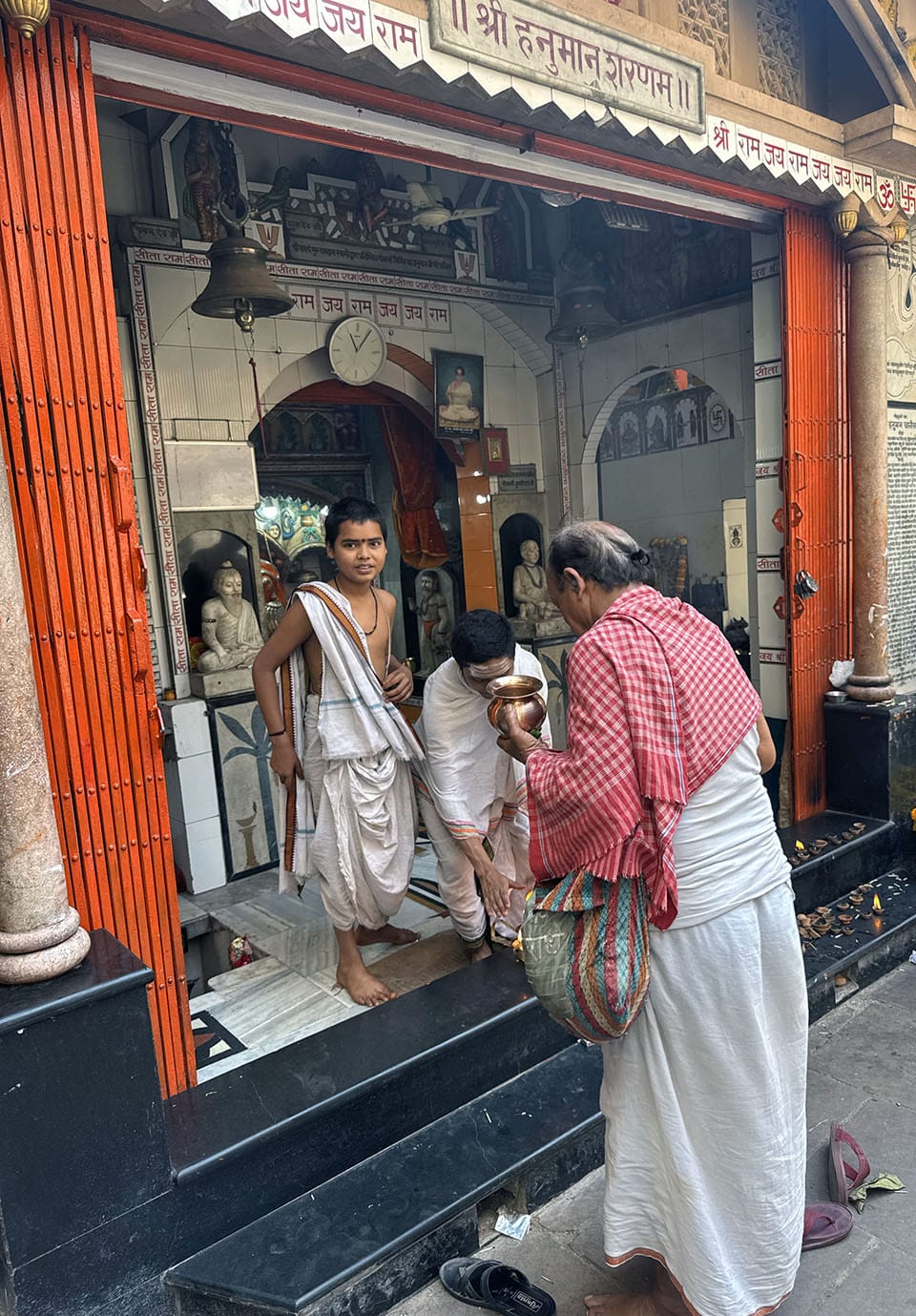
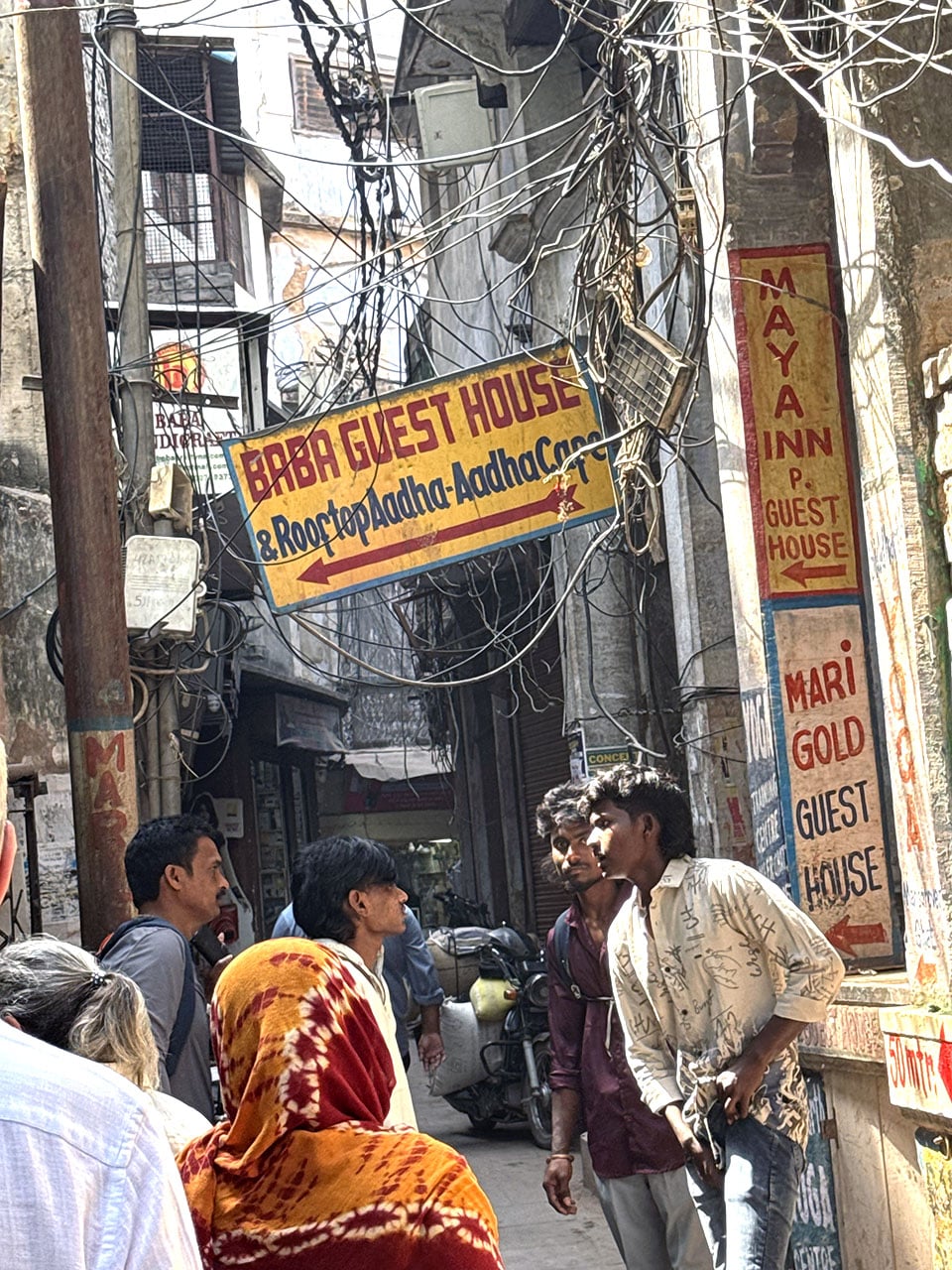
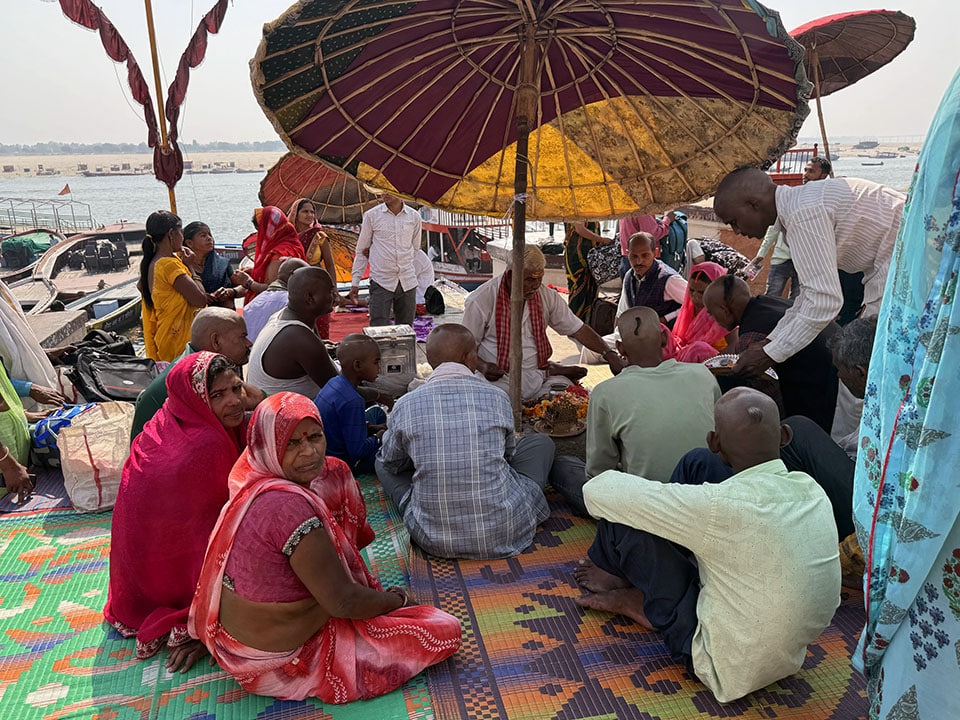
Varanasi Aarti Ceremony
On our first evening in Varanasi, we were treated to a sunset river cruise and then the spectacular evening Aarti ceremony that we had long heard about.
The stunningly beautiful Ganga Aarti (“removal of darkness”) ceremony—performed nightly at dusk along the stone ghats of cities on the banks of the sacred Mama Ganga—was one of the most powerful experiences we had in India. And we were fortunate to witness this mesmerizing ritual in Varanasi, Rishikesh, and Haridwar, all uniquely different.
Our hotel boat driver did an excellent job jockeying us into position for front-row seats from the water… Initially, we had been in a different location, but then he decided to move for a much better view, and we were so glad he did.
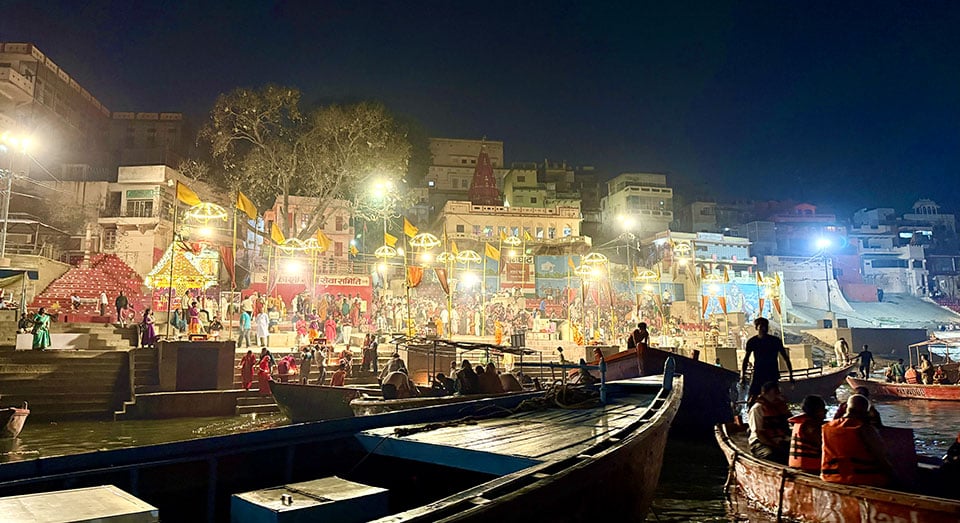
The belief that “we are all one” and the outpouring of love and light emanated throughout the boats and people on shore.
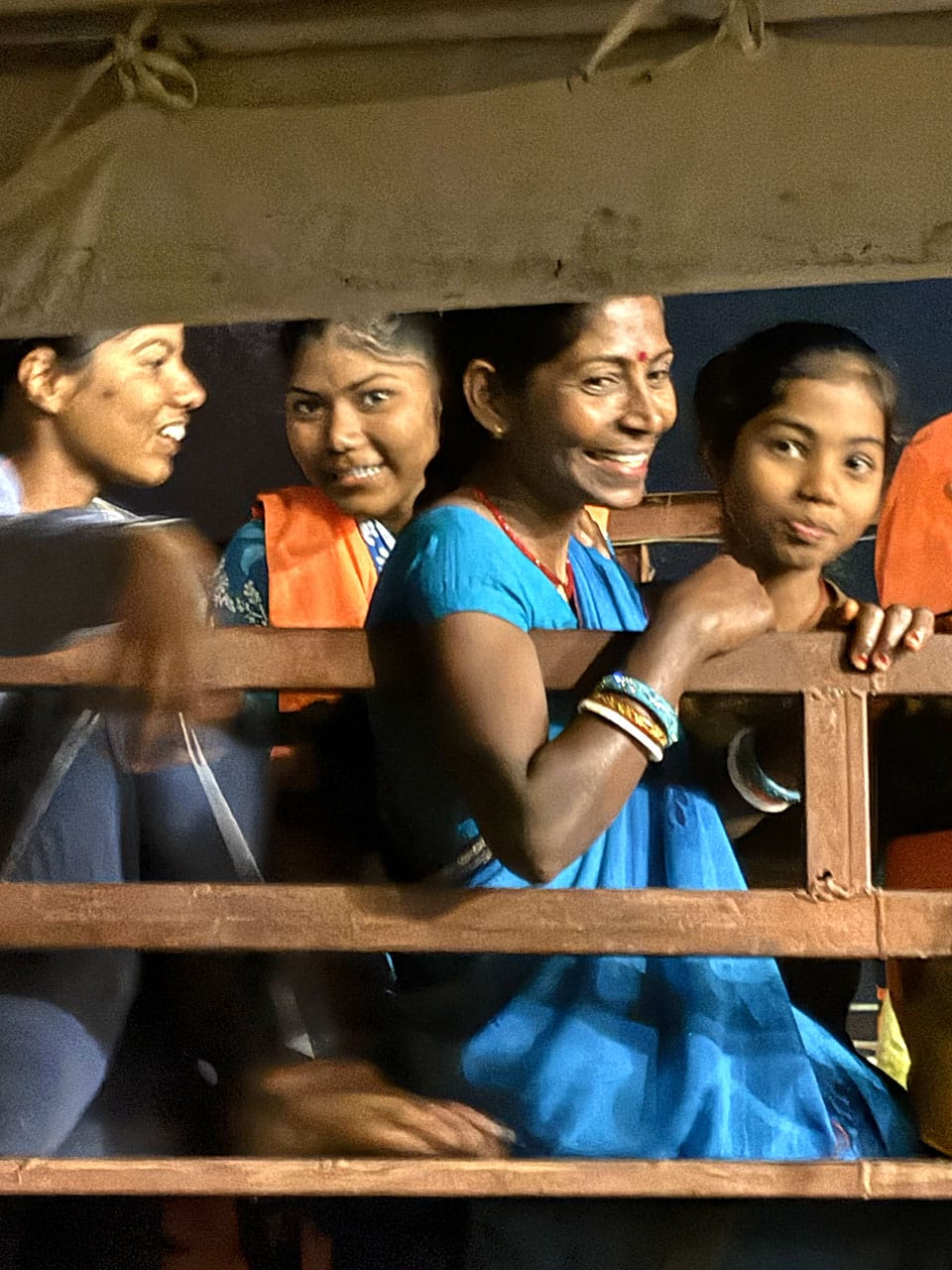
There were literally hundreds of boats all jammed together, touching each other…and before the ceremony began, we smiled and waved at the passengers in the other boats. Soon everyone was smiling and waving back, shaking hands, and taking selfies.
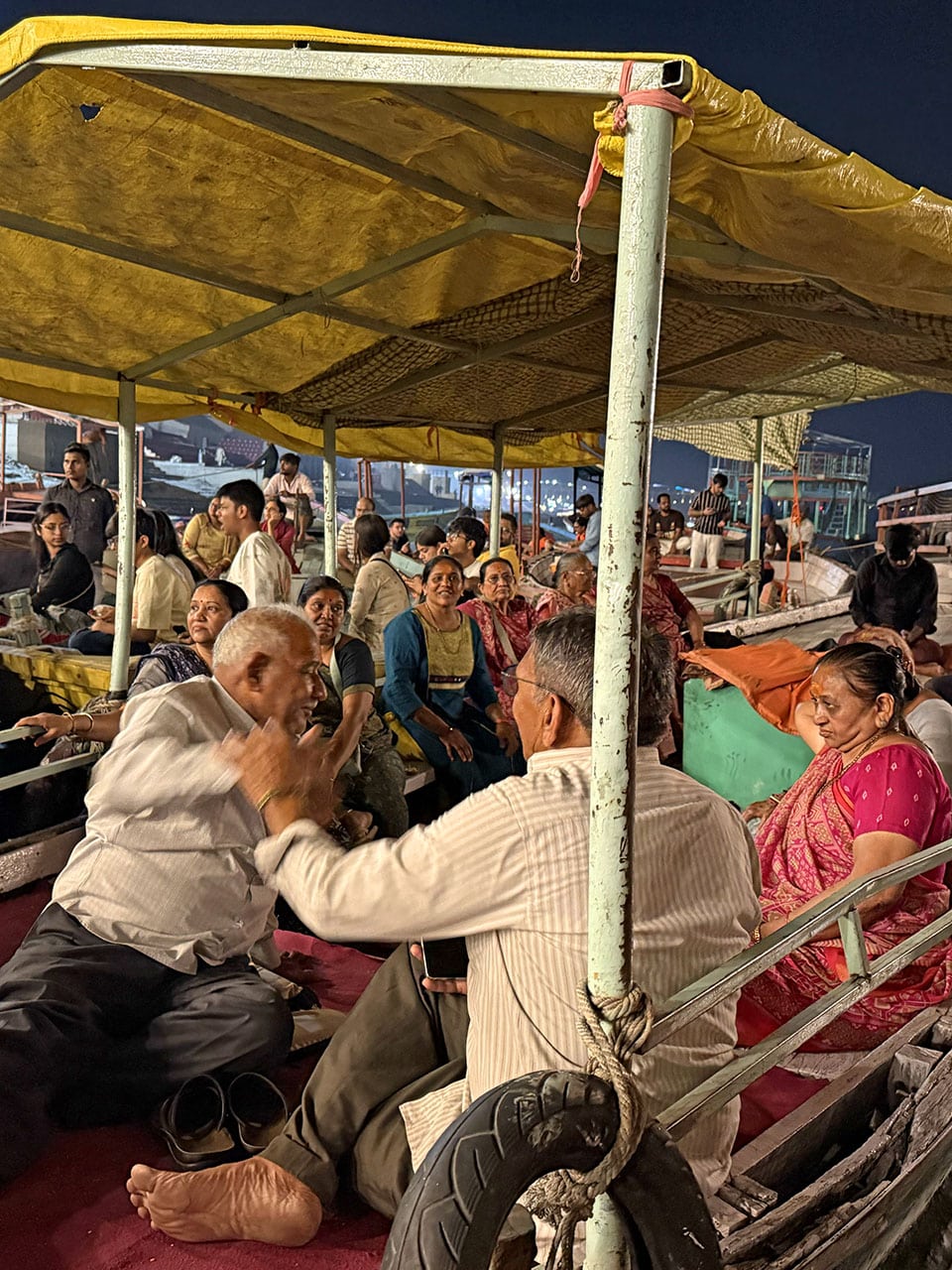
During the Aarti ritual, priests in bright orange or maroon clothing chanted sacred prayers honoring Mama Ganga while swinging large brass butter lamps (filled with ghee) in rhythmic patterns tracing the OM 🕉️ symbol. The whole celebration was accompanied by traditional live music, bell ringing, and audience clapping. Can you imagine they do this celebration EVERY NIGHT, rain or shine!? Click the first photo below to see a video of the Varanasi Aarti.
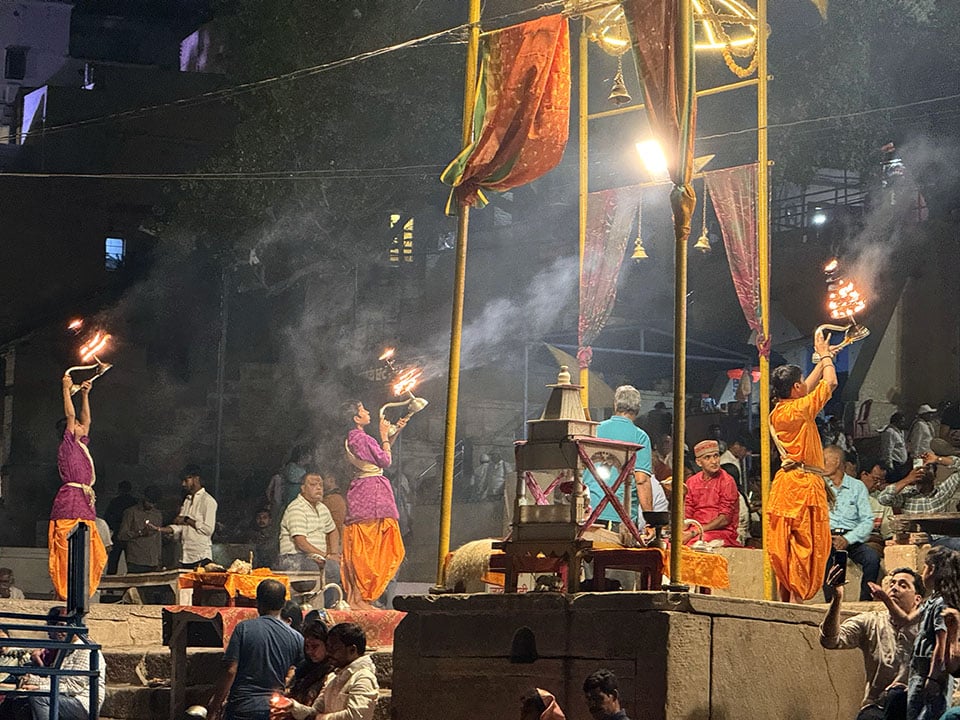
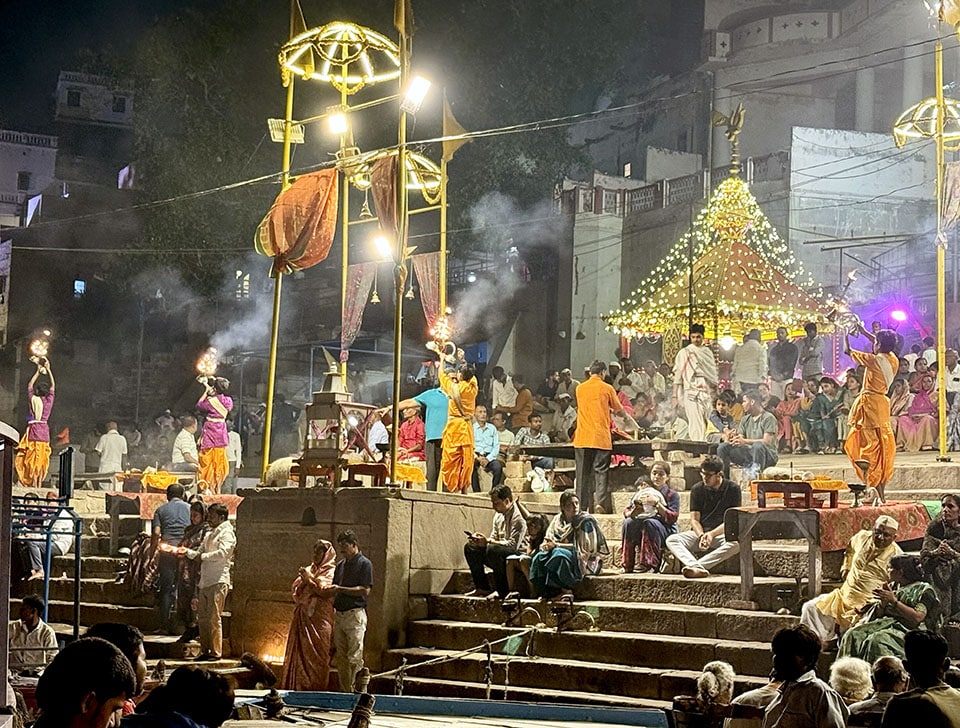
This ritual—combining prayer, worship, and celebration—symbolizes the five elements (earth, fire, air, water, and space) and represents humans offering their devotion to the divine through this sacred river.
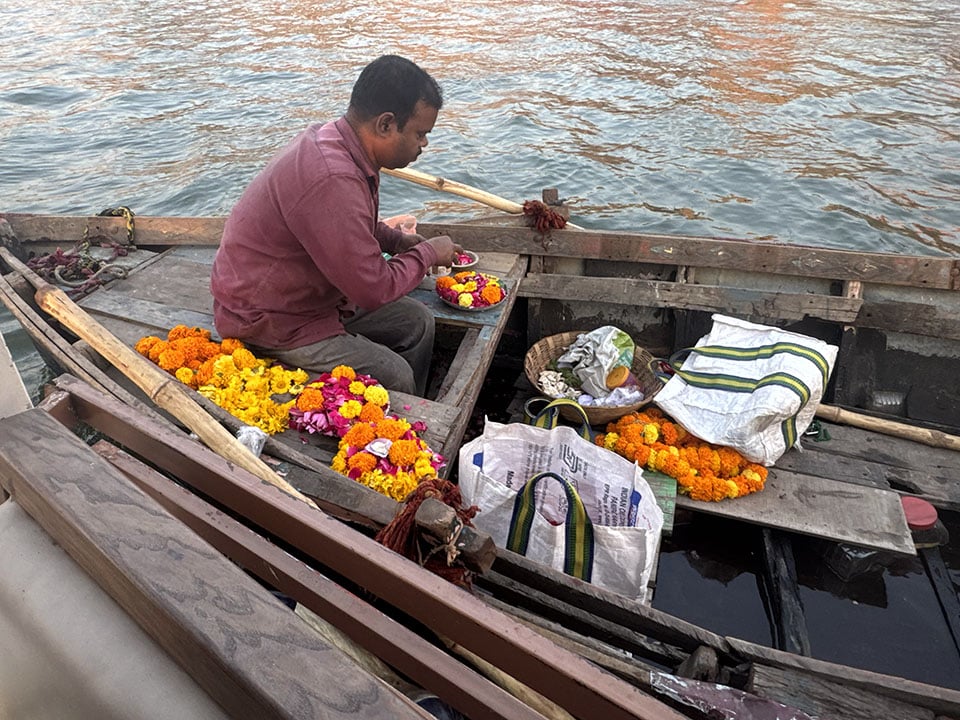
As the Aarti ceremony unfolded, young boys jumped from boat to boat, selling small palm-frond plates called diyas, with burning incense, flaming camphor, and flowers for us to offer to the river.
Contributing to the Aarti’s powerful experience is that everyone joins in—thousands of pilgrims, tourists, and locals gather along the ghats and in boats on the water each evening to celebrate the river goddess Ganga, rain or shine. Pure magic!
Sunrise over Mama Ganga
Early the next morning at 5 AM, we took another boat ride downriver to see sunrise over the Ganges.
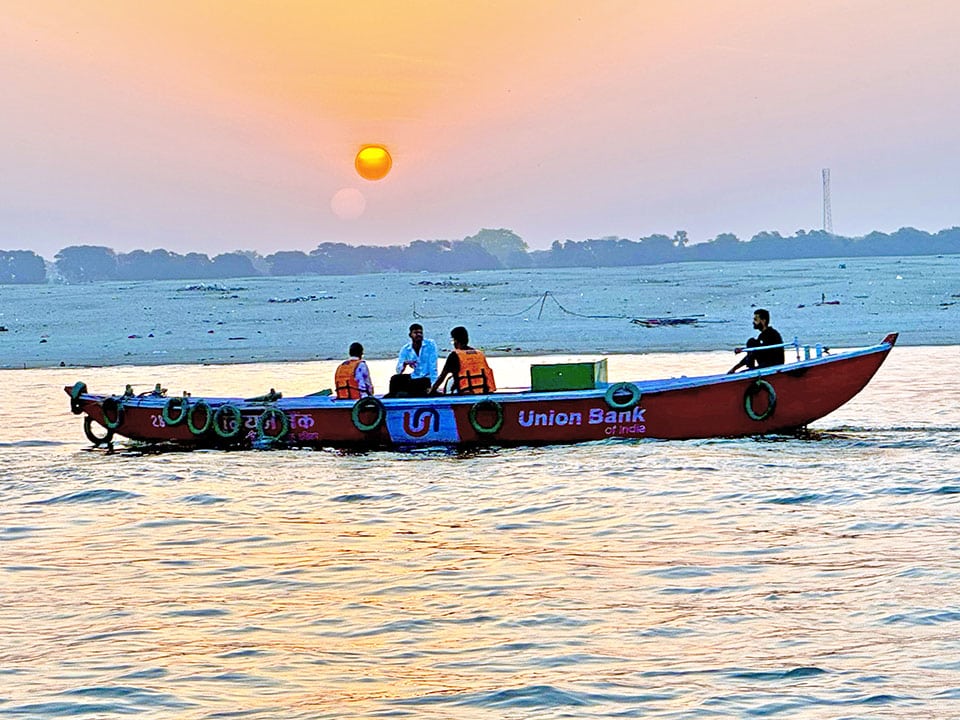
Even this early in the morning, the air pollution was already nearly as bad as Delhi, with only 2 million people here, versus 35 million in Delhi. While we frequently wore face masks to help our lungs, the air pollution did make for beautiful sunrises and sunsets!
The views along the river continued to amaze us, so many old buildings, and possibly the best photos of our whole trip are from here in Varanasi, along the Ganges. And so many boats everywhere, large and small, full of people, and cleaning up the water…
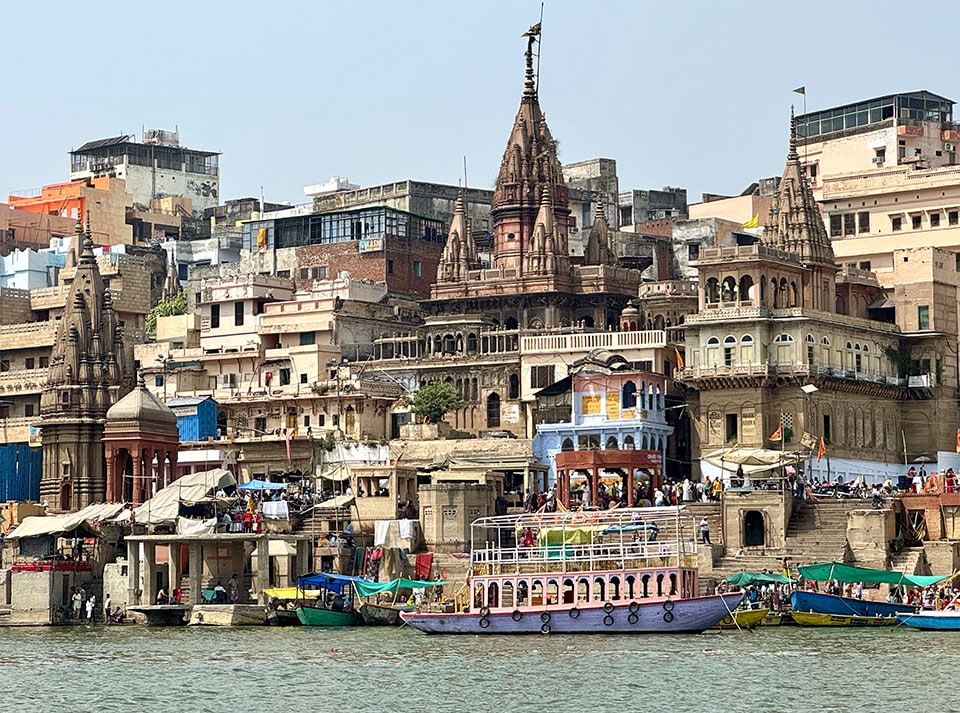
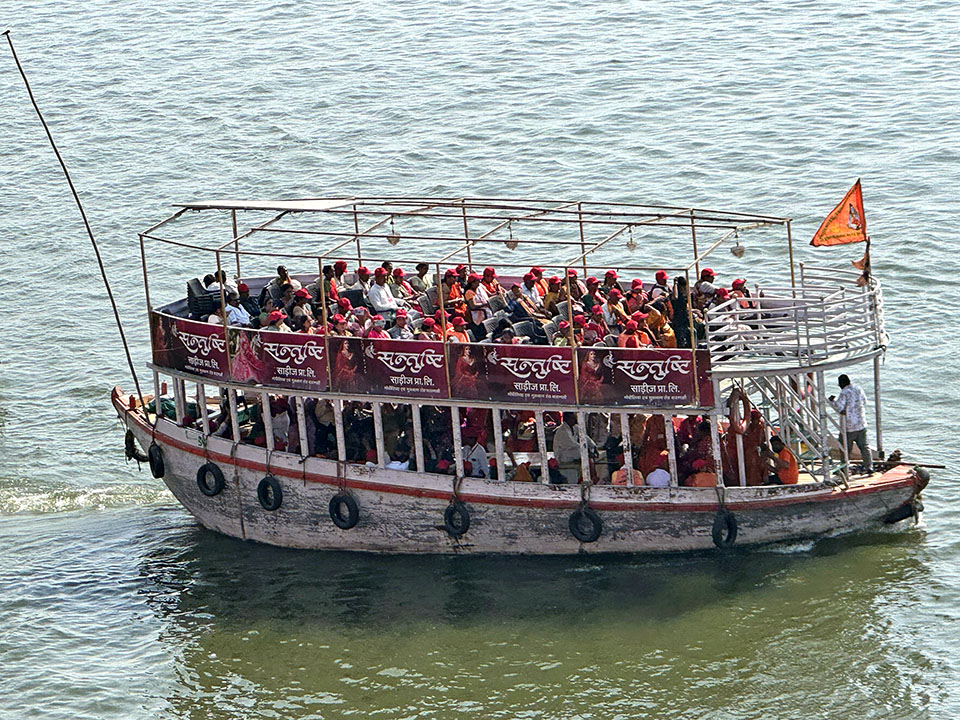
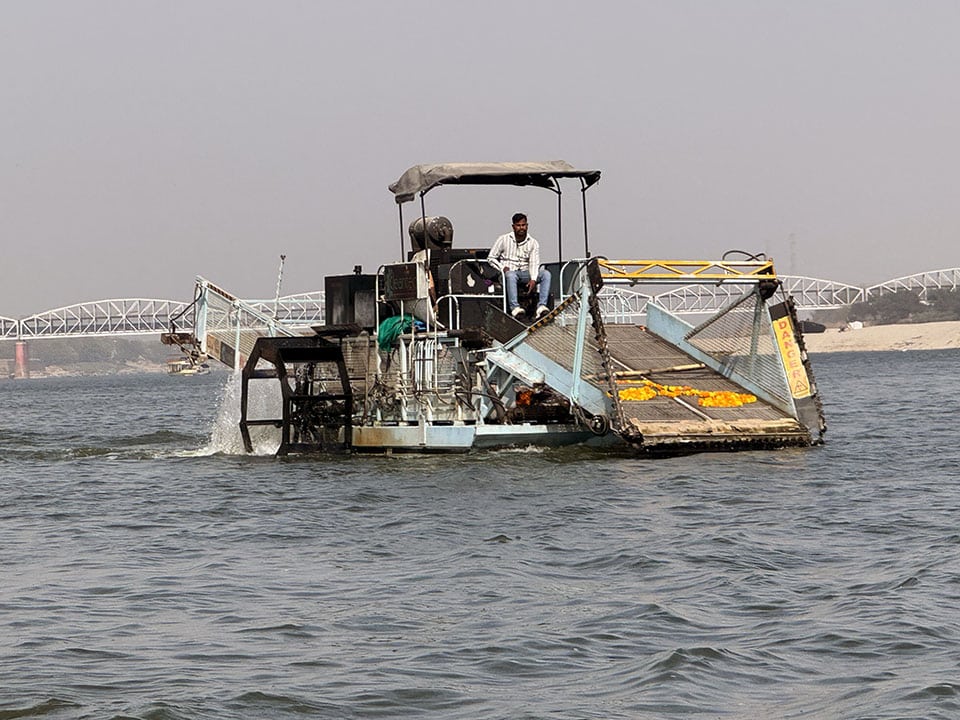
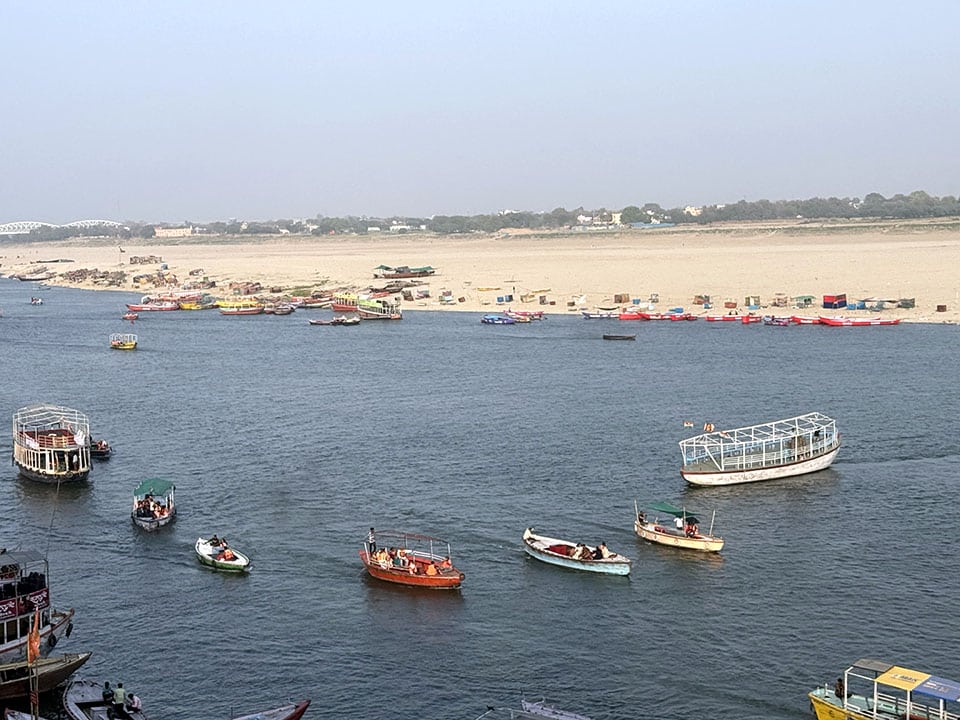
Across from the city side of the river is a huge sandbar that is totally submerged during monsoon season.
Manikarnika Cremation Ghat
Just after sunrise, we had an up-close-and-personal view from the water of the Manikarnika cremation ghat, with its stacks and stacks of wood and bodies wrapped in white cloths, draped in brightly colored fresh flowers. While many in western nations shy away from death as morbid or unsettling, Hindus embrace death as part of the cycle of life in the natural world—of which humans are a part.
These cremation grounds have been in continuous use for thousands of years—and the same family has overseen the sacred fires for generations. (In the second photo, the orange and peach colored building with gold domes behind the cremation ghat is the Satua Baba Ashram, which we visit, below.)
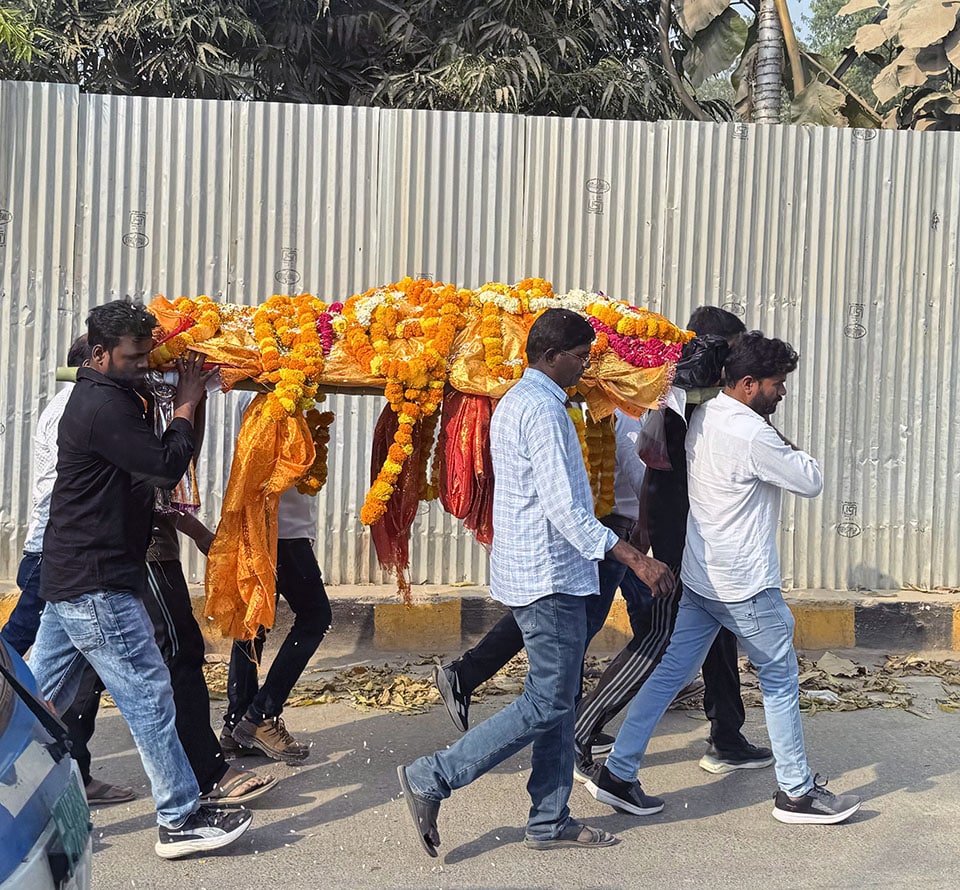
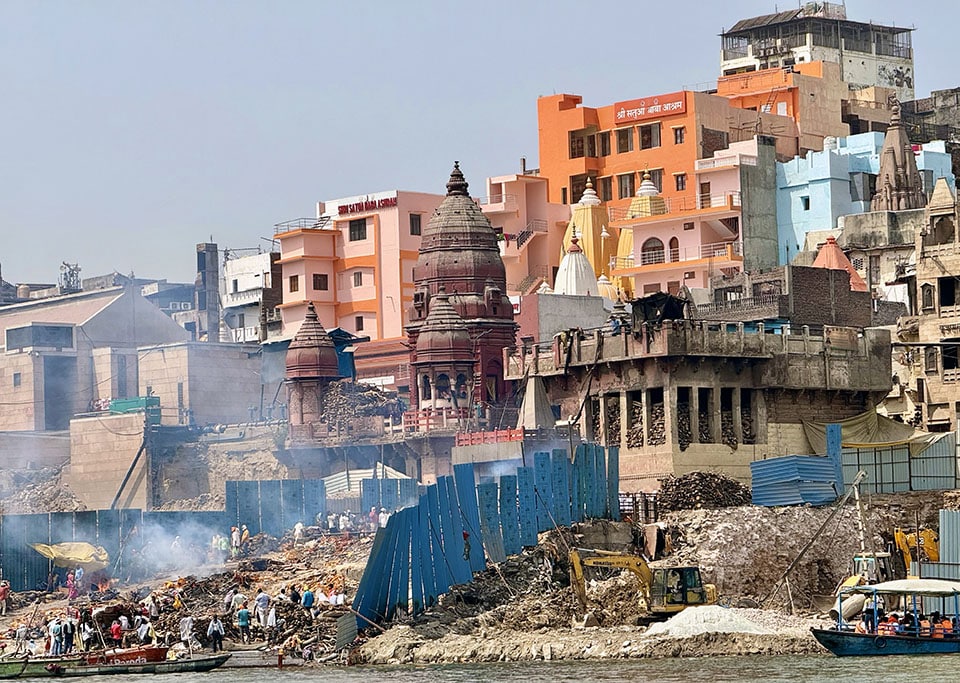
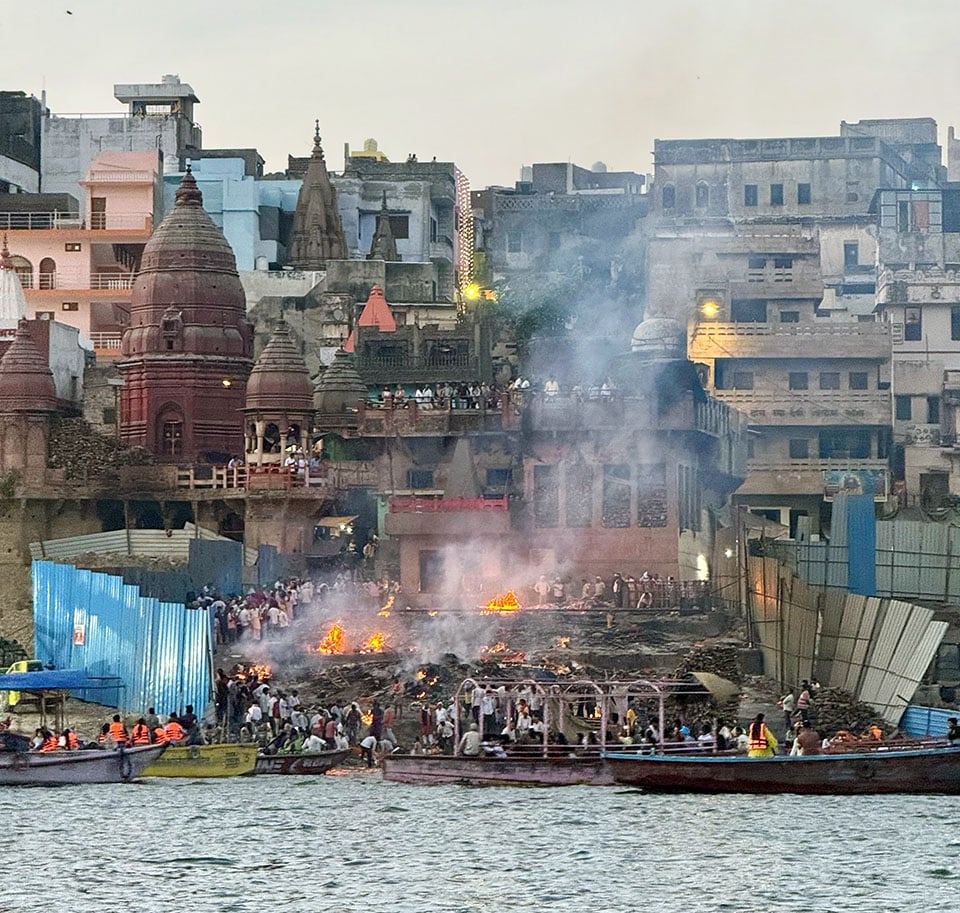
The men in the family of the deceased carry the body to the cremation ghat. The family then negotiates over the type and price of the wood used to burn the body, and it is down to a science, with a formula for how much wood they need for each body size.
Once the price for wood is agreed upon, the body is bathed in the Ganges and laid on the wood pyre. The pyre is tended throughout the cremation, and ghee is added as part of the ritual and to aid in burning. When the cremation is finished, the remaining ashes are returned to Mama Ganga—and moksha is complete.
Galen in the Ganges
Later that afternoon, we took another boat to the Satua Baba Ashram for our private tour. On the way there, we stopped in front of the cremation ghat for Kirk to sprinkle his brother Galen’s ashes in Mama Ganga.
Kirk was never sure about Galen’s spiritual beliefs or what he thought about our meditation practice (Galen never talked about any of it). And though he was an airline pilot, he rarely liked to travel outside the US. In fact, once he retired, he really didn’t like to fly much at all…he had spent so many years of his life in airplanes, airports, and hotels; he preferred to stay home… just like their dad, who never flew anywhere once he retired from being a pilot.
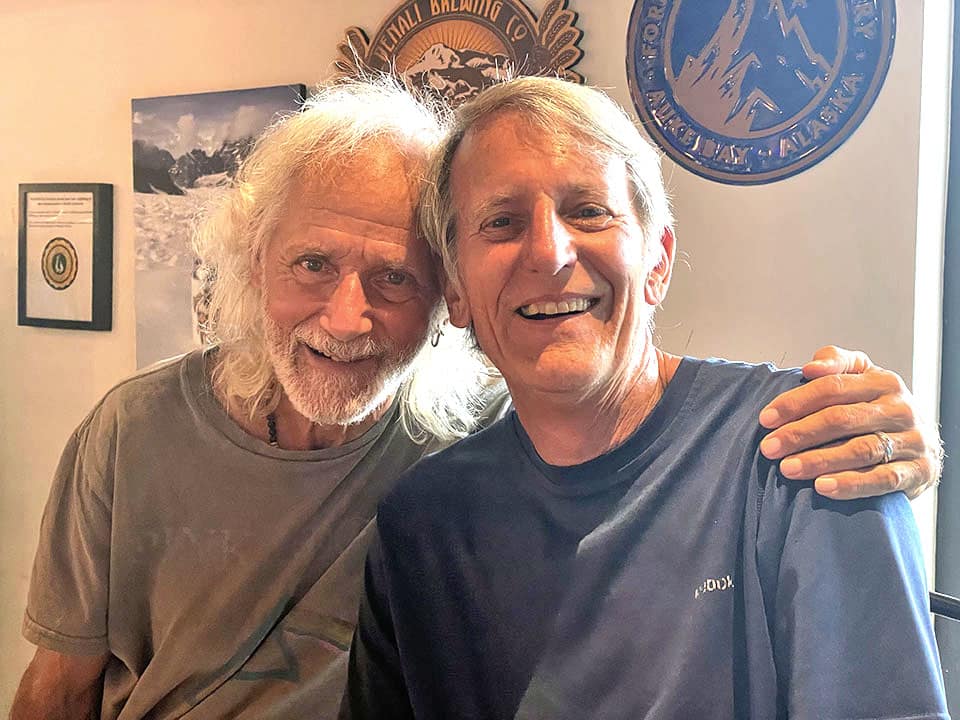
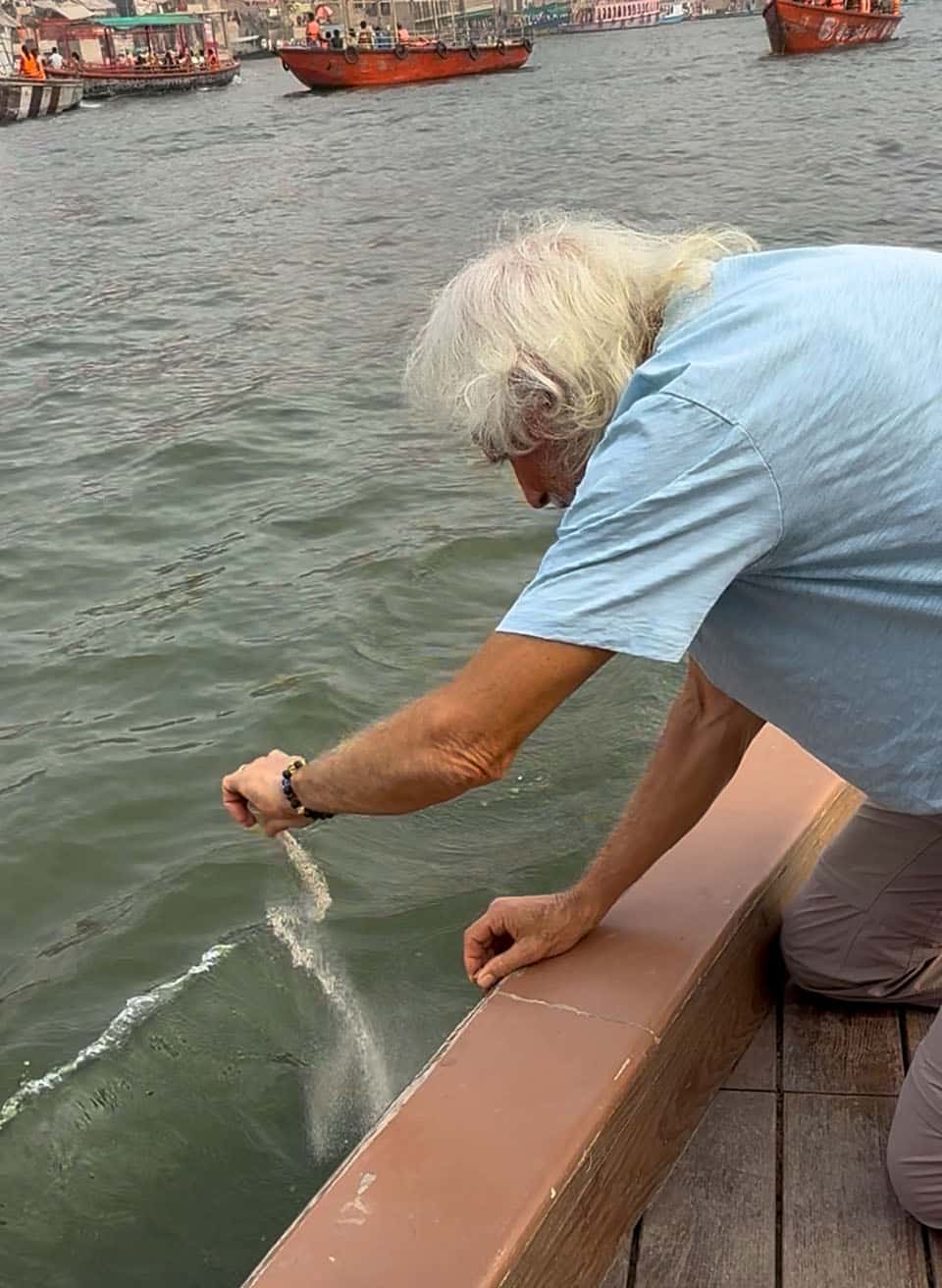
So Kirk decided it would be fun to take Galen on one last trip to India, to the most sacred and spiritual river of all. Our sister-in-law Ann agreed and gave us some of Galen‘s ashes to scatter here.
We told Roger we had brought some ashes from family along to scatter in the Ganges, and he recommended this spot in front of the cremation ghat for Galen. (We also had ashes of Heidi’s dad, Verne, and stepmom, Willa, which we would scatter later in Rishikesh.)
Roger told the boatman where to stop, and then chanted a beautiful verse from the Bhagavad Gita in Sanskrit, while Kirk talked to Galen as he sprinkled his ashes. This is the English translation of the verse Roger chanted:
The soul is never born, nor it ever dies; nor does it become after being born. For, it is unborn, eternal, everlasting and primeval; even though the body is slain, the soul is not.
As a man shedding worn out garments takes other new ones, likewise, the embodied soul, casting off worn out bodies, enters into others that are new.
Weapons cannot cut it nor can fire burn it; water cannot wet it nor can wind dry it.
For the soul is incapable of being cut, or burnt by fire; nor can it be dissolved in water, and it is undryable by air as well; This soul is eternal, all prevading, immovable, consistent, and everlasting.
The soul is unmanifest; it is incomprehensible, and it is spoken of as immutable. Therefore, knowing it as such, you should not grieve.
For, in that case, death is certain for the born and rebirth is inevitable for the dead. You should not, therefore, grieve over the inevitable.
So long, Gays-boy, we hope you enjoyed your ride down Mama Ganga, and beyond.
Satua Baba Ashram & The Golden Temple of Varanasi
Our private visit to Satua Baba Ashram and the nearby Kashi Vishwanath Temple (“Golden Temple”) was made possible through a personal connection, as Roger had been initiated by the sixth Satua Baba many years ago, becoming part of the Satua Baba lineage.
Thanks to Roger’s connection, we were warmly welcomed into the ashram for an intimate visit with the current (7th) Satua Baba himself.
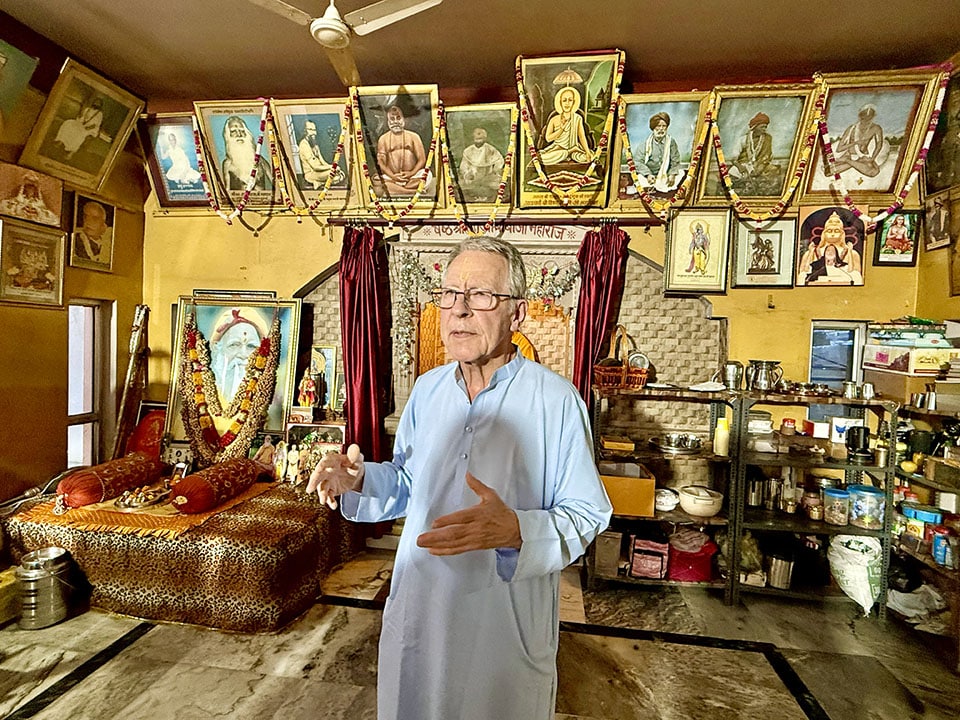
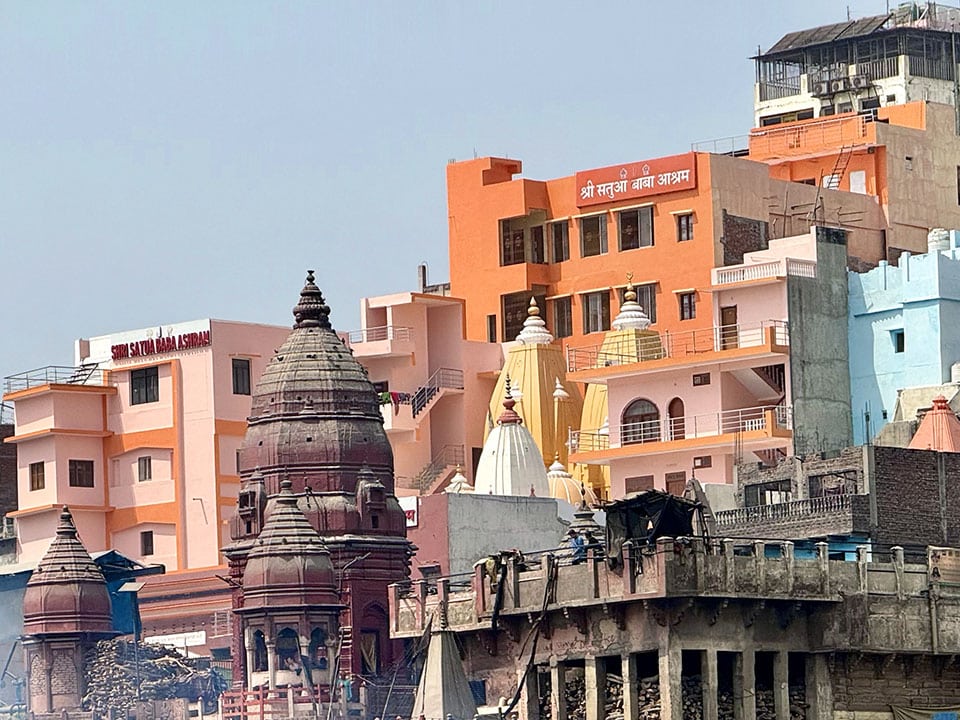
Roger, talking about the Satua Baba lineage. His guru, the 6th Satua Baba is on the far left bottom, on the bed with the large flower garlands around it. He passed on from this realm in 2012, at the age of 99.
Perched above the cremation ghat—the most sacred cremation ground in India—Satua Baba Ashram (orange and peach colored buildings) has long been a part of Varanasi’s traditions surrounding death, remembrance, and spiritual liberation.
The current Sri Satua Baba is also revered as the spiritual guru of the nearby Kashi Vishwanath Temple, the iconic Golden Temple of Varanasi, located just steps from the ashram. Dedicated to Lord Shiva and regarded as one of Hinduism’s holiest shrines, the temple has been a major pilgrimage center for well over a thousand years.
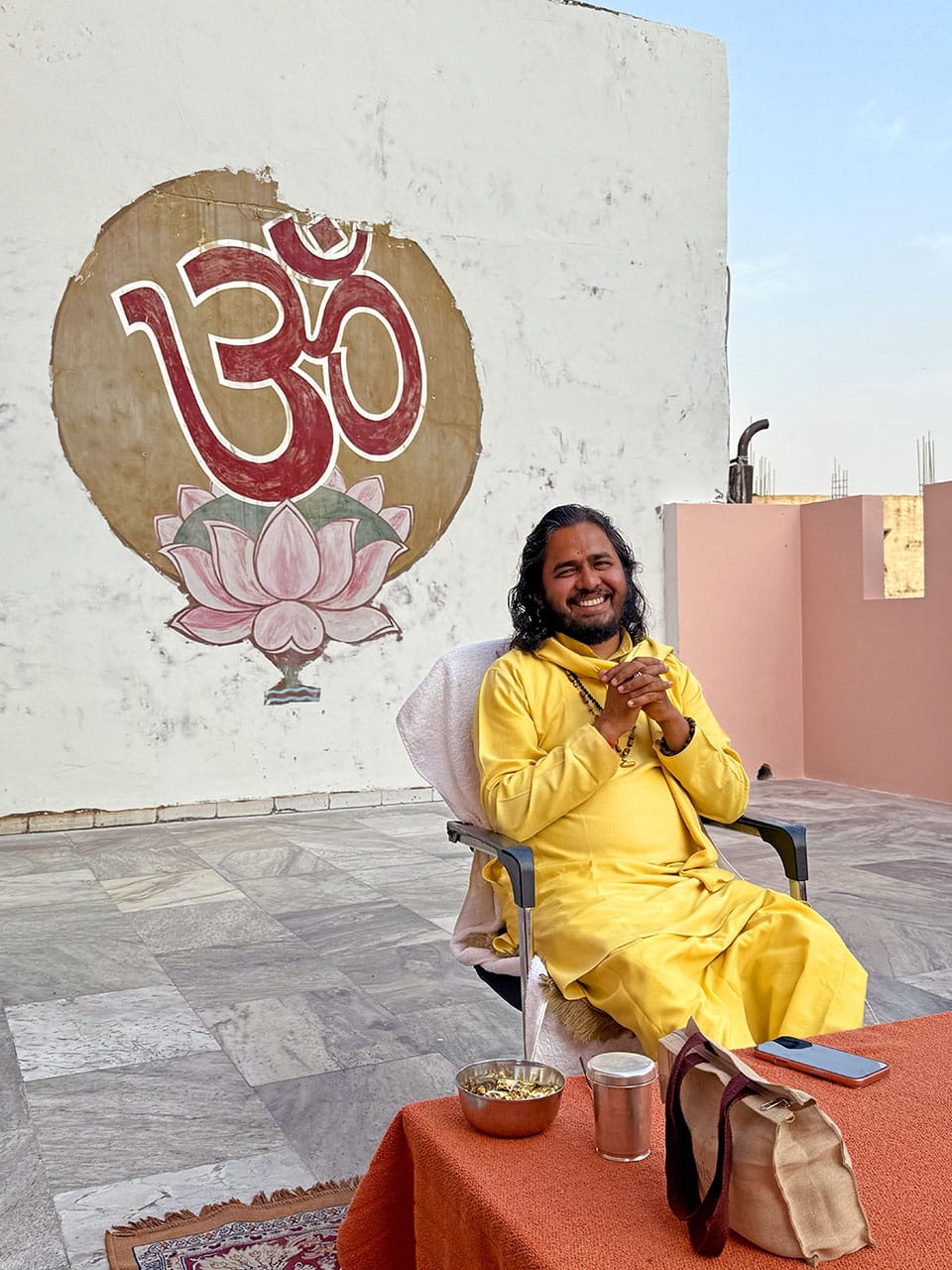
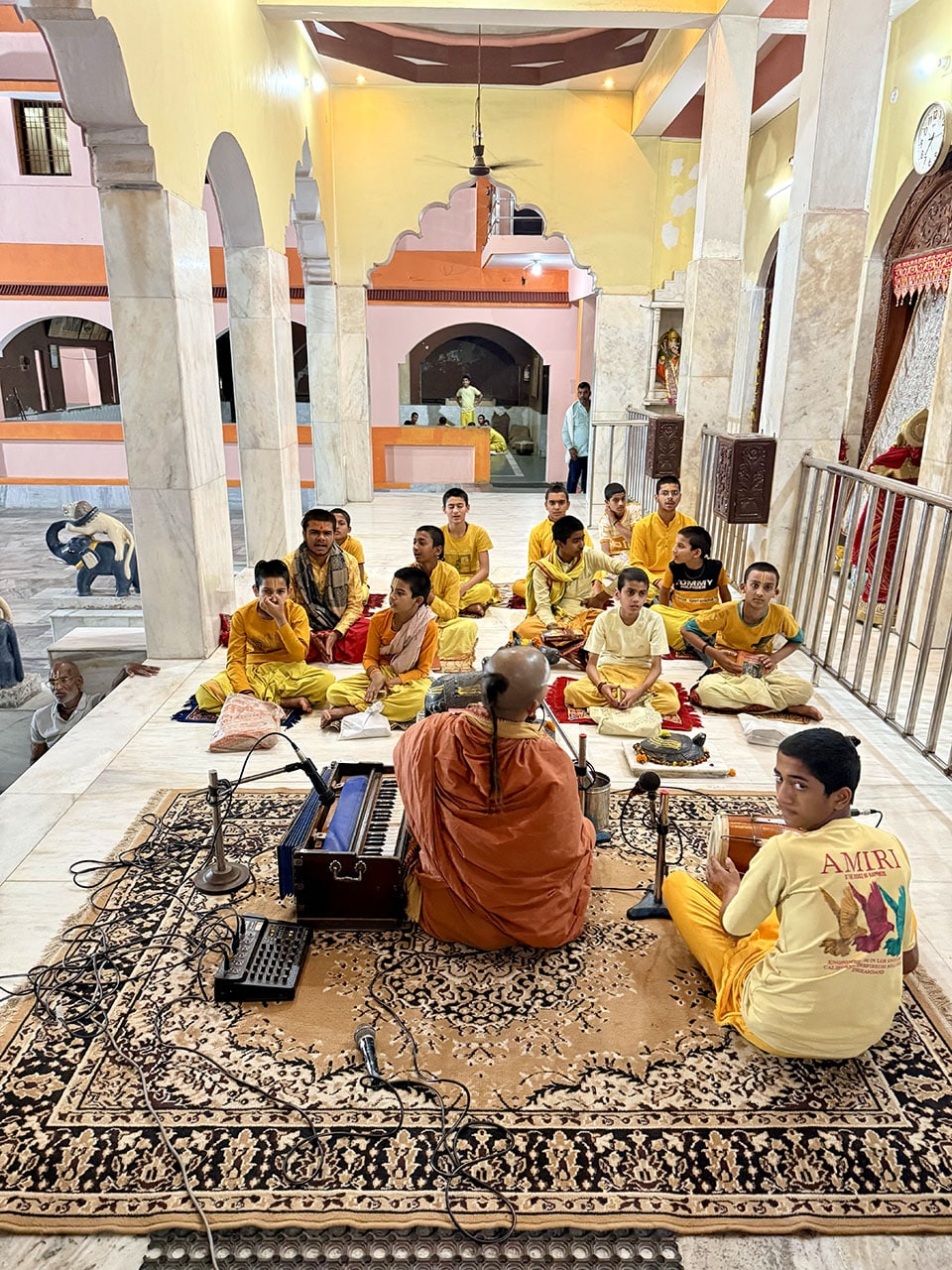
Sri Satua Baba and some of the young students from the ashram’s boarding school
Beyond its spiritual significance, Satua Baba Ashram is also a remarkable center for service and education. Guided by the principle of seva (selfless service), the ashram provides thousands of free meals three times daily to sadhus, pilgrims, and those in need.
It is also home to a traditional Sanskrit boarding school, where young boys live, study, and train to become Vedic scholars and priests, preserving ancient teachings, rituals, and the Sanskrit language for future generations.
The Inner Sanctum of the Golden Temple
We were very lucky to be escorted by Sri Satua Baba’s personal police into the inner sanctum to see the lingam—a rare privilege, where access is often limited and highly regulated. We were told to leave everything back at the Ashram, nothing in our pockets. There were hundreds of people waiting in line to get into the temple, and we were ushered right past them, to the very front, through metal detectors, and into the temple.
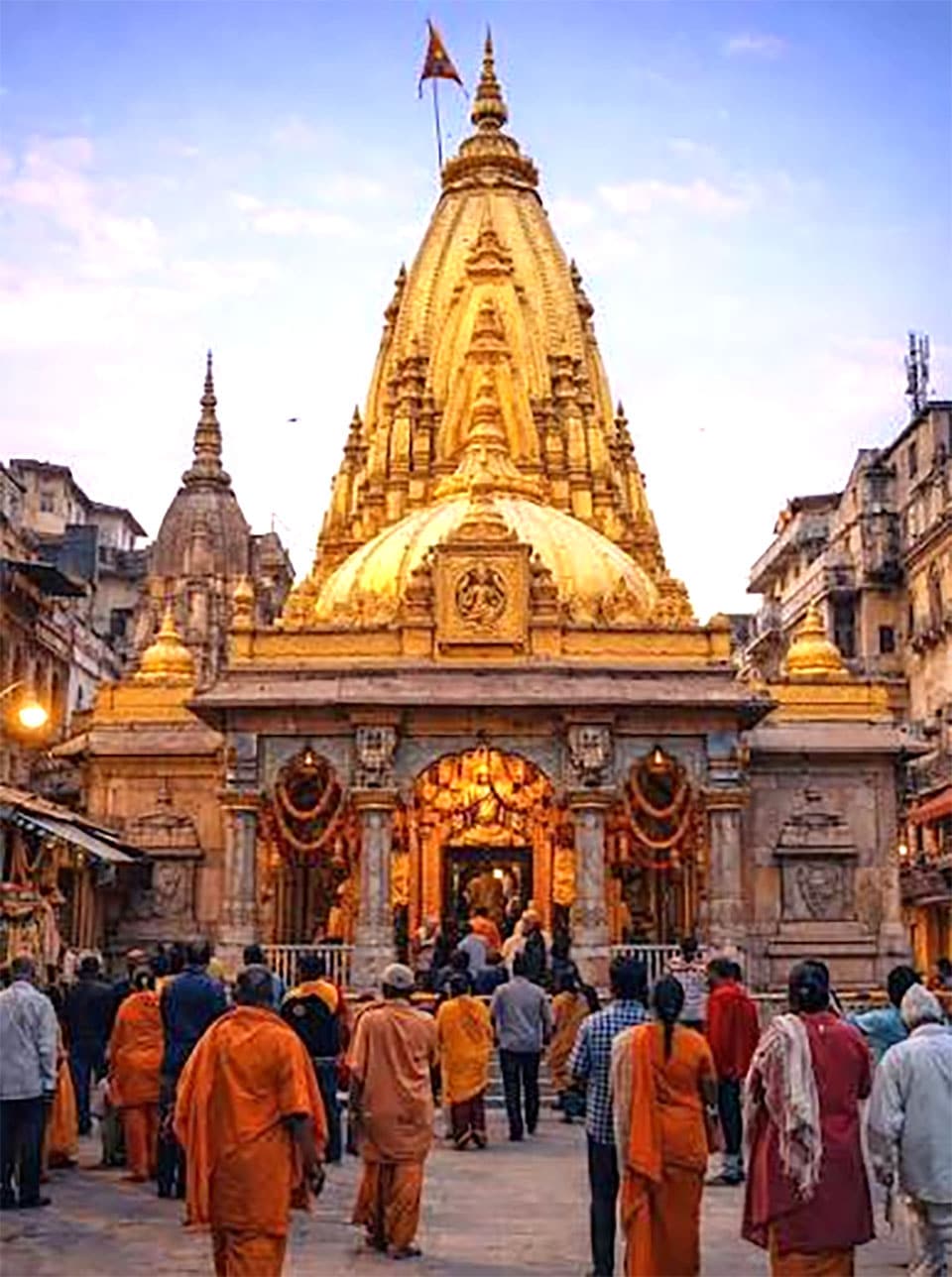
The main entrance to the Golden Temple, we entered from a side entrance from the ashram, to the right.
Unfortunately, Kirk was in the washroom and missed the memo to leave everything behind, so his sunglasses and phone were still in his pocket. Thankfully, the temple police held onto them until our exit. By then, it was nearly dark, and Kirk forgot to retrieve his sunglasses. Ironically, Heidi’s 10-year-old Jamestown sunglasses also disappeared the following day?! What is the message that we both lost our sunglasses in Varanasi, the City of Light?!?
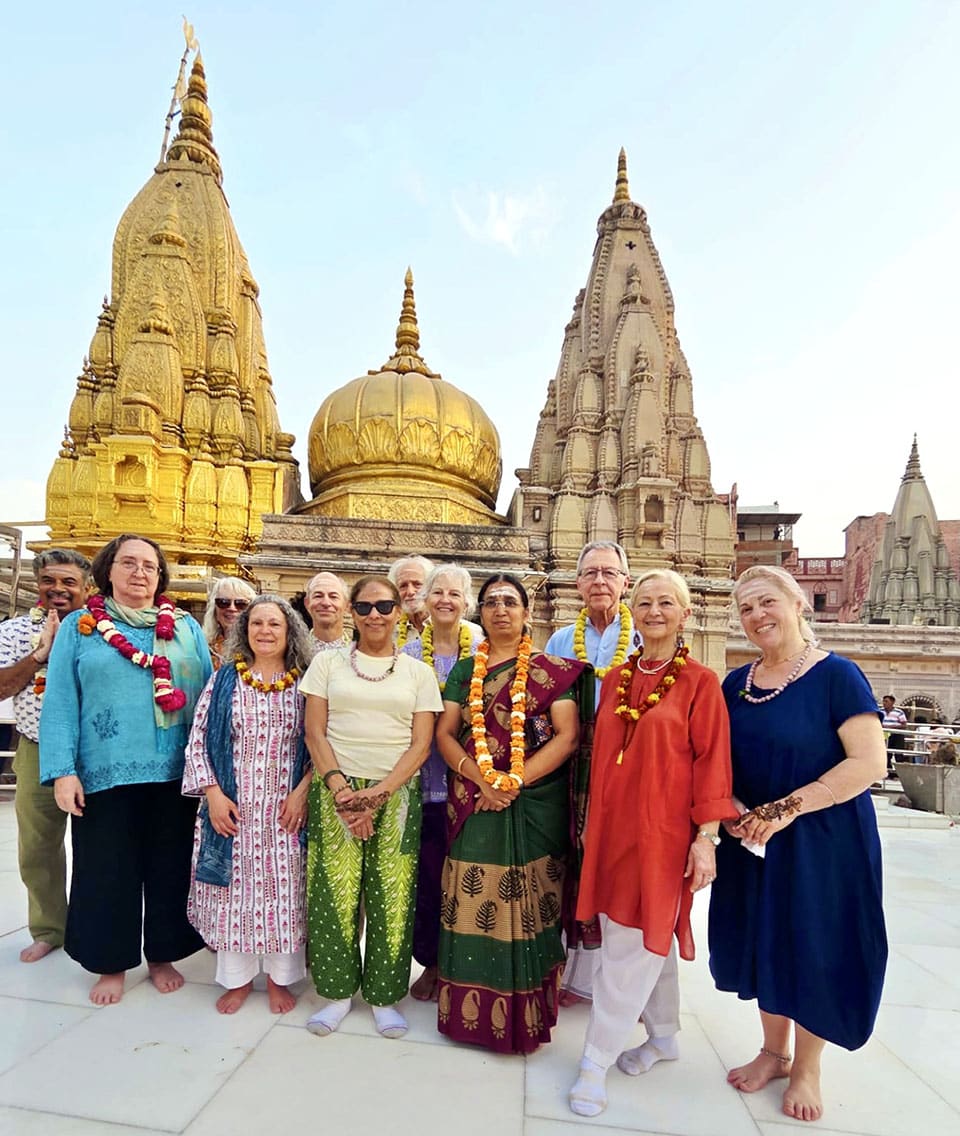
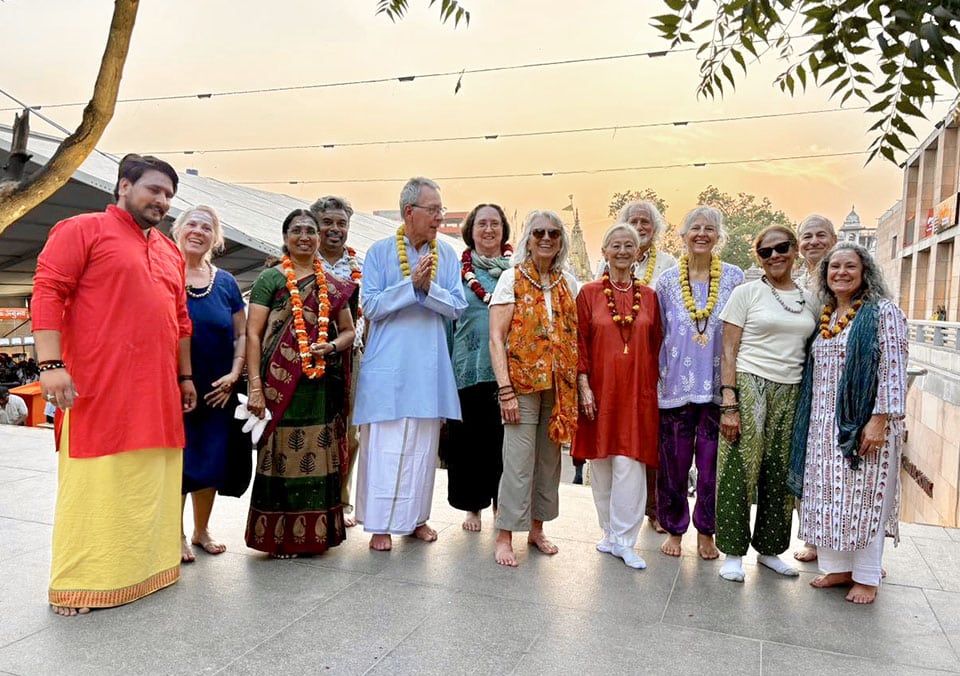
Our group in front of the Golden Temple, and with one of the ashram acyolates, Basicilica, Mallika, Remesh, Roger, Marie, Donna, Anne Marie, Kirk, Heidi, Marge, David & Pauline at sunset.
Inside the temple, there were so many monkeys climbing up roofs, then jumping down onto awnings and sliding down…over and over again, like kids playing and having such fun—it was so funny to watch! It’s too bad no cameras or phones were allowed in there, so we have no videos of the monkeys’ antics!
Once inside the inner sanctum, the energy was intense, sacred, fast-paced, and a bit of a sensory overload—and honestly, this is one area we wish we had been better educated about beforehand, because at the time we weren’t totally sure what was happening and were sort of piecing it together.
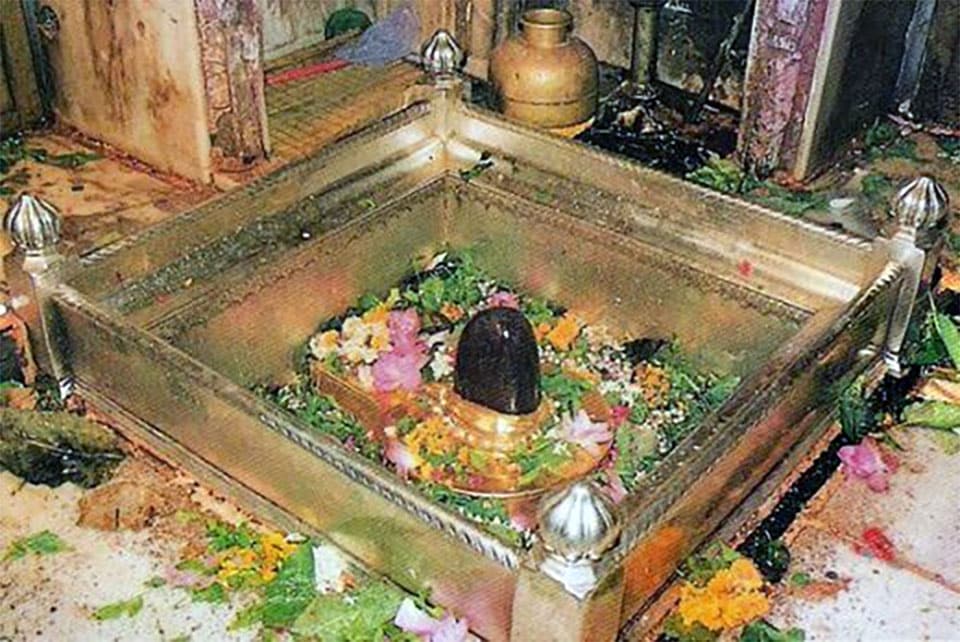
Imagine the Shiva Lingam with hundreds of pilgrims offering flowers as they stepped forward… we could hardly see the lingam through all the people and flowers (low-res image found online).
At the center sat the black stone Shiva Lingam (a sacred oval stone representing the infinite, formless power of Lord Shiva), partially submerged in a continuous flow of holy water, as thousands of devotees offered Ganges water, flowers, milk, and prayers throughout the day.
Priests worked in a constant rhythm, sweeping away marigold and rose garlands almost as quickly as they were offered, to keep the lingam clear. These flower garlands were then passed through the sacred water surrounding the Lingam and placed around our necks as prasadam.
In Hindu tradition, once an offering touches the deity, it ceases to be a “gift to God” and becomes a “blessing from God.” By receiving a garland that had been offered in devotion and passed through the sacred waters of the Lingam, we were receiving Shiva’s Shakti (divine energy). It was a spiritual act that connected us to both the deity and the unknown pilgrim who had originally offered the flowers.
For a brief moment, we became part of an unbroken cycle of devotion that has connected pilgrims, priests, and the sacred heart of Varanasi for centuries.
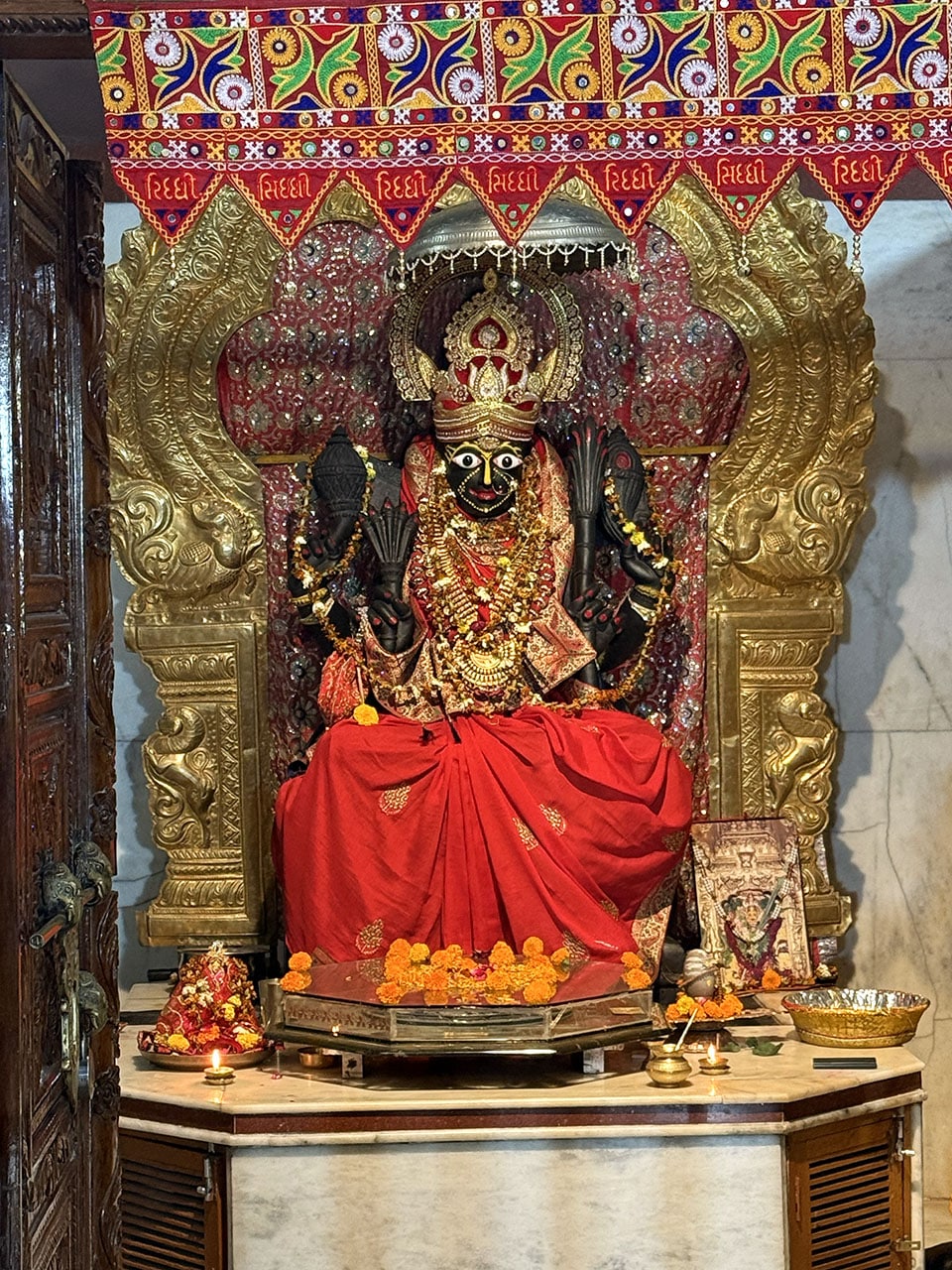
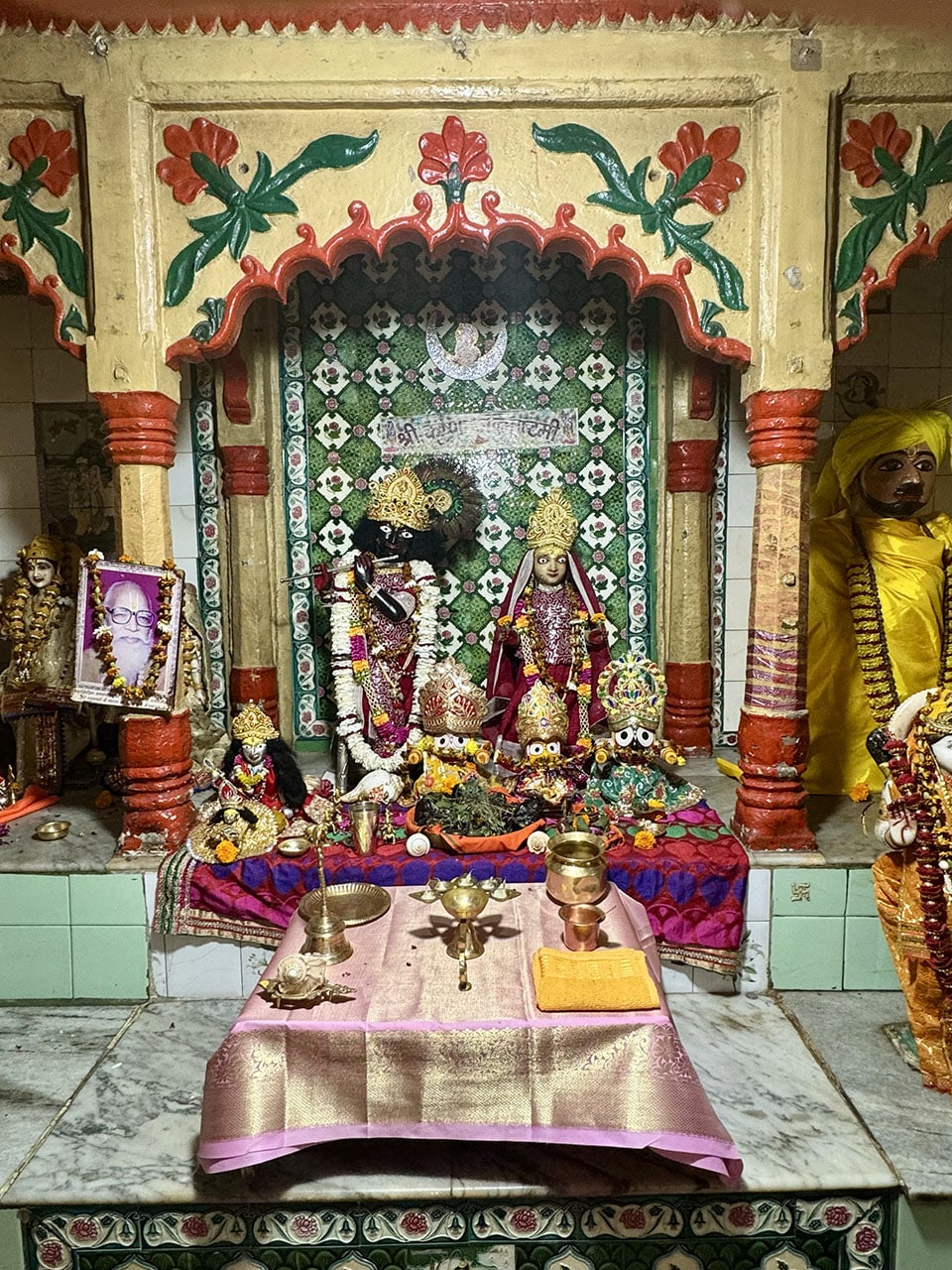
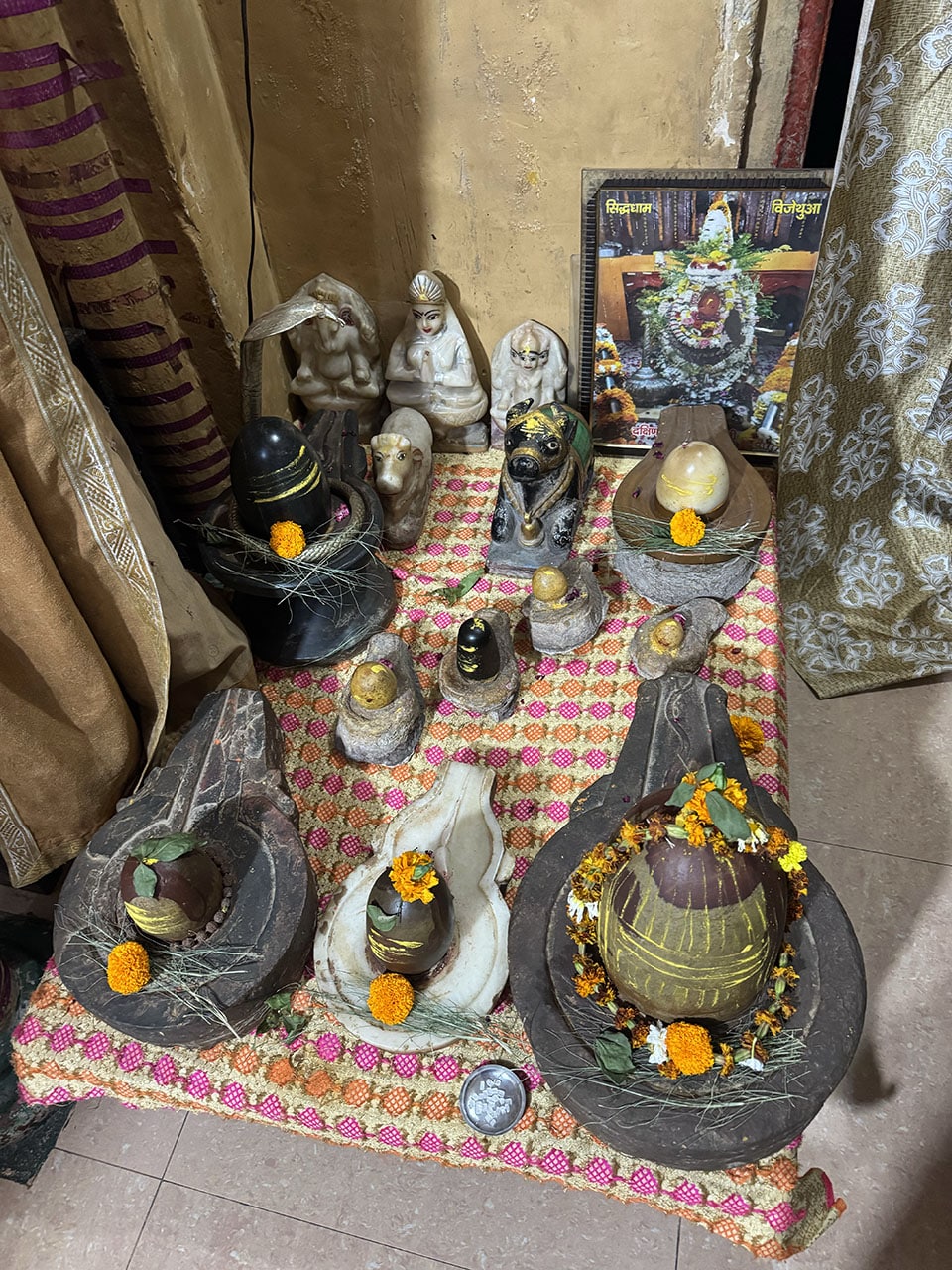
After our awe-inspiring, magical temple visit, we returned to the ashram for a tour, down some steep steps, beneath the complex to see an old shrine dating back to the 4th century AD, many small altars (above), then on to the kitchen where some of the students were helping make food to feed thousands of people daily.
Homan Fire Circle
Our group was grateful to be invited to a Homan (fire ceremony) at the Satua Baba Ashram, to promote spiritual healing, ancestral peace, and prosperity.
Each of us was given a plate of sugar crystals mixed with herbs. As some of the priests chanted in Sanskrit and Roger ladled ghee onto the fire, we scattered handfuls of sugar and herbs into the flames while chanting “swa-ha”. Swaha is a sacred Sanskrit mantra chanted every time an offering is dropped into the fire, translated roughly to “offered completely”, or “and so it is”, and represents letting go of your ego, attachments, and negativity into the divine fire. Click the image below to watch the video.
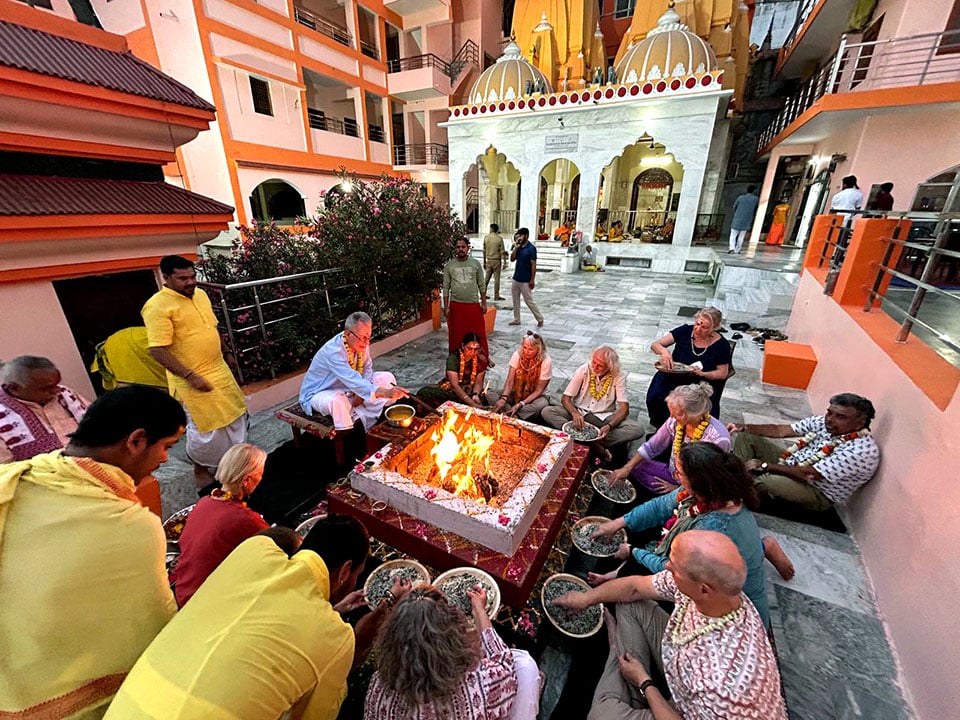
We were so honored to share in this mesmerizing, timeless Hindu ritual combining chanting, offerings, and flames.
Afterward, we thanked Sri Satua Baba for the wonderful time, and our group made our way back to our hotel on foot, only half a mile along the riverfront.
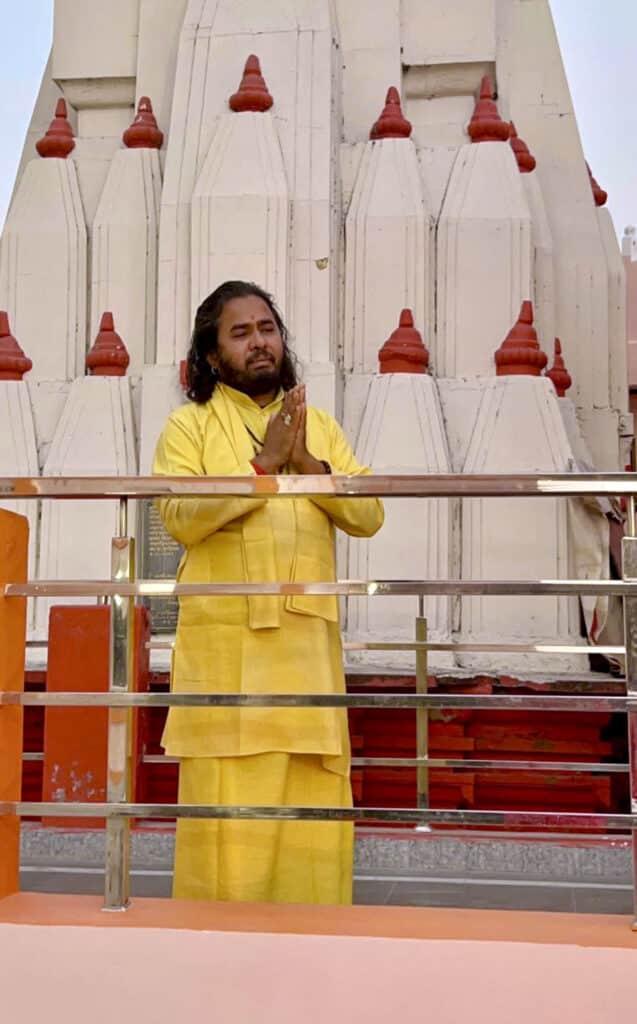
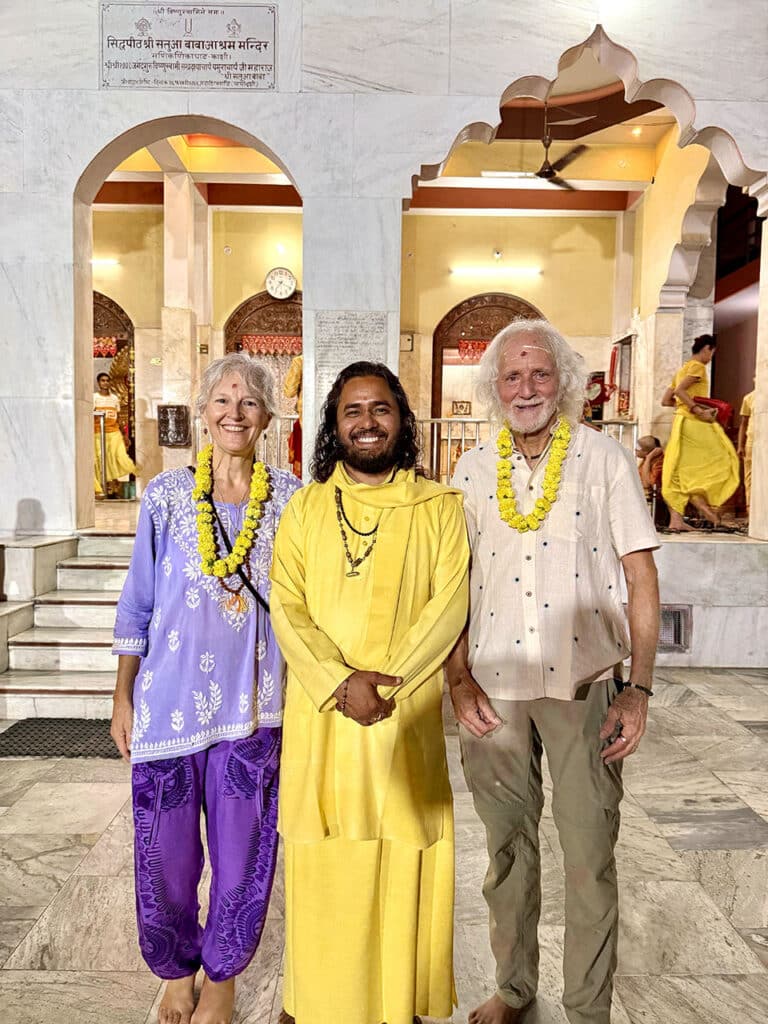
Our timing was a bit off as we left the ashram just as that night’s Aarti let out… we were swimming upstream through the ghats (stairs) against thousands of people headed in the other direction.
Most of us hung on to each other, so as not to get separated…but somehow Kirk and Ramesh ended up apart from the rest of us. Heidi panicked momentarily when she couldn’t see Kirk, but then realized he would easily find his way back to the hotel—she just hoped he wasn’t looking for her in the crowds. Even in the throngs of people, we never felt unsafe for a moment—just an outpouring of love and light in every direction—and in short order, we were back at our hotel.
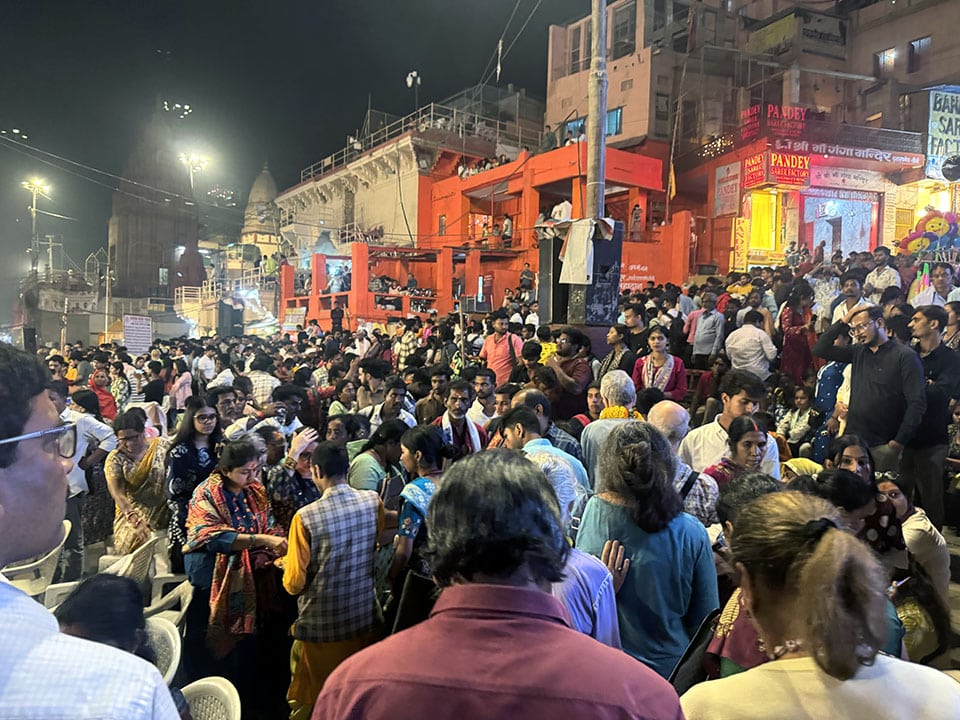
Kirk took this photo just before we got separated, you can just see Heidi’s purple shoulder in the center, with her hand on Marie’s back…
Buddha, Sarnath, and the Dhamek Stupa
The next morning, we took another boat ride from the hotel up the Ganges to our bus, then toured inland Varanasi.
A short ride away, our first stop was at Sarnath and the Dhamek Stupa, where Gautama Buddha delivered his first discourse (the Dhamma) to his five disciples in 528 BCE. It was here that Buddha first taught the Four Noble Truths and the Eightfold Path, officially setting the ‘Wheel of Dharma’ into motion and forming the first Buddhist Sangha.
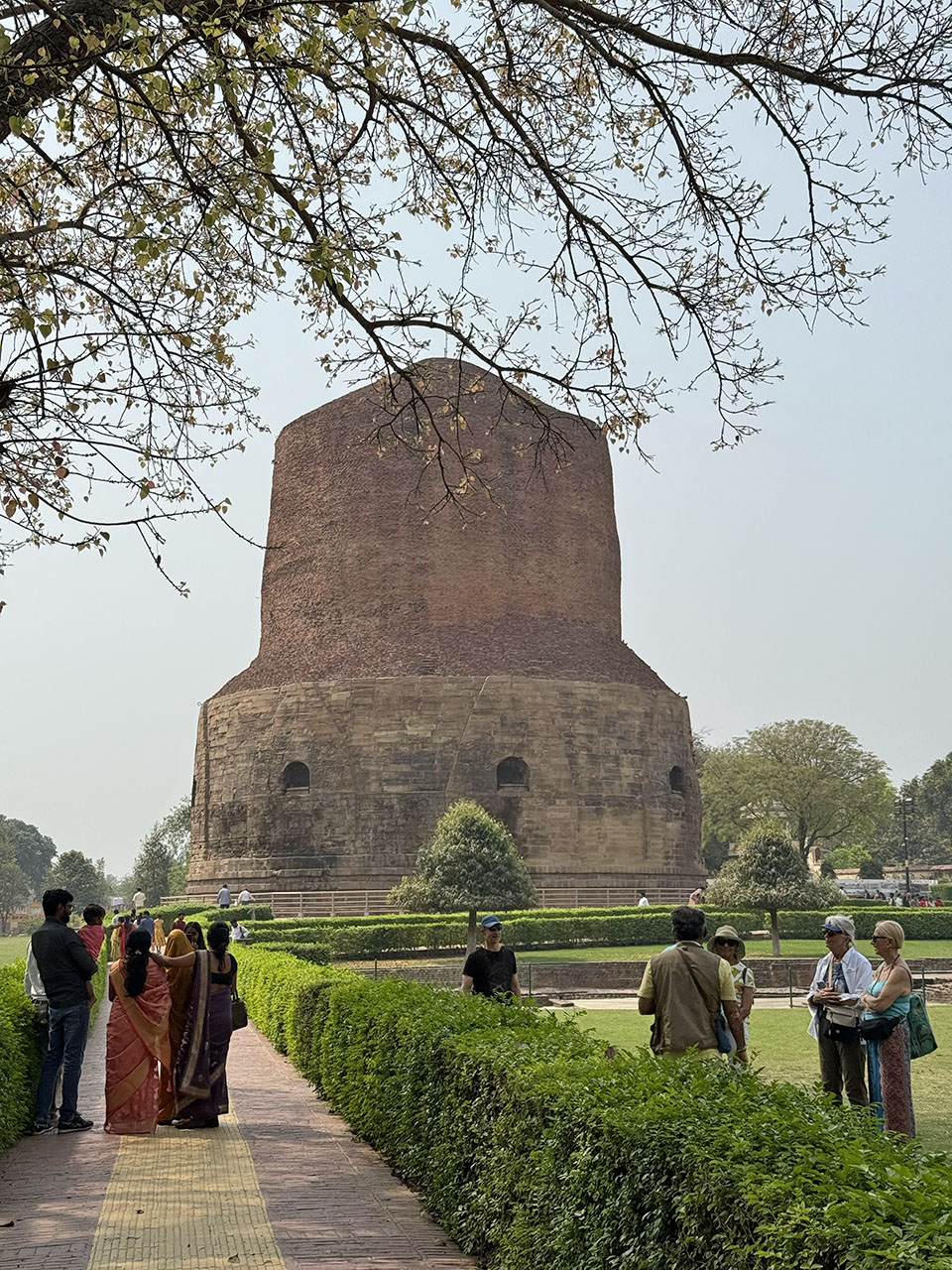
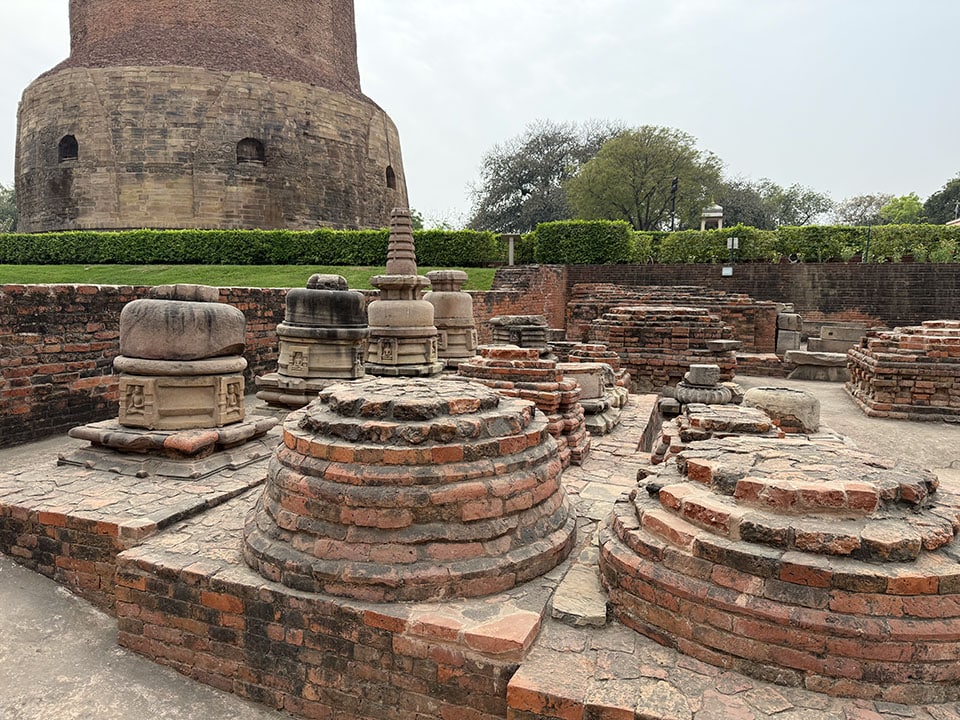
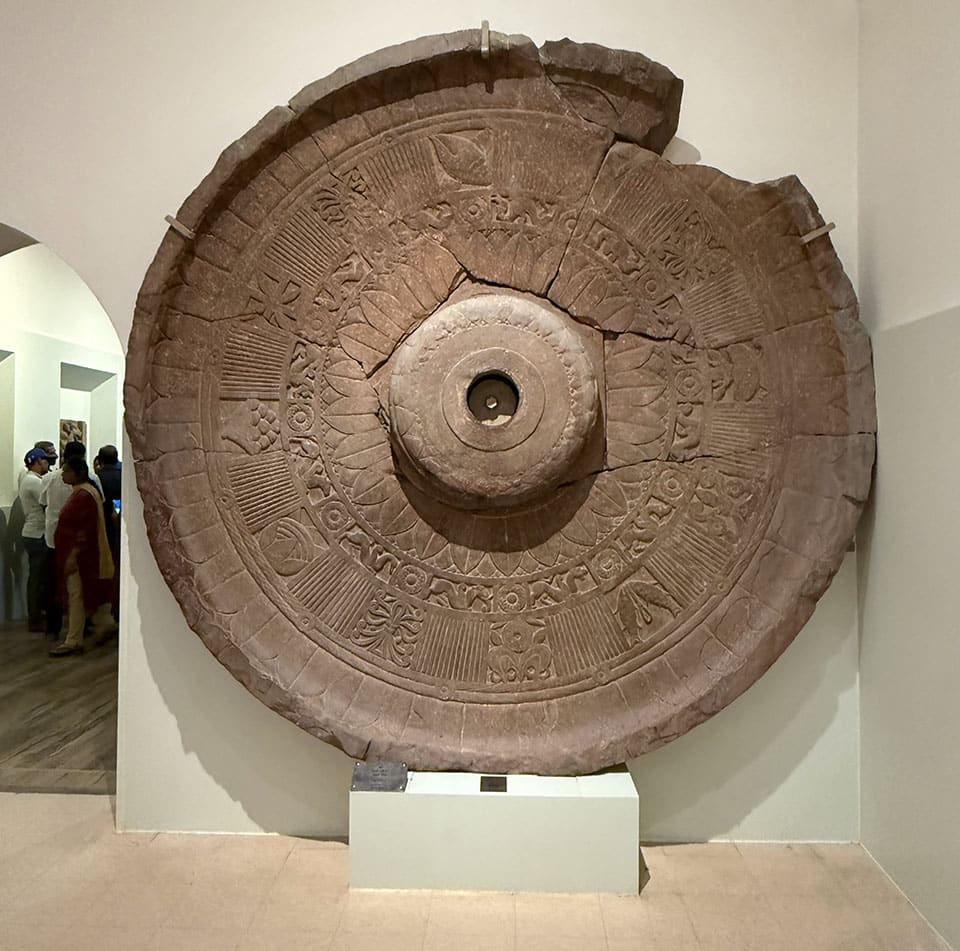
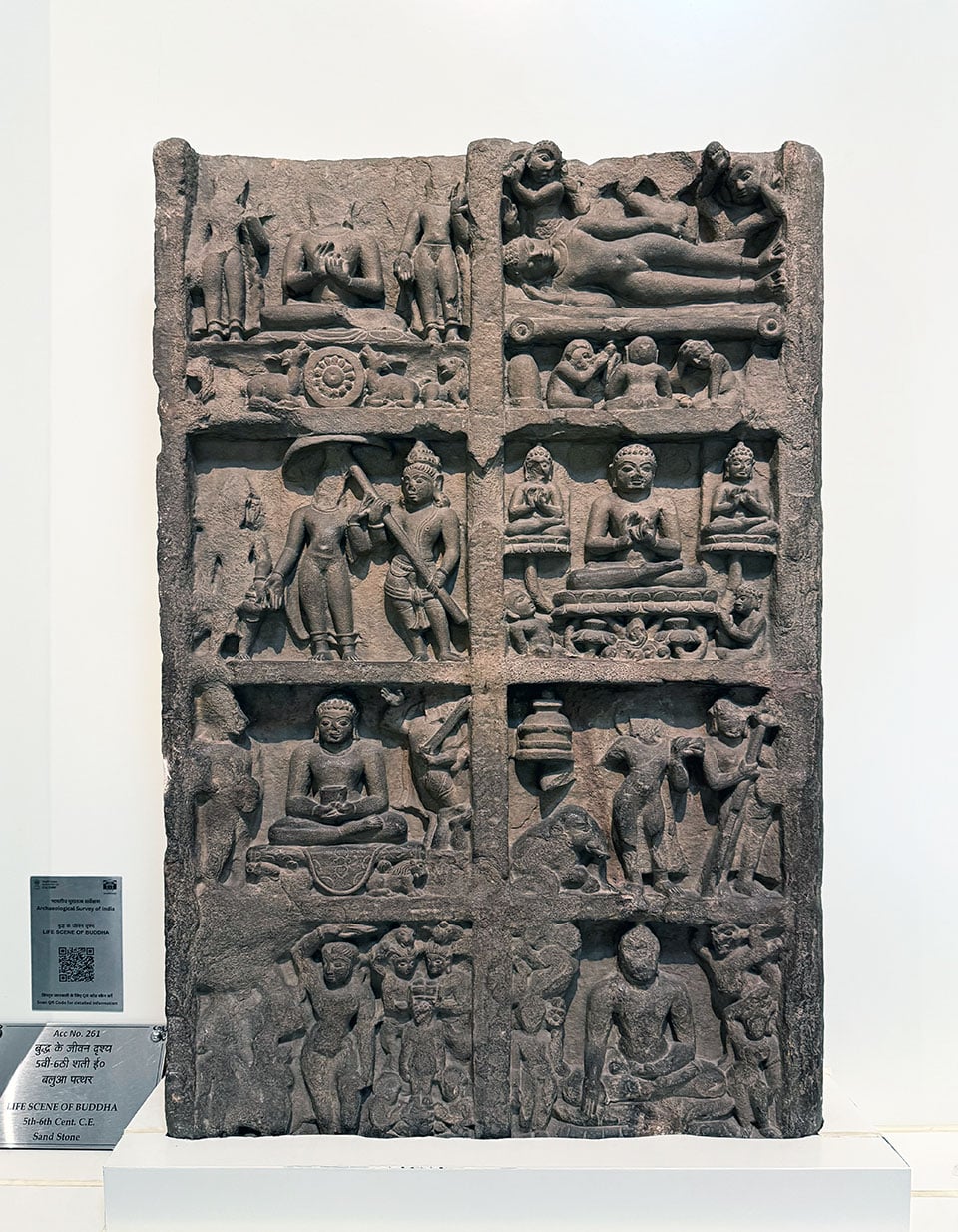
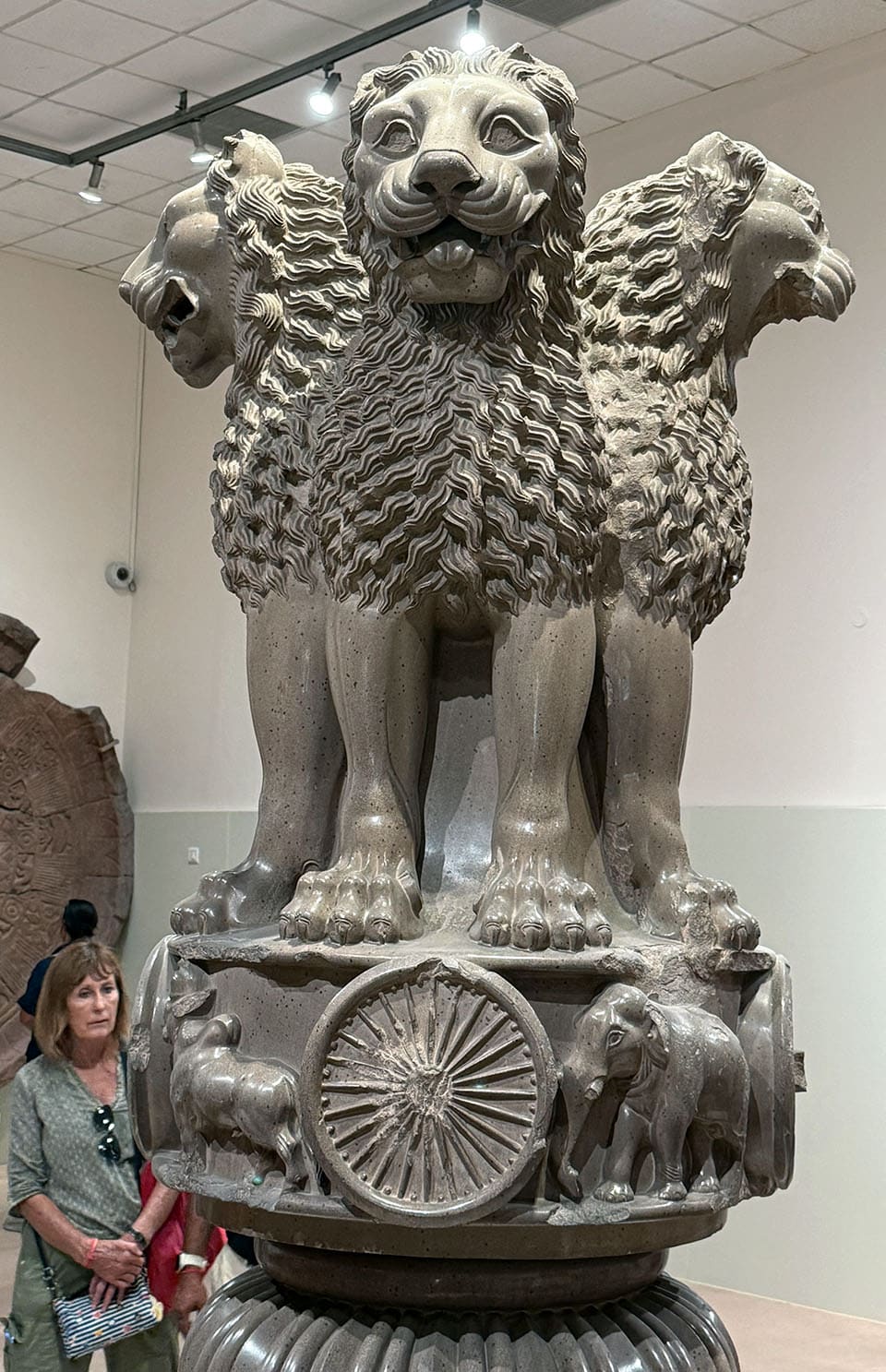
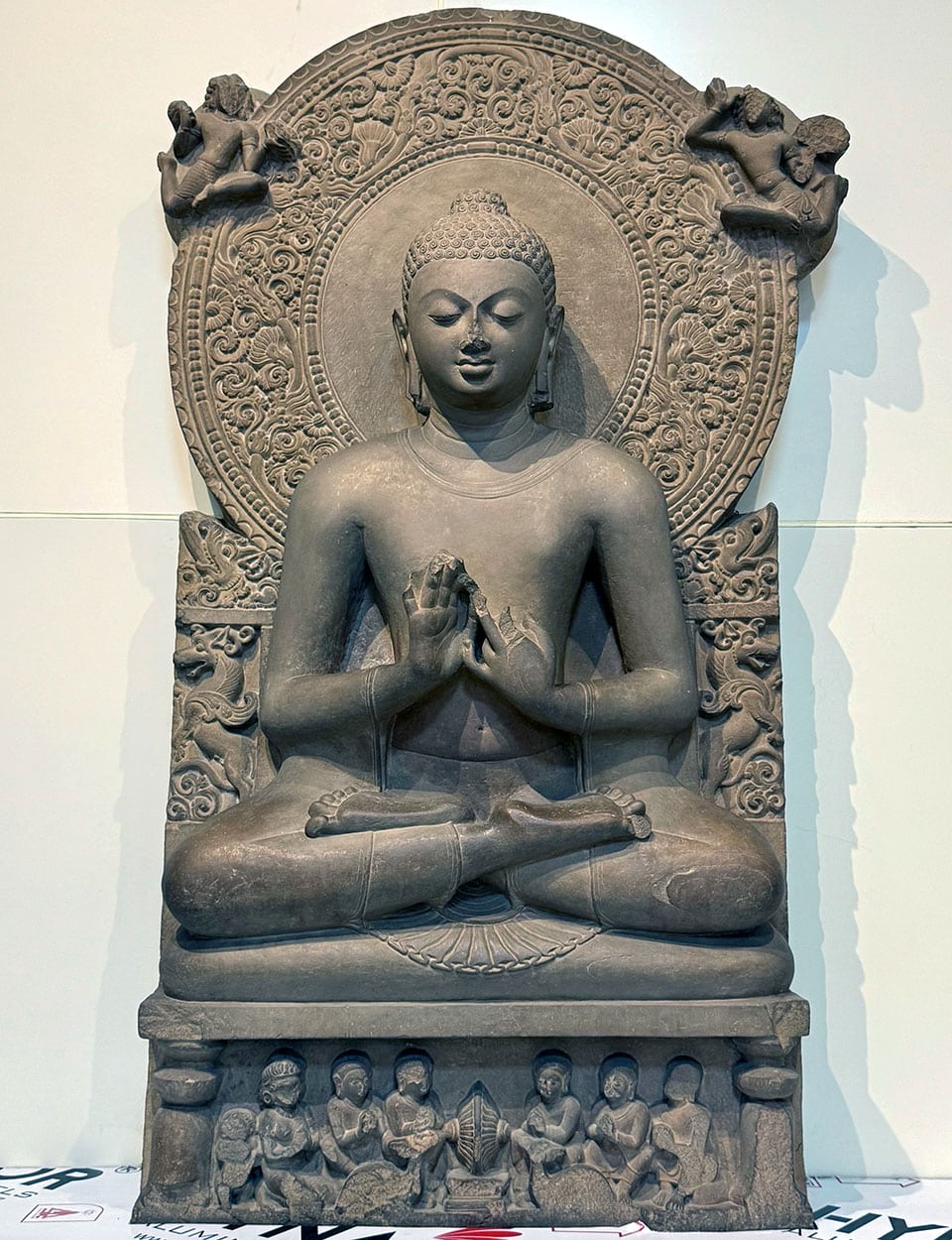
Over the centuries, as Buddhism declined in much of India, Sarnath gradually became integrated into the Hindu sacred landscape, with Hindu temples and practices developing alongside the ancient Buddhist monuments.
Today, the site is home not only to ancient ruins but also to the Sarnath Archaeological Museum, which houses an extraordinary collection of Buddhist artifacts, including the Lion Capital of Ashoka (above)—the national emblem of modern India. And the ancient stone umbrella (or chhatra), originally used to shade and honor a sacred statue of the Bala Bodhisattva, dates back to 130 CE. All of the Buddhas had their noses smashed around 1200 CE during the Islamic invasion of India, in an attempt to “kill” their spirits.
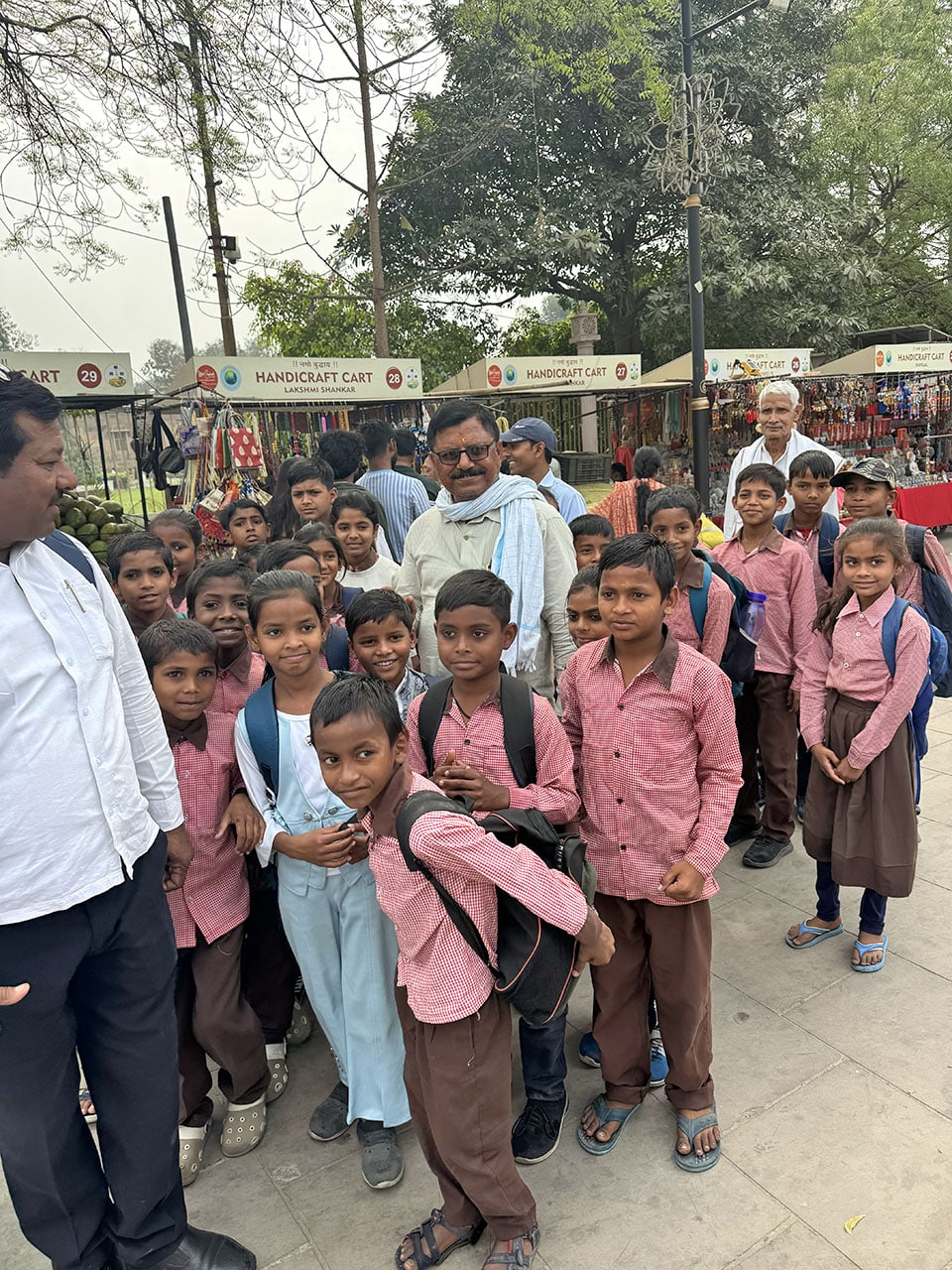
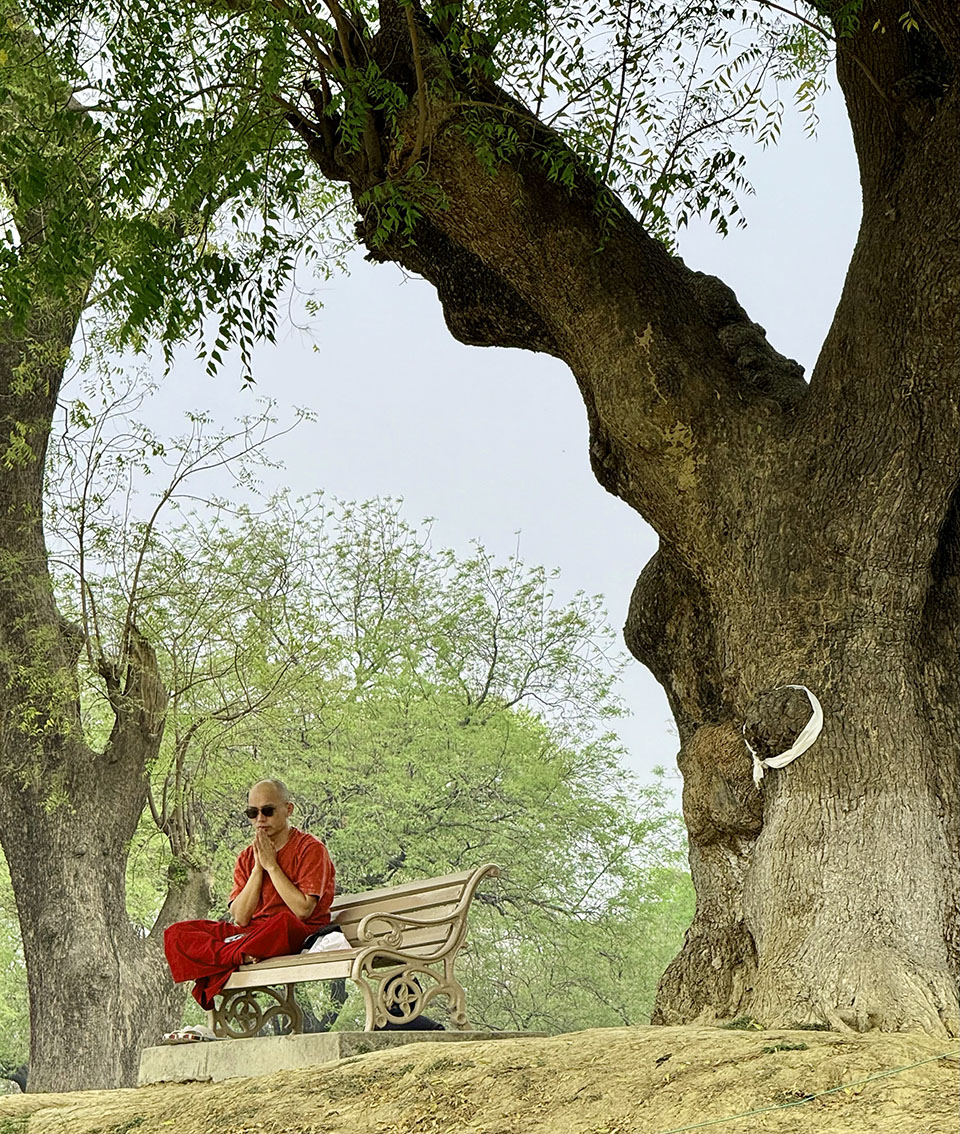
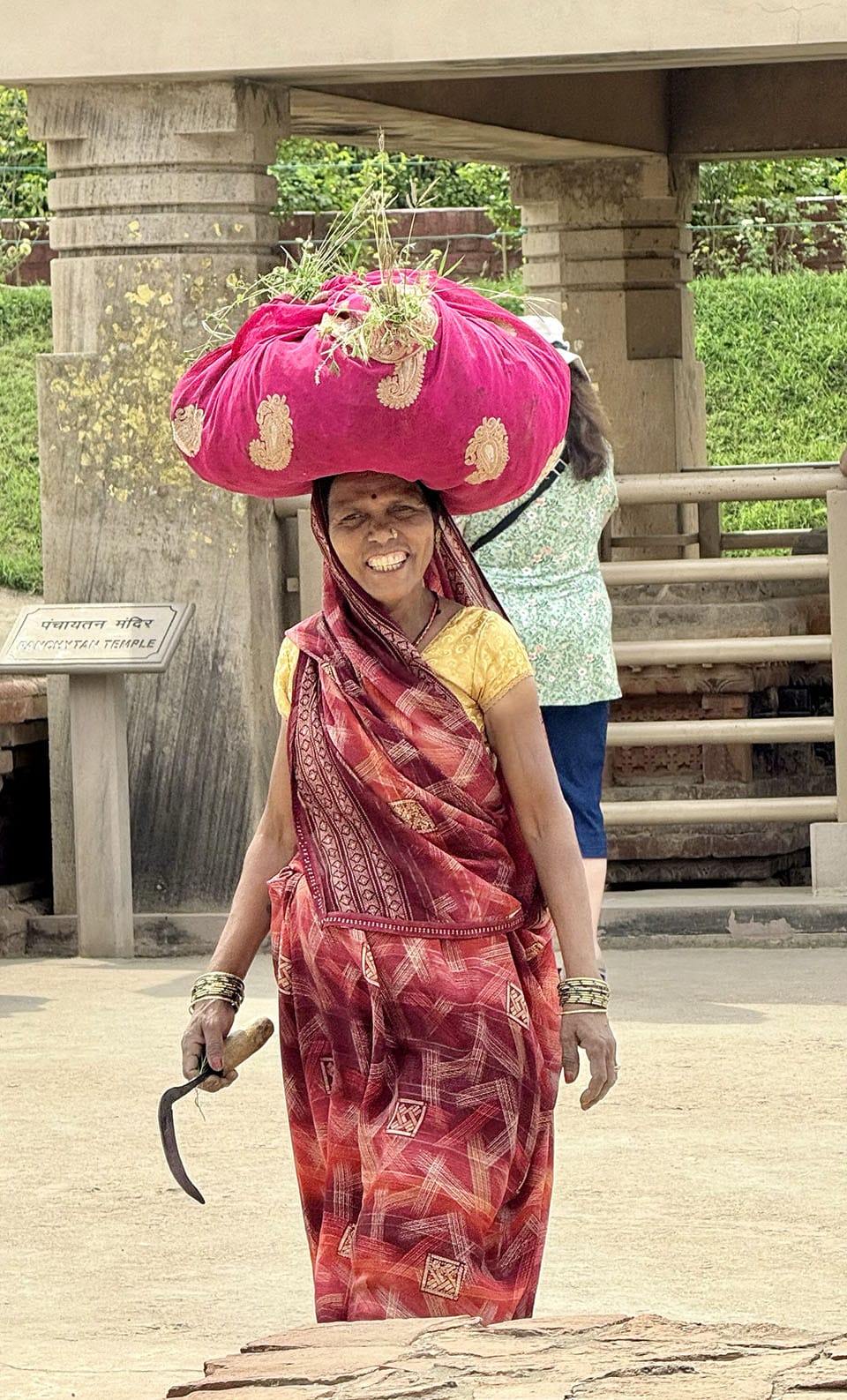
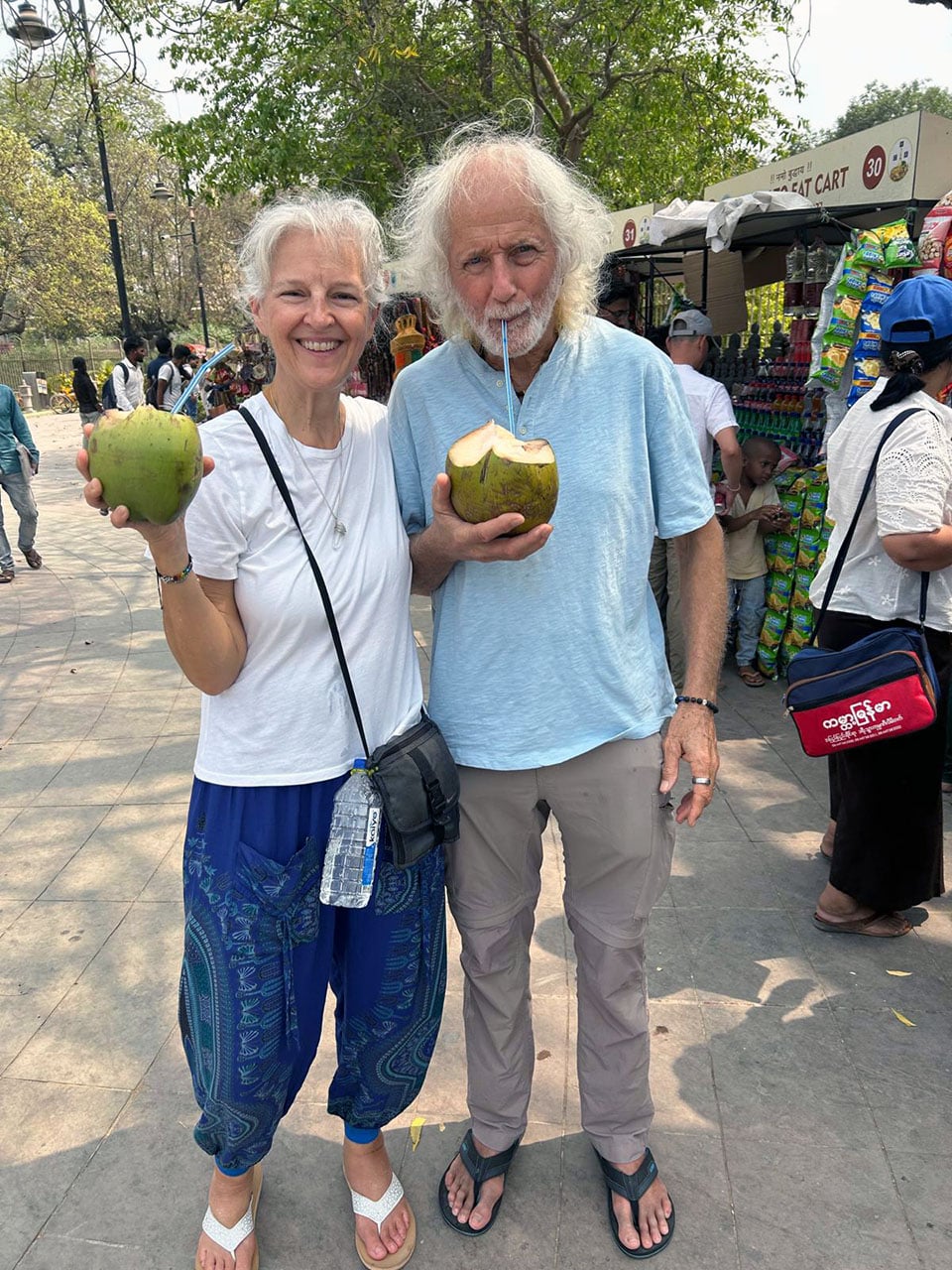
It was wonderful to see so many school kids on field trips to experience these ancient and sacred ruins, as well as gardeners using traditional tools and dressed in traditional attire. Outside the archaeology park were many vendors selling all kinds of trinkets, as well as coconuts to drink, Heidi’s favorite!
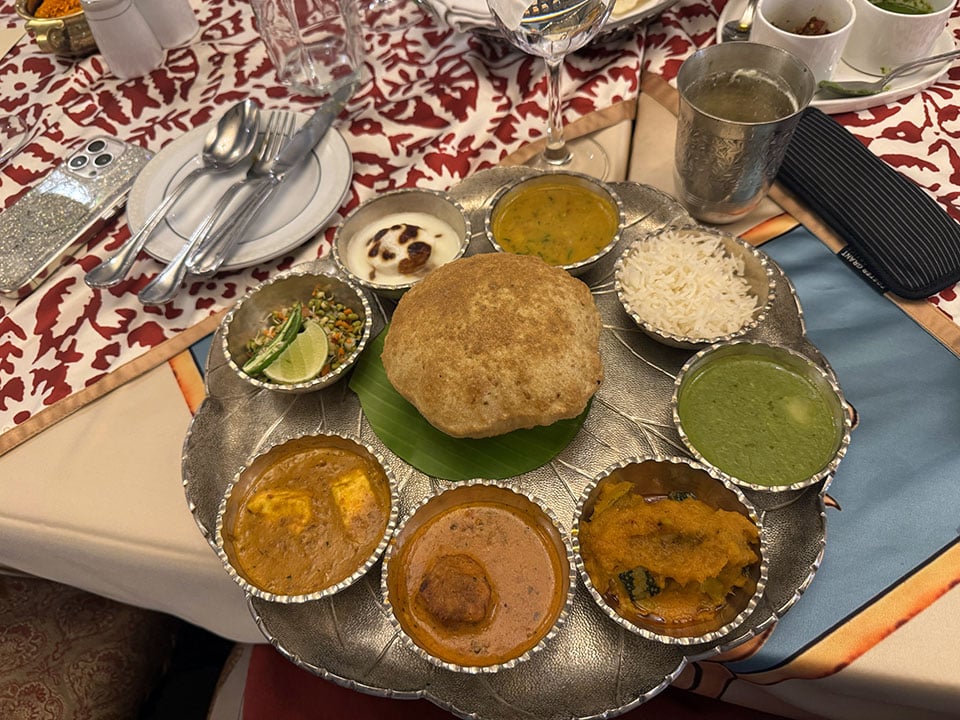
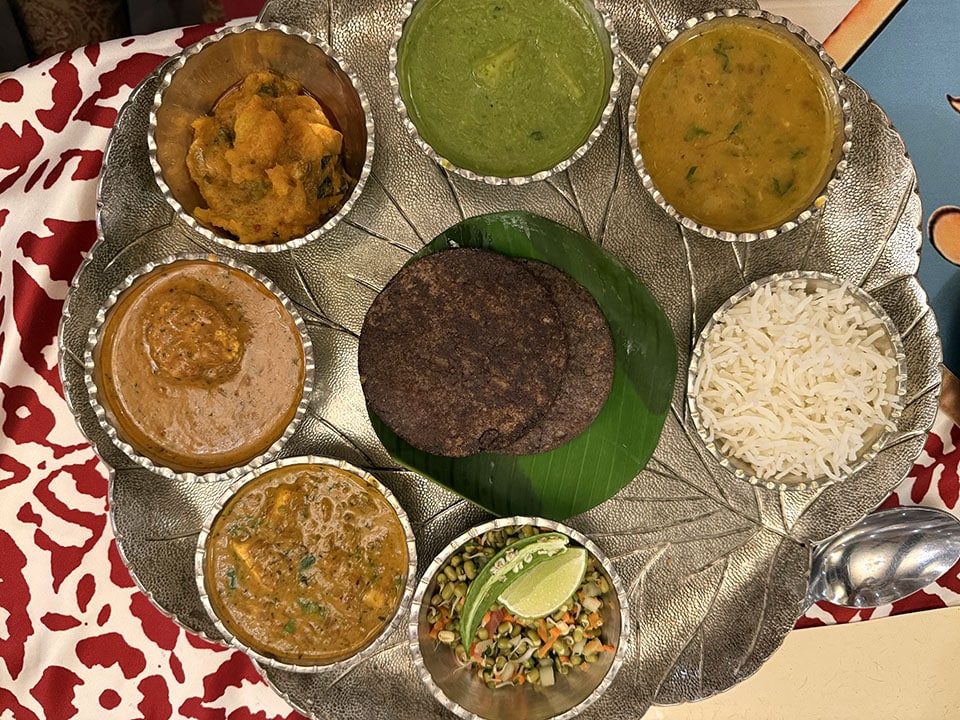
Then we were back on the bus for a quick ride to a Thali (“Ta-lee”) restaurant. Thalis are large brass plates, usually with rice or some type of bread in the middle, surrounded by many small brass bowls, each holding a different sauce, vegetable, or curry. At this particular restaurant, they also had three brass cups at each place: the tallest for filtered water, the medium for a delicious milk drink with rose water and cardamom (they made Heidi a special one out of almond milk instead of dairy), which was very good but a bit rich, and the smallest cup was the best…filled with sandalwood water! Not even sure how they make that, but it was so refreshingly delicious!!
They also brought a bowl of rose water around to each person at the table to wash our hands before eating. So civilized!
After lunch, we stopped at the oldest silk weaver in Varanasi; one of their silk looms was over 1,000 years old! We got a tour of the silk-weaving process before they pulled out all of their silk scarves and the fabrics for us to view and purchase… Heidi, of course, had to buy a couple of beautiful silk scarves here for herself and a few friends.
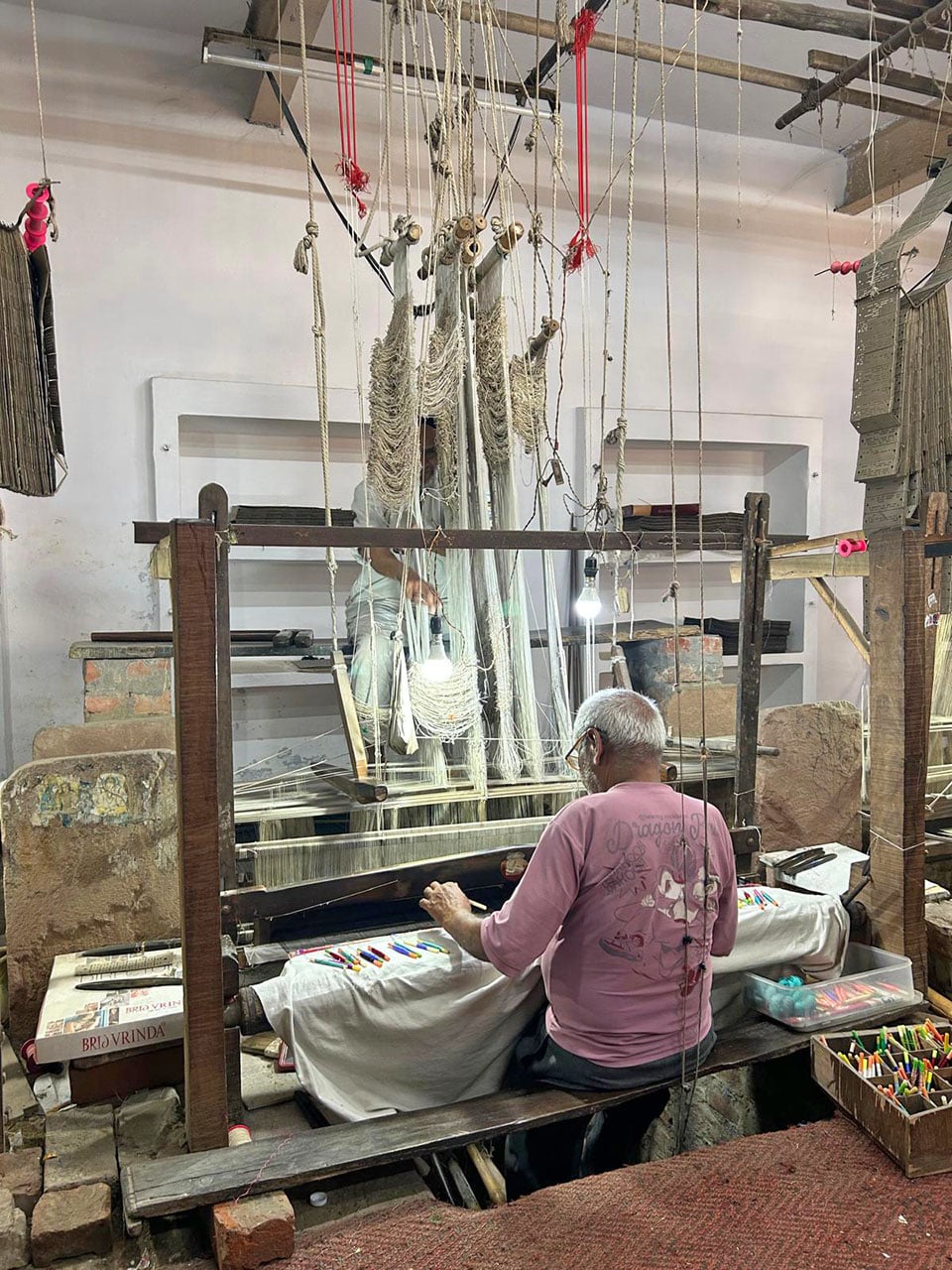
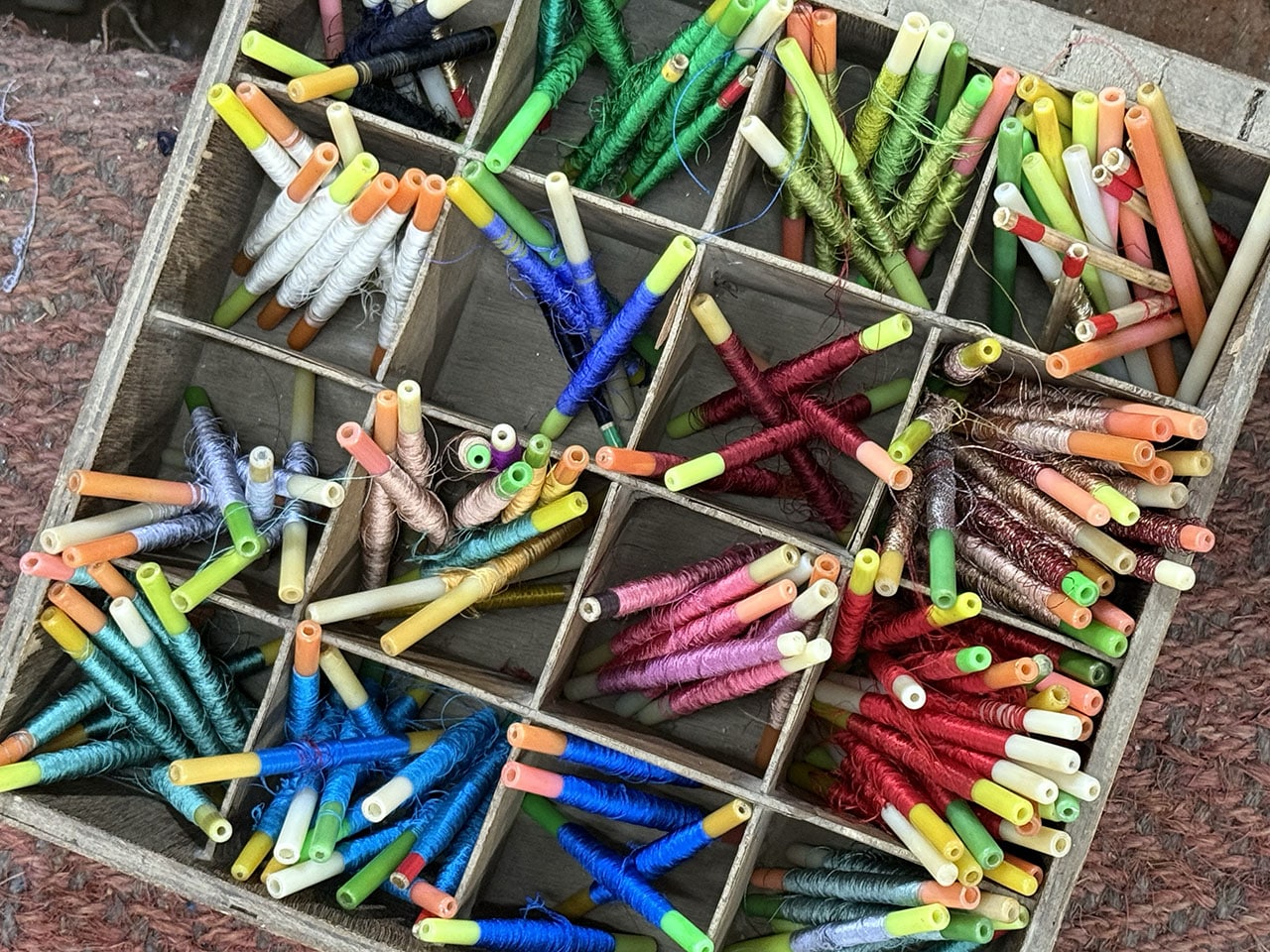

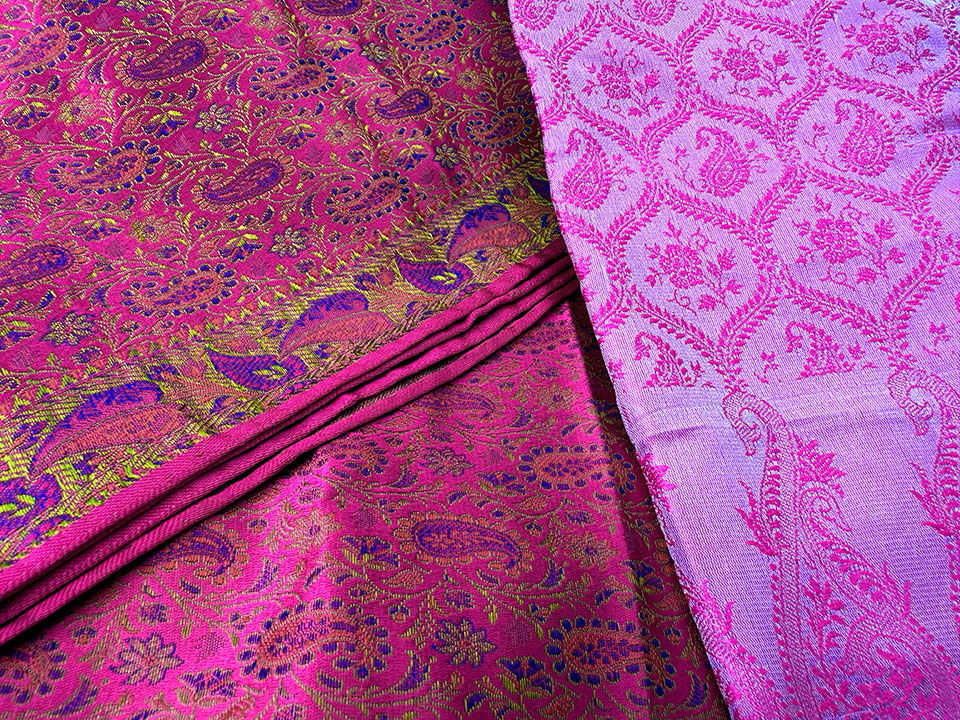
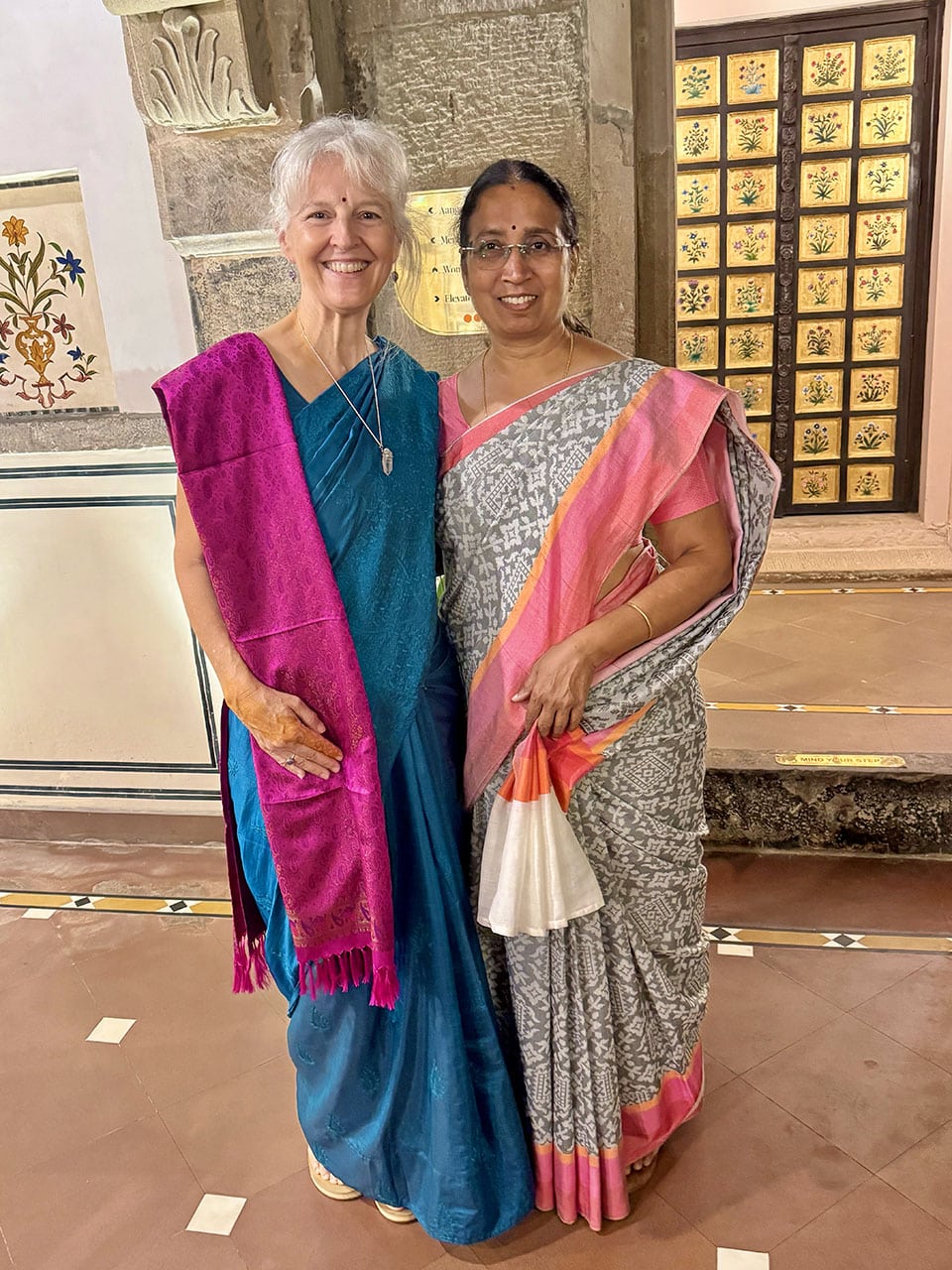
Back at the hotel, we had more Ayurvedic massages (not nearly as good as in the south), this time including steam showers afterward. And Mallilka dressed Heidi up in one of her Saris with Heidi’s new silk scarf (close-up above) that complemented it well, for our last evening in Varanasi.
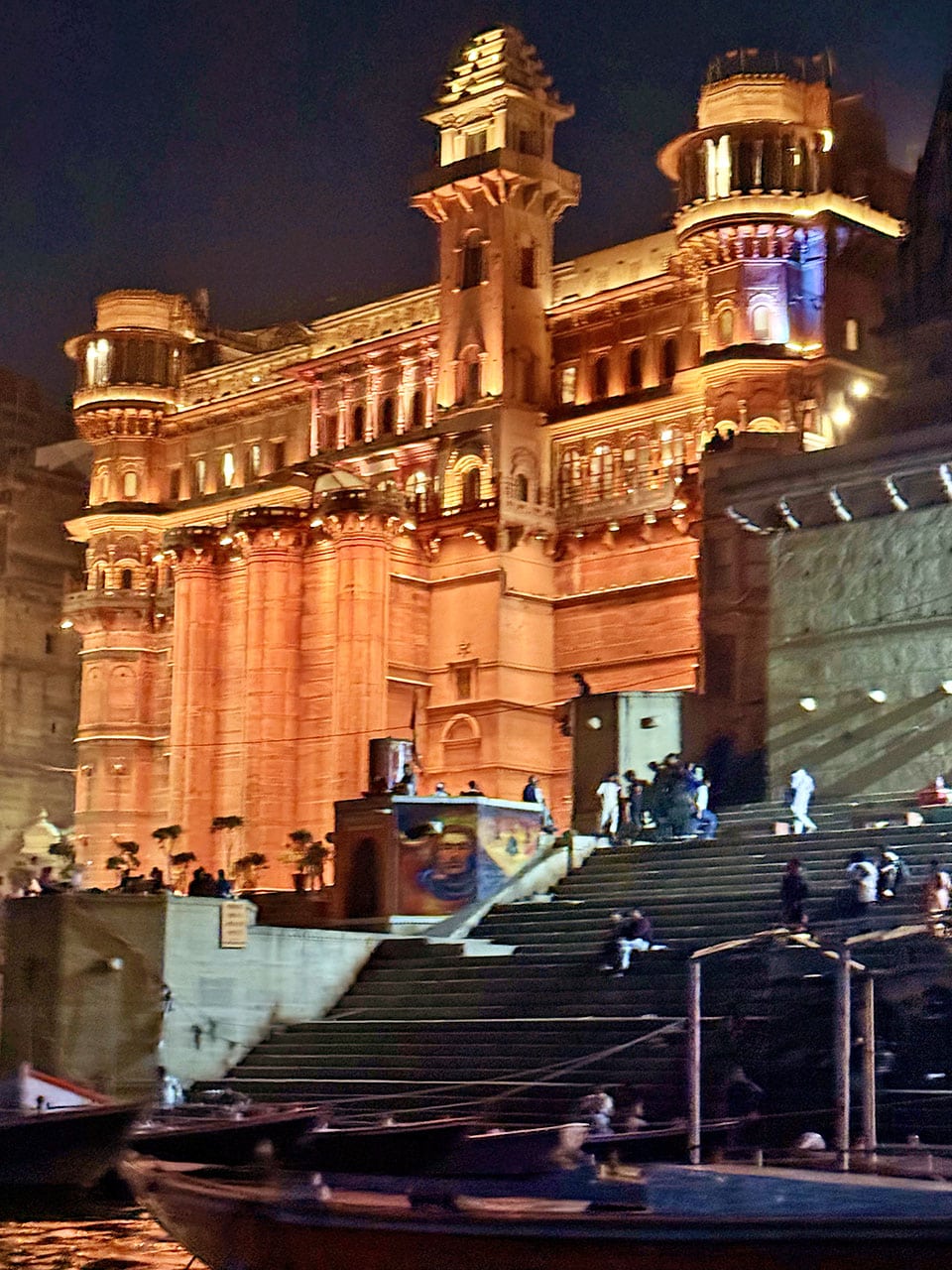
BrijRama Palace was truly one of the top hotels we’ve ever stayed in, and we are so grateful for our time visiting Varanasi and everything that Roger and Athma Tours planned for us to experience in this City of Light.
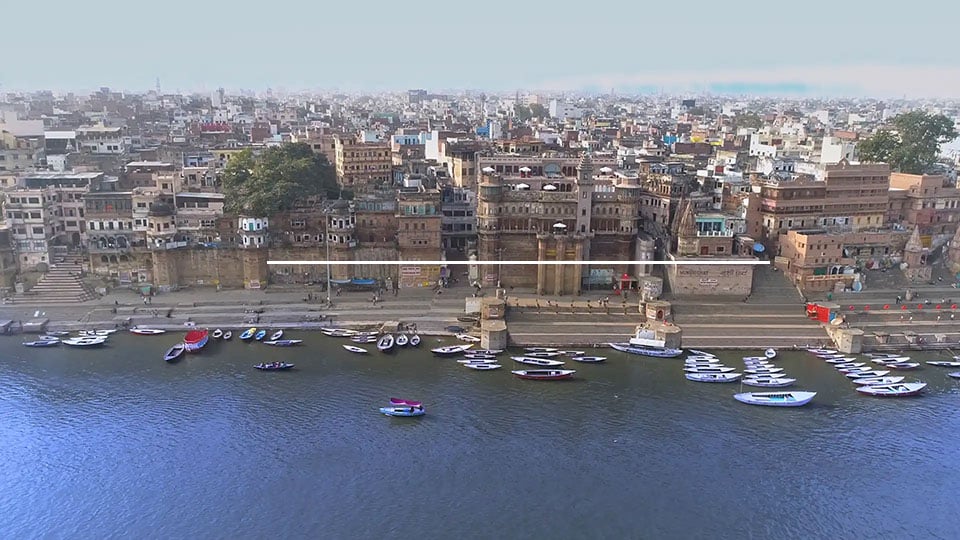
During the monsoon season, the Ganges water level can rise by 20+ feet above the level we experienced (the white line indicates the high water level). The BrijRama Palace (center of photo) actually has to close its elevator because the shaft fills with water.
So long, Varanasi… we will miss you as we head upriver to visit Rishikesh, near the Himalayan headwaters of the Mama Ganga.
Getting to Rishikesh
Our flight to Rishikesh was delayed for a mechanical issue—first by 30 minutes, then an hour, then another 30 minutes—and eventually, four hours later, we finally took off.
This was also the only leg of our entire time in India that we flew Air India, not Indigo. We know mechanicals can happen, and try to go with the flow when we travel… But being strung along every 20 or 30 minutes for four hours was ridiculous—we were not impressed.
The silver lining was that the delay gave us time to find a Sunglasses Hut at the airport, and we each got new sunglasses after sacrificing our old ones in Varanasi.
Rishikesh: Gateway to the Himalayas
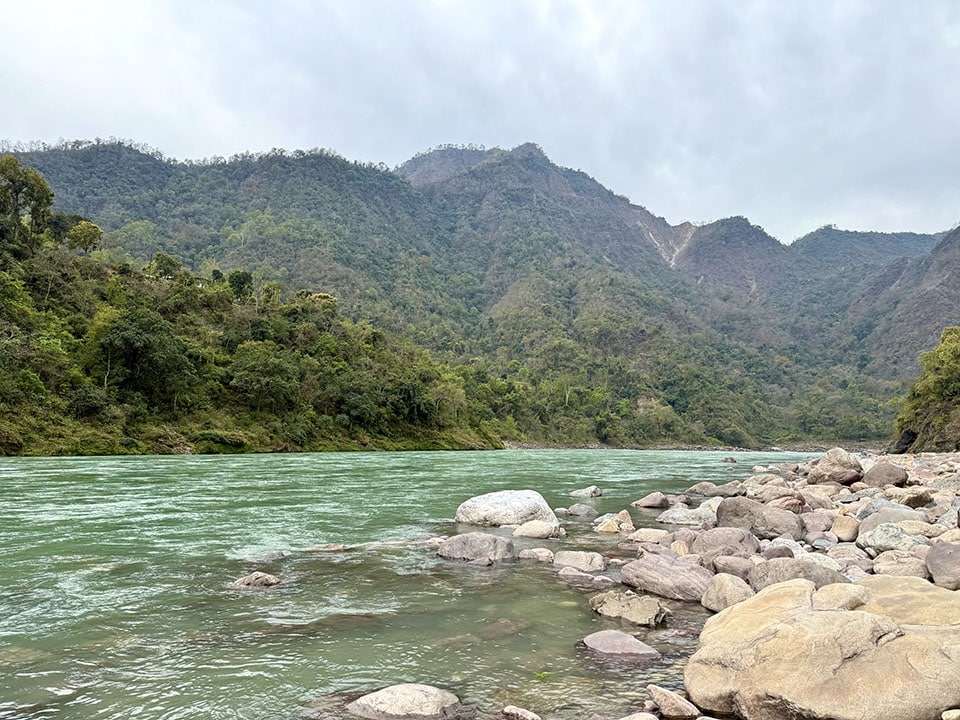
Once we finally landed in Rishikesh, our local tour guide, BC, met us at the airport, and our group piled into four taxis for the 30-minute drive to the hotel. We were grateful to be in the same taxi with BC and Roger, getting a personal guided tour of Rishikesh along the way. They pointed out the Sacred Mt Kunjapuri, and the arid, open forest understory of the Himalayan foothills. We also got our first glimpse of Mama Ganga in Rishikesh (only 175 miles from her glacial headwaters). She flowed so GREEN, fast and clear here—very different than Varanasi!
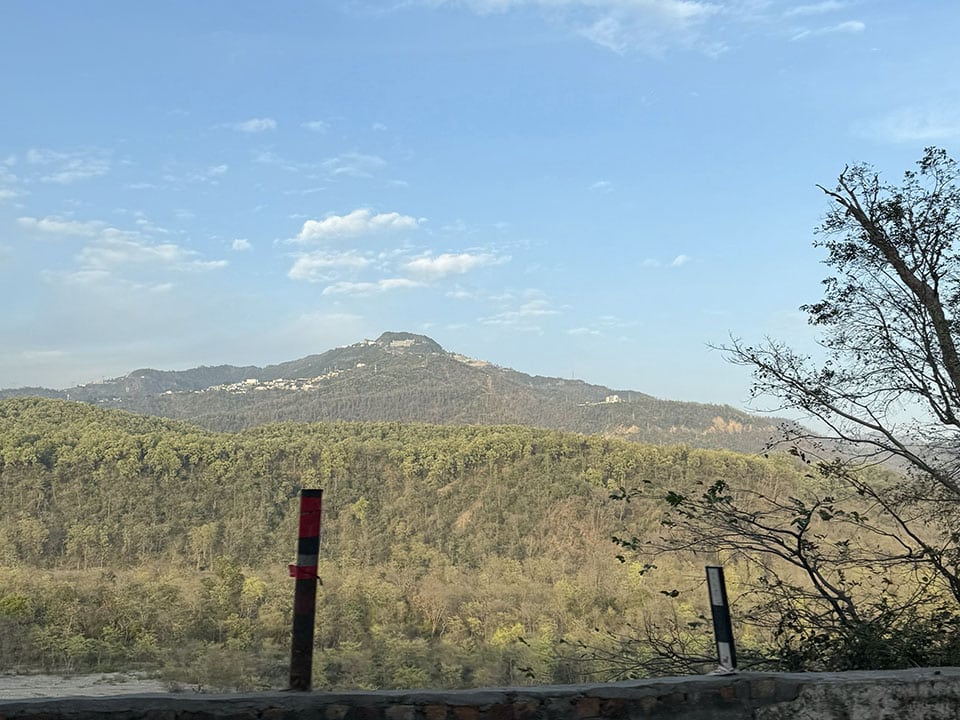
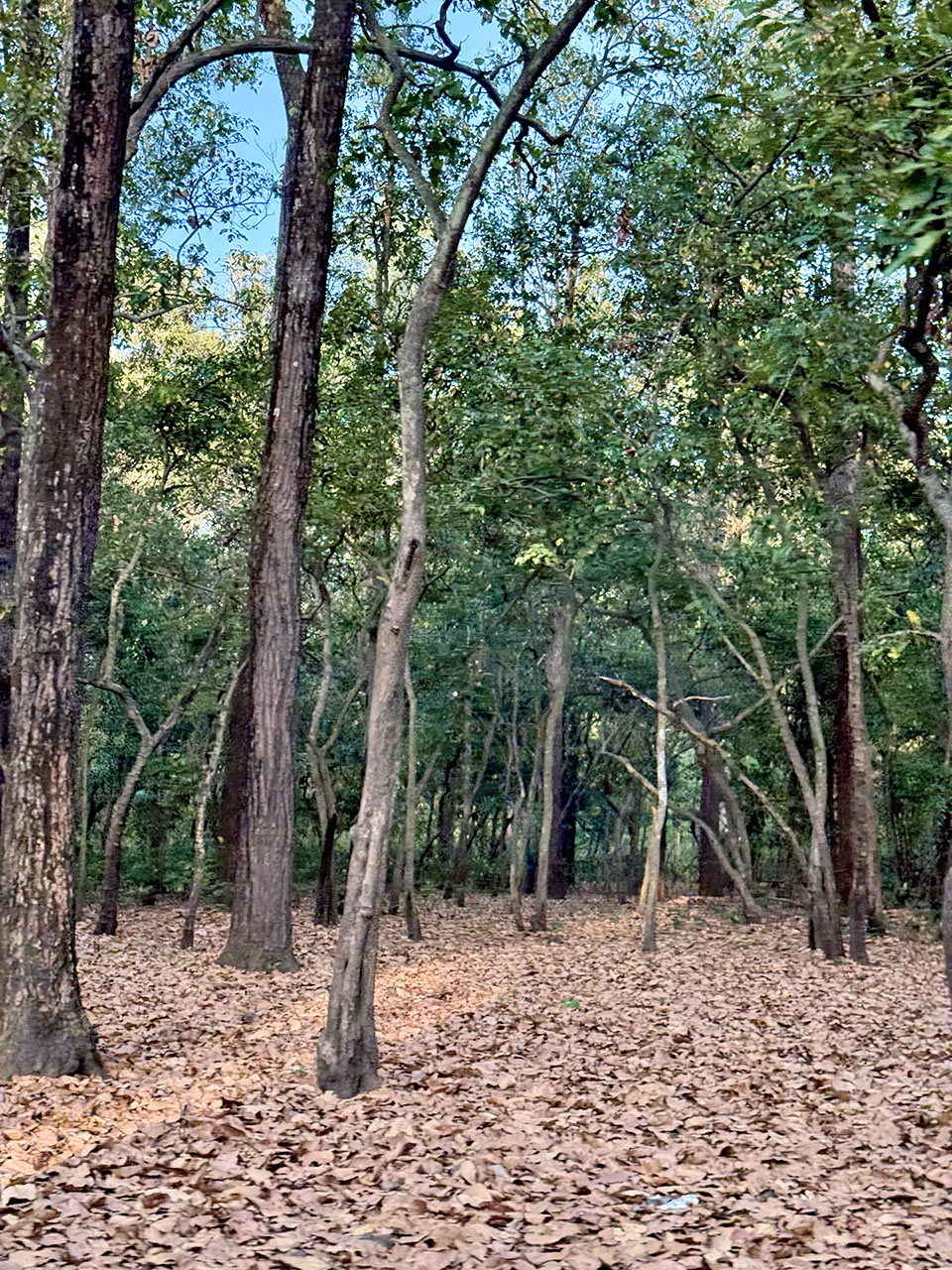
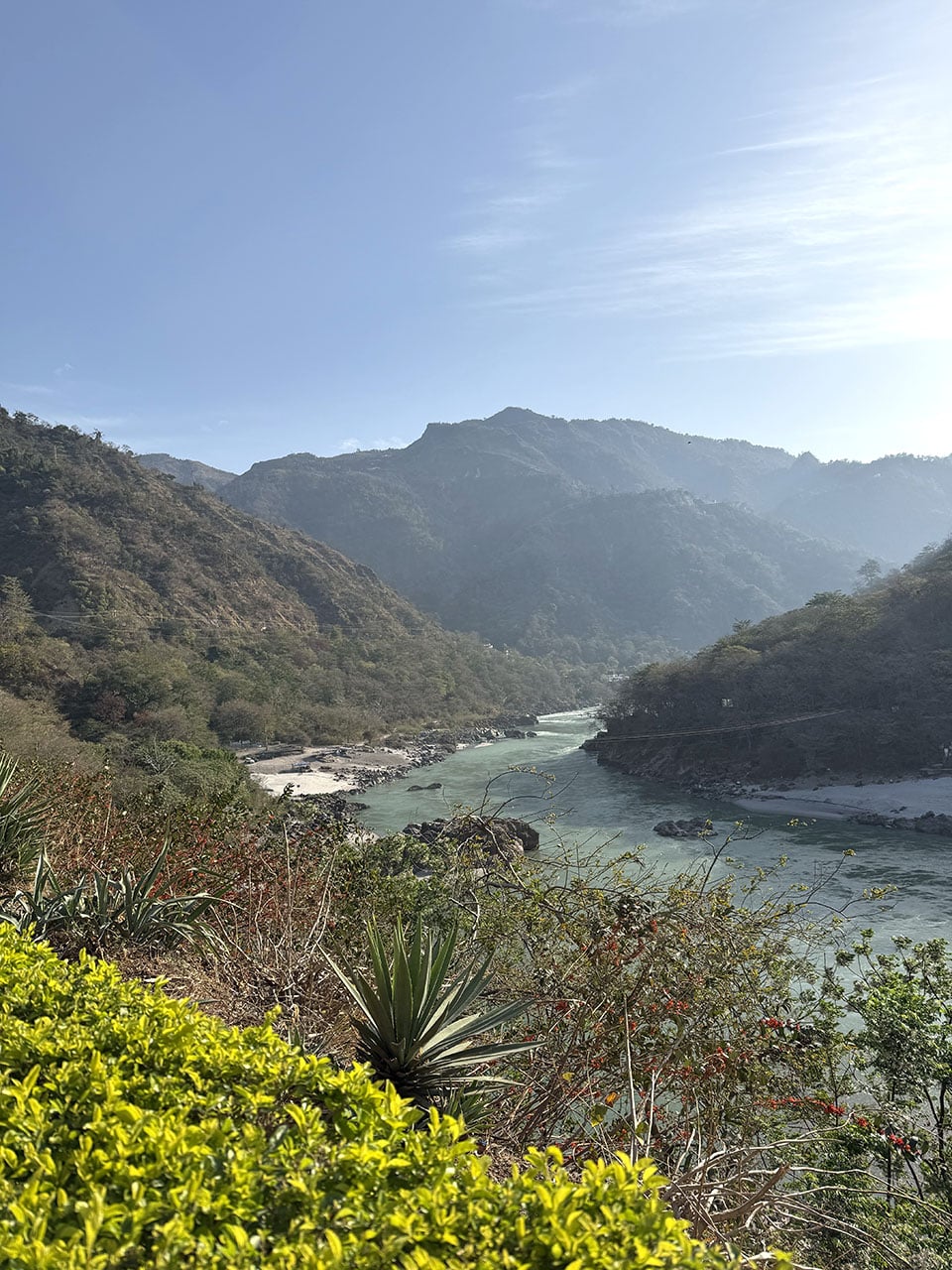
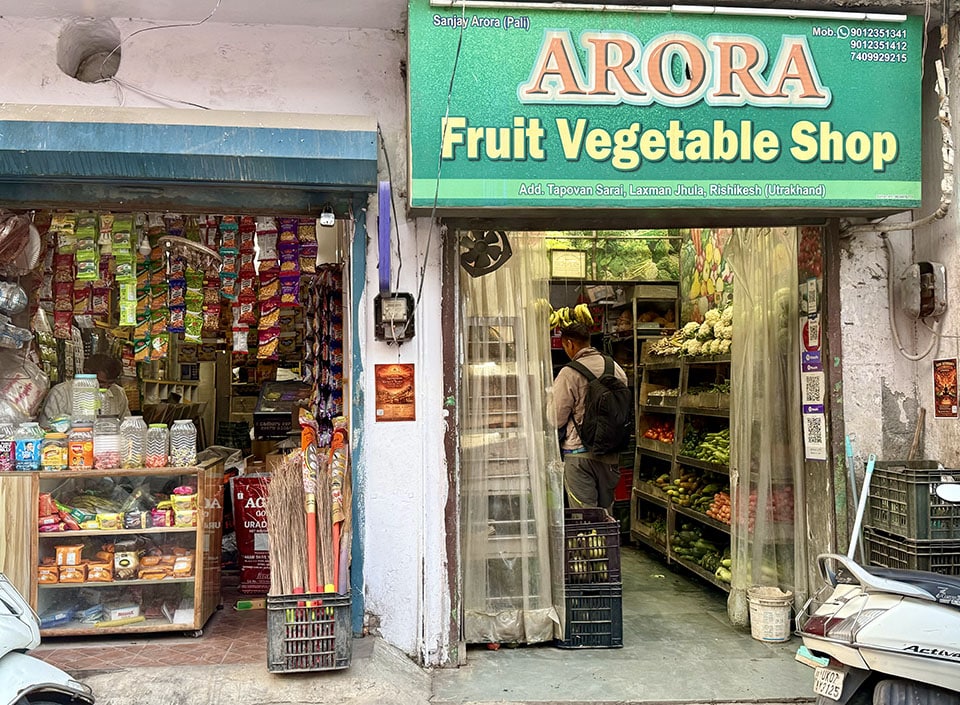
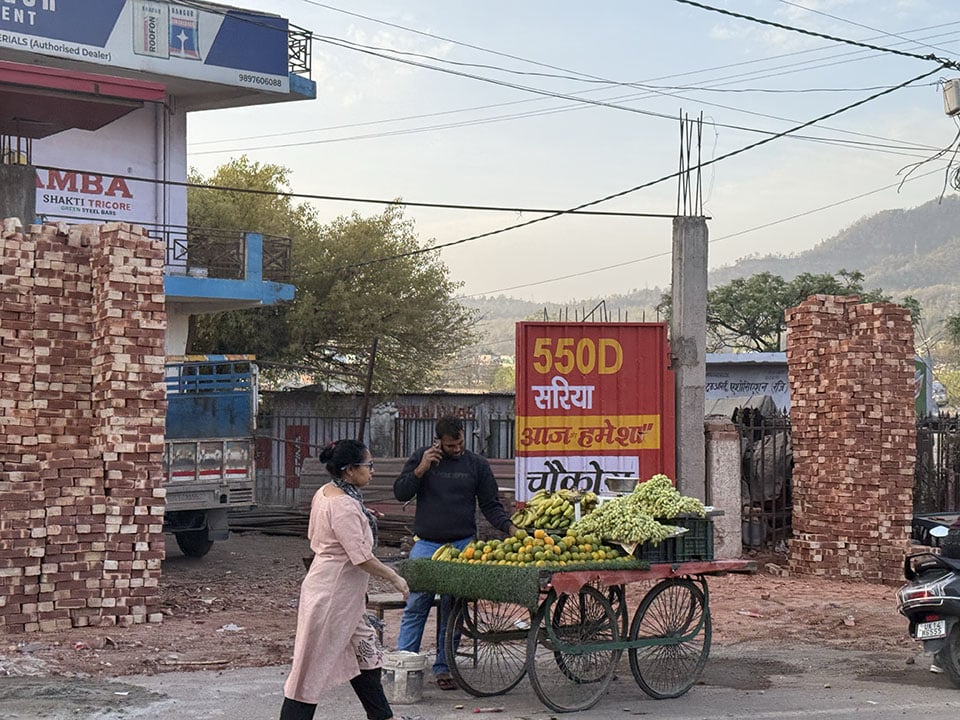
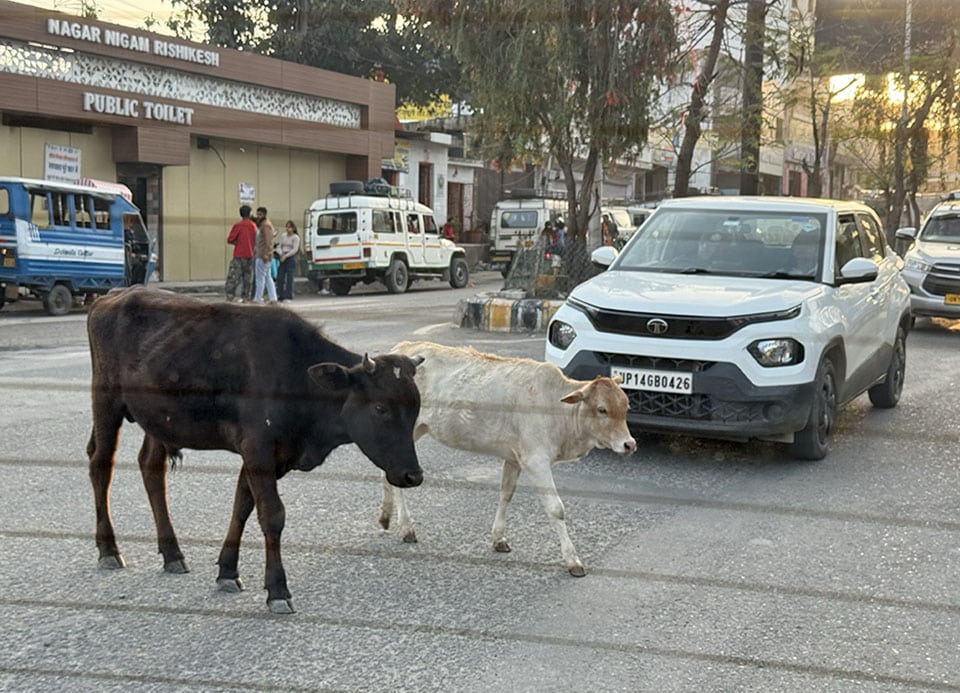
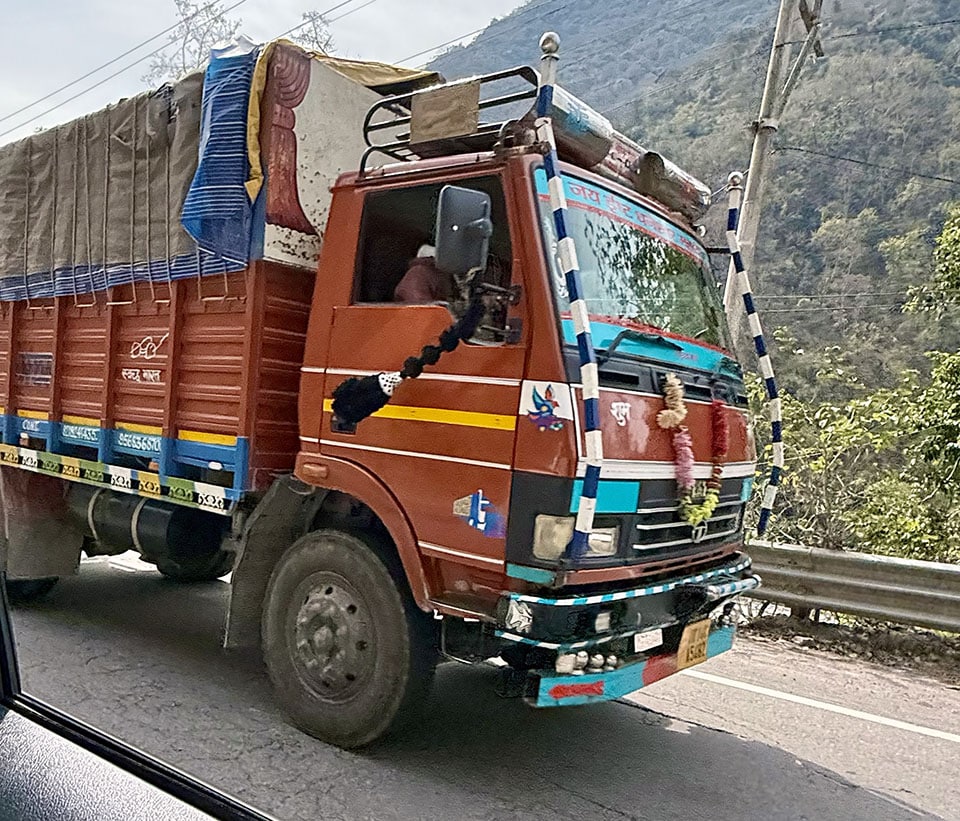
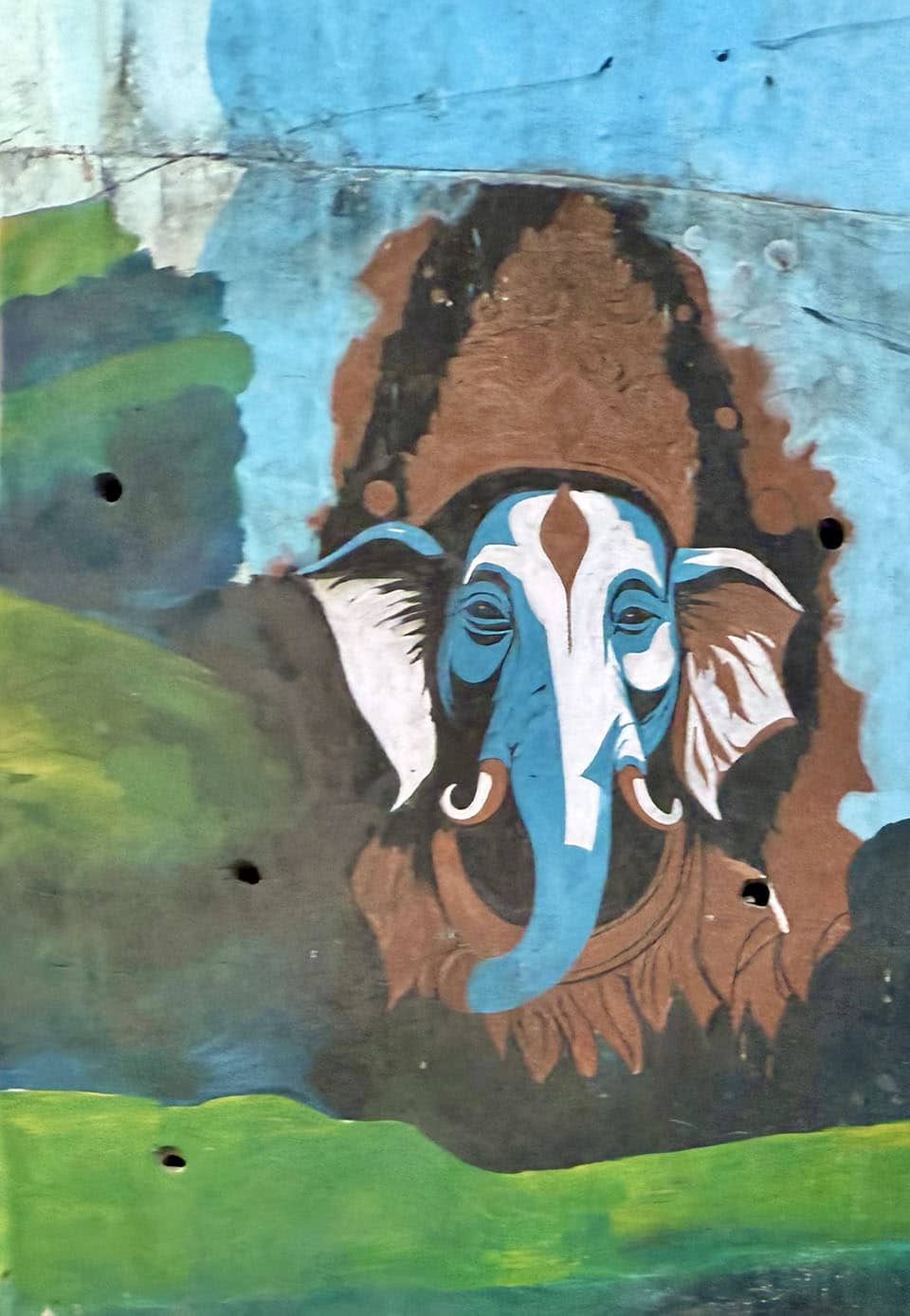
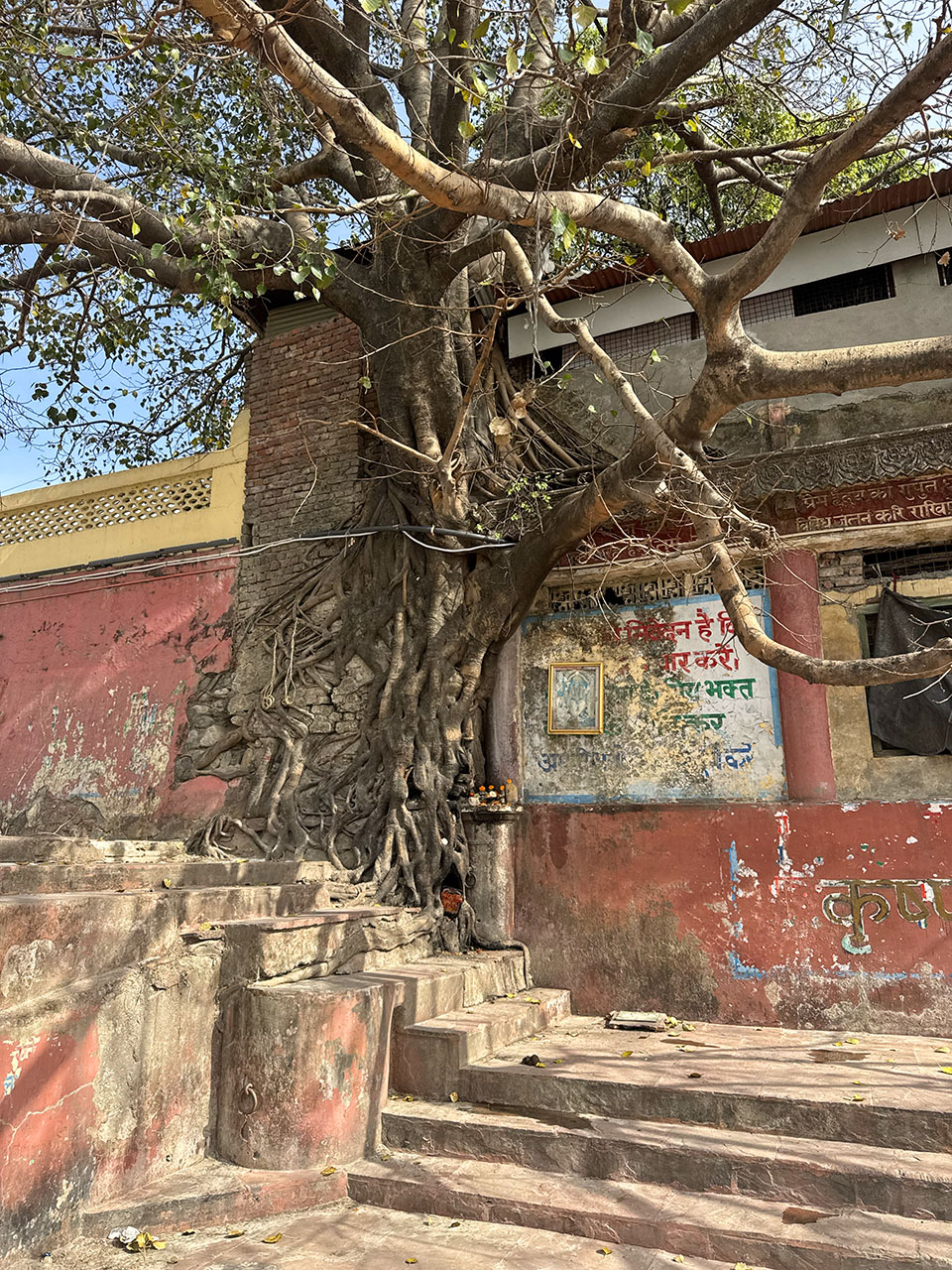
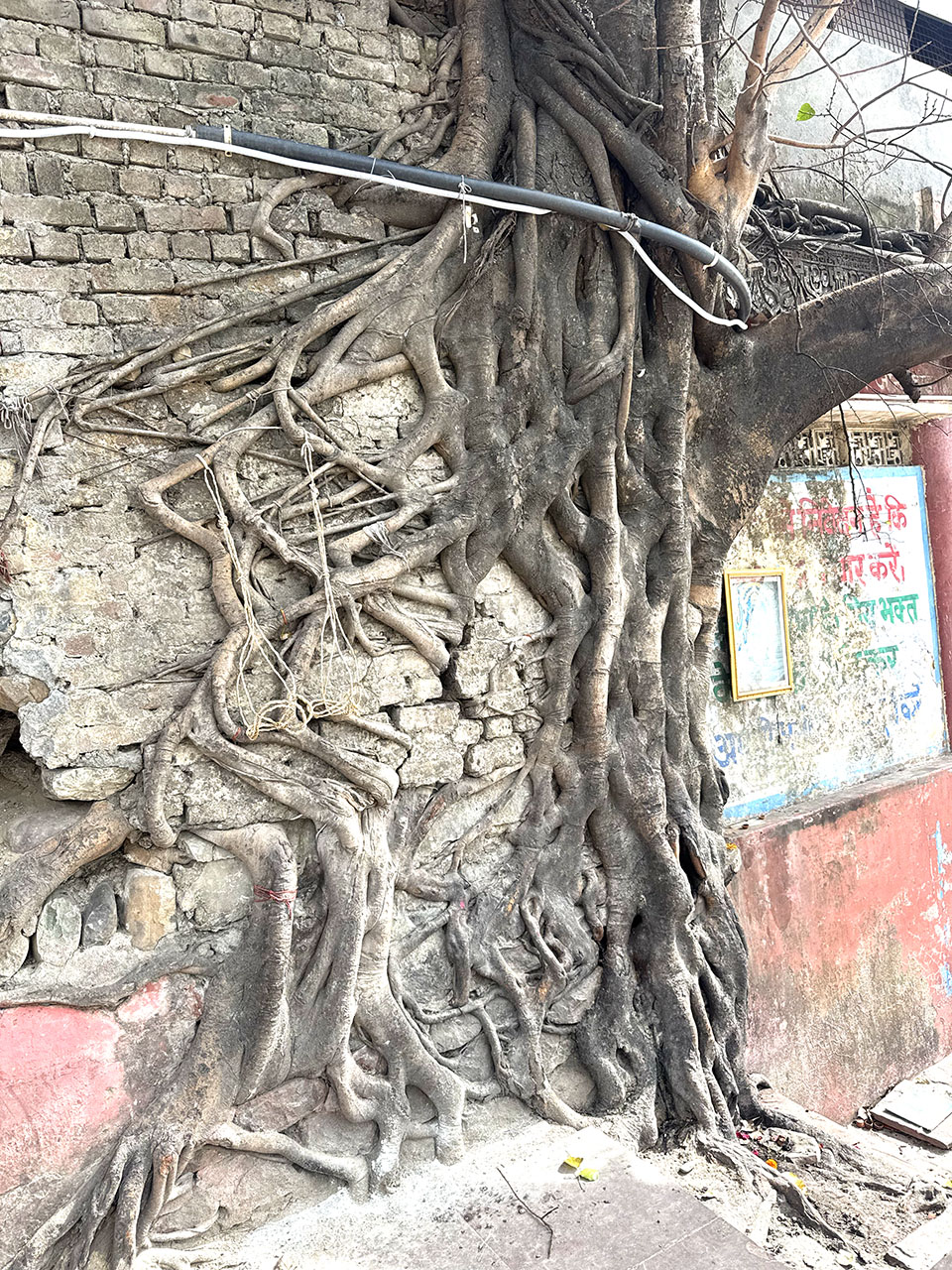
From the minute we arrived, Rishikesh felt different from anywhere else we had been in India. Nestled in the foothills of the Himalayas, the air was dry, clean, and clear, and the temperature was about 10°F cooler than the cities we had been visiting—bonus: no face masks needed for air pollution! Surrounded by forested mountains, Rishikesh is one of the main jumping-off points for Himalayan treks, and the vibe here was laid-back, outdoorsy, and a little bohemian.
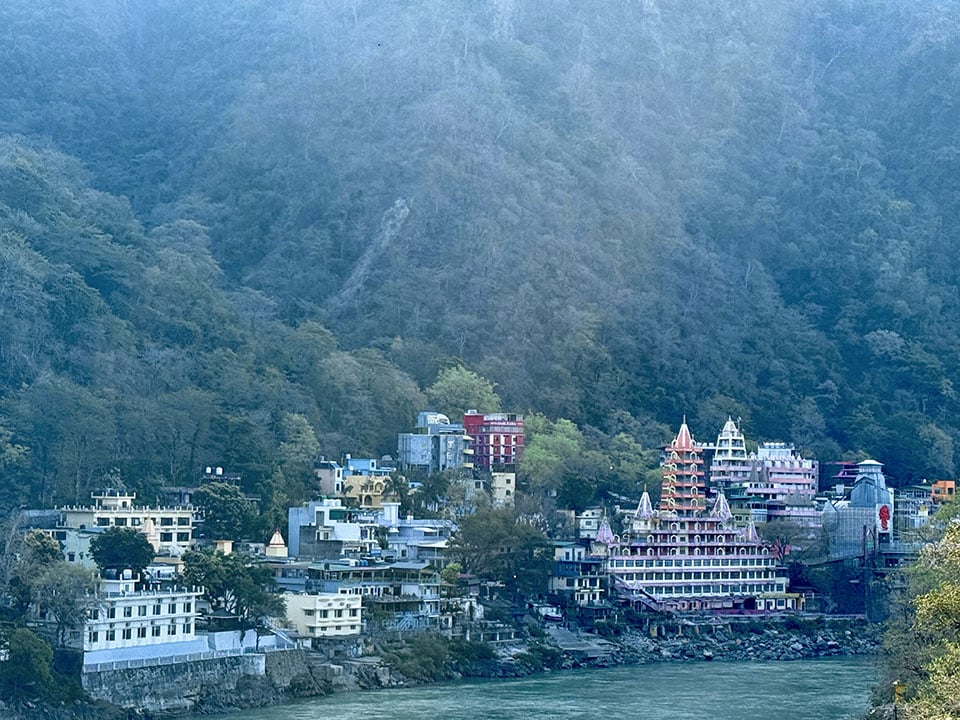
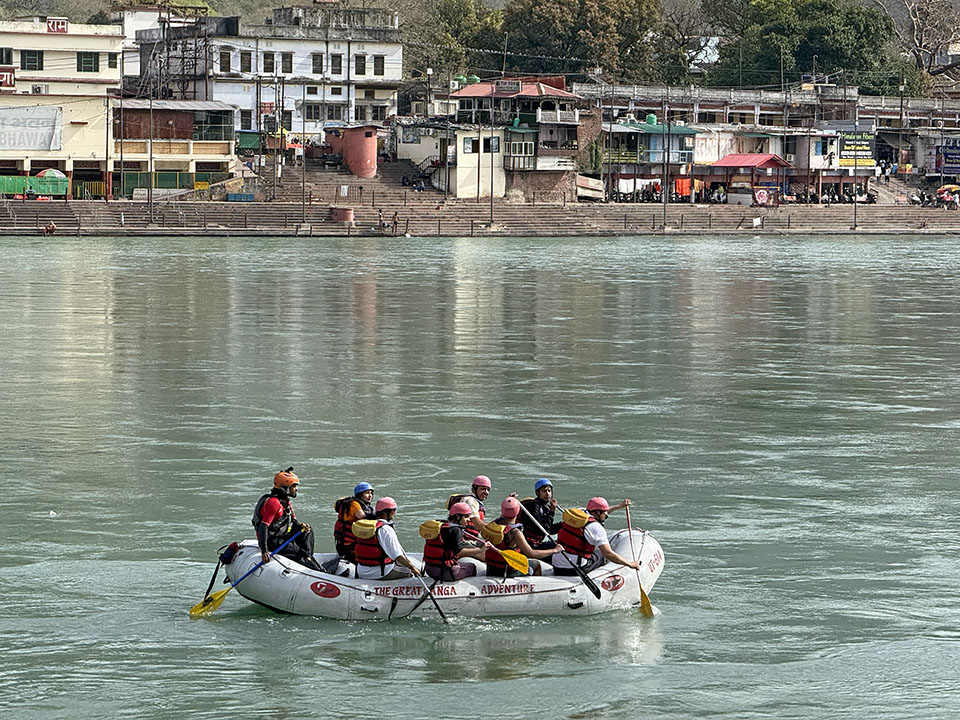
A vibrant city of about 100,000 people, Rishikesh spreads along both banks of the sacred Ganges River (with bridges at each end of town). Known as the “Yoga Capital of the World,” Rishikesh draws spiritual seekers, pilgrims, and travelers from around the globe. It’s also considered the white-water rafting capital of India, where class III and IV rapids are juxtaposed with the peaceful atmosphere of its temples, ashrams, and riverside ghats.
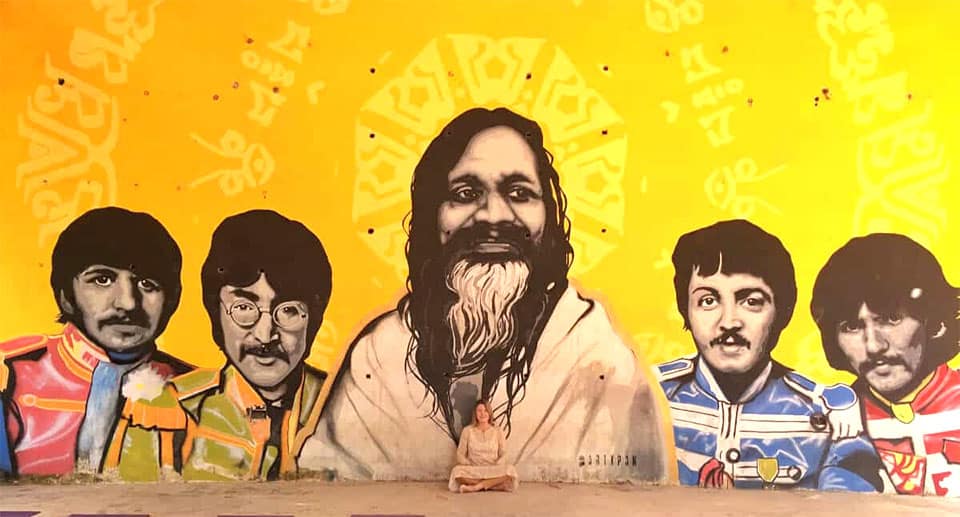
Rock ‘n’ Roll Trivia: Rishikesh is where the Beatles retreated to Maharishi Mahesh Yogi’s ashram in 1968 to write much of what would later become the White Album. And although we were both followers of Maharishi TM Meditation for a few years, and Kirk is one of the biggest Beatles fans on earth (having seen them in person in Seattle in 1964), we didn’t really have a desire to visit that ashram, as it seems to mostly be a tourist trap these days.
By the time we left Varanasi, Kirk was feeling worse and coughing up dark gray gunk, so antibiotics were clearly in order. Heidi’s cough was improving, but most of our group had now come down with some version of the same upper respiratory bug. Several people wanted to see a doctor, and Mallika had arranged for one to meet us at the hotel. Unfortunately, our four-hour flight delay meant the doctor had been waiting for hours and had finally gone home before we arrived.
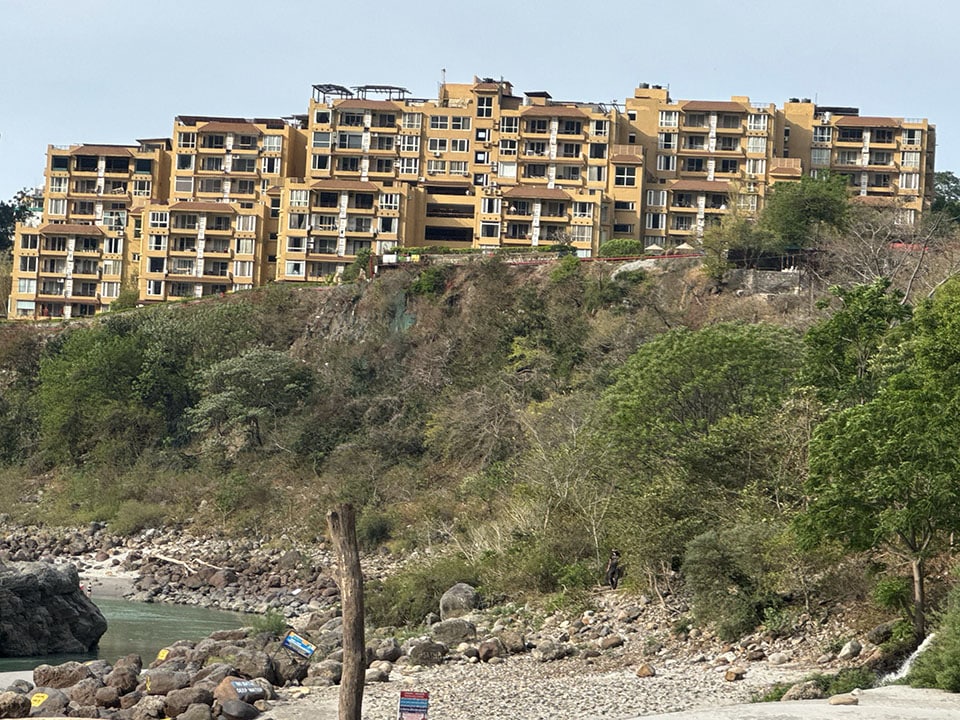
The hotel stair-stepped down a hillside overlooking Mama Ganga, with the main entrance on the top floor. Even though the view from the grounds overlooking the river was amazing, this was one of the few hotels on our trip that just didn’t resonate with us. This may have been partly because the porte-cochère was being remodeled, so we had to enter through the service entrance.
To get to the lobby, we wound through a circuitous maze of gray-walled halls and corridors and down a flight of stairs, making us wonder WHERE we were going?! As an energy worker, Heidi also picked up some unsettling energy at this place.
By 6 PM, we were finally checked in and made our way to our room—another journey down a few floors in the elevator, then up some stairs inside and down some more stairs outside, and around the outside of the building to the far corner (in the photo above, our room was at the bottom, far right corner). Unfortunately, one of our tour-mates took a tumble down some stairs, and we later learned that she had broken her ankle and would have to return to the US for surgery! Like Heidi said… bad energy here.
Thankfully, the bellboys hauled our luggage to our room by golf cart. The recently remodeled rooms had a somewhat Art Deco meets Mid-Century Modern (or was it Miami Vice?) vibe, and although we couldn’t see the river from our room, we did have a nice view of the grounds.
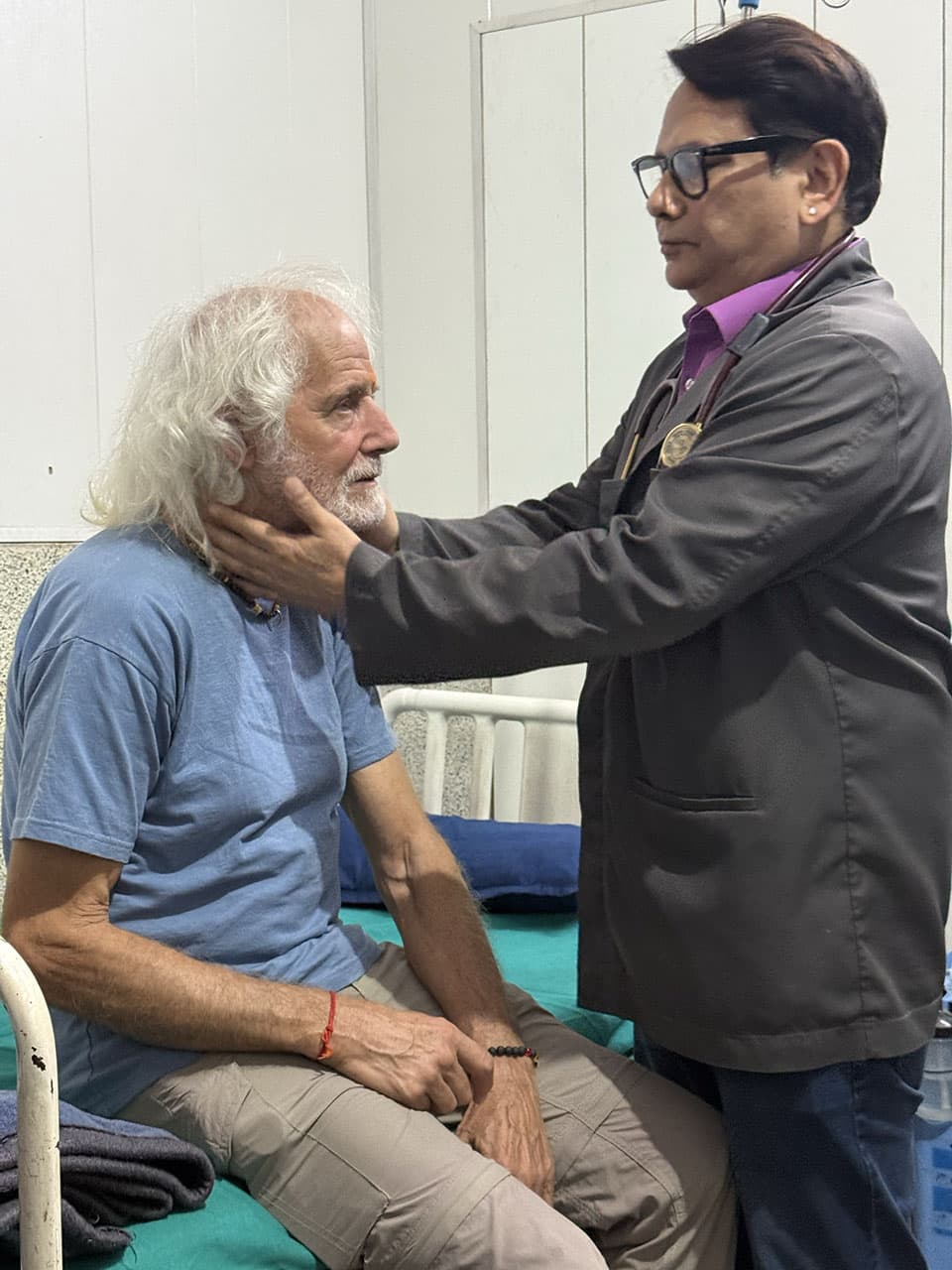
After a long day of travel, we were hungry, but some of us opted to visit a doctor while the rest of the group headed to dinner. Five of us, plus our wonderful Rishikesh guide, BC, and his driver, piled into a Toyota SUV to head to the local clinic. Though the clinic was only a couple of miles away, rush-hour traffic was so bad it took over an hour to get there. We could have walked faster!
Thankfully, there were only a few patients ahead of us, and the doctor on duty was a pulmonologist. Just what we all needed! After listening to everyone’s lungs, he prescribed amoxicillin to all. He told Heidi that although her cough was improving, her lungs were still congested and could easily progress to pneumonia, so she agreed to antibiotics for five days. He also prescribed some cough syrup and a decongestant.
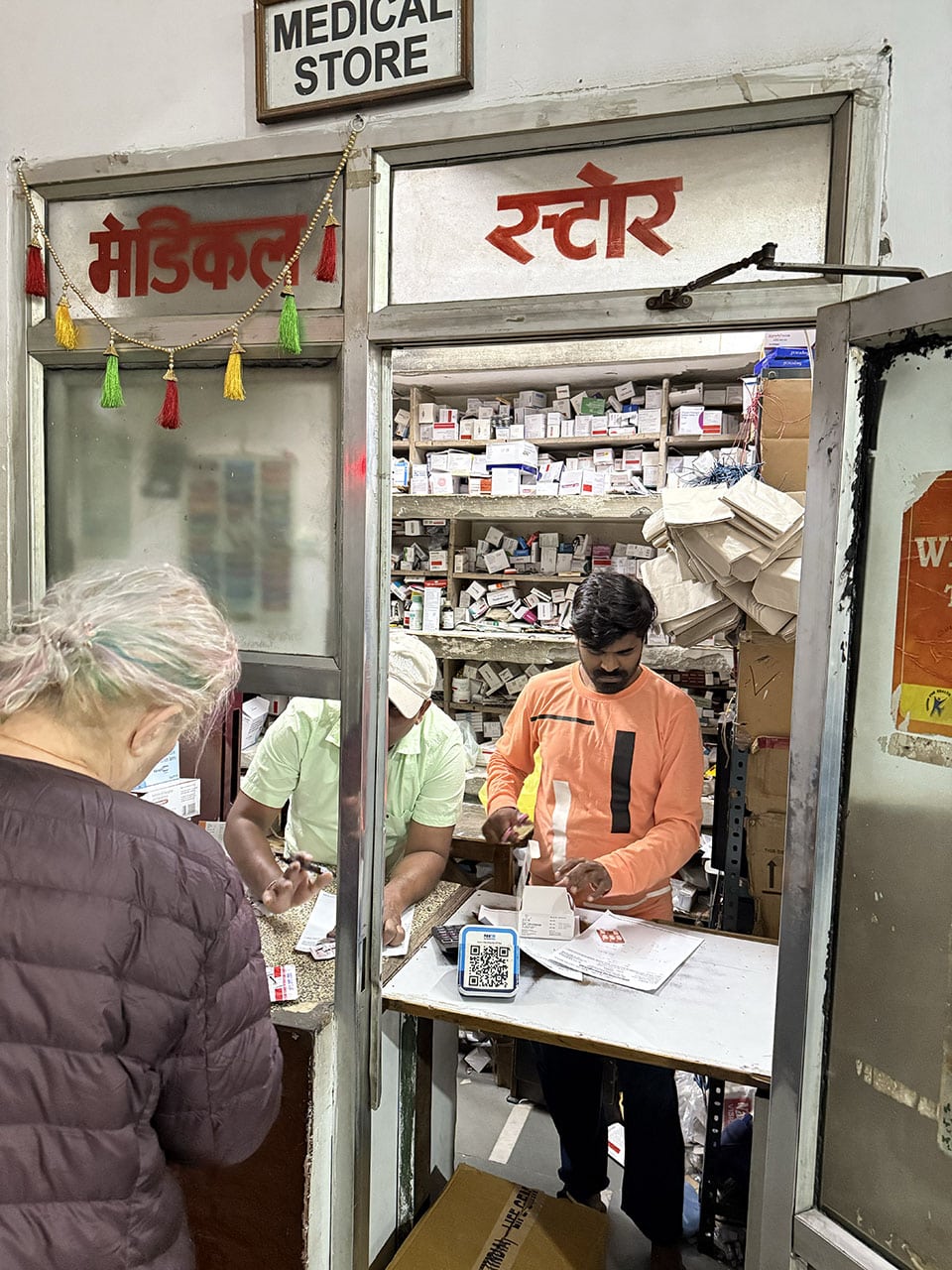

Total cost:
Doctor visit: $10 USD /each
Medications: $4 USD / each (for antibiotics, cough syrup, and a decongestant)
Watching the pharmacist climb the shelf to get the prescriptions: Priceless!!
The drive back in the dark afterward took nearly as long, and we really wished we could’ve walked back, because we passed by so many cool-looking shops, vendor stalls, and food markets along the way—all a buzz with multitudes of people in the evening—in a part of the city that we never had an opportunity to visit again. One more reason to return to Rishikesh!
Thankfully, the hotel restaurant was still open for dinner when we returned. Most of us grabbed a bowl of soup and then headed to bed.
Whitewater Rafting Capital of India
The next morning, we were off in four cars again to visit the historic Vashishta Gufa cave, about a 30-minute drive to this hidden spiritual gem tucked away on the banks of the Mama Ganga.
On our drive along the road and in the river, we saw hundreds of whitewater rafts, rigs, and people getting ready to go rafting. Having grown up whitewater rafting in an outdoor-adventure town, Heidi had never seen so many rafts in one place at one time. Then again, there are over a billion people in India, and this was the country’s whitewater capital! (We were curious about prices and the length of the trip, so we checked out a few places. Float trips run $8-$12 USD and last 30 to 45 minutes when Mama Ganga is flowing this fast.) The first photo below is the view from our hotel. There are at least five rafts in the water, and more on the sandy shore to the far left.
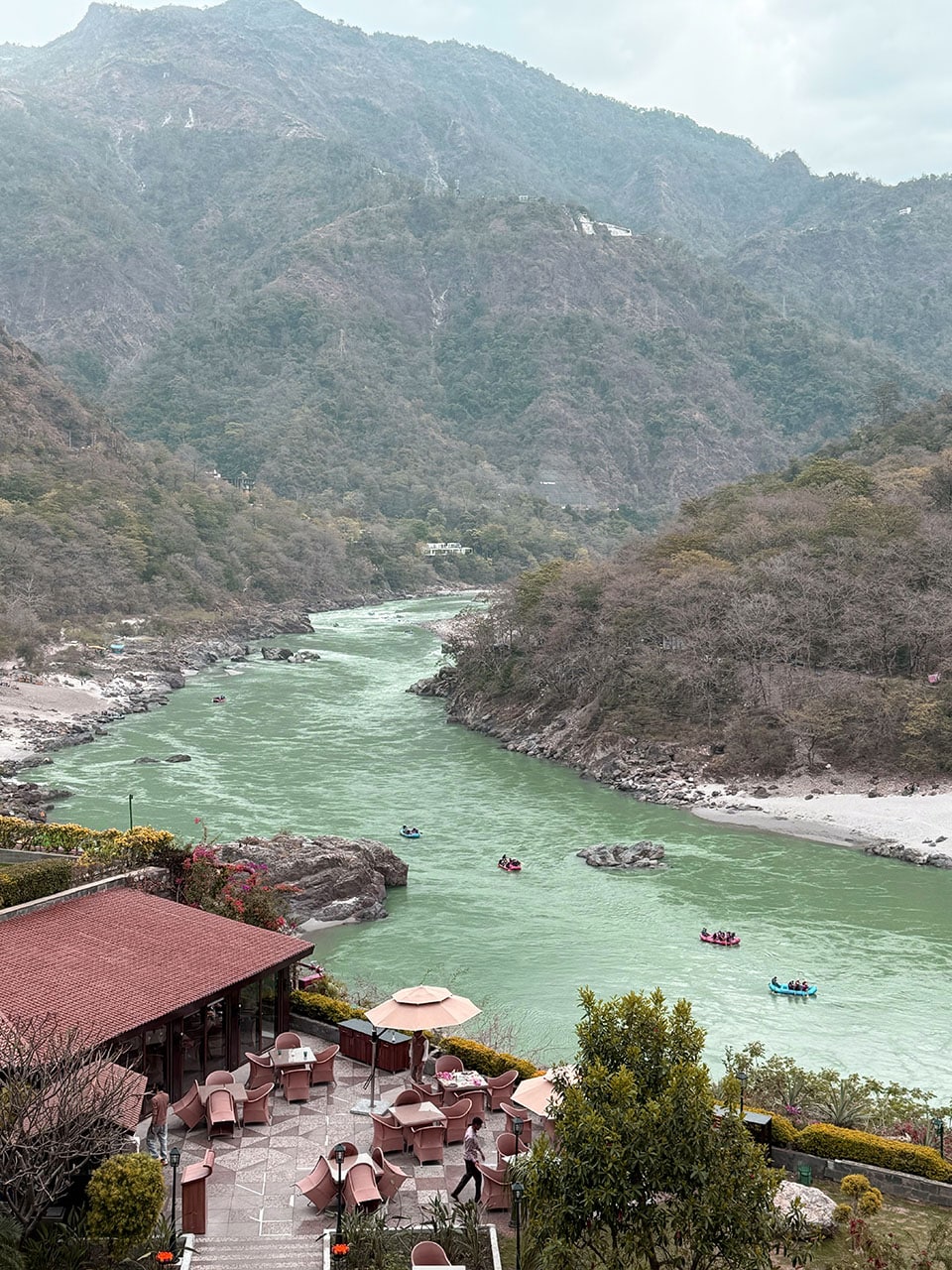
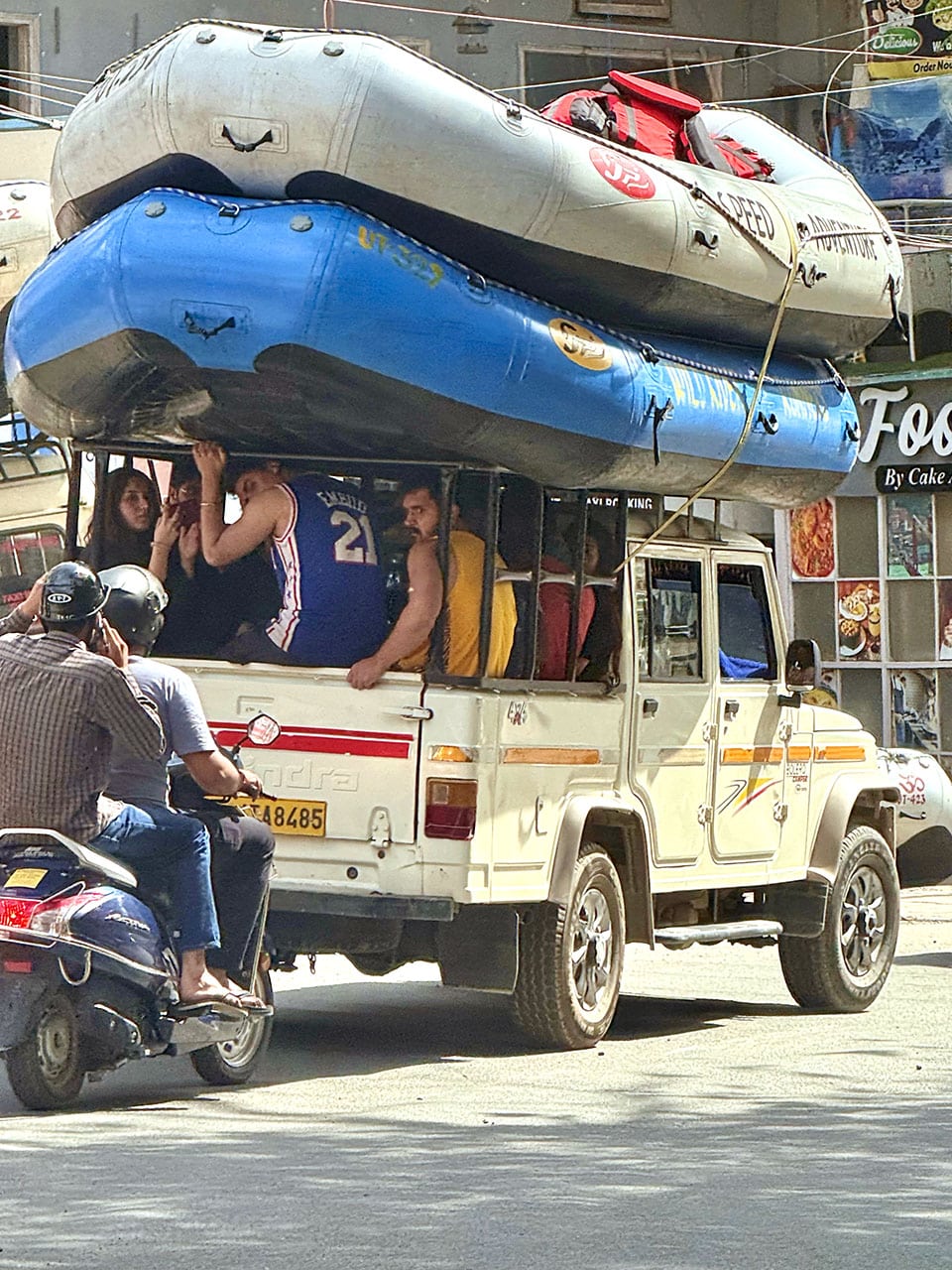
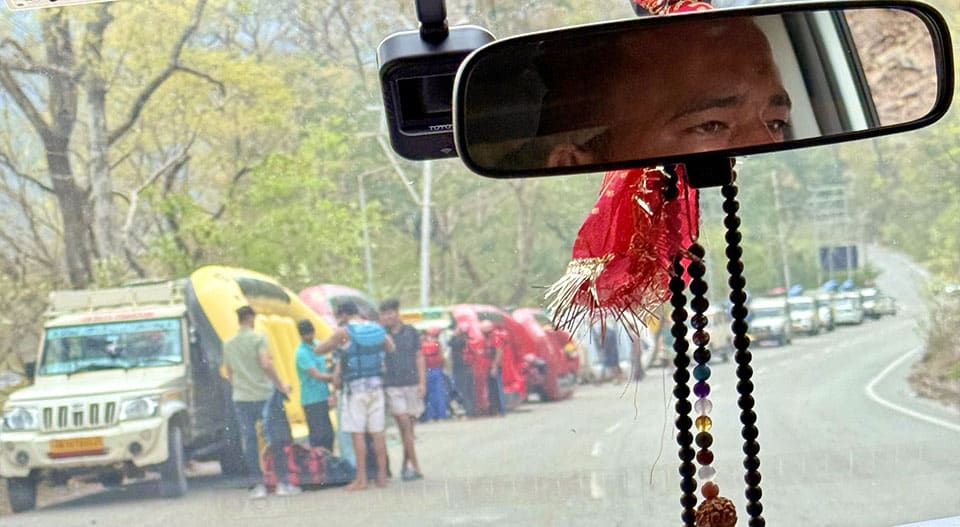
We could see why Roger recommended spreading Heidi’s Dad, Verne’s, and step-mom Willa’s ashes here in Rishikesh—Verne was a whitewater rafting pioneer and guide, and he and Willa had met while whitewater rafting in the early 1970s—and we would scatter their ashes after visiting the cave.
Vashishta Gufa cave
Maintained by the Swami Purushottamanand Ashram, the Vashishta Gufa cave, where the legendary Sage Vashishta once meditated, offers a beautiful sanctuary of deep silence and cool, pitch-dark tranquility—and except for the monkeys!—it was a perfect spot for meditation.
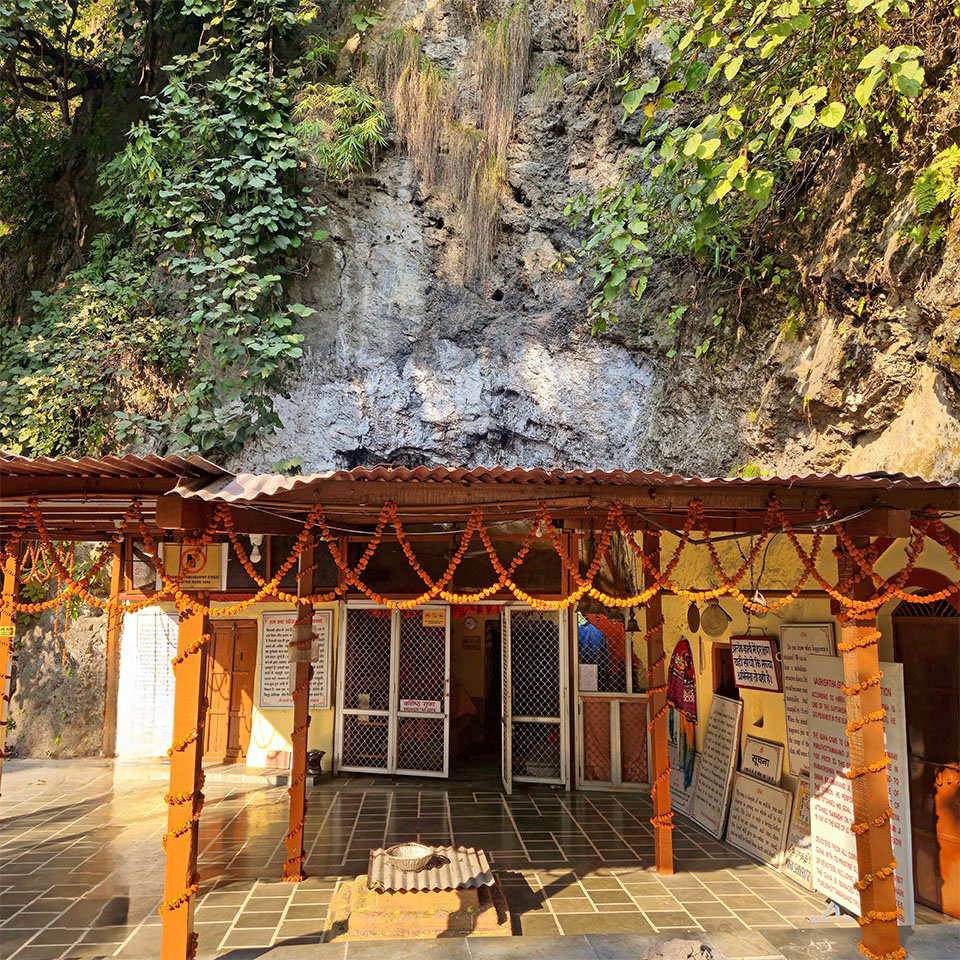
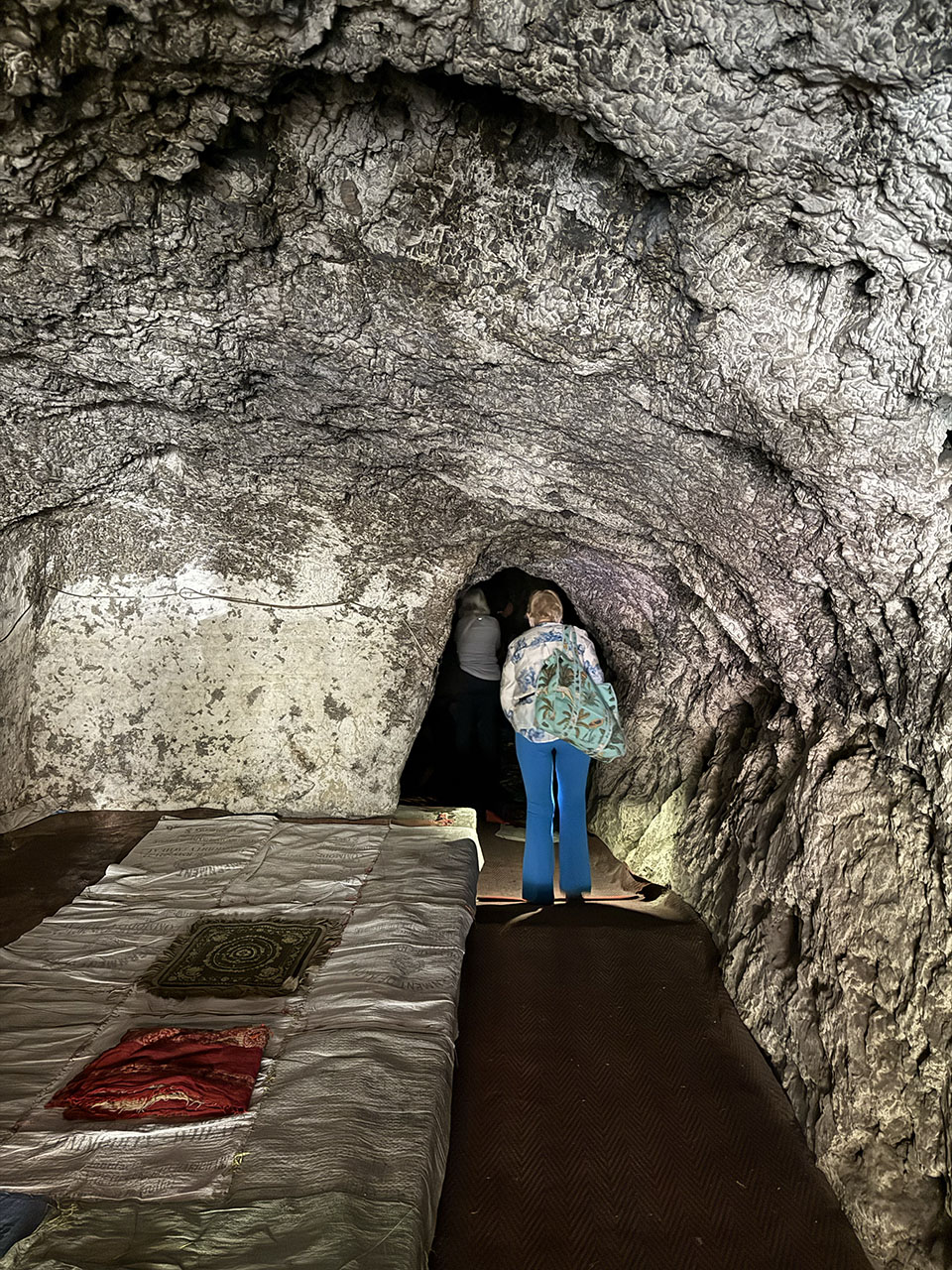
The walk to the cave is down 200 steps from the highway above, and all along the way, there were monkeys everywhere. At the bottom of the steps is the very small ashram (with pit toilets), several cows they use for milk and ghee, a few friendly dogs, and did we mention the MONKEYS?!
A tin-roofed structure covered the cave’s front entrance, protecting it from sun or rain. And as with any sacred space in India, we had to take our shoes off—and were warned to stash them somewhere the monkeys would not steal them! A sign at the entrance read:
OM
Do you know when happiness is obtained?
We eat some delicious food; hear a melodious song; enjoy an attractive dance.
On such occasions the mind becomes tranquil. Happiness is in tranquility.
And where is this tranquility? It exists in our own heart.
When the mind becomes calm, that happiness just reflects in it,
even as the image of the sun fully reflects in clear, still water.
OM
—Swami Purushottamananda
The Vashishta Gufa cave was about 15-20 feet deep, and very dark inside, with no light except what shone in from the entrance. We had to pause at the opening to let our eyes adjust because we couldn’t see a thing. There were wool or silk rugs on the floor, and some cushions for seating along both sides of the narrow cave. And most of our group went in and sat for a few minutes to meditate.
One member of our group stayed for about half an hour and had a very profound spiritual experience there. Unfortunately, the voices of those who stayed outside chatting carried into the cave, and the crazy monkeys were jumping out of trees onto the tin roof, which reverberated with a loud BANG inside the cave every few minutes. Kirk left the cave with a coughing fit, and Heidi followed soon after as the monkey noise was just too much to ignore.
Verne & Willa in the Ganges
After our visit to the Vashishta Gufa cave, we walked down the rocky path to Mama Ganga. The views here were spectacular, just river and mountains as far as the eye could see, no other buildings in sight.
In spite of the serenity of the place, there were quite a few tourists along the river’s edge and on the boulders. Strangely, surrounded by so much natural beauty, many along the river’s edge seemed to be talking—and many about mundane things like TV shows—we were momentarily shocked! And Heidi wanted to shout “BE HERE NOW!”
Here we were at the edge of Mama Ganga in one of the most beautiful spots in the world, and instead of listening to the wind blow, the birds sing, and the river rushing over the rocks…people were chattering?!
Ironically, it made us think of Verne, the consummate nature man, always telling his kids and grandkids, while out camping or hiking, “BE QUIET and just LISTEN!” Thanks, Dad, we learned to appreciate the stillness and beauty in nature from you!
Finding the best place to scatter Verne’s & Willa’s ashes took a minute (and if we had waited 10 minutes more, the other tourists finally left the spot we really wanted), but the spot we chose was fine.
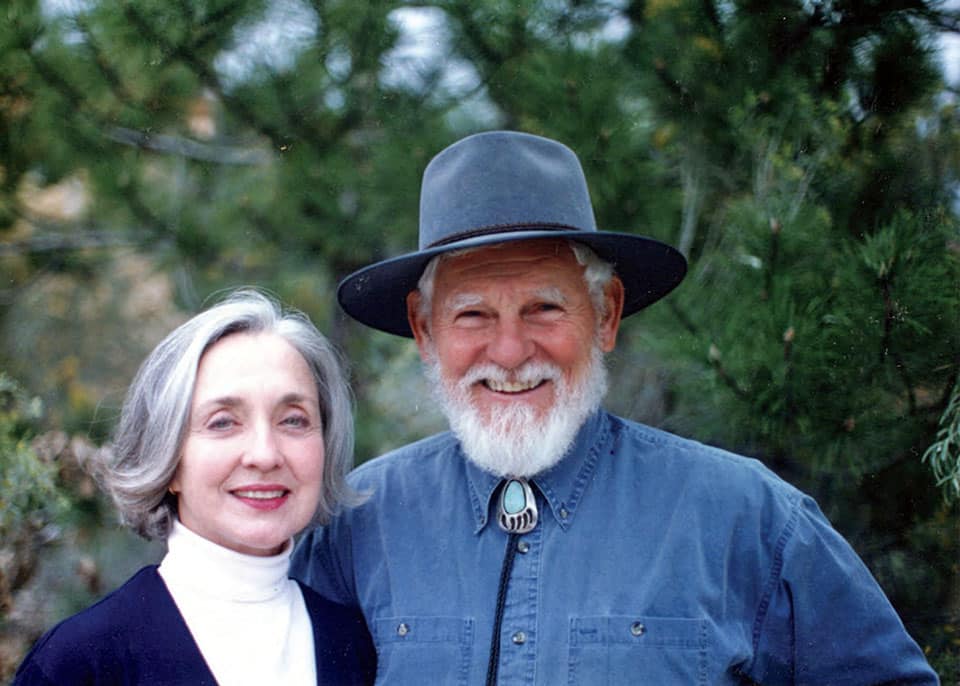
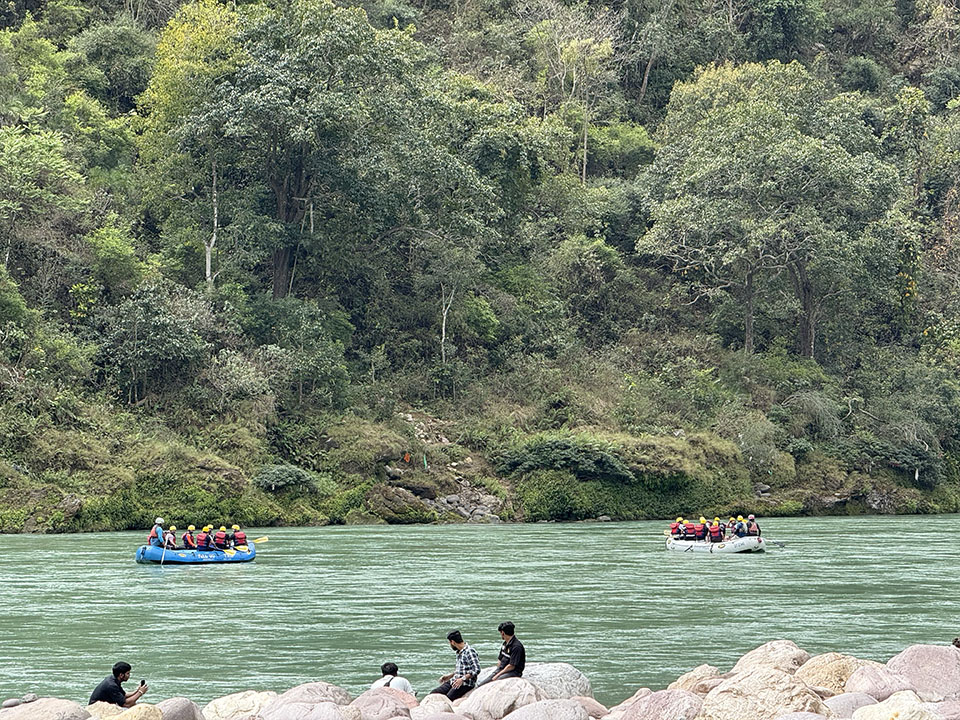
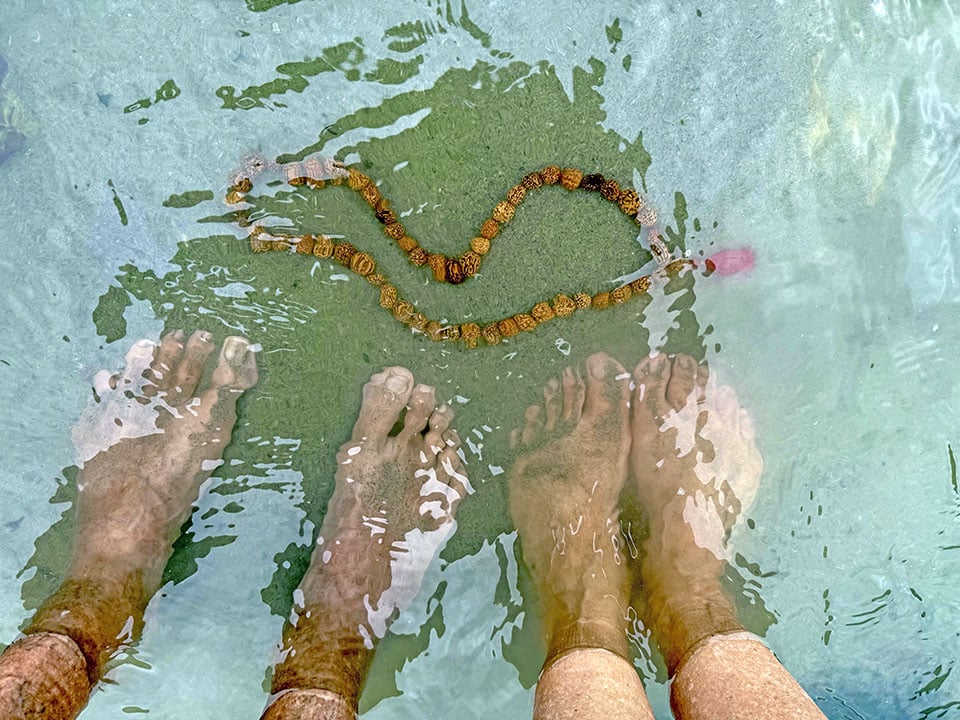
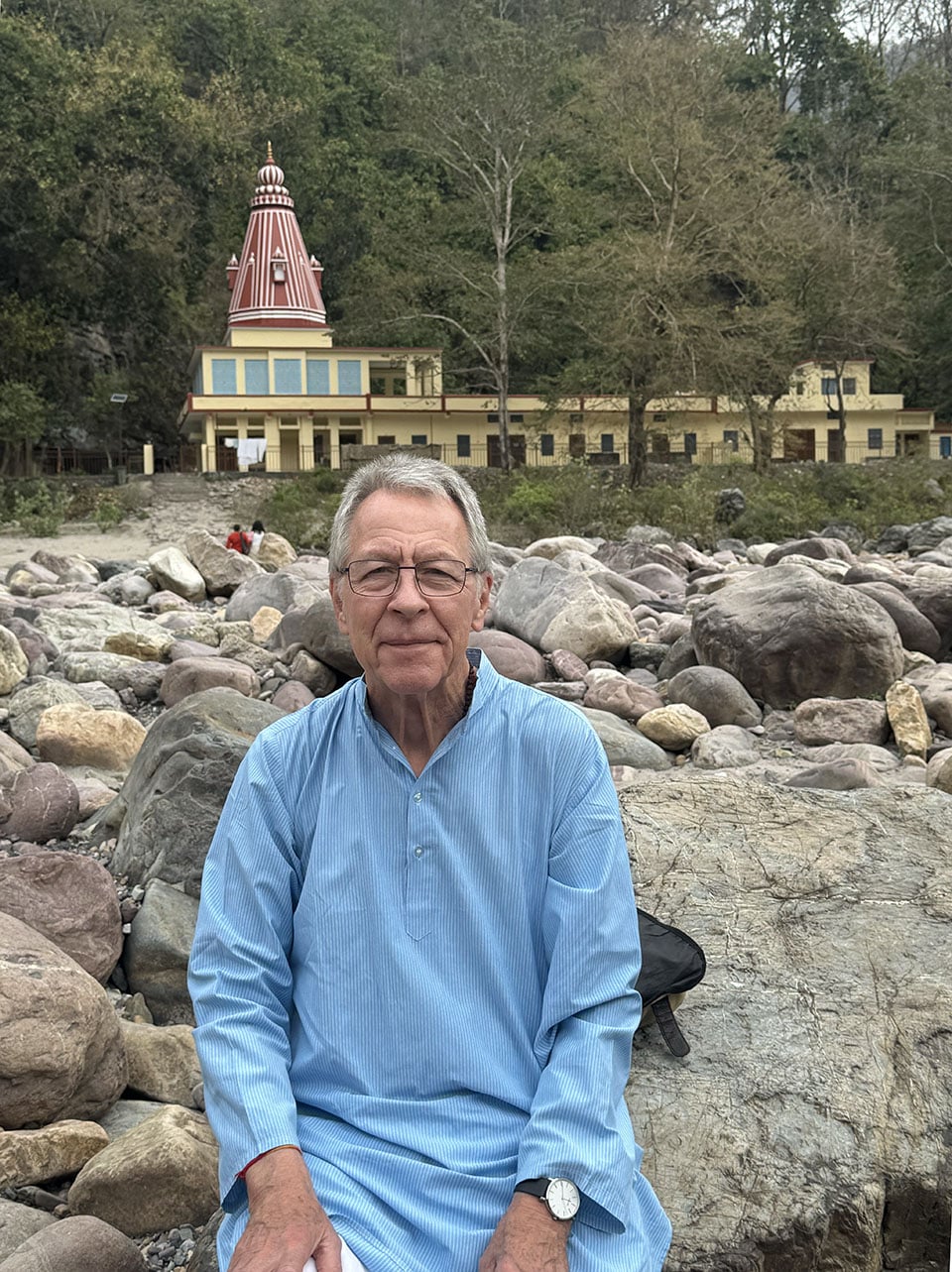
Again, Roger chanted while we scattered Verne’s and Willa’s ashes just above some rapids. We watched them swirl out into the swiftly flowing, glacial-green Mama Ganga (flowing at about 50,000 cfs at that time!) And just as we scattered them, several rafts passed by. We pictured their ashes flowing through the whitewater with the rafts—it was perfect!
We had also been gifted new mala beads when we checked into the hotel, and we washed ours in Mama Ganga before heading back.
Hiking back up the 200 steps to the bus and the highway above was not for the faint of heart, and Kirk had to push Heidi up the hill as she was wheezing and coughing so hard.
Glass House on the Ganges
We stopped for lunch at the Glass House, overlooking the Ganges, where we had to walk back down nearly as many steps to the restaurant. Thankfully, on the way back up, we took the ramp, which was easier than the stairs would’ve been.
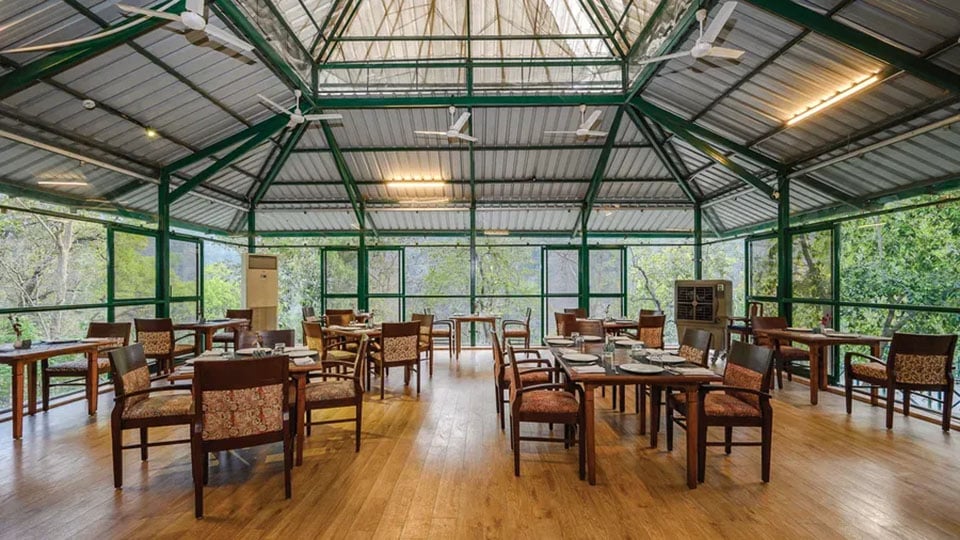

They offered a nice buffet lunch, but unfortunately, everything contained gluten or dairy (this was an ongoing theme in North India, where they are big on wheat and dairy). Thankfully, the chef came out to talk with Heidi and made her several gluten-free/dairy-free dishes that were very delicious, if a bit too spicy HOT!
We were intrigued by the pattern on our lunch plates. It’s hard to imagine a restaurant in the U.S. using a cannabis leaf design so openly, so we asked about it, and this is what we discovered: Cannabis is considered one of the five sacred plants described in the ancient Hindu Vedas and grows wild in the Himalayan foothills.
The leaf is also closely associated with Lord Shiva, the Hindu deity of meditation, who is said to have discovered its contemplative qualities in the Himalayas. Because of this spiritual and mythological connection, the cannabis leaf often appears in local folk art, Ayurvedic traditions, and botanically inspired designs throughout the region—such as the dinnerware at this restaurant.
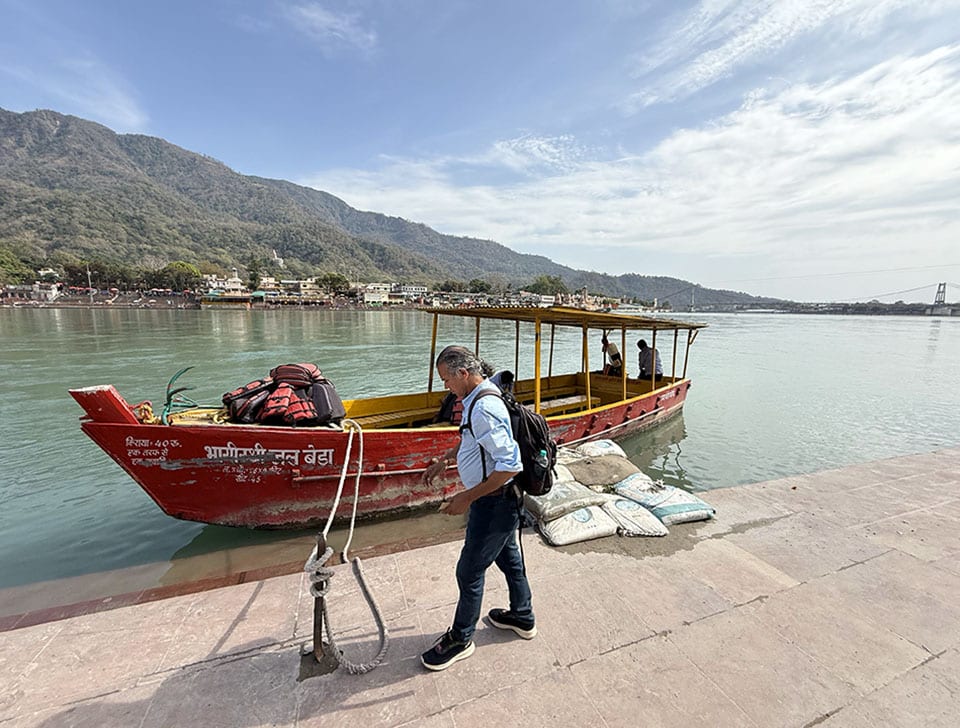
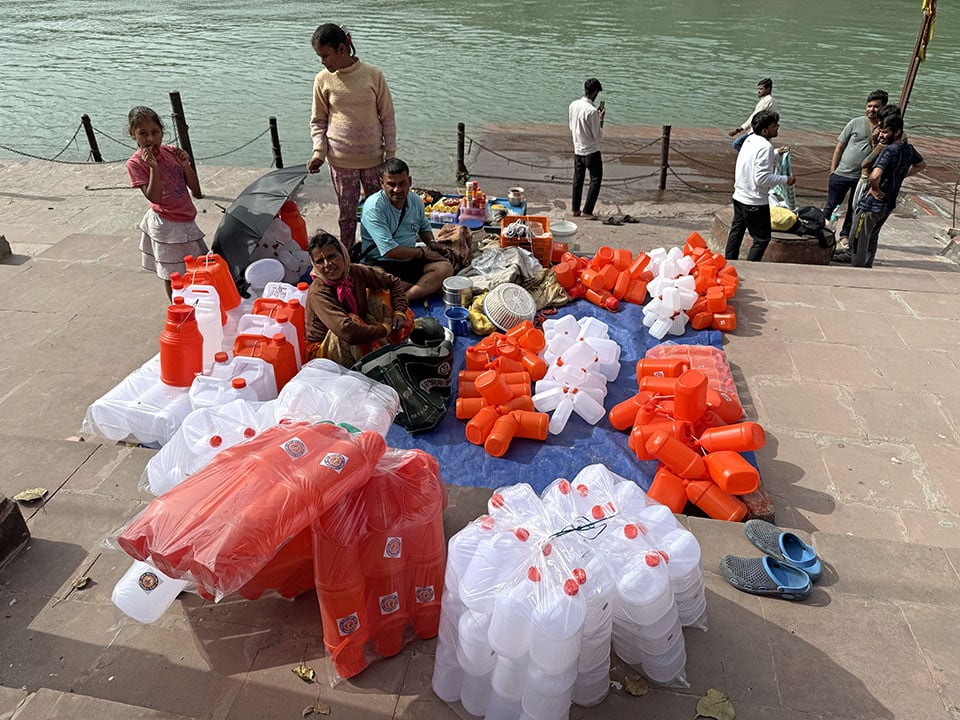
After lunch, we took a shuttle boat across the river to the other side of Rishikesh, where we all split up and spent a couple of hours shopping. Kirk found a new bag for his yoga mats with the seven chakra symbols on it. We also found an Ayurvedic pharmacy that had some fantastic herbal cough drops that really seemed to do the trick, the best we’ve found so far! And we got scammed buying a couple of small pieces of “sandalwood” that turned out not to be sandalwood at all… we were actually skeptical to begin with. Sandalwood is extremely expensive, and this wood was not priced high enough to be real sandalwood. But they use artificial sandalwood fragrance to soak the wood in…which can make it a bit hard to tell if you’re not a sandalwood expert. Gringo tax! Thankfully, we refrained from buying any plastic containers, LOL.
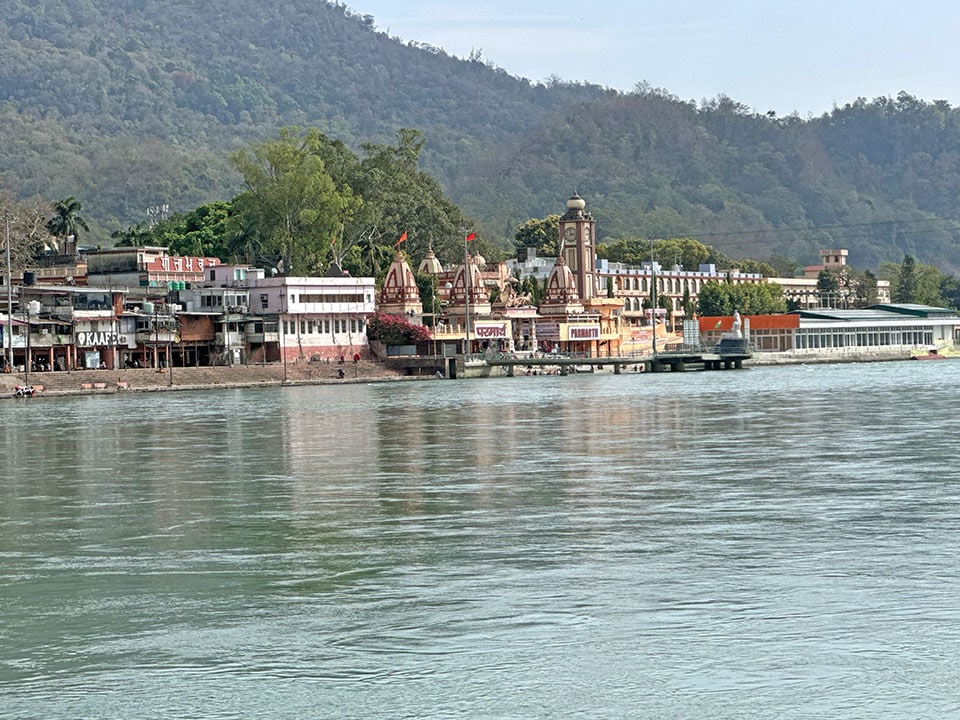
Parmarth Niketan Ashram
After shopping the streets of Rishikesh, we rendezvoused with our group at the beautiful Parmarth Niketan Ashram on the banks of the Ganges. We had a meet-and-greet planned with Sadhvi Bhagawati Saraswati and would also experience their evening Aarti ceremony.
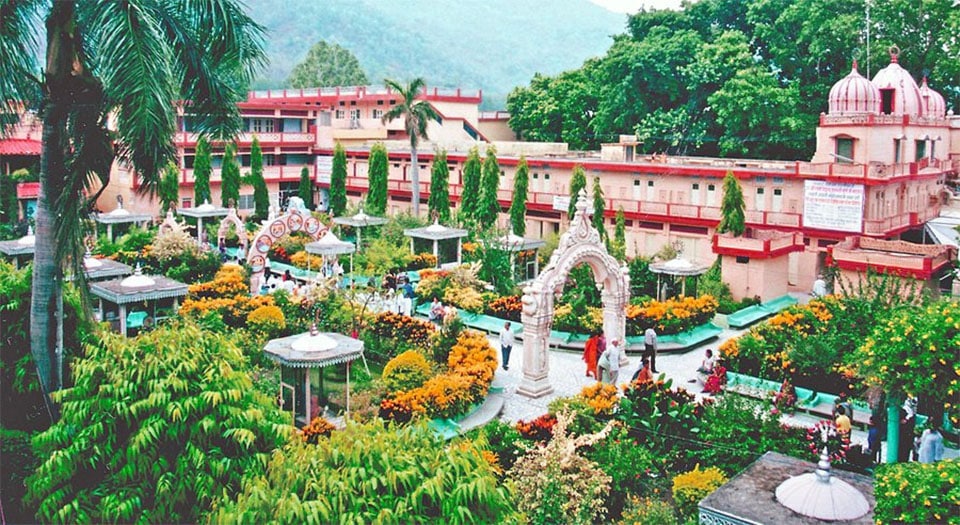
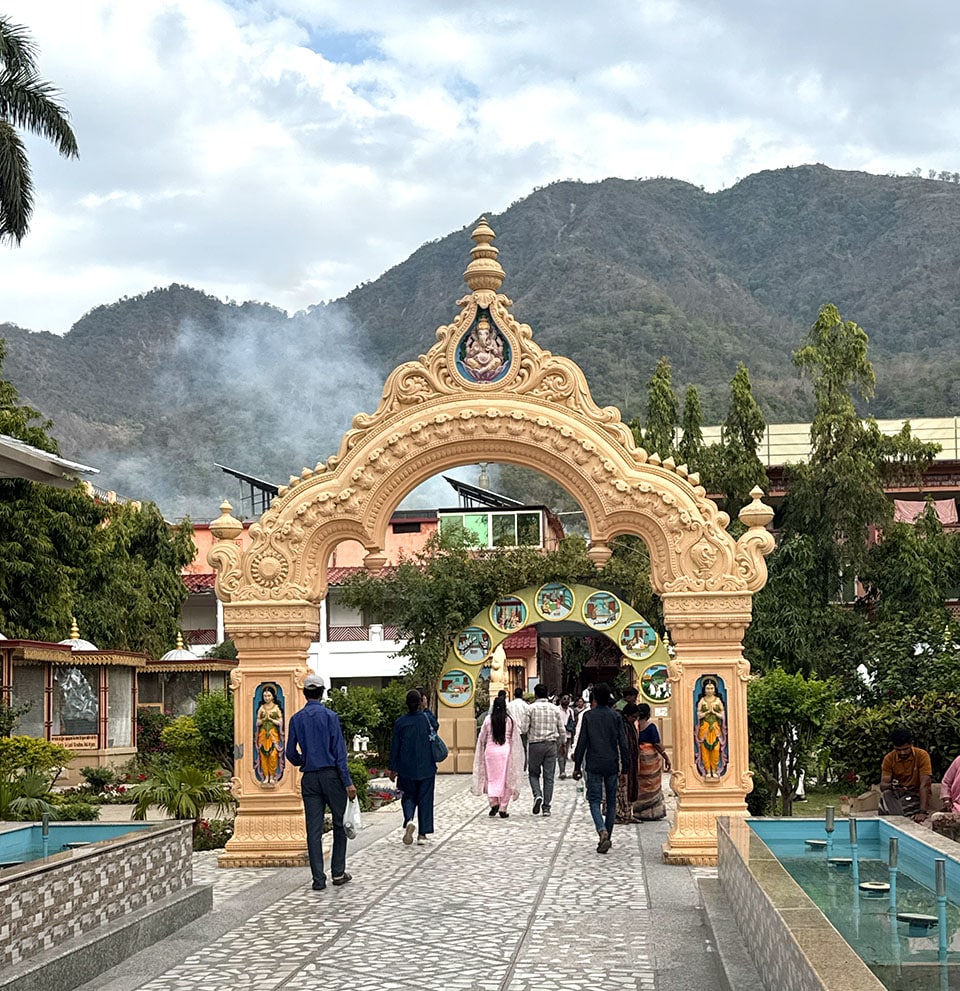
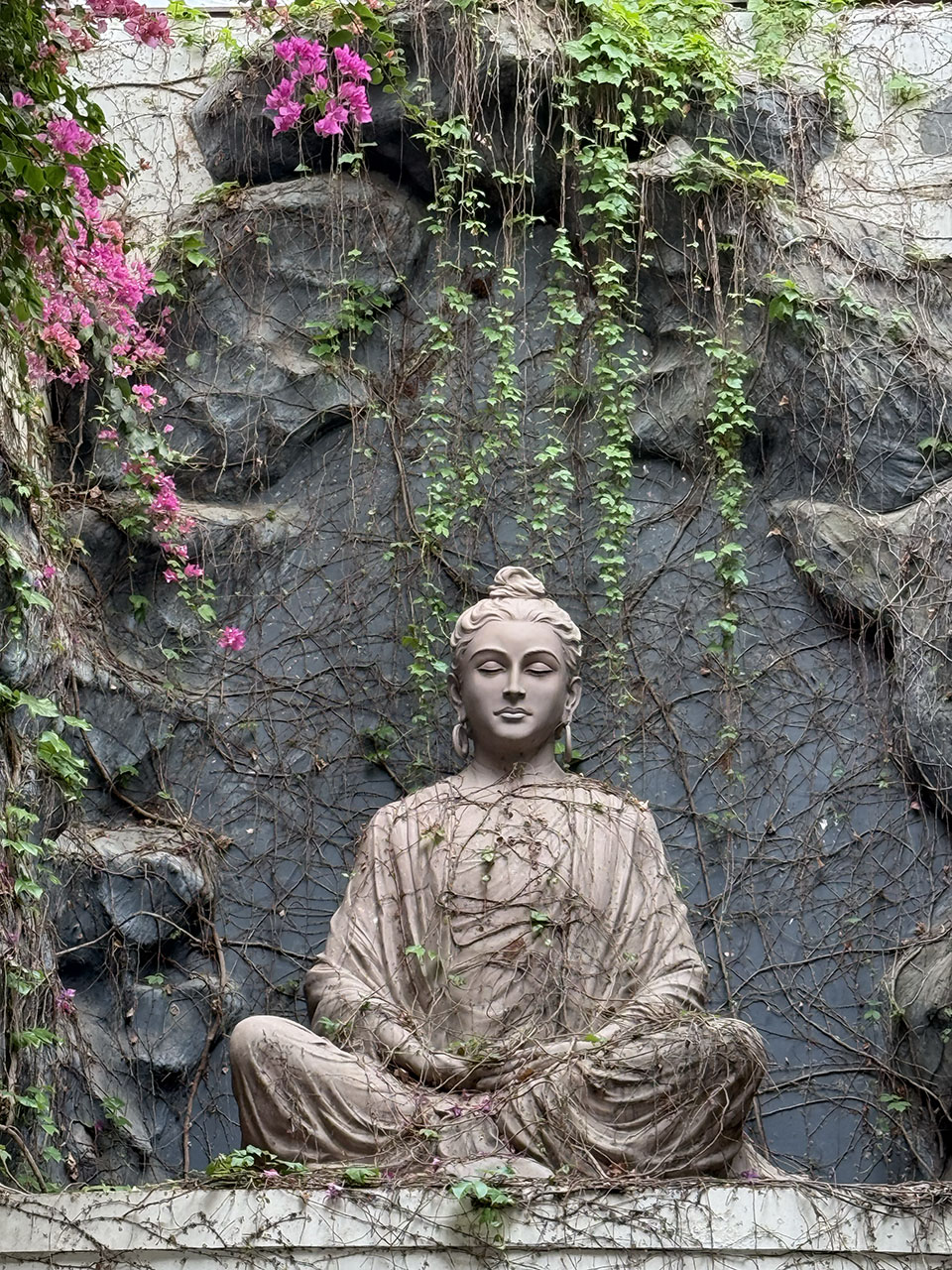
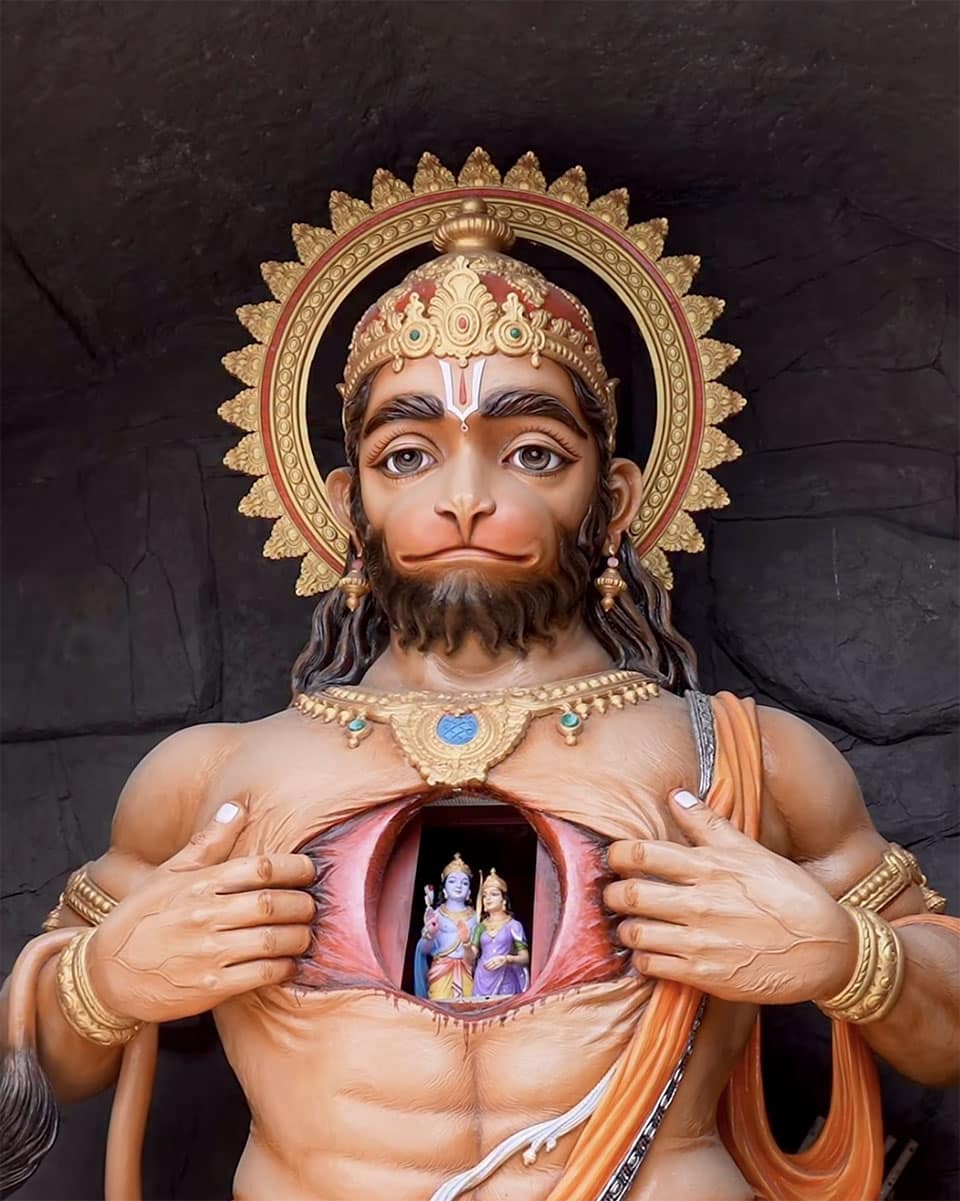
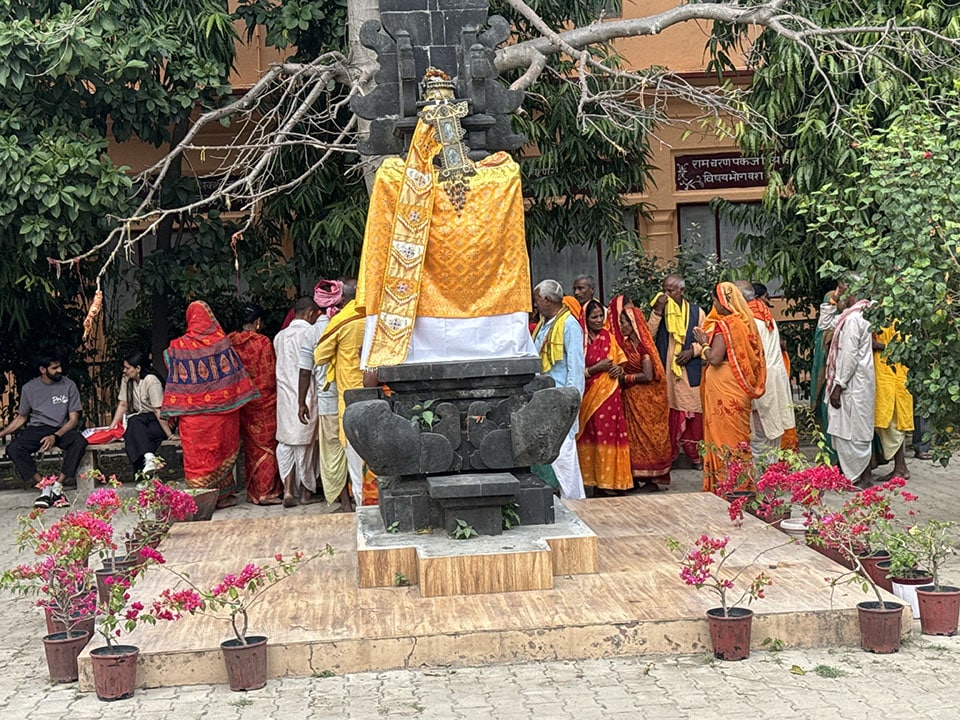
Founded in 1942, the sprawling ashram, with its gorgeous grounds and gardens, houses and feeds more than a thousand guests at a time and functions like a small village. Room and board are provided by donation for those who come to meditate, practice yoga, and attend the nightly Aartis.
Since 1986, Parmarth Niketan Ashram has been guided by Swami Chidanand Saraswatiji, who has extended the ashram’s values of seva (service) into the wider community. The ashram is committed to environmental stewardship, education, healthcare, and humanitarian service, supporting schools, charitable health initiatives, organic farming, girls’ education programs, and major efforts to protect and restore the sacred Ganges River. It is a wonderful example of the Hindu belief that spiritual practice and service to others are inseparable.
Through his environmental movement, Ganga Action Parivar, Swami Chidanand Saraswatiji has also been a leading force behind the National Ganga River Rights Act (“Mama Ganga Act”), which seeks to recognize the Ganges as a living entity with legal rights. Under this framework, polluting or defiling the river is considered a direct violation of her rights, and citizens are empowered to take legal action on her behalf.
Unfortunately, Swami Chidanand Saraswatiji was not in residence during our visit. He frequently travels to meet with world leaders and to promote peace, environmental protection, and girls’ education throughout India. Interestingly, we had seen him interviewed in a documentary before our trip and remember thinking, “What a great guy.” Little did we know we would soon be visiting his ashram.
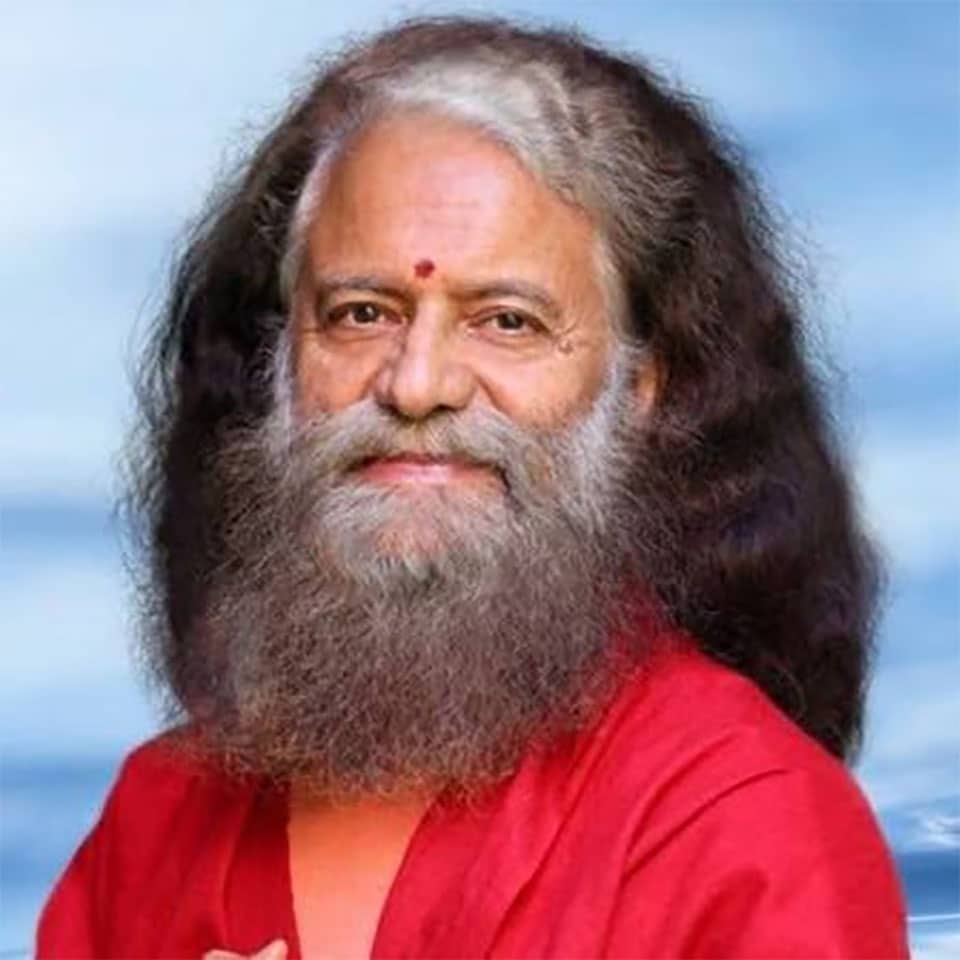
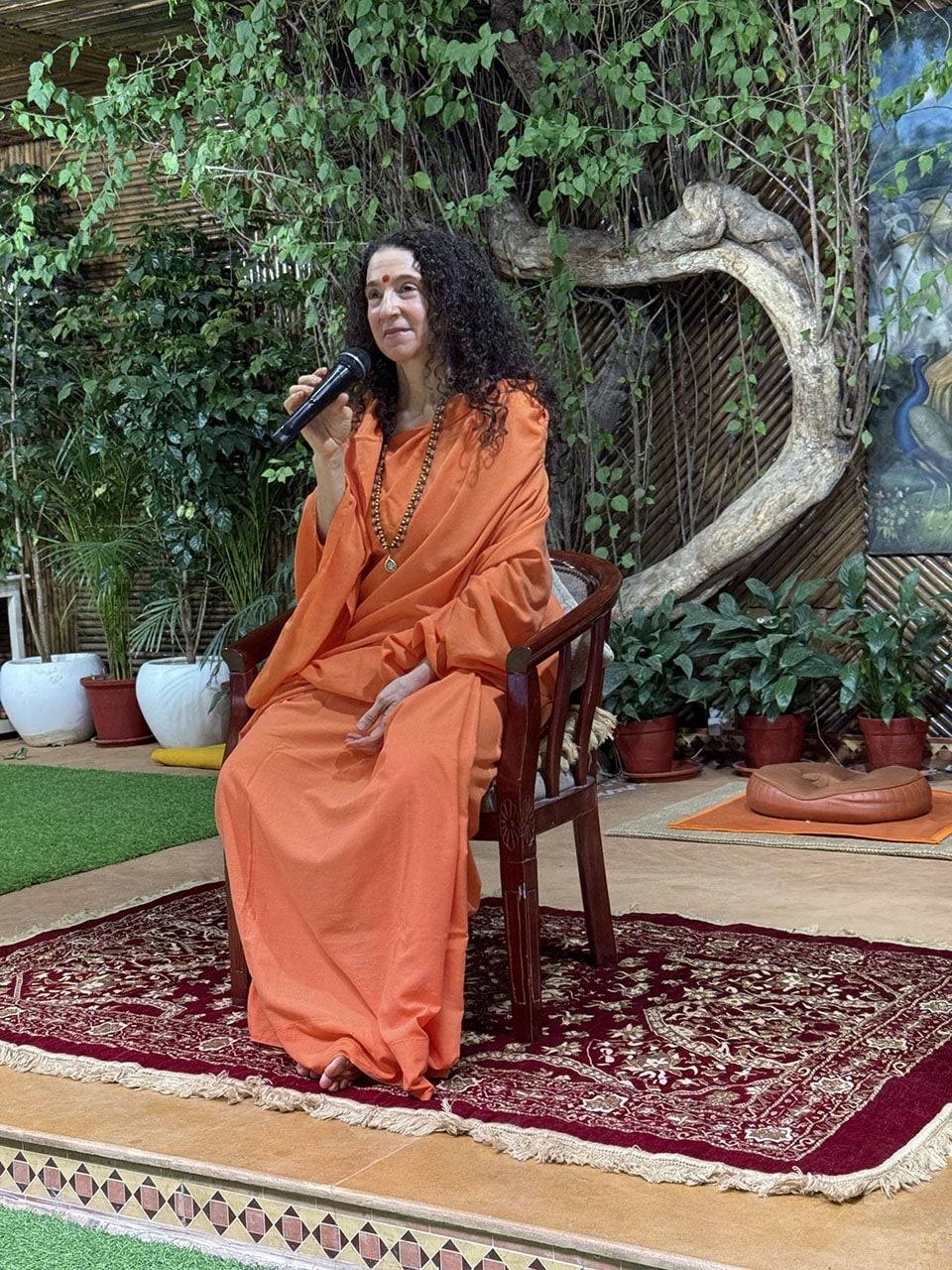
Swami Chidanand Saraswatiji and Sadhvi Bhagawati Saraswati
What we all thought would be a brief meet-and-greet with his assistant, Sadhvi Bhagawati Saraswati, turned into an hour-long visit. Born and raised in Hollywood, California, with a PhD in psychology from Stanford, she visited Rishikesh and fell in love with the ashram, making it her home for the past 30 years.
Sadhvi is also mentioned in the novel The Love Thief, which Heidi had read before our trip, never realizing she was a real person—or that we would actually meet her.
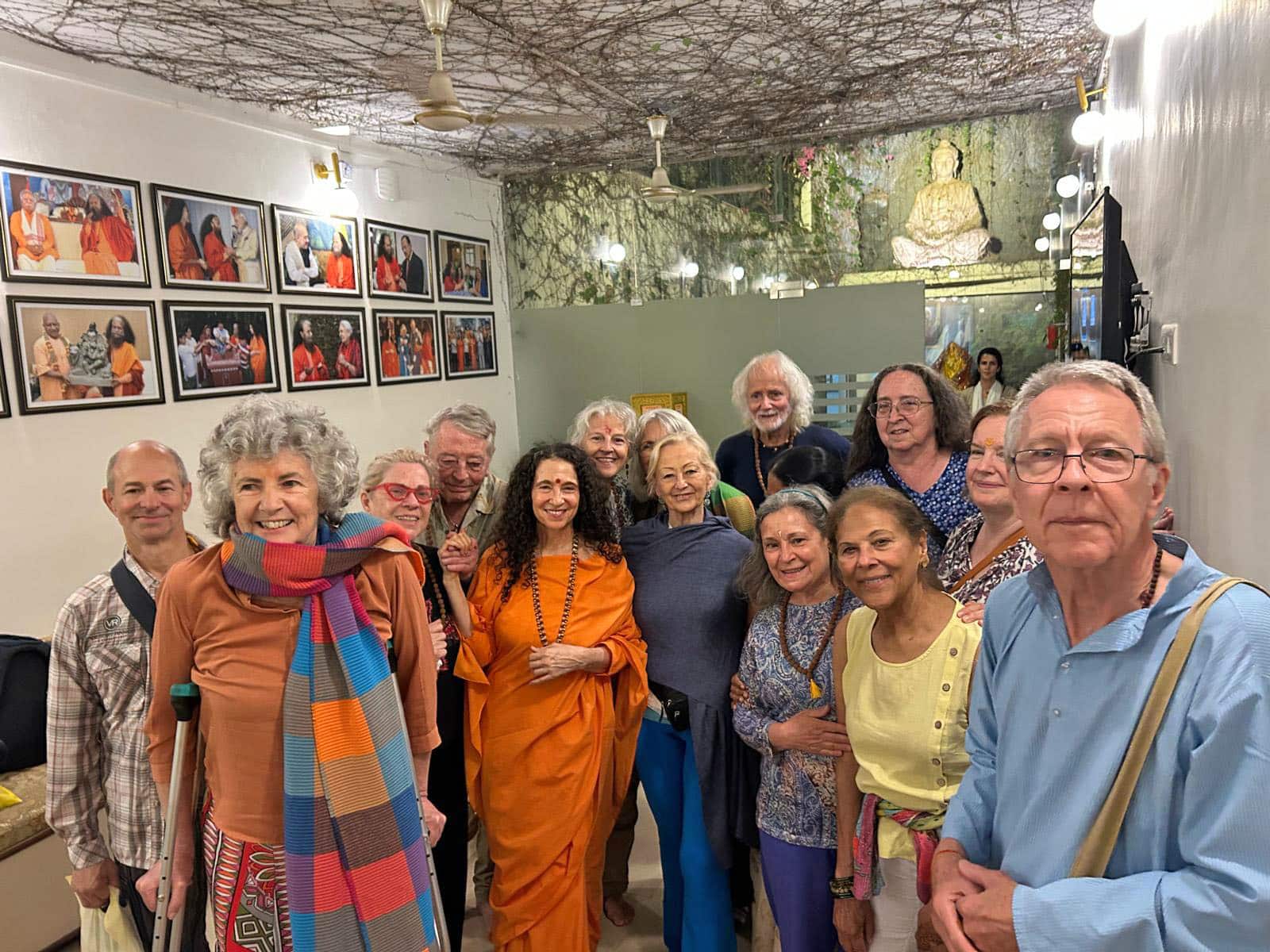
David, Diane (with broken ankle, heading back to the US the next day), Basilica, Tris, Sadvhi, Heidi, Donna, Anne Marie, Kirk, Pauline, Marie, Marge, Amy, and Roger.
She remembered Roger from a previous visit and spent more than an hour with our group, answering questions and sharing insights about forgiveness, letting go, and personal freedom. One message that especially resonated with us was that while we may not be able to forgive what someone did, we can forgive the person and release ourselves from carrying the burden. If we continue replaying old hurts, we are the ones drinking the poison while the other person has often long since moved on. Her message was simple: forgive, let go, and free yourself.
She also shared how Swami Chidanand Saraswatiji helped establish the nightly Ganga Aarti here, as part of a movement to restore and protect the river. As he said, “People won’t shit where they pray. If we bring them to the river to pray every night, they will stop using it as a toilet.”
She said all that and so much more—in a far more elegant way than we are recounting it here. Sadhvi has written several books on these themes, including From Hollywood to the Himalayas, which recounts her journey from a privileged life in Hollywood to an ashram in Rishikesh.
After her talk, we were led to another room for high tea. Many places in India still practice this holdover from the British.
Parmarth Niketan Aarti
Soon it was time to experience their Aarti. Once again, we were treated like royalty and escorted to front-and-center seats by one of the senior ashram acolytes. It was awe-inspiring to experience the ceremony from the heart of the action rather than from the perimeter, as we had in Varanasi.
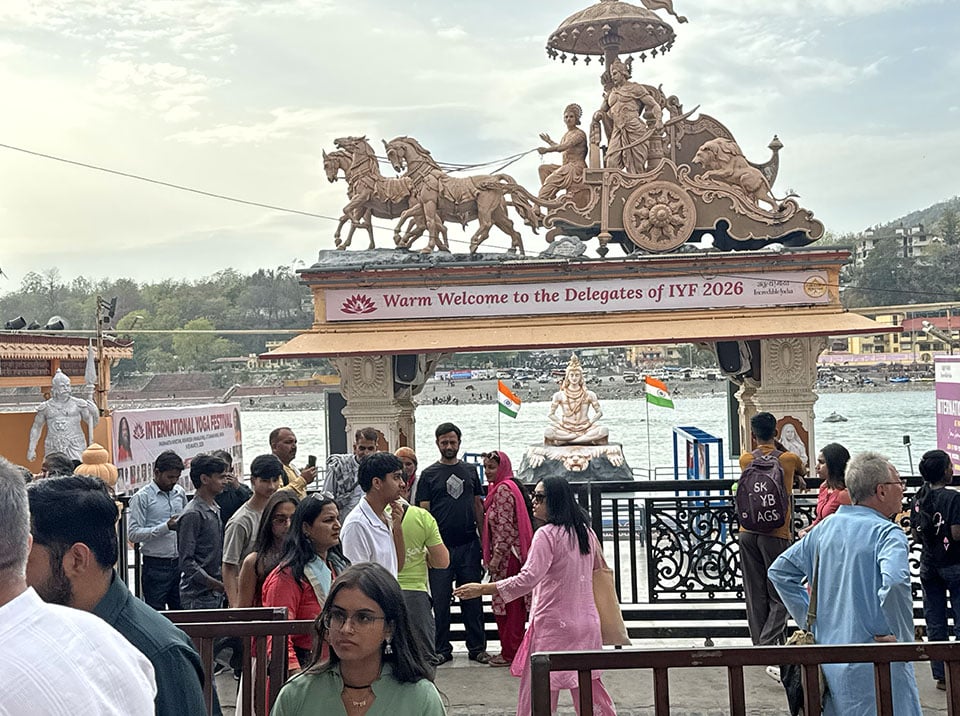
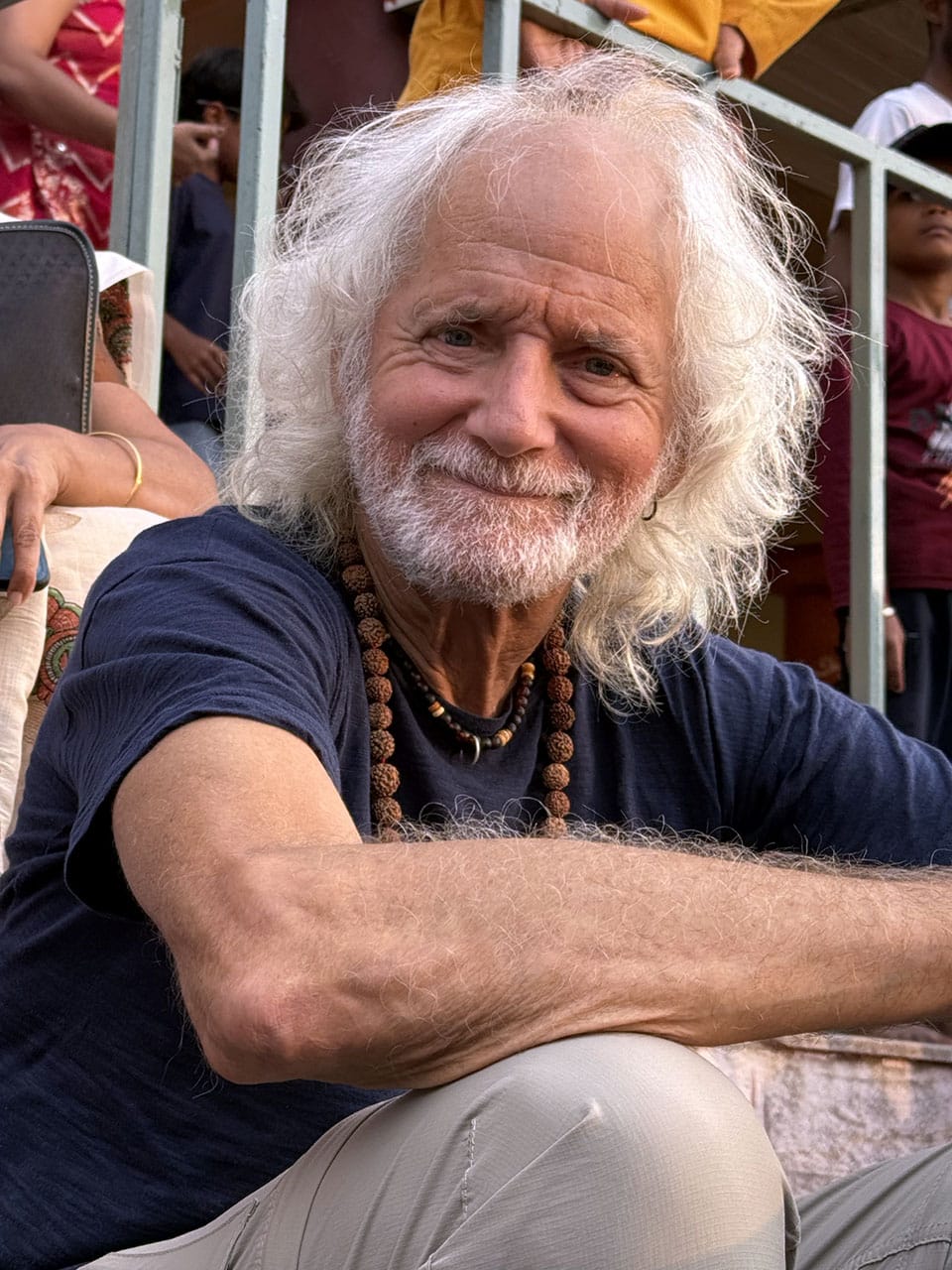
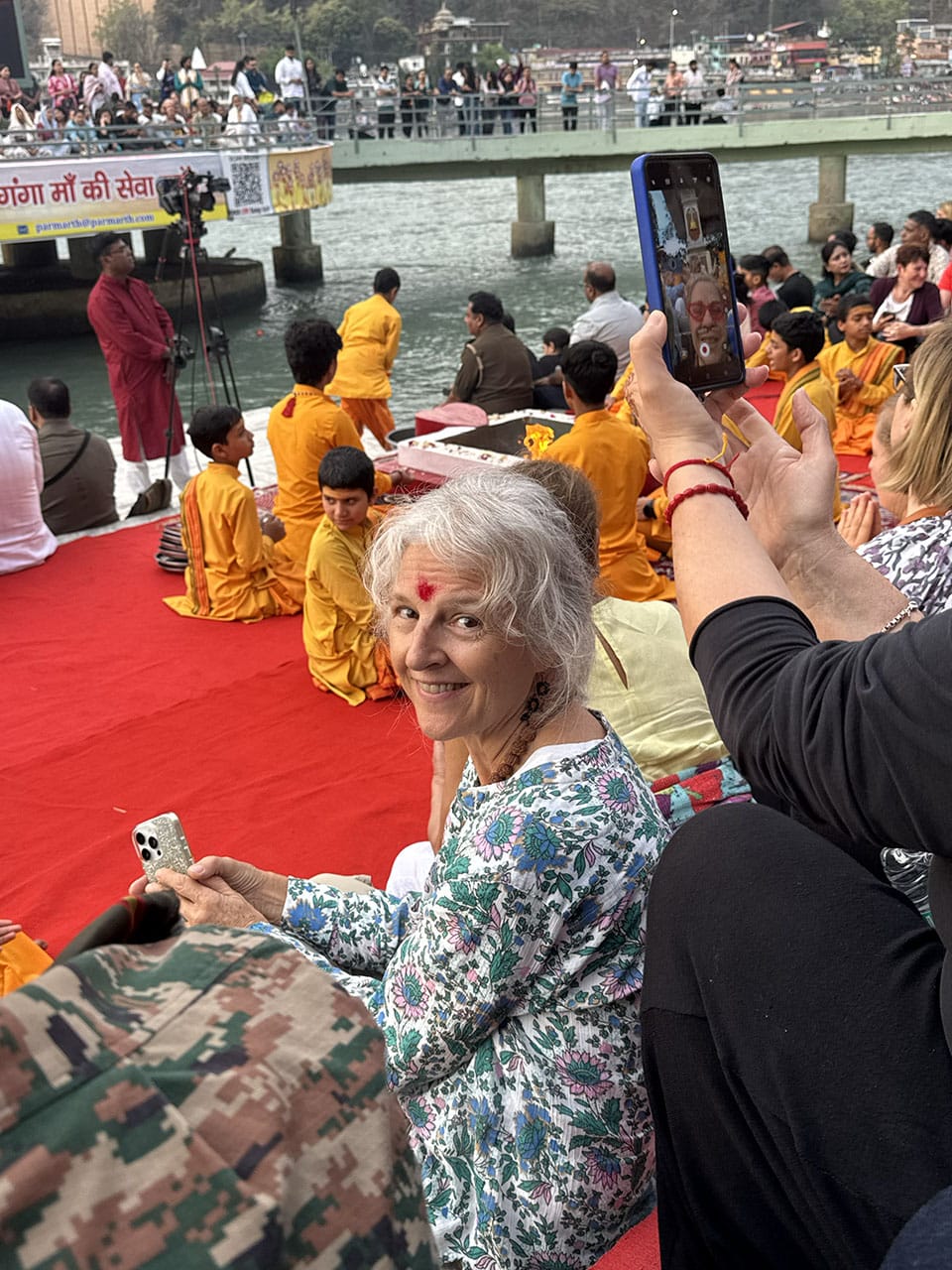
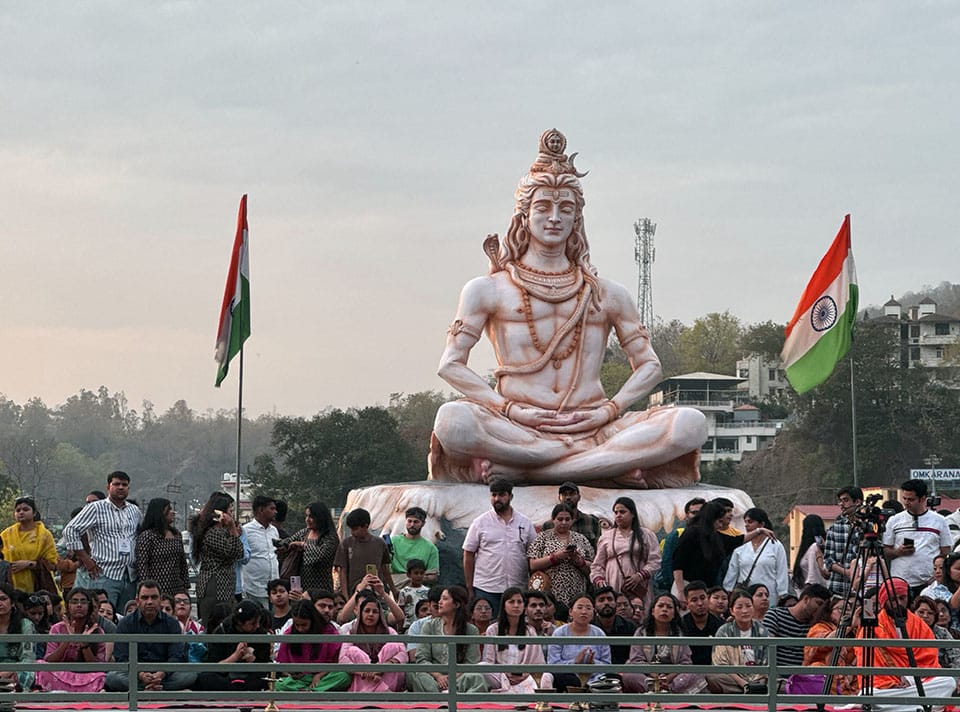
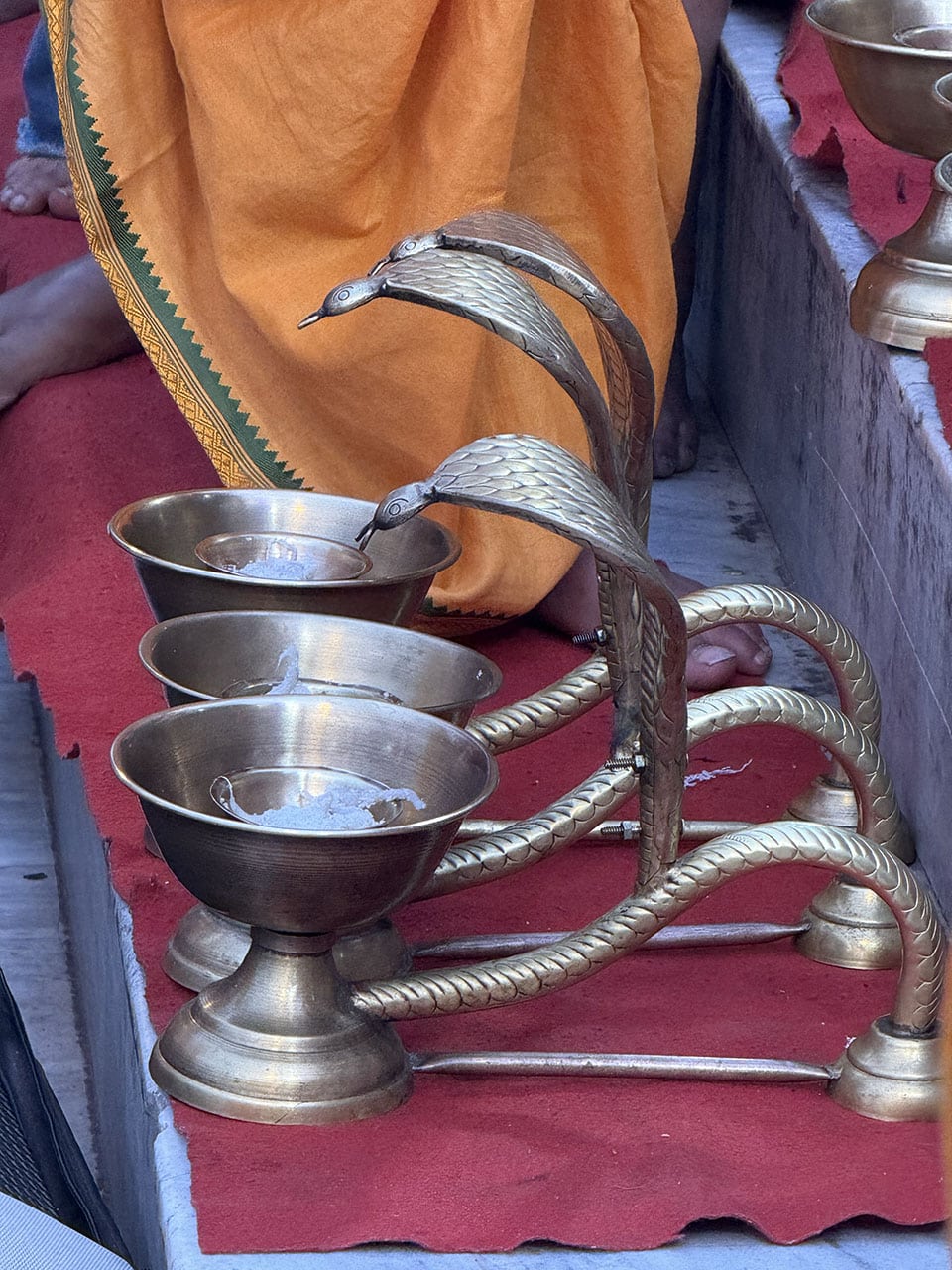
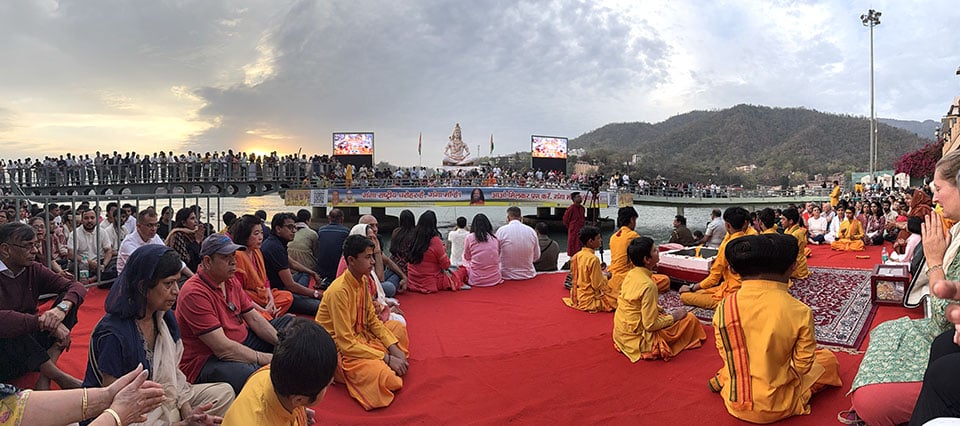
Aarti Thalis—brass plates holding burning ghee and camphor—were passed through the crowd and swung around in a specific pattern. Only later did we learn the movement traces the shape of the sacred OM symbol. Thousands of people lined the shore and filled the Aarti platform, a walkway above the river featuring a giant Shiva statue and large Jumbotron screens so everyone could see the ceremony.
Like the Aarti we experienced in Varanasi, it was truly magical to be surrounded by so much love and light, chanting, clapping, and traditional Indian music.
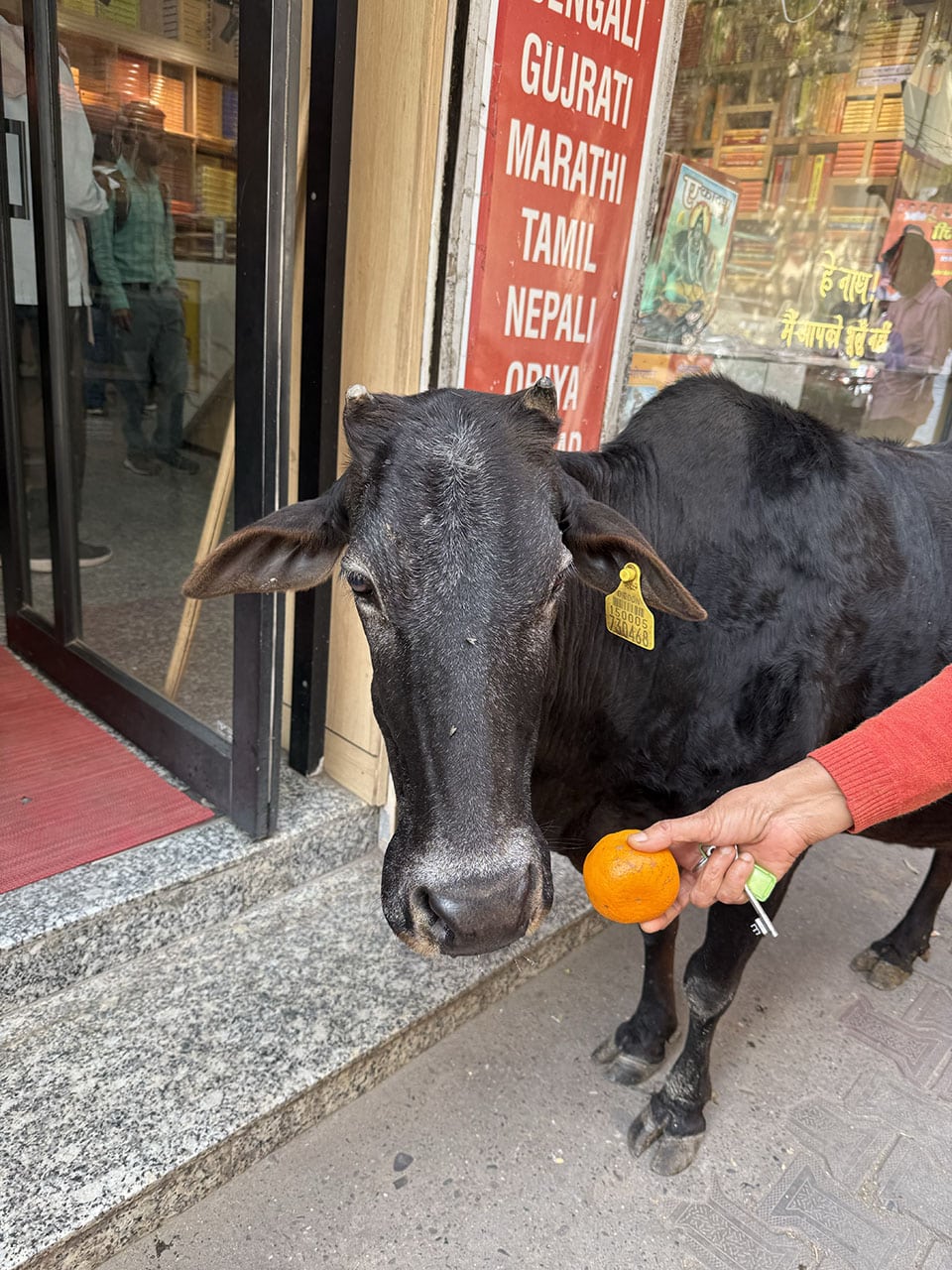
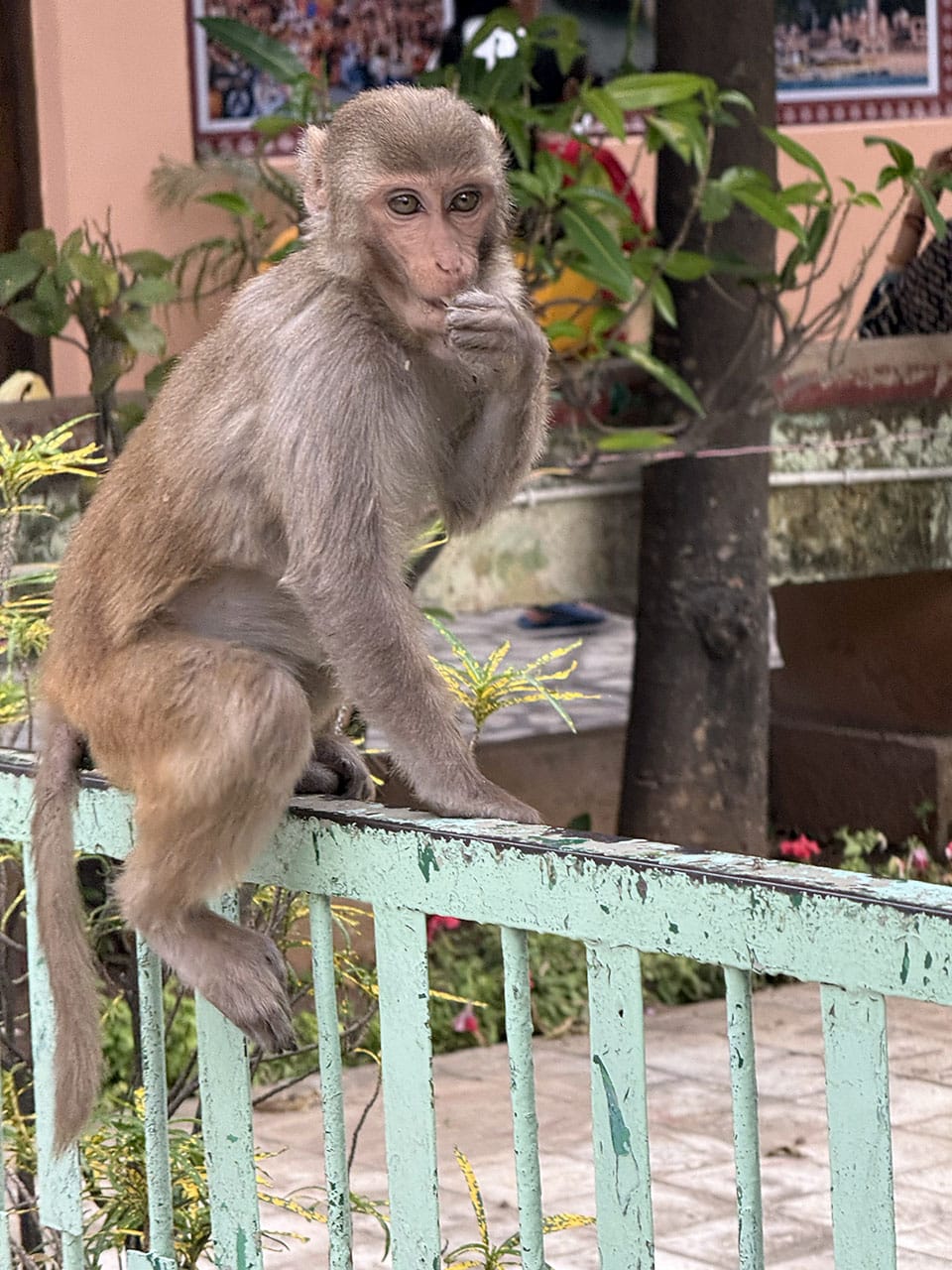
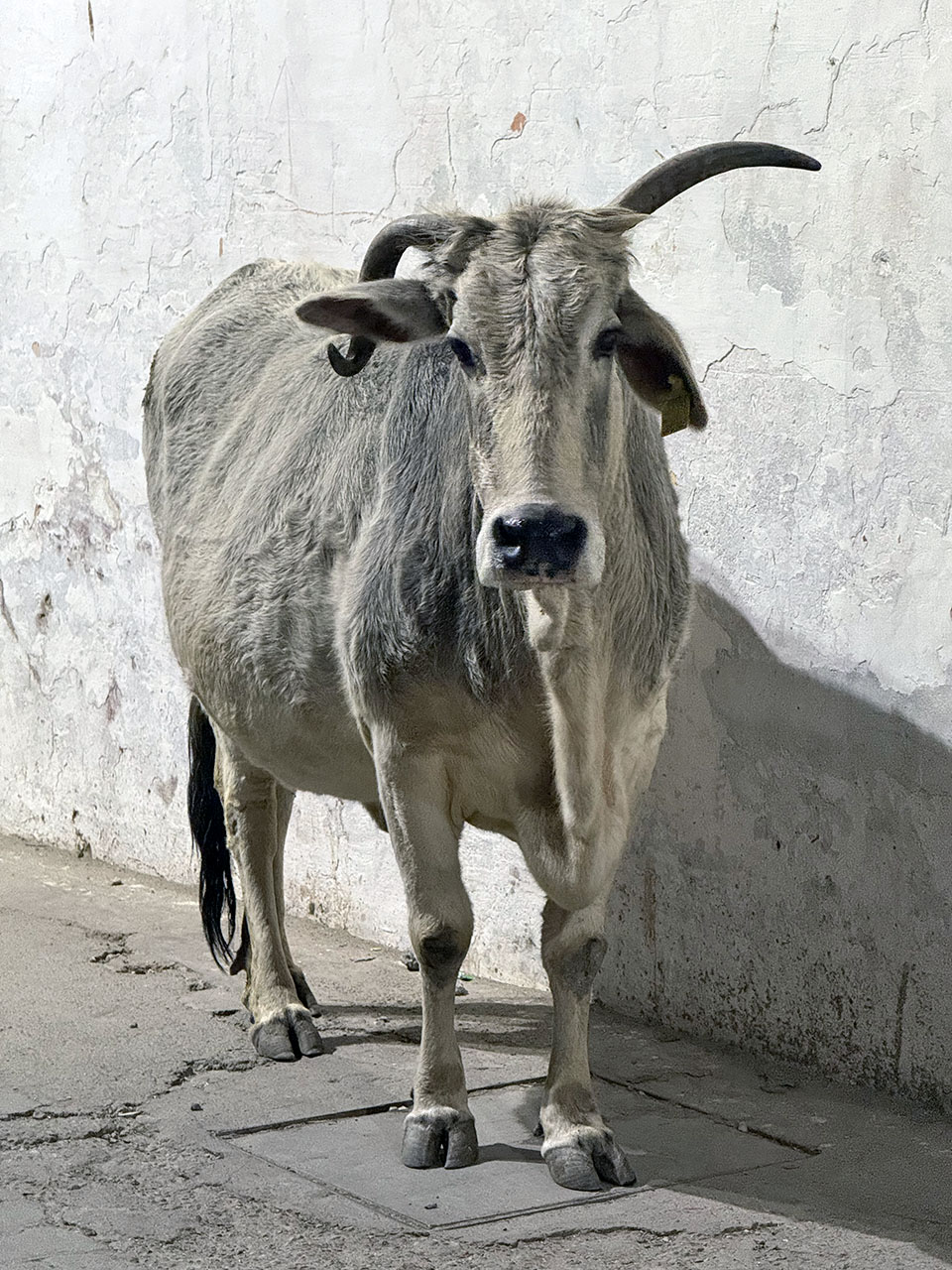
Sacred cows and monkeys were everywhere inside and outside the ashram.
Afterward, we walked a few blocks to meet our drivers and cars, then headed back to the hotel to hit the hay. We had an early morning and another exciting adventure ahead.
Rishikesh Ganga Snān
Heidi and several of our tour mates were eager to experience the traditional purification by dipping into the Mama Ganga (Ganga Snān) and asked Mallika and BC about arranging it.
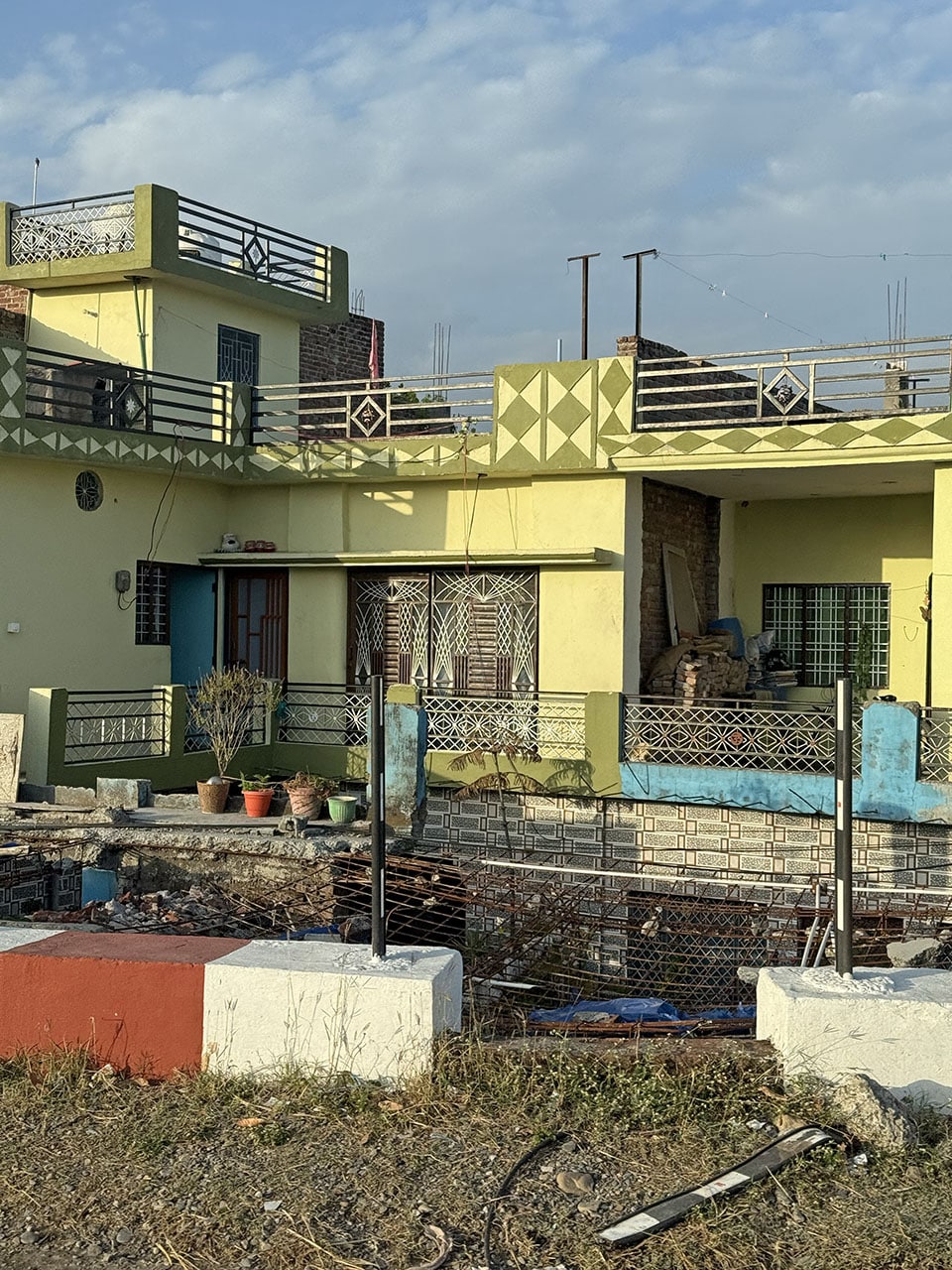
BC knew of a small beach about a mile from the hotel that we could walk to in the early morning, before it became crowded with river rafters. Lots of new construction was going up along the walk.
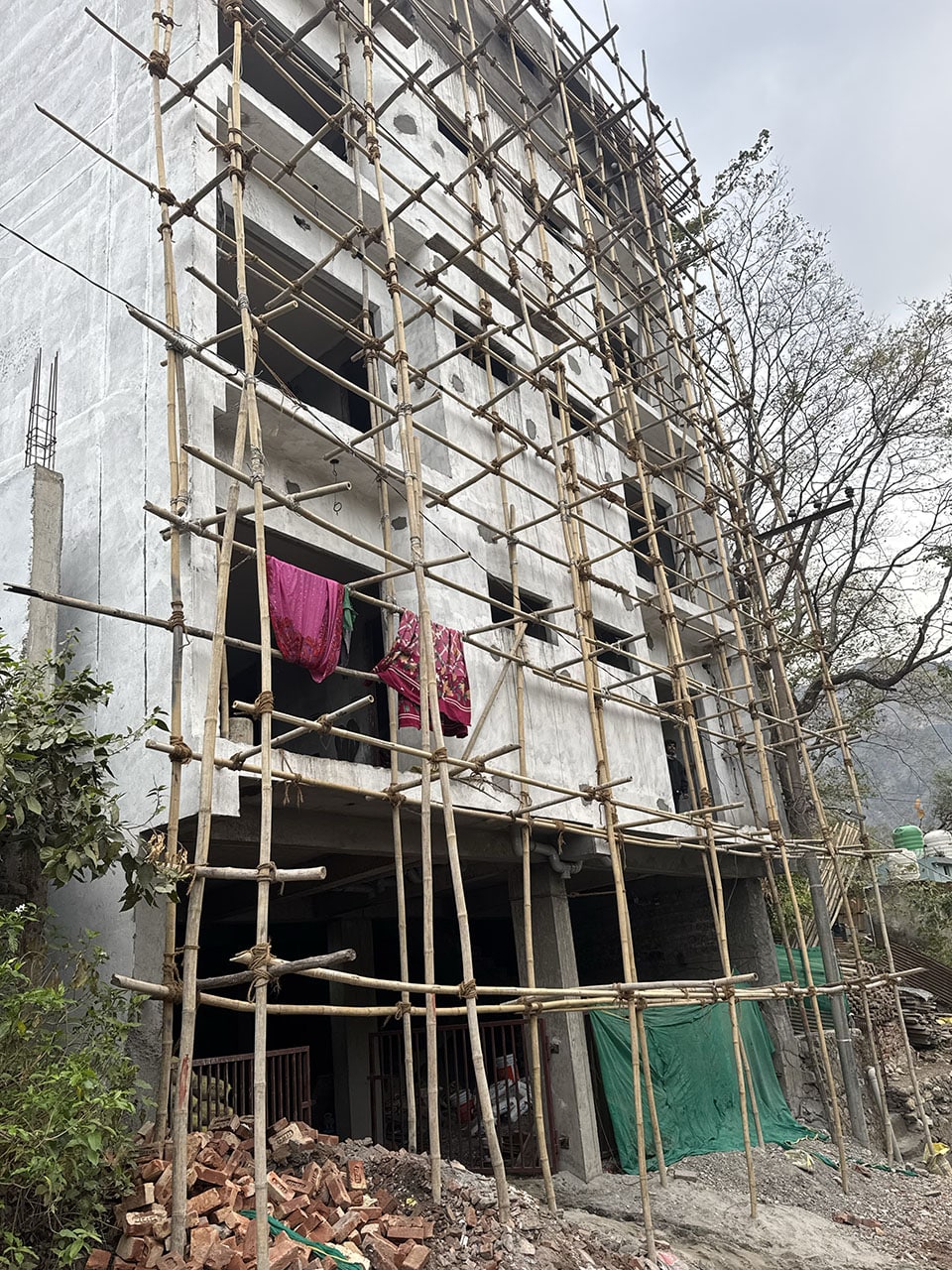
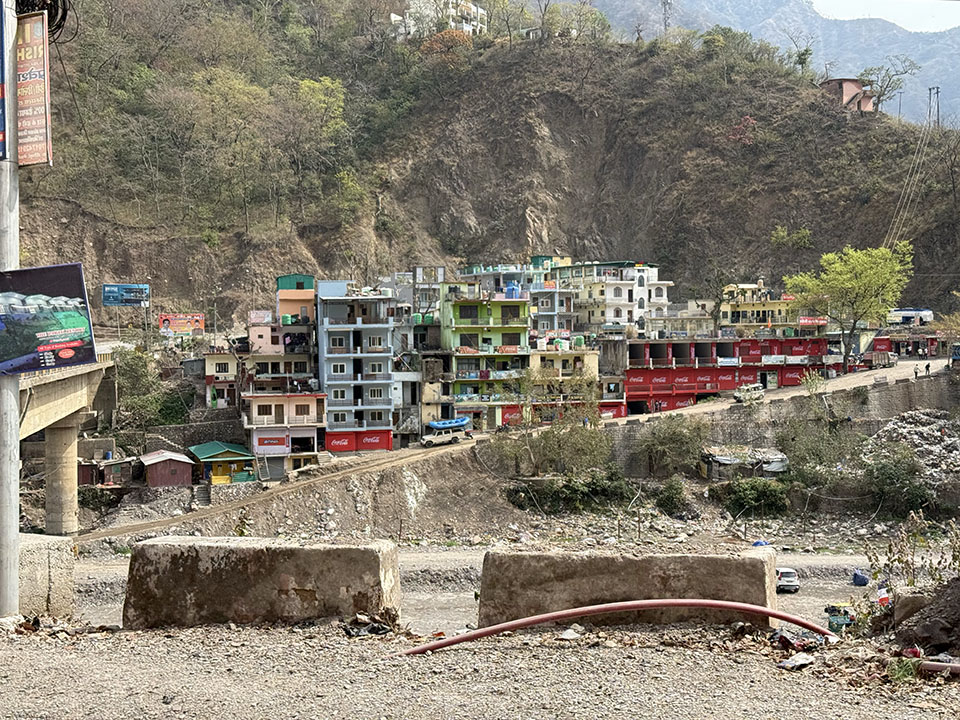
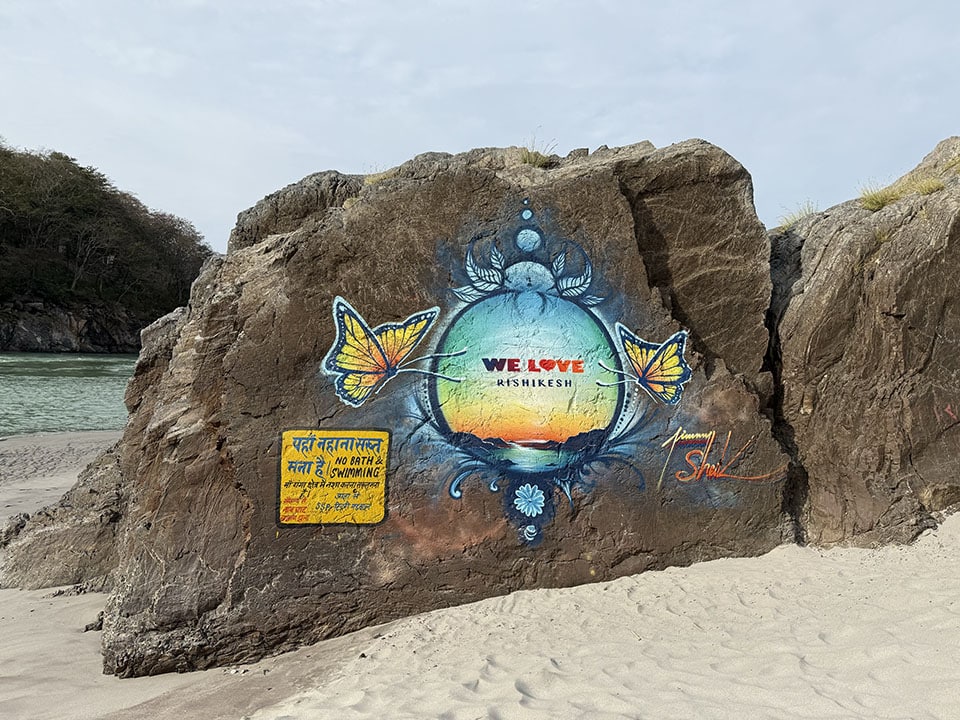
Technically, we weren’t swimming or bathing, just taking a dunk.
Kirk joined Heidi, BC, Mallika, Marge, and Pauline to take photos for everyone (he didn’t feel the same urge to dip into the icy-cold, swiftly flowing Ganges as Heidi did!)
The river was flowing so fast! But BC took us to an eddy where the water was flowing a bit more slowly. Most of us waded out about waist-deep in the chilly water with a sandy bottom. BC was careful not to let us get any deeper, as the river was running very swiftly; he did not want anyone getting swept away. Initially, it was really cold but also super refreshing and invigorating, and after being in for a few minutes, it didn’t feel so cold (maybe because the numbness had set in?)
Heidi was the first to dunk all the way under three times. Mallika shared the significance of dipping three times to purify a person across three distinct cosmic dimensions:
- The First Dip: Cleanses the physical body and washes away worldly, physical impurities.
- The Second Dip: Purifies the mind and intellect, washing away negative thoughts, anger, and ego.
- The Third Dip: Purifies the soul (Atman), washing away past karma and inviting spiritual liberation (Moksha)
It was truly one of the most AWE-some feelings in the world, in all respects…To this day, when Heidi thinks about it, she can still feel the cold, clear, green Mama Ganga rushing over her.
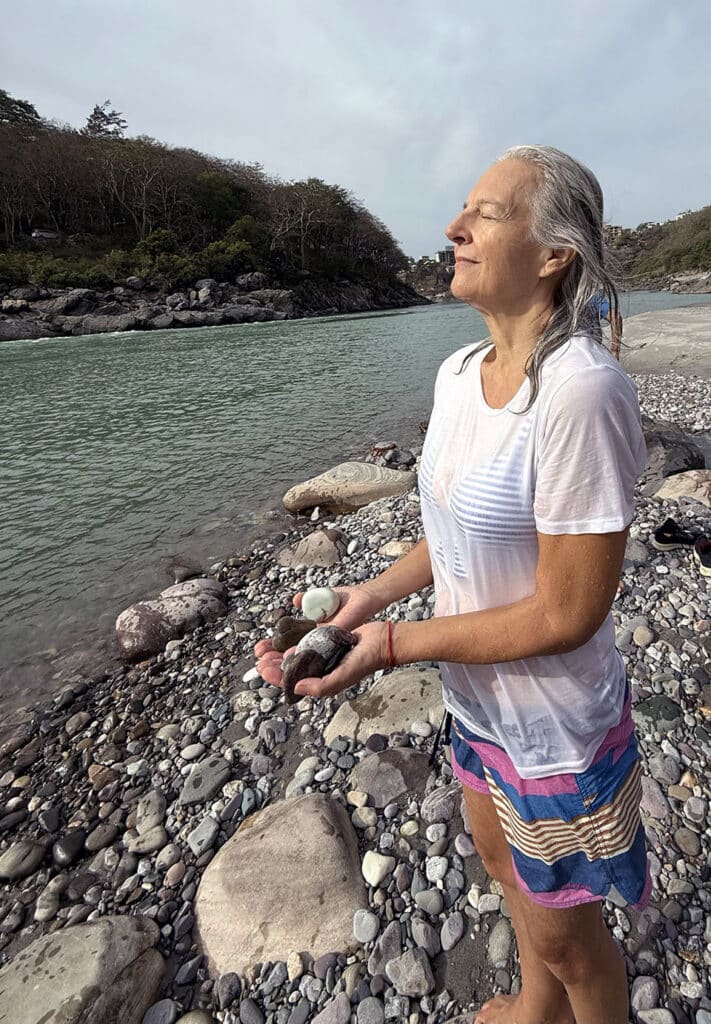
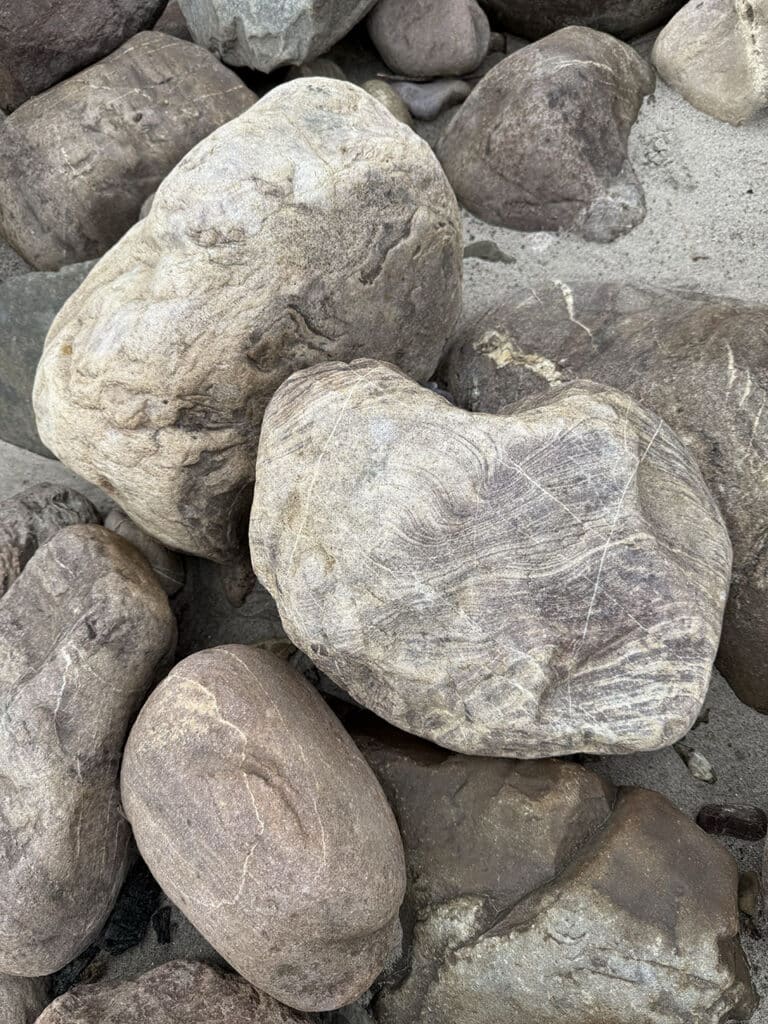
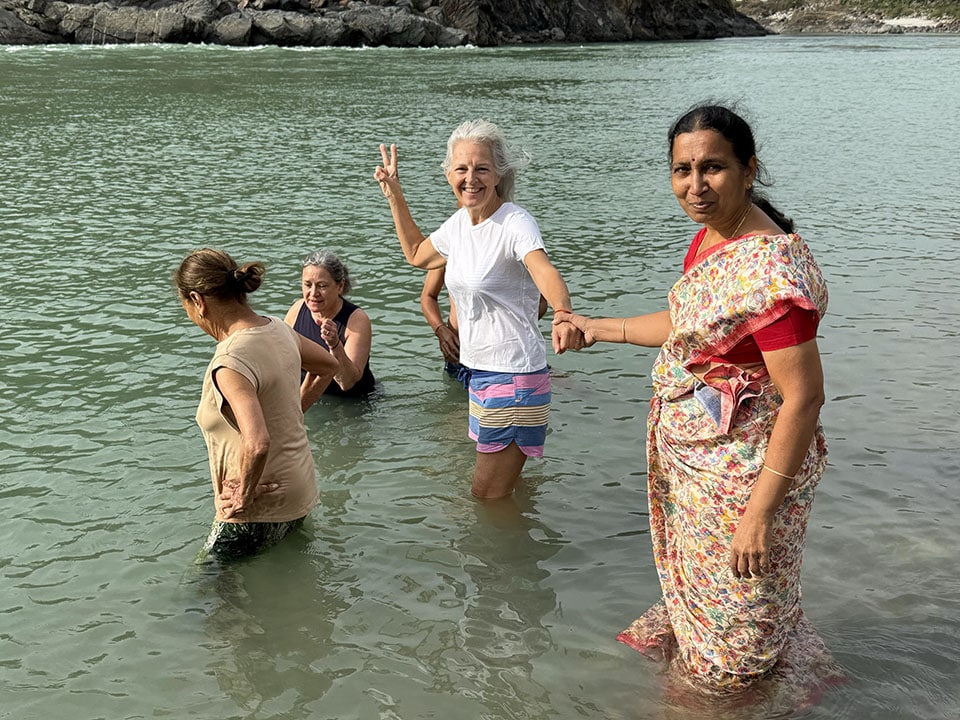
The other three ladies all dipped in as well. And as it turned out, it was also the Hindu New Year, so it felt very auspicious for us all to dip in the water to purify ourselves for the new year. We brought back a few rocks from the Ganges, too—they were so beautiful!
Thankfully, BC called a driver to pick us up and take us back to the hotel, as we were all wet and cold, and it was quite windy out. Back at the hotel, our Ayurvedic massages were nice… but still not as good as in South India.
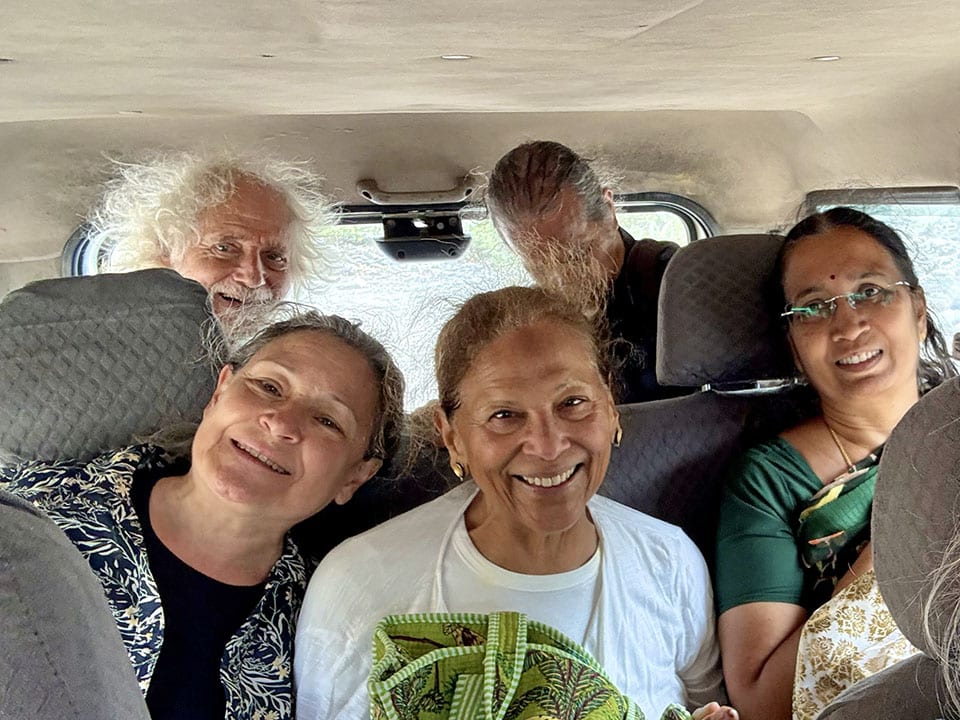
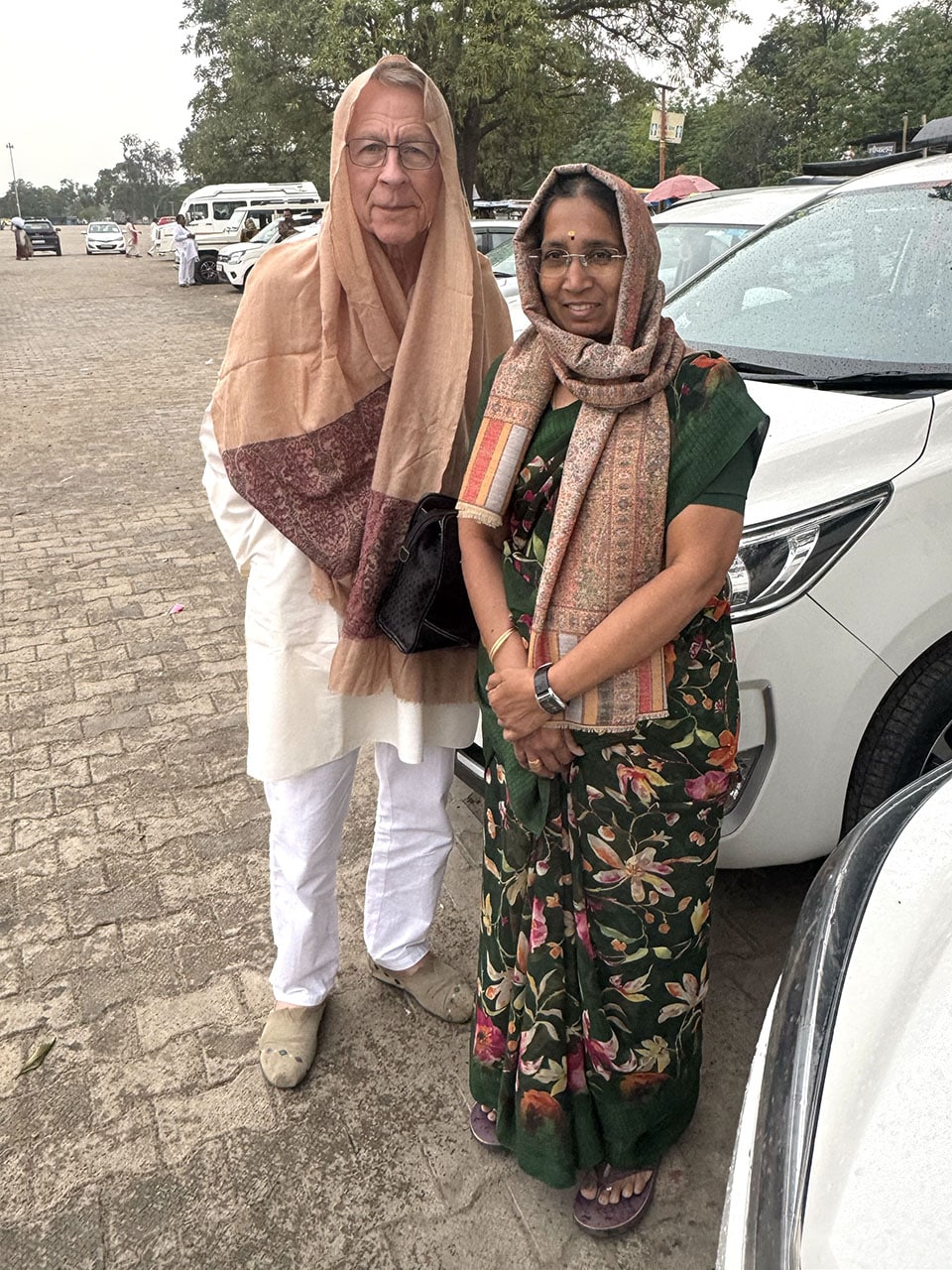
Haridwar Aarti
The day had been mostly cloudy and rainy, great for massages, but not so much for hanging outside. This is one reason Heidi decided to skip the Haridwar Ganga Aarti. She was also still basking in her Ganges dip and, finally starting to feel much better, didn’t want to sit out in the rain with the potential to get wet. Luckily, Kirk got some great photos, so she almost felt like she was there.
Haridwar was about a 30-minute drive downriver from Rishikesh. Although it rained on the drive down, thankfully, the rain stopped by the time we got parked.
Every 12 years, Haridwar (population 350,000) hosts the Purna (Full) Kumbh Mela, one of Hinduism’s most sacred and colossal pilgrimages. Marking the completion of Jupiter’s 12-year orbit and a full cycle of spiritual renewal, it is the world’s largest religious gathering. The multi-week festival celebrates the ancient legend of divine nectar (the elixir of immortality) spilling onto the city’s sacred riverbanks and draws an astonishing 50–100 million pilgrims, with up to 10 million arriving on the most auspicious bathing days. It’s happening in Haridwar in 2027. Roger has attended a couple. We can’t imagine the crowds!
Unlike in Varanasi, where Mama Ganga is wide, deep, and slow, or in Rishikesh, where she is scenic and pristine, in Haridwar the Ganges emerges forcefully from the Himalayan foothills, rushing through the ghats with a roar that amplifies the ritual’s sensory and spiritual intensity.
This fast-flowing torrent is spanned by pedestrian bridges and flanked by concrete steps (with fences and big chains on both sides for pilgrims to hold onto), creating a large 360-degree amphitheater where thousands of pilgrims pack tightly together.
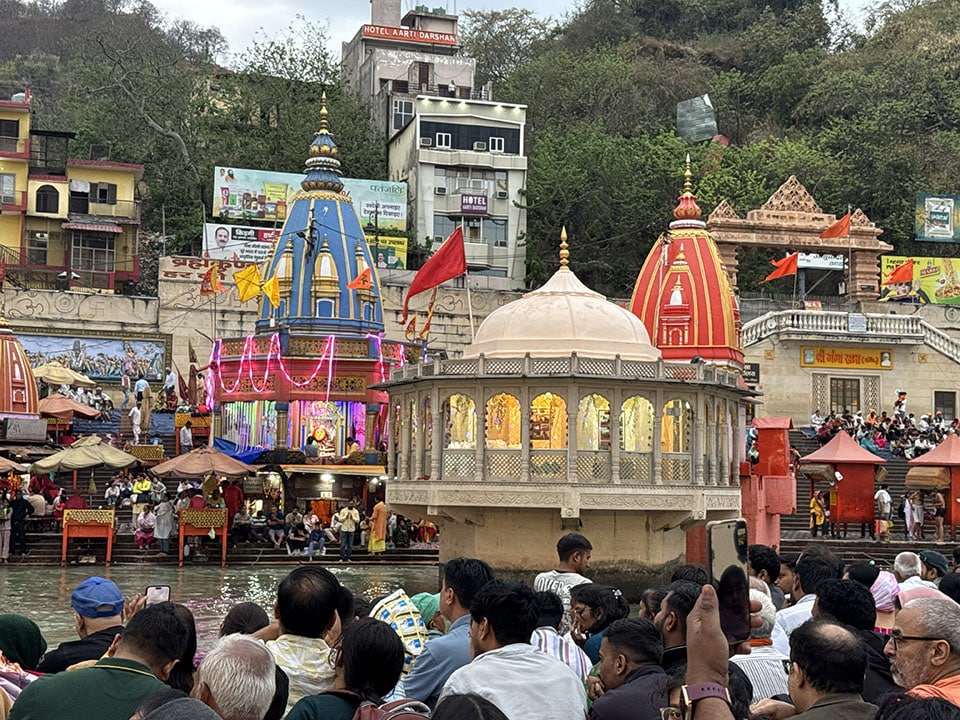
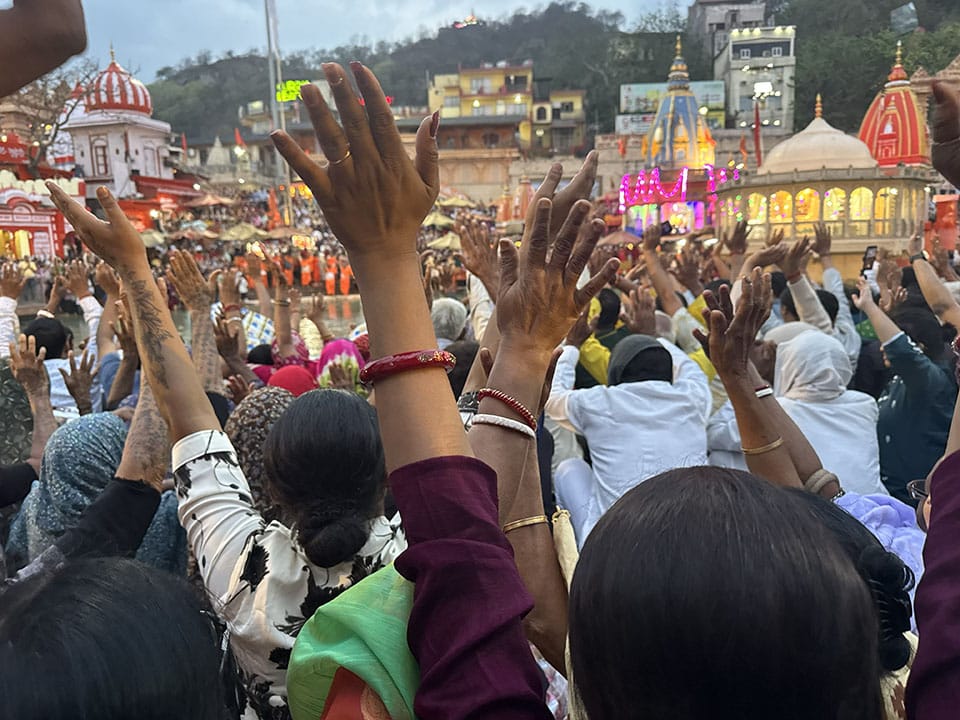
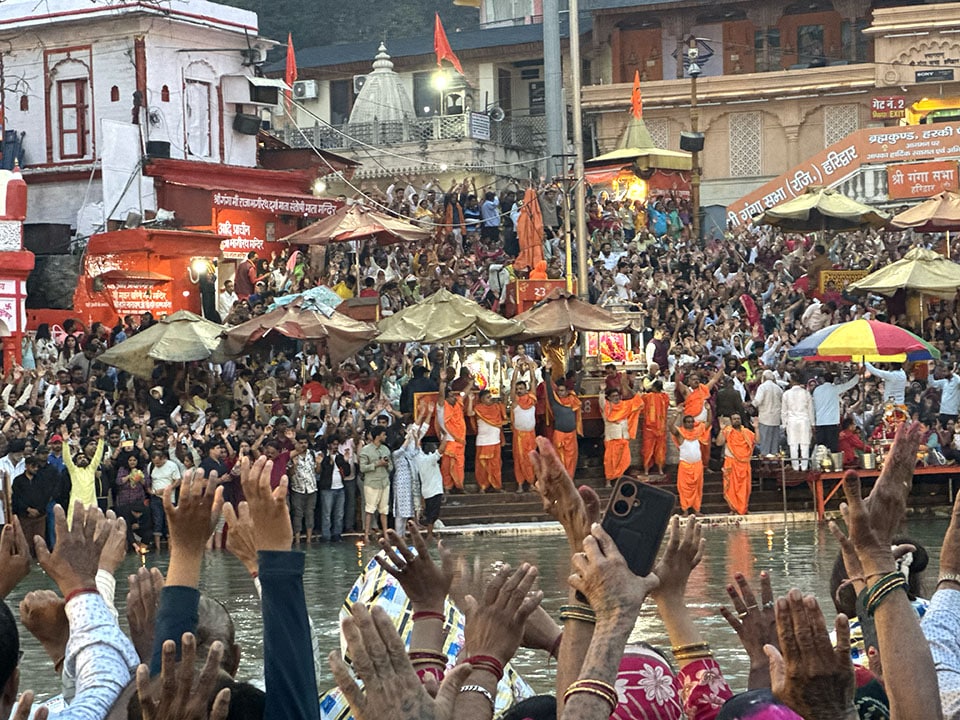
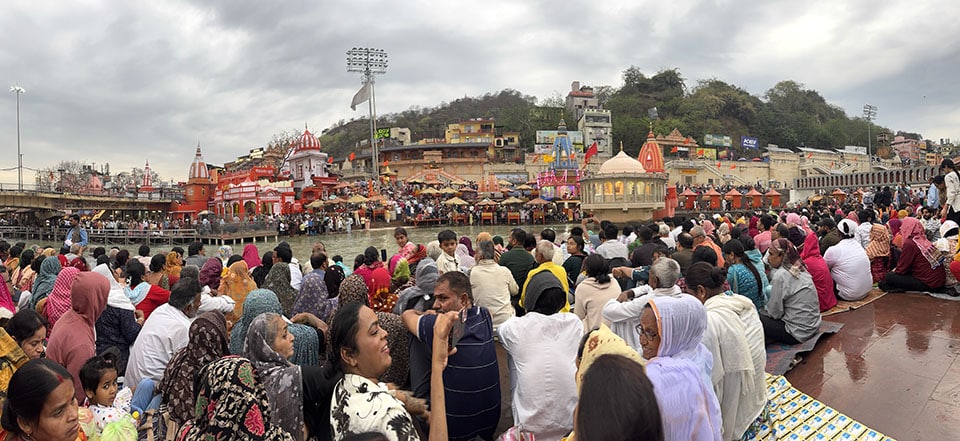
While the chanting and swinging of the butter lamps were similar to the other Aartis, the hallmark of Haridwar was the thunderous collective singing of the Ganga Lahari hymn. This, combined with booming conch shells, heavy brass bells, and the roaring river, created a physical vibration across the entire crowd. So spiritually powerful!
Thankfully, the rain held off until the very end, and we walked back to the cars as quickly as possible, among throngs of thousands, then back to the hotel to pack up.
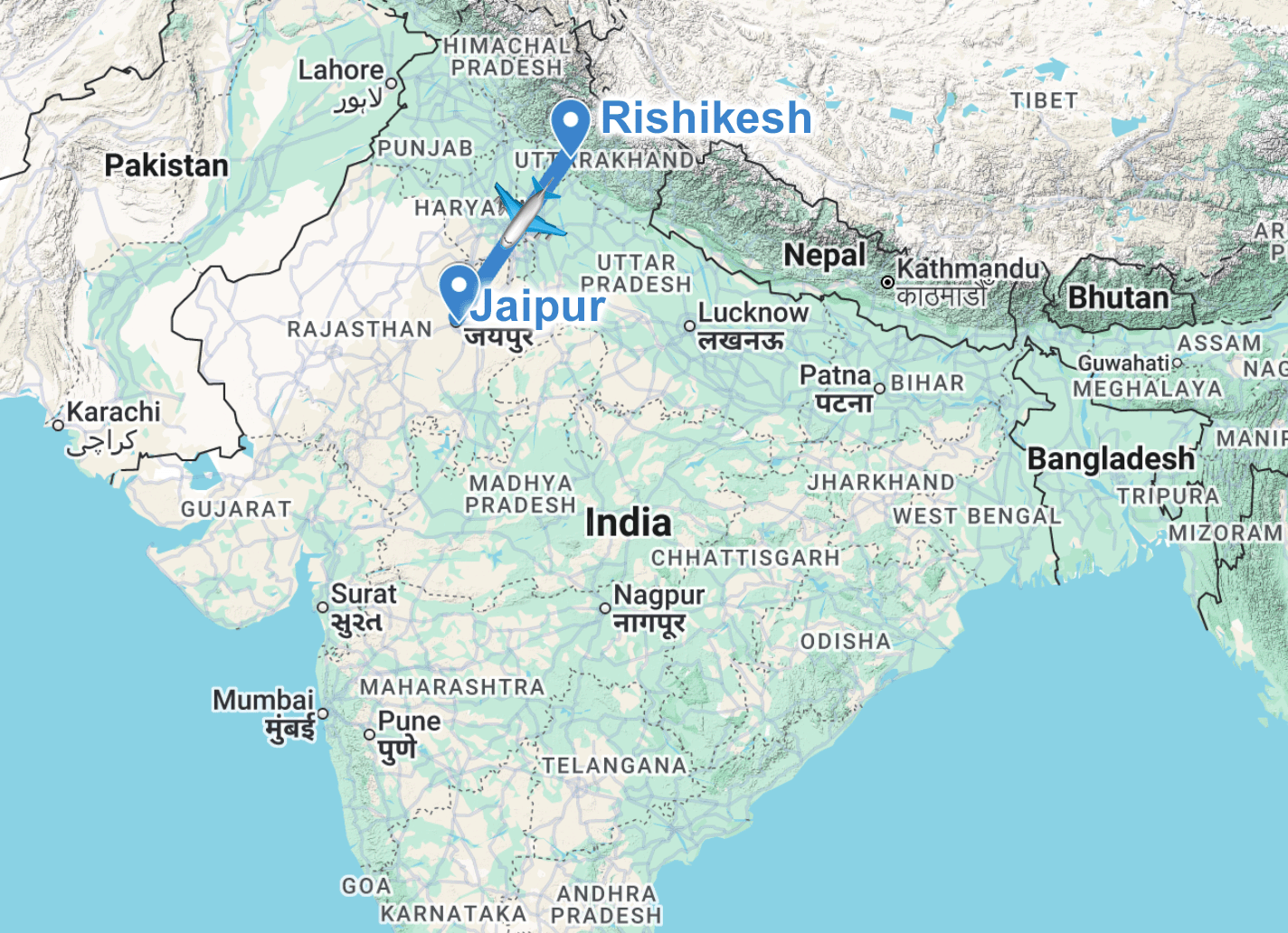
The next morning, we were off to the Rishikesh airport to fly to Jaipur. We were excited to visit the opulent palaces and bustling bazaars of Jaiupr—but we also left a bit of our hearts behind in the green Mama Ganga and lush Himalayan forests. We LOVED Rishikesh, and will be back. Big thanks again to Roger, Mallika, Remish, BC, and Athma Tours. You knocked it out of the park!
Wow! What an immersive experience you both had in India. Your photos are amazing!
Big hugs,
Shane & Lybby
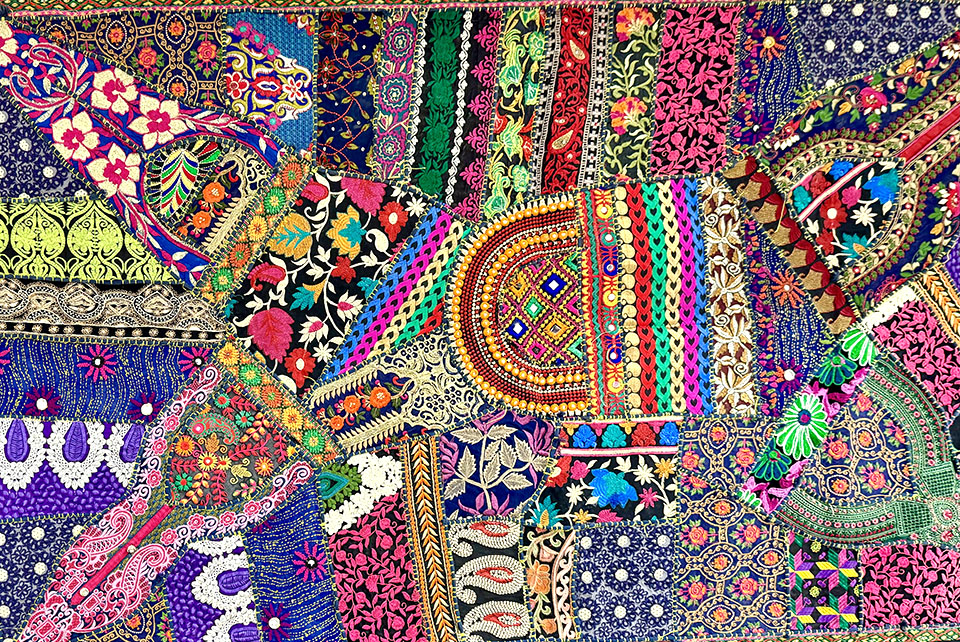
Thanks so much Shane & Lybby. That means a lot coming from a world famous professional photographer like you! As you know, there were so many shots we didn’t get, and this is only a smattering of what we did get… India is SO colorful, beautiful, and photogenic! XO Heidi & Kirk